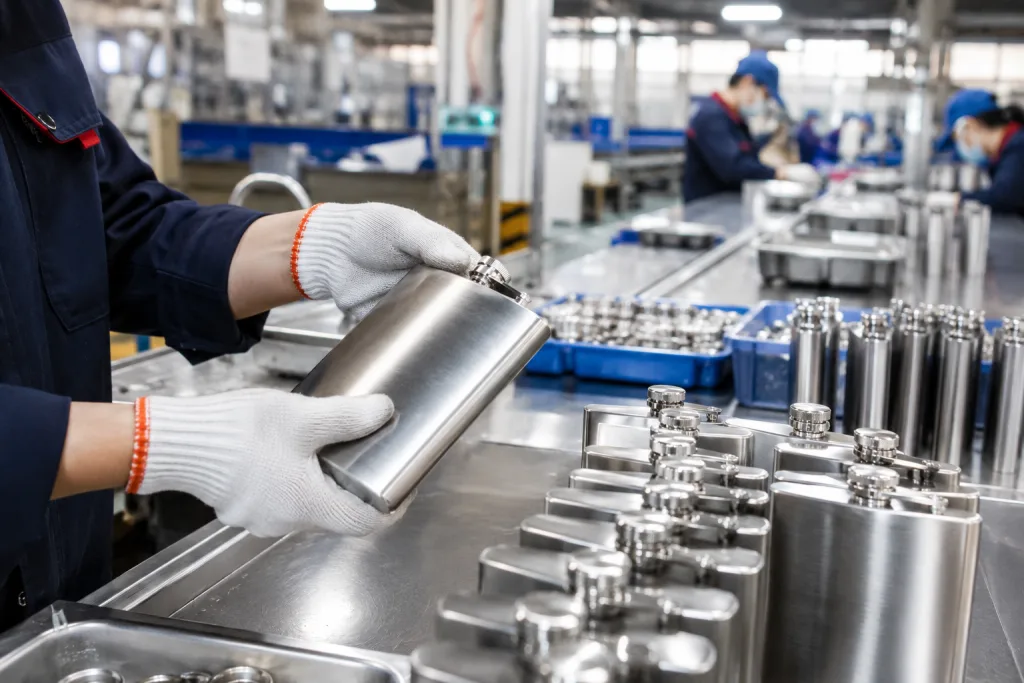
Key Takeaways
- For stainless hip flasks, insist on 18/8 steel with 0.5-0.6 mm body thickness and 100% leak testing before packing
- Most avoidable claims start in decoration and closure fit; cap chain pull tests and logo position tolerances should be signed off at pre-production stage
- A practical QC plan is AQL 2.5 for major defects and AQL 4.0 for minor defects, with carton drop checks from 76 cm
- Entry FOB pricing in China often runs about USD 1.80-3.60 for basic 6 oz to 8 oz hip flasks at 1,000-3,000 pcs, excluding complex gift boxes
You usually spot a weak supplier after money is already on the table: the first pilot run leaks at the bottom seam, the laser logo sits 3 mm off-center, or customs asks for REACH paperwork the factory never filed. Hip flasks look easy. They are not. We’ve seen this go sideways when buyers treat them like generic custom drinkware and skip the weld spec, wall thickness, or carton drop standard. The same problem shows up on adjacent SKUs such as custom canteen, custom growler, and canteen promotional programs, where a simple salt spray miss or a rough polish line gets exposed fast on small stainless bodies.
If you are buying from a hip flask factory in Zhejiang or elsewhere in China, the lowest FOB price is the wrong question to ask. The safer move is a written specification that blocks predictable failures before tooling starts, before samples go out, and before the line runs bulk. A capable Zhejiang factory should answer fast on MOQ, AQL standard, monthly output, and lead time, not “we will check.” At BottleForge Industrial, we run 300,000 units/month capacity, MOQ from 500 pcs, and typical bulk lead times of 25 to 35 days; QC pulled a sample last month where the PO typo switched satin finish to sand finish, and that is exactly why tight paperwork matters.
Where low prices usually break
The first mistake is treating a hip flask like a souvenir shell, not a liquid-contact metal product. We see this all the time. A quote looks sharp at USD 1.62 FOB Ningbo, then the sample lands and QC pulled the sample under a 6500K light box: thin 201 stainless body, cap gasket fit all over the place, and a satin finish that hides polishing lines until it hits retail shelf lighting. A solid hip flask factory in China should break out material grade, wall thickness, finish, leak test method, and packaging cost on the quote sheet. If those lines are missing, this is the wrong comparison to make.
For B2B buyers, ask for the full bill of construction. Nothing vague. You want steel grade, body and cap thickness in mm, hinge or chain spec, logo process, unit packing, carton quantity, and gross weight in kg. We run into buyer pushback here—some say this is too detailed before sampling—but the math doesn't work without it. This applies to hip flasks, customizable drinkware, and related lines such as custom canteen and customized growler projects. We have seen canteen manufacturers and canteen suppliers cut price by shifting cost into lighter gauge steel, less hand-polish time, or plain inner boxes with no divider.
- Minimum useful spec: SUS304 body, 0.5 mm body wall, food-grade silicone or PE gasket, 24-hour leak test sample validation.
- Risk spec: mixed-grade stainless, no declared gasket material, no mention of weld polishing, no AQL commitment.
- Commercial warning sign: MOQ is vague, lead time is "about one month," and carton dimensions are unavailable.
If you also buy canteen custom items or source as a distributor drinkware importer, the same rule applies. A canteen factory or canteen manufacturer that cannot hold metal thickness and decoration registration on one SKU—say a 0.5 mm body drifting to 0.42 mm, or a screen print shifting 1.5 mm off-center—usually has the same problem across custom growler, customizable canteen, and other stainless ranges. We have seen this go sideways after PO approval, and then the buyer flagged it only after the line had already packed 2,000 pcs.
Leaks start with seams and caps
The claim buyers hate most is leakage. It turns a small appearance defect into a refund case. On hip flasks, leaks usually start at the side seam, the shoulder transition, or the cap seal. If the line is weak, final inspection will not save it. We have seen QC pull a clean-looking sample, then find seepage after a 0.02 MPa air test. You need process controls written in numbers.
For welded stainless hip flasks, ask how the body is formed after welding and what polishing step follows. This is the right question. On our shop floor, the body goes through seam grinding before final buffing, and the neck area is where bad rework shows up first. A solid Zhejiang factory will pressure-test or vacuum-test, then run a second 100% water leak check after cap assembly. If they only random-check finished units, expect claims. For 6 oz and 8 oz models, cap threading must stay smooth with no cross-threading after 10 open-close cycles. The cap chain rivet or hinge should also pass a basic pull test of around 5 kgf without loosening. Buyers sometimes push back on 100% leak testing because it adds time; the math does not work once one leaking batch lands in retail.
What to lock into your purchase order
- 100% leak test on finished units, not just first articles
- Cap torque consistency check on each production lot
- Gasket material declaration suitable for food contact
- No sharp internal burrs around neck opening
- Salt spray standard if plated components are included
This matters beyond flasks. We ship the same lesson into customized drinkware, customizable growler, and canteen customized lines. Closure systems drive most complaint files, not artwork. Last season, one buyer flagged a canteen PO where the logo Pantone was specified but the lid seal check was missing. That is backwards. A custom canteen with a bad seal and a hip flask with a bad seam fail for the same reason: nobody wrote the mechanical checks into the order, and the line ran anyway.
You do not need a perfect factory. You need one that can describe its leak-test process in plain numbers.
Bad decoration ruins sell-through
Most retail buyers will let a few carton scuffs pass. They will not let a bad logo pass. We see this on the line all the time: artwork gets approved from a flat screen, then production starts and the real variables show up. On curved stainless bodies, laser position can creep, silkscreen can pull at the shoulder radius, and a faux leather wrap can walk 2 mm at the seam if the jig is loose. If the brand mark sits high or low, the flask looks cheap even when the shell passed leak test.
Set the logo standard in numbers, not opinions. For a front logo on a classic 8 oz flask, specify the print or engraving centerline tolerance at plus or minus 1.5 mm, and the rotation tolerance at no more than 2 degrees. For silkscreen, define ink adhesion by cross-hatch tape test. For powder-coated or painted gift flask sets, ask for color tolerance against Pantone reference and rub resistance. We usually tell buyers to ask for one pre-production sample and one golden sample, then lock both. A capable Zhejiang supplier should be able to send pre-production samples within 7 to 10 days once artwork is approved.
This is where mixed assortments go sideways. A canteen supplier might run larger cylindrical bottles well, then miss alignment on flatter flasks where 1.5 mm looks obvious to the naked eye. We had one buyer flag this exact issue after approving a bottle print and assuming the flask would match; QC pulled the sample and the badge sat off-center near the cap shoulder. The same risk shows up in canteen vendor programs, custom growler launches, and distributor growler gift sets. If your distributor canteen range includes multiple shapes, do not approve decoration from one SKU and assume the others will match. That is the wrong shortcut.
- Laser engraving: durable, clean, usually USD 0.08-0.20 extra depending on size; on a flat flask panel, fixture setup matters more than buyers expect.
- Silkscreen: lower cost at volume, but more sensitive to registration and adhesion; if mesh tension is off, the art can spread at the edges.
- Embossed wrap or badge: strong gift look, but higher assembly risk and more handwork; this is where seam position and glue squeeze-out get checked first.
If your target market is Europe or North America, ask for barcode placement rules, carton marks, and retail pack approval before mass production. We ship plenty of FBA orders, and the math does not work if small placement errors become relabeling or returns. For Amazon FBA or distributor programs, 3 mm placement drift can turn into a return problem fast.
Packaging fails before the product does
A lot of claim reports get pinned on production when the damage started in packing. Hip flasks are small, but they hit hard in transit because the body is dense for the size, and a mirror-polish surface shows every rub mark. We have seen clean goods pass final inspection, then arrive dented because the inner tray was 0.6 mm too soft or the carton was packed too loose. Buyers pushing souvenir-price packaging on a gift-finish flask are asking the wrong question. The math doesn't work.
Packing has to match the sales channel. For bulk promo orders, a polybag plus partition works if the finish is brushed and the buyer accepts light handling marks; we run this setup on MOQ 3,000 pcs often enough. For retail gift sets, the flask needs EVA, molded pulp, or a rigid blister that locks the body in place so it does not walk inside the box. Carton burst strength should be written on the spec sheet, and outer carton drop tests from 76 cm are a fair export baseline. If unit weight is 220 to 350 g including accessories, keep the master carton under control instead of stuffing more pieces in to shave freight. QC pulled the sample on one 24-piece pack last year and the corner crush told the story before shipment.
The same problem shows up on canteen jobs. Customizable canteen, canteen customized, and customized canteen orders fail for the same reason, especially on mixed packs for distributors. We ship plenty of combo sets, and the buyer flagged one PO because they wanted a flask, funnel, two cups, and a strap in one box with no insert upgrade. That setup goes sideways fast. Canteen distributors and canteen vendors often ask for extra accessories first, then push back on the carton size after they see freight and damage numbers.
- Specify individual bag material and thickness
- State gift box board grade and insert type
- Set max master carton weight, ideally under 15 kg for mixed gift sets
- Require shipping marks, barcode labels, and pallet rules in writing
If a canteen factory or hip flask factory cannot send packed carton dimensions before order confirmation, you cannot estimate landed cost with any accuracy. We ask for this before deposit, not after; even a PO typo on carton count can throw off loading plans. This is basic export control, not some premium extra.
Compliance problems are expensive and slow
A hip flask is small. The compliance bill is not. Buyers and importers usually ask for REACH, LFGB, FDA-related food-contact declarations, or California Proposition 65 screening based on market and bill of materials. Once the flask includes paint, faux leather, adhesives, solder, plating, or a printed gift box, the test scope widens fast. We have seen buyers assume 304 stainless covers the whole item, then QC pulled the sample and found the issue was the cap gasket, not the body. That is the wrong question to ask.
Ask the factory for a component-by-component map of direct and indirect contact with the user and with liquid. That means gaskets, inner coatings, decorative wraps, and even packaging inks where migration is a concern. On our line, the compliance file usually ties each part back to a PO, supplier batch, and a 1.5 mm silicone seal spec so nothing gets mixed up. A solid China supplier already runs this file structure and knows when third-party lab work is required. Procurement teams also ask for BSCI or Sedex-style audit status, and quality teams still want ISO 9001 process discipline. If a factory answers in general terms, we have seen this go sideways.
If you buy across categories, put the document request into one matrix for hip flasks, custom drinkware, customized drinkware, and customizable drinkware. Use the same sheet for canteen manufacturer, canteen manufacturers, and canteen supplier options. We ship this way because it cuts back-and-forth, and it catches simple errors like a PO typo on origin marking before cartons hit the warehouse. Include:
- Material declaration by component
- Existing test reports and validity dates
- Factory audit status
- Country of origin marking method
- Lot traceability format on cartons or production records
Testing adds time. A new project with custom coating or wrap can need 7 to 14 extra days for lab submission and report turnaround. In practice, we see 12 days vs 18 days depending on whether artwork, adhesive data, and carton specs are ready on day one. That cost is still lower than a held shipment at destination port. Zhejiang factories can run fast, but customs and retailer compliance gates do not care if the line was waiting on approval.
Sampling shortcuts create mass production surprises
The sample that wins the order often tells you less than buyers expect. A hand-polished showroom piece looks clean on the table, then bulk runs at actual line speed and the gaps show up fast: logo position shifts 1.5 mm, polishing marks stay on the shoulder, and labor time gets cut on the line. We have seen buyers approve one pretty sample, then flag 3 issues in the first inspection. The wrong question is “does the sample look good?” The right question is “was this made the same way as production?”
For a new hip flask project, use at least three gates: reference sample, pre-production sample, and golden sample. The reference sample locks shape and general finish. The pre-production sample must use actual artwork, actual packaging, and the same line method we run for bulk, not bench work by the sample master. The golden sample is the signed benchmark both sides keep for QC comparison, usually packed in a labeled PE bag with PO number and date. If tooling is involved for cap shape, badge, or gift insert, do not skip a tooling sample review. QC pulled one cap sample last month that was 0.8 mm off at the thread, and that small miss becomes a leak complaint later.
This discipline matters if you run broader programs with a canteen factory, canteen custom line, or custom growler assortment. We ship these mixed programs every season, and repeatability is where some suppliers fall short. A lot of canteen suppliers can make 2 attractive development samples; holding the same finish across 4 SKUs and 2,000 sets is the harder part. If you are a canteen distributor or a distributor growler importer managing several SKUs, standardize your sample approval form across categories. We have even seen a buyer flag a simple PO typo on carton mark copy after 600 units were packed, so the form needs a carton section too.
- Reference sample: 3 to 5 days if using an existing mold
- Pre-production sample: 7 to 10 days after artwork and details are frozen
- Mass production: usually 25 to 35 days, and gift set assembly can push it to 32 days vs 25 days for flask-only orders
Ask for production photos from day 1 of the bulk run, not only finished cartons. That is how you catch decoration drift, accessory mismatch, or carton mark errors before all units are sealed. We usually send photos from polishing, laser marking, and packing, plus one shot of the first 20 pcs on the table. Good factories in China are used to this. Weak ones push back because the process is loose, and the buyer usually finds the problem only after AQL 2.5 inspection starts.
How to write a buyer-proof spec
If you want fewer arguments later, write the purchase order like a control plan, not a price sheet. We have seen too many problems start with one loose line on the PO: “same as sample.” That is not a spec. Most production failures happen because the buyer did not turn expectations into measurable tolerances. A hip flask factory will not guess your market standard from instinct. You need to state it in numbers.
A workable hip flask spec sheet should list capacity, dimensions, net weight tolerance, steel grade, body thickness, finish definition, logo size and location tolerance, cap construction, gasket material, leak test requirement, packaging details, barcode format, and inspection standard. Put the unit beside each item—0.3 mm matters more than “slight variation.” On our line, QC pulled the sample once because the logo sat 2 mm low, and the buyer flagged the full lot against the approved artwork. Use AQL 2.5 for major defects and AQL 4.0 for minor defects unless your retailer already gave stricter limits. For premium gift sets, add accessory count checks and carton drop requirements from a set height like 76 cm. If the order includes matching customized canteen or customizable canteen items, keep the same QC language across all SKUs. If not, this goes sideways fast.
For procurement teams comparing suppliers, the stronger question is not "Can you do this?" Ask, "What number do you control this by?" This is the right question. A real canteen manufacturer, canteen vendors group, or hip flask factory will answer with 0.4 mm body thickness, cap torque range, 35-day lead time, or defect limits at inspection. A brochure supplier answers with “no problem.” That is the gap between a sales sheet and an operating factory.
- Typical MOQ: 500 pcs for standard flasks, 1,000 pcs for custom color boxes
- Typical tooling: USD 100-400 for simple packaging inserts or badges, more for new body shapes
- Typical inspection point: pre-shipment random inspection under agreed AQL
- Typical payment term: 30% deposit, 70% balance against inspection or copy B/L
If you source from Zhejiang, China, or any nearby supply base, you may have 20 or 30 factories on the shortlist within one week. Finding a supplier is easy. Finding one that can run your spec into repeatable mass production across hip flasks, custom canteen, and wider custom drinkware programs without changing details after deposit is the hard part. We ship plenty of repeat orders where the whole win came from one thing: the first spec was tight.
Send your flask spec and pressure-test your sourcing plan
Share your target price, artwork, packaging, and compliance market. We will review failure points, MOQ, and lead time before you place a risky order.
Frequently asked questions
What MOQ should I expect from a hip flask factory?
For a standard 6 oz or 8 oz stainless model using an existing mold, a realistic MOQ is 500 to 1,000 pcs per design. If you need a custom box, mixed accessories, or special coating, MOQ usually moves to 1,000 to 3,000 pcs because setup waste and packaging sourcing increase. Very low MOQs under 300 pcs are possible, but unit cost rises sharply and decoration choices narrow. Ask whether MOQ is based on product only or product plus retail box. In China, some factories quote 500 pcs, then add a separate 1,000-pc MOQ for the gift box, which changes the real commitment.
What material specification is safest for stainless hip flasks?
For export to Europe and North America, 18/8 stainless steel, commonly called SUS304, is the safest standard choice for the body. A practical body wall thickness is 0.5 to 0.6 mm. Thinner than 0.4 mm saves cost but increases dent risk and makes weld finishing less forgiving. You should also confirm the cap and neck components, not just the body, because mixed-grade stainless shows up there. If a factory offers plated carbon steel or 201 stainless for a premium program, ask why. For most B2B projects, the price difference is smaller than the quality risk and compliance headaches.
How do I inspect a hip flask order before shipment?
Use a pre-shipment inspection with a defined AQL, usually 2.5 major and 4.0 minor, and include functional checks, not just appearance. The inspector should verify dimensions, logo position, finish consistency, quantity, carton marks, and barcode labels. Add leak testing on sampled units, cap open-close cycling, and accessory count if the order is a gift set. For polished flasks, inspect under consistent lighting because swirl marks disappear in poor warehouse light. If your order is above 5,000 pcs, it is smart to do both a DUPRO inspection during production and a final random inspection before the balance payment.
Can one factory handle hip flasks and other custom drinkware together?
Sometimes yes, but do not assume it. A factory may be strong in flat stainless hip flasks and average in vacuum bottles, custom growler products, or custom canteen items. Ask for category-specific production photos, test reports, and recent shipment references by product type. If they claim they are a canteen factory, canteen supplier, and hip flask factory all at once, check whether production is in-house or subcontracted. It is common in China for one supplier to manage several lines through partner workshops. That is not automatically bad, but you need transparency on who controls welding, decoration, assembly, and final QC.
What lead time is normal for customized hip flask orders?
For an existing flask shape with standard finish and simple logo, sampling usually takes 7 to 10 days and bulk production 25 to 35 days after sample approval and deposit. If you add a custom gift box, faux leather wrap, or third-party testing, allow 35 to 45 days total production time. Peak season before Q4 promotions can add another 7 to 15 days, especially in Zhejiang and other busy China clusters. The useful question is not only total lead time but when materials are locked. Delays often start because artwork, barcodes, or packaging approvals are still open after the factory has reserved production capacity.