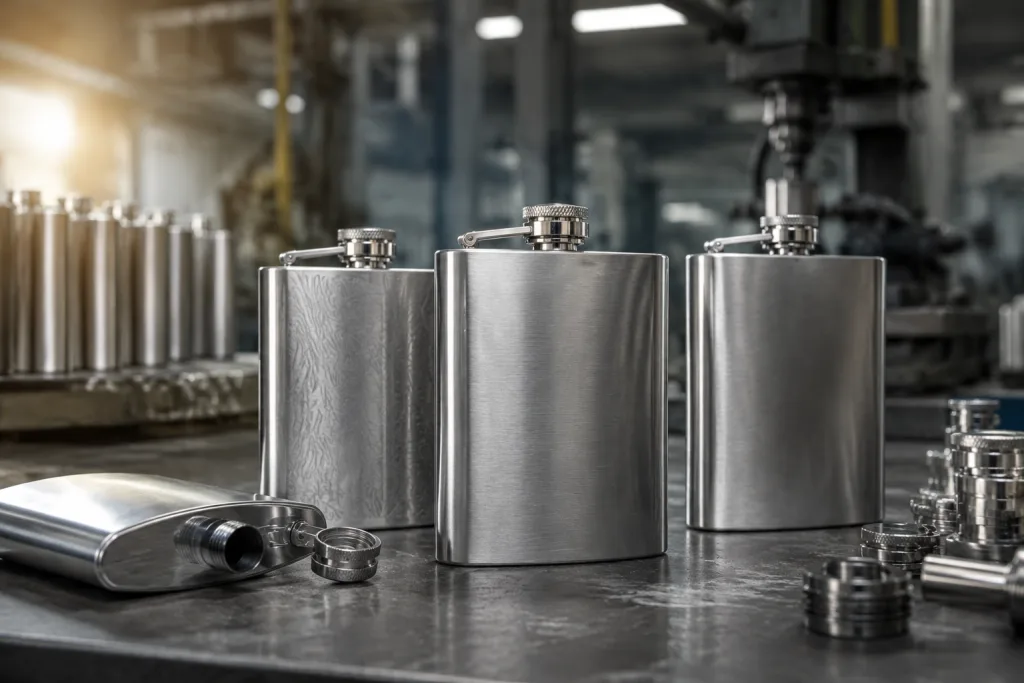
Key Takeaways
- For 6 oz to 8 oz hip flasks, 18/8 stainless with 0.5 mm to 0.6 mm body thickness is the practical balance of durability and FOB cost
- Most custom logo flask projects in China start at MOQ 500 to 1,000 pcs per design, with 25 to 35 day lead time after sample approval
- Leak testing should be defined in writing: 100% water-fill check plus AQL 2.5 final inspection reduces claim risk on hinged caps
- Laser logo is durable for long-term retail use, while 1-color silkscreen usually saves USD 0.05 to 0.12 per unit on larger runs
You can buy a hip flask on looks alone, but we’ve seen that go sideways in B2B. The outline looks right, the logo on the pre-production sample looks clean, and the quoted FOB price hits the target. Then the line starts and problems show up fast: cap threads feel rough after 500 open-close cycles, curved panels stretch the artwork by 1.5 mm, welding marks get flagged at final inspection, or the gift box fails a 76 cm parcel drop. For hip flask custom made programs used in retail, gifting, or promo, the spec sheet matters more than the photo.
At factory level in Zhejiang, China, a flask is not a simple SKU. It is a stack of decisions: stainless grade, wall thickness, mouth size, hinge structure, finish, decoration method, test standard, and carton packout. We run into this on the floor all the time—a buyer sends a PO with the logo size typed as 35 mm on one page and 53 mm on another, and QC pulls the sample before mass production. If you also buy custom canteen, customizable drinkware, or customized growler lines from a canteen manufacturer or distributor drinkware program, the same rule applies: every line on the drawing changes cost, defect risk, and lead time. This is the wrong question to ask if the only question is price.
Start with capacity and silhouette
The first line on the spec sheet is usually capacity, and it drives more than carton size. For hip flask custom made projects, the common sizes are 4 oz, 6 oz, 7 oz, 8 oz and 10 oz. In North America and Europe, 6 oz and 8 oz move fastest because they feel solid in hand without turning into a brick in a jacket pocket. If you are buying for gift retail, 6 oz is the safer base; we ship that size more than any other for box-set programs with a 500 pcs MOQ. If you are buying for event merchandise or canteen promotional programs where the logo has to read from 1.5 meters away, 8 oz gives more front-face area for decoration. Buyers sometimes ask for 10 oz first, but this is the wrong question to ask if pocket carry still matters.
Shape is next. A classic curved body is still the standard because it sits against the body better, but the decoration tradeoff gets missed on a lot of POs. More curve feels better in use. Less clean print area. If your logo is wide, or you need legal text, barcode placement, or a gift-box window alignment, ask for a flatness drawing with printable area in millimeters before artwork approval. A typical 8 oz flask may have a body around 95 to 98 mm high and 92 to 96 mm wide, but the reliable logo area may be closer to 45 x 60 mm depending on shoulder radius. QC pulled a sample last month where the buyer flagged a crest logo at 68 mm wide, and the shoulder broke the top line once the screen was burned.
This is also where line extension matters. We have seen buyers start with flasks, then add a custom canteen, customized canteen, or customizable growler range for the same customer base within one season. If you are building a coordinated custom drinkware collection, lock the visual language early: edge radius with a target like R6, brushed direction, cap finish, packaging color, and even where the laser mark sits from the bottom seam. The math doesn't work if you wait until tooling is cut. A capable canteen factory in Zhejiang, China can usually help standardize these details across flask, bottle, and growler programs, but only if you define them at the beginning instead of after tooling and artwork are locked.
Steel grade and wall thickness
A quote that says “stainless steel flask” tells you almost nothing. Ask for the grade on the PO. For hip flask custom made orders, 18/8 stainless steel, also referred to as SUS304, is the standard for body-contact surfaces. It holds up better in salt-spray and daily use, keeps taste cleaner, and makes REACH and food-contact paperwork easier to clear. We have seen buyers push for cheaper steel to save USD 0.03 to 0.05 per unit, then QC pulled the sample and found odor, tea-stain marks around the neck, or missing material backup. That math does not work.
Next check wall thickness. On the line, we usually measure it with a micrometer at the shoulder and near the base seam, because that is where thin material shows first. For standard single-wall flasks, 0.4 mm is entry-level, 0.5 mm is common, and 0.6 mm feels more premium. Small number, big difference in hand feel. At 0.4 mm, dent resistance drops fast, especially after vacuum packing and carton stacking. At 0.5 mm to 0.6 mm, the flask feels steadier and usually ships better. One buyer flagged corner crush complaints on a retail gift set; after moving from 0.4 mm to 0.5 mm, the complaint rate dropped from 3.2% to 1.1% across two shipments.
A practical rule: if your target FOB price is under USD 1.40 for a plain 6 oz unit at 1,000 pcs, the factory is likely cutting cost somewhere, often in thickness or finishing labor. Ask for net weight tolerance, not just a nice-looking sample. An 8 oz flask using 304 stainless at 0.5 mm will usually sit in a stable weight band, and we run a spot check every 30 minutes on the scale. If sample weights jump 6 g to 8 g between pieces, process control is loose. This is the wrong question to ask: “Can you match this low price?” Ask what steel thickness and weight band the price is built on.
- Recommended baseline: SUS304 body, 0.5 mm wall, brushed or powder-coated surface
- Gift-grade upgrade: SUS304 body, 0.6 mm wall, tighter polish control
- Red flag: no material cert, no thickness tolerance, no weight range
The same discipline applies if your supplier also acts as a canteen supplier, canteen vendors partner, or custom growler producer. A canteen manufacturer that controls incoming steel well usually shows the same consistency across customizable canteen and customized growler programs. We look for the same signals every time: heat number traceability, incoming sheet checks, and a clear thickness spec like 0.5 mm ± 0.03 mm. If a factory cannot show that on one category, we have seen the same issue carry into the next one.
Cap structure decides complaint rate
Most flask returns start at the cap. Buyers usually stare at body finish and logo placement, then the field complaint lands on leakage, a loose hinge pin, or threads that start crooked by 0.3 mm. On the spec sheet, “screw cap” is not enough. Ask if the cap is a welded hinge, a riveted arm, or a free cap, and ask how that joint is made on the line. For promo orders, hinged caps cut cap loss. For premium retail, they also look finished on shelf. Still, this is where we've seen projects go sideways: hinges bring two failure points fast—alignment and weld quality.
Get thread pitch and gasket material confirmed in writing. A decent flask cap should close in 1.5 to 2.5 turns with even torque, no scraping, and no jump at the last half-turn; QC pulled samples before where the cap felt fine before coating and dragged after powder by 40-60 μm. Food-grade silicone and PE are both common sealing parts. If the factory cannot name the gasket, this is the wrong supplier to shortlist. You also want a cap-to-neck fit check after coating, not before, because bad masking around the neck thread changes the feel and the seal.
Leak testing belongs on the PO, not in a chat record. We run 100% water-fill leak test in production, then final inspection under AQL 2.5 for major defects. For boxed sets with higher retail value, some buyers tighten leakage and cosmetic defects to AQL 1.5, and the math works if the claim cost is high. If your channel is Amazon FBA or direct-to-consumer, add carton drop requirements too. We ship flasks that pass bench leak test, then the buyer flags seepage after transit because the inner tray lets the cap take impact and back off a fraction.
For a flask, the cheapest part on the drawing can create the most expensive after-sales problem.
Experienced canteen suppliers and canteen distributors usually understand this fast because bottle-lid complaints follow the same pattern. The same closure-control habit used on custom canteen and canteen customizable projects should show up on flasks too, whether that means a torque check with a manual cap tester or a 30-piece seal check per batch. If a canteen vendor already runs closure torque checks on sports bottles or customizable drinkware, that is a good sign. The line already has the discipline.
Surface finish and logo method
Surface finish is where buyers read too much into the pre-production sample. One hand-made sample from a senior polisher on the buffing wheel can look clean; the line at 5,000 pcs will tell the real story. For hip flask custom made orders, the common options are brushed, mirror polished, powder coated, leather wrap, and painted color. Brushed stainless hides light handling marks best. Mirror looks premium on day one, then QC starts seeing hairline scratches, fingerprints, and small waviness around the shoulder seam. Powder coat gives stronger color impact, but this is the wrong question to ask if the body welding is uneven—coating will not hide bad forming.
Logo method needs to match both the finish and the sales channel. Laser engraving is still the safest option for long-term use; hip flasks are usually hand wash only, but buyers still ask about abrasion from bag carry and bar use. On stainless or powder coat, laser stays sharp and avoids the peeling claims we have seen on lower-adhesion inks after a cross-hatch tape test. Silkscreen works for simple 1-color logos and can cut cost by around USD 0.05 to 0.12 per unit at volume, but only if the artwork is clean and the print area is stable on the jig. Embossing or debossing looks good on wrapped versions, especially on PU or leather wraps with a 0.8 mm to 1.2 mm thickness, though setup cost is higher and registration can go sideways fast.
What to request before approval
- Artwork size in mm, not just a visual mockup
- Pantone reference for coated parts and print ink
- Adhesion test method for printed logos
- Photo approval under neutral lighting, not heavy retouching
If you also buy for distributor canteen, distributor growler, or distributor drinkware programs, ask one factory to standardize the branding method across the range. We ship mixed sets like this, and the buyer flagged it once when the flask logo was silver laser but the custom growler used flat white print from a different PO line. That mismatch weakens shelf consistency unless you want the contrast on purpose. Good canteen manufacturers in Zhejiang usually manage this well because the same workshop may be running flasks in the morning and customized drinkware gift sets in the afternoon.
Packaging, MOQ, and freight math
Packaging is not the last detail. It drives unit cost, master carton size, damage rate, and freight math from day one. A plain polybag plus white box is the safest commercial packout, and we run this option most often for repeat orders because the line stays stable and carton drop risk is lower. Gift box, window box, tin set, funnel set, and sleeve wrap all add cost, and they usually add 7 to 15 days once you include box sampling and barcode checks. Buyers ask for a nicer box first; this is the wrong question to ask. Ask where the flask will sell. If you supply a canteen distributor or retail chain, shelf presentation can justify a rigid gift box with 1200 gsm board. If you sell to a promotional importer, simple packout usually wins because the freight math doesn't work on bulky packaging.
Typical MOQ for hip flask custom made projects is 500 pcs for existing molds with simple decoration, and 1,000 pcs when you add custom color box or multiple print positions. On our side, flask orders below 500 pcs usually get buyer pushback on price after we break down setup cost for screens, jigs, and carton marks. At BottleForge Industrial scale, output can reach 300,000 units/month across drinkware categories, but flask-specific scheduling still depends on finish and package complexity. Standard lead time from deposit and artwork approval is usually 25 to 35 days. New packaging structures, leather wrap, or bundled accessories can push that to 40 to 50 days. We've seen this go sideways when a PO says “brown box” and the approved artwork file is actually for a full CMYK retail box.
For reference, FOB China pricing on a standard 6 oz or 8 oz flask can range roughly:
- USD 1.10 to 1.55: basic brushed flask, white box, 1-color logo, 1,000 pcs
- USD 1.55 to 2.20: powder coat or polished finish, upgraded logo, tighter QC
- USD 2.20 to 3.80: gift set with funnel, premium box, more labor content
Ask for carton dimensions and gross weight early. Do not wait for final PI. QC pulled the sample on one project and the gift box was only 6 mm wider than approval, but the outer case count dropped and the container load plan changed fast. A few millimeters added to the gift box can reduce container efficiency by a painful margin. That same freight logic applies across custom canteen, custom growler, and canteen customized projects. The better canteen suppliers plan product and packaging together instead of quoting them separately and hoping the case pack still works.
Compliance paperwork and factory controls
If you import into Europe or North America, treat compliance as part of sourcing from day one, not something to chase after the deposit. For hip flask custom made programs, ask for paperwork on the exact bill of materials: stainless steel declaration, food-contact test reports where relevant, REACH screening, and packaging compliance details. If the flask is sold as drink-contact ware, the file should cover every part that touches liquid, including the cap insert and silicone gasket. We have seen buyers miss the 2 mm PP insert inside the lid, and that is where the claim fell apart.
Factory controls matter as much as the certificates. Ask how incoming steel is checked, how weld zones are reviewed, and what cosmetic standard the line uses for curved mirror-finish surfaces. A solid China supplier should talk through checkpoints, not just send a polished catalog. On our floor, QC pulled the sample after hydrostatic leak testing and checked the seam under a 500 lux light box because hairline polish marks show up fast on reflective flasks. Common checkpoints are raw material confirmation, in-process forming review, cap-fit inspection, 100% leak test, decoration approval, and final AQL inspection before packing.
Social and quality audits matter more once the account gets bigger. BSCI is a regular ask from European buyers, and ISO 9001 is the usual management-system baseline. For children’s drinkware, ASTM or CPSIA moves to the front of the discussion. For flasks, the core issue stays simpler: food-contact materials, stable workmanship, and packaging compliance. This is the wrong place to get distracted by fancy audit decks if the supplier cannot first explain its gasket control and traceability lot code.
If the same partner also presents itself as a canteen factory, canteen supplier, canteen manufacturers resource, or canteen distributor support vendor, ask how they handle overlap between categories. The buyer flagged this with us once because the flask line used one polish standard and the canteen line used another, which created color tone variation on brushed stainless. A stronger canteen manufacturer usually has steadier sourcing for stainless, lids, and finishing, and that helps later if you expand into customized canteen, canteen custom, or customizable canteen assortments under one purchasing program.
The best purchasing results usually come from one basic habit: make the factory confirm every critical spec in writing before deposit. Material grade, thickness, capacity tolerance, logo size, package structure, carton spec, test standard, and ship date should all appear on the PI or approved spec sheet. We ship against that sheet, not against memory. One typo on a PO—8 oz instead of 8.5 oz—can turn into 3,000 wrong gift boxes, so this part is not admin work.
Get a flask spec review before you place
Send your target price, capacity, logo file, and packaging idea. We will mark up the critical specs, MOQ, and lead time before sampling starts.
Frequently asked questions
What is a normal MOQ for a hip flask custom made order?
For an existing flask mold, the practical MOQ is usually 500 pcs per design for a simple logo and standard box. If you want a custom color body, printed gift box, or bundled funnel set, expect 1,000 pcs per SKU to keep the unit cost reasonable. Some factories in Zhejiang, China may quote 300 pcs, but that often means higher setup charges or limited finish choices. If you are combining the flask with custom drinkware, custom canteen, or customized growler items in one shipment, ask whether they can balance MOQs across categories. A larger mixed order sometimes gives you better leverage than pushing the flask MOQ alone.
Which material should I specify for a stainless steel hip flask?
Specify SUS304, also called 18/8 stainless steel, for the body and neck as your baseline. It is the standard choice for food-contact drinkware because it performs well on corrosion resistance and taste neutrality. For body thickness, 0.5 mm is the commercial sweet spot; 0.6 mm feels more premium and dents less easily. Avoid vague wording like “stainless steel” with no grade listed. Also ask the factory to confirm gasket material, usually food-grade silicone or PE. If your canteen supplier or canteen manufacturer already produces customized drinkware and customizable canteen lines, they should be used to providing this level of material detail.
How long does production usually take after sample approval?
For a standard hip flask custom made project, lead time is typically 25 to 35 days after deposit, artwork approval, and sample sign-off. If you add gift-box development, leather wrap, multiple logo locations, or mixed accessories, 40 to 50 days is more realistic. During peak shipping periods, booking space from China can add extra time, so do not plan based only on factory days. Ask for a milestone schedule covering sample confirmation, mass production start, leak test completion, final inspection, and ex-factory date. If the same order includes custom growler or customizable drinkware items, coordinate all packaging approvals early to avoid one product delaying the whole shipment.
What logo method is best for retail versus promotional use?
For retail, laser engraving is usually the safest option because it stays clean through long-term handling and does not depend on ink adhesion. On brushed stainless or powder-coated bodies, it gives a consistent premium look. For canteen promotional or event-driven programs, 1-color silkscreen can be the more cost-efficient choice, often saving USD 0.05 to 0.12 per unit on larger runs. If the flask has a strong curve, ask the factory to confirm maximum print width in millimeters. The same decision logic applies if you also buy customized canteen or customized growler products and want branding consistency across the range.
What QC points should I put on the purchase order?
At minimum, write in these controls: SUS304 material requirement, wall thickness tolerance, approved capacity, approved finish standard, logo size and Pantone, 100% leak test, and final inspection to AQL 2.5. For gift-boxed retail orders, also include carton drop expectations and barcode requirements such as FNSKU or customer-specific labels if needed. Ask for photos of in-line production, not only finished packed goods. If you work with canteen distributors or a distributor growler channel, consistent QC wording across all custom drinkware categories helps your team compare suppliers fairly and reduces avoidable claim disputes later.