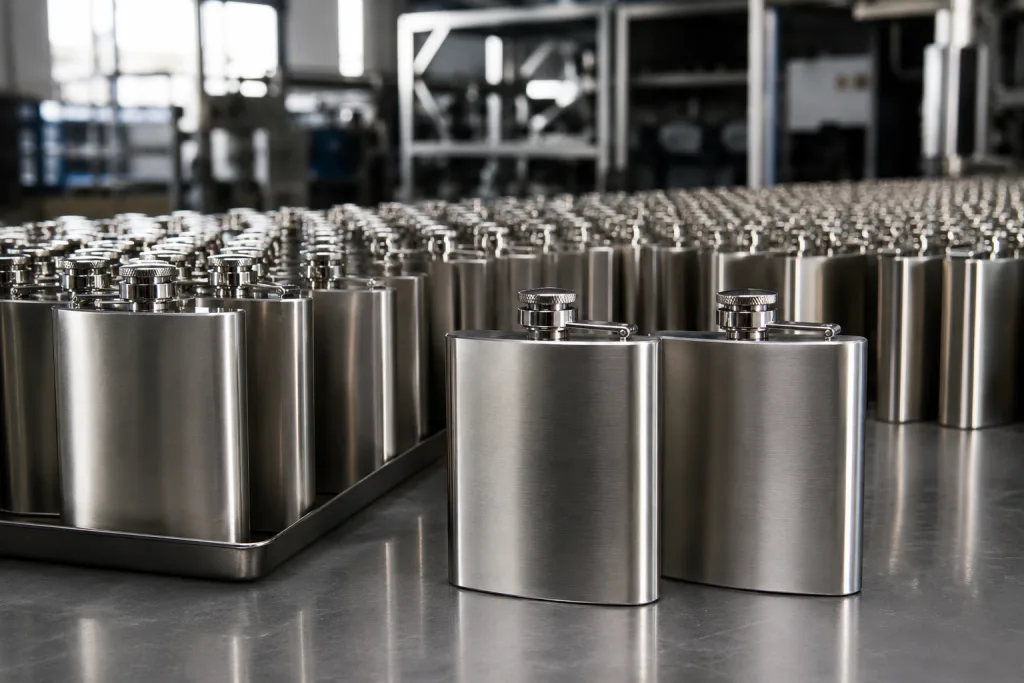
Key Takeaways
- The 4 decisions that matter most are material grade, capacity, decoration, and packaging; changing any one can move unit cost by USD 0.18-0.90
- Typical MOQ for hip flask bulk is 500-1,000 pcs per SKU, with 25-35 day lead time and factory output that can reach 300,000 units/month in Zhejiang, China
- For gift and alcohol-related retail, 304 stainless steel with laser logo and individual box packaging usually gives the best claim rate versus margin balance
- Ask for AQL 2.5 inspection, leak test, coating adhesion test, and REACH or LFGB material confirmation before you approve mass production
You can buy a hip flask from almost any supplier list in China. Easy part. The harder part is locking the right body construction, decoration method, gift box setup, and compliance route before you approve tooling, artwork, and deposit terms. Get those calls wrong at the sample stage and a cheap quote turns into leakage claims, logo rub-off after the 3M tape test, or a ship date that slips from 12 days to 18 days. We have seen this go sideways after a buyer approved a 0.4 mm shell to save cost, then QC pulled the sample and found seam distortion on the line.
For procurement managers and brand owners, the lowest unit price is the wrong question to ask. The job is to set a spec that matches your sales channel, margin target, and market rules in Europe or North America. If you also buy bulk canteen, bulk growler, or other bulk drinkware lines, hip flask bulk sourcing in Zhejiang, China follows the same factory logic: the spec decides the order before production starts. We run into this on POs every season, sometimes from one small typo on artwork size or a 3,000 pcs MOQ packed in the wrong insert.
Start With The Four Decisions
Most sourcing mistakes start the same way: the buyer asks for price before the spec is locked. On hip flask bulk orders, we tell customers to settle four points first—material, capacity, decoration, and packaging. These four choices usually drive more than 80% of the final margin, complaint risk, and freight math. On the line, even a 0.1 mm change or a box upgrade can move the quote fast.
Decision 1: Material. For export work, 18/8 stainless steel, commonly called SUS 304, is the safe default. Yes, it costs more than lower-grade steel, but the corrosion claim rate is lower and the product sits better in alcohol flask wholesale programs. If a factory throws out a low number, ask two things right away: steel grade and wall thickness. A common body thickness is 0.4-0.5 mm, and QC usually checks it with a micrometer at the shoulder and base. Below that, dent risk climbs during transit. We have seen buyers push for thinner bodies to save a few cents, and the math doesn't work once cartons start arriving with corner hits.
Decision 2: Capacity. Standard sizes are usually 4 oz, 5 oz, 6 oz, 7 oz, and 8 oz. The 6 oz and 8 oz sizes are the easiest to source because factories across China already run that tooling, neck size, and cap fitment. Custom sizes raise cost and can add 10-15 days for sample confirmation. That delay is real: one new mold correction on the hinge area can turn a 12-day sample cycle into 18 days. Buyers sometimes ask for a unique size first, but this is the wrong question to ask if the target is a fast launch.
Decision 3: Decoration. Laser engraving is durable and low-risk. Silk screen is cheaper at volume, but it scratches more easily if curing is weak or the ink adhesion test fails after tape pull. Powder coating plus laser logo looks premium, and retail buyers like it, but every color change slows the line and adds clean-down time on the spray setup. We ship plenty of coated flasks, but mixed colors on one PO can go sideways fast if the carton marks or cap color notes are not clear.
Decision 4: Packaging. Polybag plus export carton is the cheapest route. White box, window box, kraft gift box, or flask-with-funnel sets all push up landed cost and carton volume, and sometimes the carton drop result changes too. A gift box set with funnel and 2 cups usually needs an EVA insert, which adds both piece cost and packing time at the table. If you sell online, packaging is part of the product. We have had buyers flag a clean flask because the outer box corner crushed in transit, while the unit inside was fine.
- Low-cost promo route: plain stainless body, 1-color print, polybag
- Gift route: powder coat, laser logo, individual box
- Retail set route: flask, funnel, 2 cups, EVA insert box
If you also source wholesale drinkware, wholesale canteen, or growler wholesale programs, this order will look familiar. Lock the structure first. Then ask for price. We see fewer PO revisions that way, and fewer mistakes like the buyer typo that asks for “6oz black box” on an 8 oz silver flask order.
Choose Specs That Match Sales Channel
A flask for a souvenir shop, a whiskey brand gift set, and an Amazon-ready private label item should not use the same spec sheet. This is the wrong question to ask. Start with the sales channel, then lock the flask spec. On our line, the same 6 oz body can pass one program and fail the next because the cap fit or box size is off by 2 mm.
For promotional distribution, buyers push on landed cost and reorder speed. We usually run standard molds, 2-3 color options, and 500-1,000 pcs MOQ per design. A plain silver 6 oz flask in 304 steel can sit around USD 1.55-2.20 FOB China depending on quantity, finish, and packaging. Add a printed logo and individual white box, and you may move to USD 1.95-2.65. We have seen buyers ask for custom coating at this price level, and the math doesn't work.
For retail gift projects, finish consistency and unboxing drive the decision. Powder coating, faux leather wrap, embossed sleeve, or gift box inserts can work, but each added part creates one more defect point. QC pulled the sample last month because the leather seam was 3 mm off center, and the buyer flagged it right away. If your target retail is EUR 19.99 or USD 24.99, paying USD 0.35 more for better presentation is often rational. Paying USD 0.90 more for a complex box that fails drop testing is not.
For e-commerce, packaging survival is non-negotiable. Ask for carton drop testing, barcode placement confirmation, and master carton optimization. We ship plenty of online orders, and dimensional weight can kill margin faster than unit cost. One common issue: the outer box passes visual check but bursts at the corner after a 76 cm drop, so the nice flask inside does not matter anymore.
Simple rule for channel fit
Use the cheapest spec that still survives the channel requirement:
- Distributor promo: cost first, standard spec, repeat orders without reworking the mold
- Retail shelf: appearance first, controlled packaging, finish consistency under inspection light
- Online: damage prevention first, barcode position checked, carton size tight enough to protect margin
You do not need the best flask on the market. You need the right flask for the way you sell it.
This matters even more if hip flask bulk is one line within a wider range that includes canteen bulk, wholesale growler, or beer tumbler wholesale bulk. Once a catalog gets past 12 SKUs, loose spec control starts to slow approvals, confuse POs, and create avoidable QC findings. We've seen this go sideways over one typo in a cap finish code.
Know Where Cost Really Moves
New buyers on hip flask bulk usually stare at the unit price and miss where the money actually moves. In our line, the bigger swings usually come from decoration, packaging, and MOQ breaks, not the bare flask body. Base flask cost is only one part of the FOB number. This is the wrong question to ask if you only ask, “What is your best price?”
A standard 6 oz stainless hip flask with brushed finish and no logo is a routine item. We run this shape off standard tooling, and QC usually checks the mouth curl and hinge pin fit first. Cost starts to move once decoration is added. Laser engraving might add only USD 0.05-0.12 per unit at 3,000 pcs. A 1-color silk screen print can land in the same range, but 2-color or 3-color artwork adds screen setup, registration time, and a higher reject rate if the logo sits too close to the shoulder radius. Powder coating can add USD 0.18-0.40 depending on color and finish. Faux leather wrapping or stitched PU sleeves can add USD 0.35-0.80.
Packaging moves cost faster than most buyers expect. A plain polybag is close to nothing. A white tuck box may add USD 0.08-0.15. A rigid gift box with EVA insert can add USD 0.45-1.20 and may reduce loading efficiency by 20-35% depending on box dimensions. We have seen a gift box go from 18 days to 26 days just because the insert cavity was cut too tight by 2 mm and the flask scratched during drop test.
Then quantity. The spread between 500 pcs and 5,000 pcs is often real, but not big enough to justify dead stock sitting in a warehouse for 8 months. On common flask shapes from Zhejiang factories, the drop might be USD 0.20-0.45 per piece. Buyers sometimes push for a custom cap, special hinge, or an odd body curve to save a few cents later. The math does not work. New tooling, sample revisions, and scrap on the first production run can wipe out those savings fast.
- Decoration usually moves supplier margin more than raw steel cost, especially if QC pulled the sample and found print registration drift
- Gift packaging usually pushes freight higher than buyers expect, especially once master carton size jumps past the original packing plan
- Standard molds usually beat custom molds on total risk, lead time, and reorder stability
The same logic applies across drinkware wholesale categories. A buyer comparing alcohol flask in bulk with bulk growler, beer growler wholesale bulk, or beer tumbler in bulk should look at total landed cost, not just FOB unit price. Ask the supplier to break out flask cost, decoration cost, packaging cost, and carton data separately. If they will not do that, you are not looking at the real commercial picture.
Compliance Is Not A Side Issue
A hip flask looks simple. Customs does not care. If the flask touches beverage, treat it as a food-contact item from day one, the same way we handle a 304 stainless bottle on the line. For Europe, buyers usually ask for REACH and LFGB-related material compliance based on the sales channel and country. For North America, FDA-related food-contact expectations come up often, and some gift programs also ask for CPSIA screening if the set-up, packaging, or retail claim pulls the item into a wider review.
You do not need every test on every PO, but you do need a clean paper trail. Ask for the steel grade, mill source, and declarations for coating and printing ink; if the supplier cannot match the body material to a batch record or even explain whether the wall is 0.4 mm or 0.5 mm, the cheap quote is not the issue. We have seen buyers focus on price, then get stuck when QC pulled the sample file and found no backing paper for the black logo ink.
Quality control should be this specific. A solid finished-goods standard is AQL 2.5 for major defects and 4.0 for minor defects, though premium gift sets often get tightened after the buyer flagged small scratches on mirror polish. Your inspection checklist should include:
- 100% leak test or pressure/vacuum equivalent process confirmation
- Cap thread fit and gasket seating check
- Logo position and color check against approved artwork
- Coating adhesion and scratch resistance spot test
- Drop check on packaged sample from finished carton
If you source from Zhejiang, China, ask whether the factory runs under ISO 9001 procedures and whether social compliance such as BSCI is available for your customer file set. We ship to accounts that ask for both in the first RFQ, and we also see smaller importers skip it until a retailer steps in. This is the wrong question to ask late. Get the answer before sample approval, not after a carton mark typo forces a document recheck.
The broader your portfolio, the more this matters. If one buyer handles wholesale drinkware, wholesale canteen, alcohol flask wholesale bulk, and beer growler in bulk, standardize the compliance request list across all 4 categories and keep one template with test reports, declarations, and inspection points. The math does not work if one weak supplier breaks the file chain and delays shipment from 12 days to 18 days.
How To Judge A Factory Fast
You do not need months to screen a supplier. One week is enough if you ask the right questions. For hip flask bulk, a capable factory should reply fast on MOQ, tooling status, wall thickness in mm, steel grade, decoration limits, sample lead time, and packaging options. We usually ask for hinge structure photos and a weight spec on day 1. If the answers stay vague, production usually goes the same way.
A practical screening set looks like this:
- MOQ per SKU: usually 500 pcs for plain styles, 1,000 pcs for custom color or box set
- Sample lead time: 5-7 days for existing model, 10-15 days with custom logo and color
- Mass lead time: 25-35 days after deposit and approval
- Output capacity: for example 200,000-300,000 units/month on standard flask lines
- Inspection approach: in-line QC plus final random inspection
Ask for photos or video of hinge assembly, polishing, welding, coating, and packing. This is where the line tells the truth. QC pulled one sample last month with a 1.5 mm cap offset, and the buyer flagged it at once. Hip flasks usually fail on small points: uneven shoulder welding, crooked cap alignment, weak hinge pins, or rough edges near the mouth. You will not catch that in a polished catalog image.
If your business also includes canteen wholesale, growler bulk, or beer tumbler wholesale, check whether the supplier is a real drinkware factory or a trader with a mixed catalog. This is the right question to ask early. A trader is not automatically bad, but the communication chain is longer and engineering feedback is slower. We have seen this go sideways when artwork shifted by 2 mm, or when a gasket issue showed up during pre-shipment inspection and nobody on their side could answer from the floor.
Good factories in Zhejiang usually give direct answers on what they can and cannot do. That is a good sign. We ship better projects when the factory pushes back early. You want a partner who says, “This logo line is too thin for silk screen; use laser,” not one who says yes to everything, then sends a sample with fuzzy print and asks for approval later.
Build The Order Around Risk Control
After you pick the factory, the real work is locking down risk in the PO. Most hip flask bulk disputes are not factory disasters. They start with small misses the line did not stop: a 28 mm logo printed at 32 mm, carton marks mixed between SKUs, an inner tray that collapses in transit, or silver finish shipped instead of matte black.
Your purchase order and approval pack need hard specs, not loose wording. Write the exact flask capacity, dimensions, steel grade, wall thickness, finish code, logo method, packaging spec, carton size, barcode rules, and inspection standard into the file set. We usually see buyers miss one line on the packing spec, then QC pulled the sample and found the wrong EAN label position 15 mm off. Attach approved artwork and approved pre-production sample photos. If the project includes accessories such as funnels or shot cups, list each item separately with its own material and finish requirement. This is the right question to ask early.
Commercial terms matter just as much. Common export terms from China are FOB Ningbo or FOB Shanghai. Deposit is often 30%, with balance before shipment or against copy documents depending on account history. If timing is tied to a launch, put the ex-factory date into the order confirmation as a fixed date, not “about 30 days.” We have seen “about 30 days” turn into 36 days after laser logo queueing and final carton booking, and the buyer flagged it too late to fix.
For larger programs, add one control point before mass production: a sealed golden sample or pre-production sample signed off by both sides. That one sample saves arguments later, especially when the line runs 4 SKUs with different coatings and gift box packs. It is useful when you run multiple SKUs across drinkware bulk categories such as alcohol flask wholesale, wholesale growler, beer growler bulk, or best wholesale drink bottle assortments. We have seen this go sideways when one approved flask had satin black and the mass lot used a darker powder code.
A solid risk-control checklist includes:
- Approved sample with date and revision number
- Final artwork file and decoration location drawing
- Carton packing count and gross weight limit
- AQL standard written into the order
- Leak test and packaging drop-test requirement
- Backup plan for 2-3% overproduction or spare units
This is not over-management. It is basic factory discipline. The cleaner the spec, the fewer surprises you pay for when we ship.
Get a practical quote for your hip flask program
Send your target size, finish, logo method, and packaging requirement. We will quote with MOQ, lead time, and risk points before you place the order.
Frequently asked questions
What is a realistic MOQ for hip flask bulk orders?
For standard stainless steel hip flask models, realistic MOQ is usually 500 pcs per SKU for a plain finish and 1,000 pcs per SKU for custom color, gift box, or bundled accessory sets. Some Zhejiang factories in China will quote 300 pcs, but that often comes with limited decoration choices or a higher unit cost. If you want a custom mold, MOQ can move to 3,000-5,000 pcs plus tooling. For buyers testing a new program, the safest route is to start with an existing 6 oz or 8 oz model at 500-1,000 pcs, then increase volume after the first order proves quality and sell-through.
What price should I expect for alcohol flask wholesale orders?
A common FOB China range for a standard 6 oz 304 stainless flask is about USD 1.55-2.20 with brushed finish and bulk packing, depending on quantity. Add a logo, and you may be at USD 1.95-2.65. Add powder coating and retail box packaging, and the price can move to USD 2.40-3.60. Premium gift sets with funnel and cups can go above USD 4.50. The important part is not chasing the lowest quote. Ask for price breakdown by flask body, decoration, packaging, and carton spec so you can see where the cost moves. That makes supplier comparison much more accurate.
How long does production usually take for hip flask bulk?
For existing models, custom samples usually take 5-7 days if the change is only logo or finish. If you need a new box, accessory set, or custom color confirmation, expect 10-15 days. Mass production for 1,000-5,000 pcs is commonly 25-35 days after deposit and final sample approval. During peak season, especially before Q4 promotions, some factories in Zhejiang and other parts of China extend to 40 days or more. If your launch date matters, build in at least 7-10 buffer days for inspection, rework if needed, and vessel booking. Do not plan with only the factory’s fastest scenario.
What tests and documents should I ask for before shipment?
At minimum, ask for material confirmation for the stainless steel grade, leak-test process confirmation, and a final inspection report using AQL 2.5 for major defects. For Europe, many buyers also request REACH-related declarations and sometimes LFGB-oriented food-contact documentation depending on the retailer and country. For North America, food-contact expectations and retailer-specific requirements may apply. If the flask has coating or printed decoration, ask for adhesion or rub-resistance results. If it is sold in a gift box, request a simple packaging drop-test check. These basic controls catch the most common failures before the goods leave China.
Can one supplier handle hip flasks, canteens, growlers, and other drinkware bulk items together?
Sometimes yes, but you should verify whether the supplier is a true manufacturer across those categories or a trader combining partner factories. A factory may be strong in hip flask bulk and travel tumblers but weak in growler wholesale or canteen wholesale because the forming, welding, and lid systems differ. Ask what products are made in-house, what monthly capacity they have, and whether QC is centralized. If you are building a broader line with bulk canteen, bulk growler, beer tumbler wholesale, and alcohol flask wholesale bulk, a mixed sourcing model can work well, but only if specification control and inspection standards stay consistent across all items.