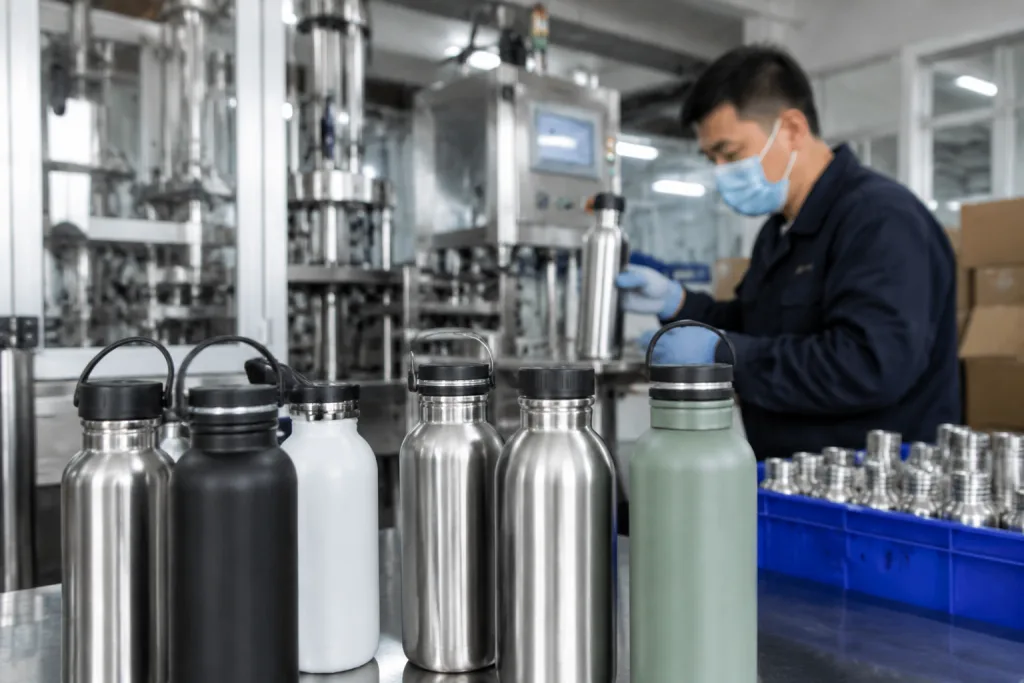
Key Takeaways
- Set the bottle format first: a 700ml single-wall sports bottle can land 20-35% cheaper than a 750ml shaker with mixer insert
- For most custom gym water bottle programs, MOQ starts at 3,000 pcs per color and lead time is usually 25-40 days after sample approval
- Use AQL 2.5 for major defects and AQL 4.0 for minor defects if you want fewer distributor returns in Europe and North America
- Screen printing is usually the lowest-cost logo option, while full-wrap decoration can add USD 0.18-0.60 per unit depending on volume and artwork
You are not buying a bottle. You are choosing a supply model for your fitness brand or gym chain: the price band you can run, the defect rate your market will reject, and the level of customization that pushes lead time from 12 days to 18 days and adds cost at packing. This is where buyers get stuck with gym water bottle suppliers. Three quotes can sit within US$0.08 of each other on the spreadsheet, then land with different complaint rates, reorder speed, and freight math. We have seen this go sideways after mass production, not at sample stage, especially when QC pulled the sample and found logo position drifting 2 mm off the approved artwork.
For buyers in Europe and North America, the decision usually comes down to four points: bottle type, compliance risk, decoration method, and replenishment logic. A supplier in Zhejiang, China can offer competitive FOB pricing, but only if those points are locked early; this is the wrong question to ask after tooling, color match, and carton spec are already on the PO. At BottleForge Industrial in Hangzhou, Zhejiang, we run this every week on projects from 3,000 pieces to 80,000 pieces, and the buyer pushback is often the same: the first quote looked cheap, but the math did not hold once drop-test standards, barcode labels, and split shipments were added.
Start with the buying model
The first call is not the factory shortlist. It is the bottle’s job in your business. On our side, fitness brands, gym chains, and distributor buyers usually fit 4 buying models, and the MOQ, print method, and packing spec change fast once that is clear.
- Promotional give-away: low unit cost, simple logo, fast repeat orders. Most buyers in this bucket run 5,000 pcs or 10,000 pcs, with silk screen print and individual polybag.
- Retail margin item: better finish, stronger packaging, tighter color control. Here the buyer flagged Pantone drift before, so we check bottle and lid color under the light box, not by eye on the line.
- Membership kit item: balanced cost, dependable stock, stable quality. This is usually a safer middle lane: 600ml to 750ml, standard carton pack, fewer complaints from gym front desk staff.
- Supplement accessory: often requires a bulk shaker bottle format, measurement marks, and leak-resistant lid structure. We normally check the ml marks on the sample and run a lid fit test before mass production.
If you are buying for gym reception sales or a fitness brand ecommerce line, your cost target is not the same as a chain giving bottles away in welcome packs. This sounds basic. Still, we get RFQs every week that say only, “Need custom sports water bottle, BPA free, best price.” Last month one PO even missed the target capacity by 100ml. A factory cannot quote cleanly from that, so the number you get back usually carries risk padding.
A better way is to rank the project on 3 working numbers: target landed cost, expected annual volume, and brand sensitivity. If your target landed cost is under USD 1.20 FOB, you are usually in a simpler bulk sports water bottle build in PE, PP, or Tritan-style plastic, with one-color print and standard polybag packing. If your retail position supports USD 2.20-4.50 FOB, the options open up: stainless bodies, upgraded lids, gift box packing, or larger print areas. This is where some buyers ask for premium details on a promo budget, and the math does not work.
For a bulk gym water bottle order, write the brief so the supplier can make engineering trade-offs early. State capacity, wall type, material preference, leak test requirement, packaging style, destination market, and whether the order is for direct retail, Amazon FBA, or distribution. We run into this all the time in Zhejiang: vague briefs get risk added into the quote. Clear briefs usually mean faster sampling, cleaner pricing, and fewer surprises after QC pulled the sample.
Choose bottle type before logo
The second decision is product architecture. Buyers jump to logo placement first; we see that on the first call all the time. That is the wrong question to ask. Most cost drift and most complaints come from the bottle type itself. For gym and fitness channels, the common formats are:
- Single-wall squeeze bottle: light, low cost, common for studios and cycling gyms, usually the easiest line for 5,000 pcs MOQ.
- Flip-top or screw-cap sports bottle: better for retail and daily use, with fewer lid-loss complaints than some pull-top styles.
- Shaker bottle: built for protein, supplements, and wellness bundles, but the insert and neck size decide whether users keep it.
- Vacuum insulated sports bottle: premium positioning, higher FOB and lower impulse-buy volume; on the line, this is also the slowest style to pack without dent risk.
For a standard 650-750ml plastic bottle, ask about resin grade, wall thickness in mm, cap thread tolerance, and whether the lid includes a silicone seal. We usually see trouble at the cap, not the body. A cheap bottle without a proper seal may pass a casual factory check and still leak after 12 days in transit vibration. QC pulled samples before with loose thread fit after a 1.2m drop test, and the buyer flagged it only after arrival. That becomes a return issue for any distributor sports water bottle or distributor fitness water bottle account.
Shakers need extra attention. A custom shaker bottle or custom logo shaker bottle looks simple on paper, but the insert design changes cost, cleaning time, and user feedback. Wire ball, plastic whisk, and snap-in grid do not perform the same, and we have seen this go sideways when a buyer approved by photo only. If your target user mixes protein powder, ask for real-use testing with 25-30g powder in 300ml water, not only a water leak test. We run that test on the bench with a timer and 20 shakes. A custom made shaker bottle also needs readable measurement marks and a neck diameter wide enough for a standard sponge brush.
Trade-off: a simple bulk fitness water bottle may cost USD 0.65-1.10 FOB at 5,000 pcs, while a decent shaker can move to USD 1.10-1.80 FOB depending on insert and packaging. Stainless sports bottles go higher again. The math does not work if you ask one SKU to cover merch sales and cheap promo giveaways at the same time. If your gym chain wants a customizable gym water bottle for merchandise and a lower-cost bottle for promotions, split the range. We ship this as two SKUs all the time, sometimes even on one PO with one typo in the item code causing less trouble than forcing one bottle to do two jobs.
Check compliance like a retailer
The third decision is your compliance threshold. If you sell into Europe, North America, or big-box retail, “food safe” means nothing by itself. Ask your gym water bottle suppliers for proof that matches the destination market and the actual resin or metal on the PO. We’ve seen buyers lose 12 days because the report was for Tritan while the line ran PP.
For plastic drinkware, buyers usually ask for reports tied to REACH, LFGB, or FDA-related food contact requirements based on where the goods ship. For kids’ items, ASTM or CPSIA can come into play. For adult sports bottles, the main checks are food-contact substances, odor, migration, and label accuracy. If a supplier claims recycled content, ask what backs it up—certificate, batch record, or supplier declaration. If the bottle has a stainless body, confirm 18/8 or 304 at the main contact area, not just on the outer shell. QC pulled one sample last month where the lid insert spec on the PO had a typo, and that kind of mistake spreads fast.
Check factory systems too, not just the lab PDFs. Ask how the factory runs process control, whether it has ISO-based procedures, whether BSCI or a similar audit is current for chain-store business, and what inspection plan they use before shipment. A practical standard for many bottle orders is AQL 2.5 major / 4.0 minor. That is commercial grade. Not premium. This is the wrong question to ask if you expect zero defects at the same price point, because the math doesn’t work. On our side, the line usually checks cap torque with a digital torque meter and logs leak-test results by lot.
Questions worth asking
- Can you provide recent migration or food-contact reports for the same material family?
- Do you run 100% leak testing or only random sampling?
- What is your torque standard for caps and lids?
- Can you support barcode labeling, FNSKU, or carton marks for Amazon and retail distribution?
- How do you handle color tolerance across repeat orders?
You do not need every certificate in the world. You need the right documents for your channel, your market, and your material. Anything else is noise.
For a customized sports water bottle or customized gym water bottle program, document approval is cost control. One delayed compliance check can push shipment by 7-12 days in China, and in peak season we’ve seen it turn into 18 days because the buyer flagged carton marks after booking.
Price the decoration honestly
The fourth decision is decoration complexity. Buyers miss this point all the time because setup cost and defect risk jump fast once the artwork gets complicated. A custom fitness water bottle with a one-color screen print is a simple line job. A customizable sports water bottle with metallic Pantone match, full-wrap art, individual names, and premium packaging is a different production setup, with separate screens, tighter jig positioning, and more chances for QC to pull the sample.
Common decoration methods are silk screen, heat transfer, water transfer, laser marking on stainless, and digital print on certain surfaces. Screen printing is still the lowest-cost and most stable option when we run volume. For many plastic bottles, one-color print may add only USD 0.05-0.12 per unit at 5,000 pcs. Multi-color wrap graphics can add USD 0.18-0.60. If you add individual names, the line slows down hard and artwork control gets stricter; we have seen output drop from 4,000 pcs per shift to 1,200 pcs on variable-data jobs.
The right question is not “What is your best logo price?” This is the wrong question to ask. Ask which decoration method gives the appearance you need with a failure rate you can live with. On sports bottles, the buyer usually flags four issues: logo misalignment, poor adhesion, scuffing in transit, and color drift between repeat orders. Last quarter, one inspection lot failed because print position moved 2.5 mm off the approved mark.
If you are buying for a chain rollout, request a pre-production sample showing actual logo size, bottle color, and print position. For a customizable fitness water bottle project, also ask whether the artwork is protected by varnish or surface coating. This matters. If the bottle will be clipped into gym bags or crate-packed for distributors fitness water bottle channels, abrasion is not a small detail; we ship plenty of cases where an uncoated print looks fine at packing and comes back rubbed after carton vibration testing.
This is also where MOQ changes. A stock-color bottle with one logo may run at 3,000 pcs. A new mold part, custom cap color, and printed gift box can move the practical MOQ to 5,000-10,000 pcs. That is normal in Zhejiang manufacturing, and the math does not work if a factory promises all of that at the lower break. We have even seen a PO approved with the box typo still uncorrected, then the buyer pushed back after print film output. Better to hear the real MOQ early than after artwork approval.
Match MOQ to replenishment reality
MOQ only matters against your reorder timing. New buyers often ask for the smallest opening order, and this is the wrong question to ask. The lower MOQ can raise unit cost fast once we add mold change time, screen prep, and carton setup. If you are working with gym water bottle suppliers in China, ask what MOQ keeps landed cost in line without leaving 2,000 pcs sitting in the warehouse.
For most sports bottle programs, MOQ starts around 3,000 pcs per design or colorway. A factory with monthly output above 300,000 units may still hold that line because setup, resin batching, silk-screen plate prep, and carton marks all take fixed labor. On our line, QC pulled the first print sample after screen alignment and checked logo position within 1.5 mm before mass production. At BottleForge Industrial in Zhejiang, standard custom orders usually ship in 25-35 days after deposit and sample approval, while more customized builds may need 35-45 days.
If you are a distributor shaker bottle or distributors shaker bottle buyer serving 12 or 20 local gyms, ask about mixed-color runs under one container or one purchase order. Some factories will split production by cap color or body color while keeping the same artwork, so you can test sell-through without opening 6 separate SKUs. We have seen buyers flag one PO typo on color codes and the whole plan drift, so confirm cap, body, and lid combinations before the line starts.
For a customized fitness water bottle or customized shaker bottle program, use a replenishment model that matches what you actually ship:
- Launch with 2 core colors or 3 core colors, not 7. We see black and white move first on 700 ml and 1000 ml bottles.
- Hold safety stock equal to 6-8 weeks of average sales. If your weekly run rate is 500 pcs, keep 3,000-4,000 pcs ready.
- Reorder when 50% of stock is committed. Do not wait until the warehouse has 200 pcs left.
- Use common components across SKUs where possible, especially lids and shaker inserts. A shared 63 mm lid saves headaches.
This is how experienced distributor gym water bottle and distributors gym water bottle buyers keep stock cleaner. The cheapest quote often stops being cheap when we ship emergency air freight 60 days later. The math doesn't work.
Audit samples, packaging, and shipping
Once product spec, compliance, and MOQ are locked, the last call is execution on the line. This is where orders slip. We’ve seen a bottle pass sample review, then fail bulk packing because the master carton burst at 12kg compression, the cap got ring scratches in transit, or the buyer flagged one wrong EAN code on the PO.
For fitness brands and gym chains, run the sample process in three stages: reference sample, pre-production sample, then shipment sample. The pre-production sample matters most. It needs to match the real resin, the real logo method, and the target packout, not a hand-made sales sample. If you are ordering a custom sports water bottle for retail, ask for drop-tested cartons and confirm master carton weight is workable—usually under 15kg if warehouse staff handle cartons by hand. QC should also pull the sample from the same mold cavity if lid fit is tight at 0.3 mm tolerance.
Packaging changes hit cost fast; buyers often miss this on the first quote. A polybag plus export carton is one cost. A color box with EVA insert, barcode sticker, and tissue wrap is a different cost stack, and the math doesn’t work if you treat them as close. For Amazon FBA, we usually add FNSKU, suffocation warning where needed, carton marks, and tighter outer carton size control. Those details can add USD 0.10-0.45 per unit quickly.
Shipping terms need to be written line by line. If you compare EXW, FOB Ningbo, and DDP without backing out local charges, trucking, customs, and destination fees, you are comparing different numbers. Most Zhejiang factories ship through Ningbo or Shanghai. In peak season, booking lead time can move from 7 days to 12 days, and we’ve seen this go sideways right before Golden Week.
If you are sourcing for distributor sports water bottle channels or a national gym rollout, put inspection standard and packaging approval in writing before deposit. This is the right question to ask. We ship smoother when the approval file shows carton spec, barcode placement, and AQL sign-off before mass production starts. That is how you keep a customizable shaker bottle or customizable gym water bottle project from turning into a margin problem after arrival.
Shortlist the right bottle program before you quote
Send your target price, volume, market, and bottle type. We will recommend a practical custom sports bottle setup with MOQ, lead time, and compliance checkpoints.
Frequently asked questions
What MOQ should I expect from gym water bottle suppliers?
For standard custom plastic sports bottles, a realistic MOQ is usually 3,000 pcs per color or design. If you use stock molds, standard lids, and one-color screen print, some projects can start there with competitive FOB pricing. If you want a custom cap color, special finish, retail box, or a shaker insert, expect 5,000-10,000 pcs to make production efficient. Stainless bottles often have similar or slightly higher practical MOQs depending on decoration. In China, very low MOQs are possible on leftover stock items, but those are usually not a good fit for serious custom branding. Ask for the MOQ by bottle body, lid color, print setup, and packaging format separately.
How do I compare a bulk sports water bottle quote with a bulk shaker bottle quote?
Break the quote into components. Compare bottle body material, lid structure, seal type, decoration method, packaging, and testing. A standard 700ml plastic sports bottle might quote at USD 0.65-1.10 FOB at 5,000 pcs, while a 700ml shaker with whisk or grid insert may run USD 1.10-1.80 FOB under the same volume. Then add print cost, carton upgrades, and compliance testing if needed. The key issue is not just price but complaint risk. A shaker has more parts, more leakage points, and higher cleaning expectations. If your gym chain sells supplements, the shaker can make sense. If the bottle is mainly a promotional item, a simpler sports bottle usually gives better value.
What compliance documents should a custom gym water bottle supplier provide?
At minimum, ask for recent food-contact test reports relevant to the material and destination market. For Europe, REACH and often LFGB-style expectations come up often. For North America, buyers typically ask for FDA-related food-contact suitability and supporting lab data. If the bottle is stainless, confirm the steel grade such as 304 or 18/8 where applicable. Beyond documents, ask about process controls: leak test method, AQL inspection level, and whether the factory supports social audits like BSCI if your retail customer requires them. The best suppliers in Zhejiang, China will not just send a generic certificate pack. They will explain which reports match your exact bottle type and market.
How long does a customized sports water bottle order usually take?
For repeat items with existing tooling, expect around 25-35 days after deposit and final sample approval. If the order includes new color matching, custom packaging, or more complex decoration, 35-45 days is more realistic. During peak periods in China, especially before major shipping rushes, booking space can add another 5-10 days depending on port and service level. Sampling usually takes 5-10 days for standard items and 10-15 days if you need more custom work. If you need a launch date for a gym chain campaign, work backward from the in-warehouse date, not the factory ex-works date. That avoids expensive air freight when one approval step slips.
What are the most common mistakes fitness brands make when buying custom bottles?
The biggest mistake is trying to optimize everything at once: lowest MOQ, lowest unit price, premium packaging, and fast lead time. Usually you can get two of those, not all four. The next mistake is approving a nice-looking sample without checking leak performance, print durability, or carton strength. Another common issue is launching too many colors on the first order, which ties up cash and complicates reorders. For custom logo shaker bottle or custom fitness water bottle projects, define the channel first: promo, retail, ecommerce, or distributor. Then set your quality standard, packaging level, and reorder logic. Buyers who do this usually get better results from suppliers in Zhejiang and broader China.