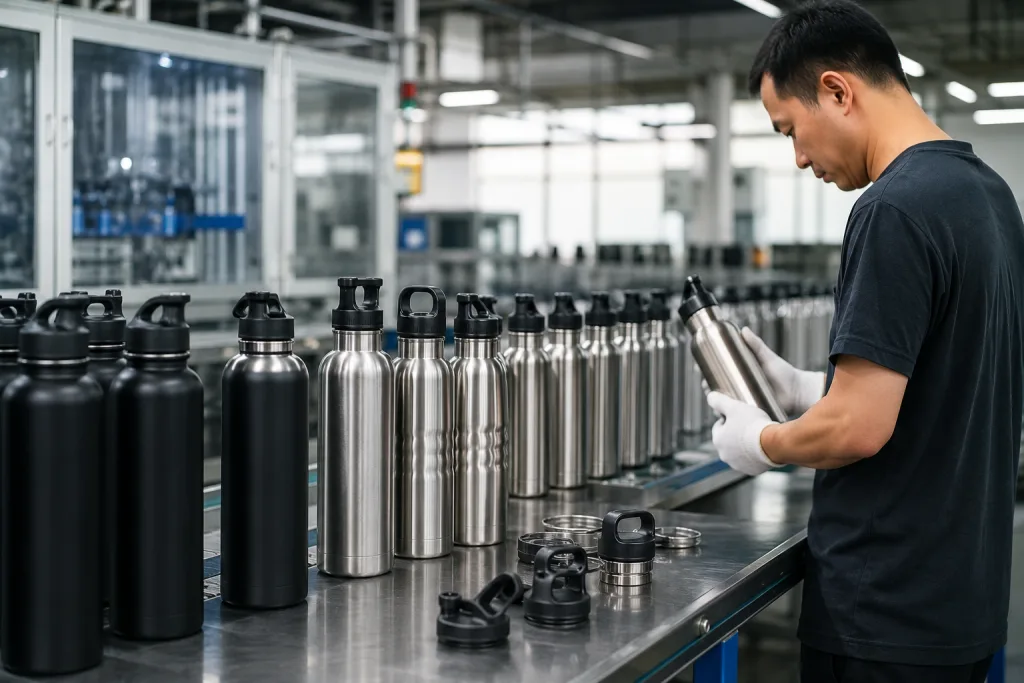
Key Takeaways
- Typical MOQ starts at 1,000-3,000 pcs per color for stock molds, while new mold projects often need 5,000-10,000 pcs
- A custom logo sports bottle usually adds USD 0.08-0.45 per unit depending on silkscreen, heat transfer, laser, or wrap
- Production lead time is commonly 25-40 days after sample approval and deposit, plus 5-35 days shipping depending on route
- AQL 2.5 inspection, REACH testing, and carton drop checks cost far less than a failed launch or chargeback
You ask for a quote on a custom gym water bottle and get three numbers that do not line up: bottle cost, logo cost, then extra charges buried in freight, testing, or a carton revision after the buyer flagged a drop-test risk. That is standard on China quotes. The job is to separate what changes with volume, what is a one-time setup charge, and what delay hits because sample approval sat 5 days on a desk before the line could run.
For fitness brands and gym chains buying from Zhejiang, China, the real sourcing job is not chasing the lowest unit price. This is the wrong question to ask. You need to balance MOQ, branding method, compliance, and ship date, and the math changes fast between a 3,000-piece order and an 8,000-piece order. We have seen buyers compare a bulk fitness water bottle, a bulk shaker bottle, and a customizable sports water bottle program as if the costing logic is the same; it is not. A silk-screen logo, a separate mold for a shaker lid, or a 5 mm taller carton can move the result more than the base bottle price.
What your unit price is really buying
Ask a gym water bottle manufacturer for a price, and you are not paying for resin or stainless alone. You are paying for a stack of production decisions: bottle body wall thickness, lid structure, seal material, logo process, packaging spec, and the factory’s allowance for scrap and rework on the line. We see this every week in Zhejiang. Two bottles can look close in a photo, then one quote comes in 18% higher because the lid has 4 extra silicone parts and QC pulled the sample for leak failure at 0.03 MPa.
For a plastic bulk gym water bottle in Tritan or food-grade PP, a plain stock model with a single-color print may land around USD 1.20-2.80 FOB China at 3,000-5,000 pcs. A stainless bulk sports water bottle with powder coating and a carry lid can move into USD 3.80-6.90 FOB at the same volume. A bulk shaker bottle with whisk ball, separate powder compartment, or dual-cap assembly often costs more in labor than buyers expect, even if the resin weight is not high. That surprise is common. We run into buyer pushback here: “the bottle is light, why is the price not low?” Wrong question. The labor sits in assembly, thread matching, and leak test time, not only in grams.
- Material: Tritan usually prices above standard PP; recycled content can add 5-12% depending on certification. On a 700ml body, even a small resin shift changes the quote once actual bottle weight moves from 128g to 146g.
- Lid complexity: Flip lids, lock buttons, straws, and leak-proof vent parts add assembly time and defect risk. A lid with 6 components instead of 3 can slow one worker from about 900 sets to 620 sets per shift.
- Decoration: A simple silkscreen logo is low cost; full-wrap heat transfer is not. We’ve seen this go sideways when artwork has a fine line under 0.2mm and the buyer flagged the blur on the first pre-production sample.
- Packaging: Individual polybag is cheap, gift box is not. Retail-ready inserts, barcodes, and bilingual warnings all add cost, and even a small PO typo on carton mark text can mean reprint fees and a 2-day delay.
If you are sourcing a custom fitness water bottle or custom sports water bottle for a gym chain, ask for a price split by bottle, print, and packaging. This makes supplier comparison cleaner and shows where a quote is strong, thin, or missing cost. We ship plenty of orders where the bottle price looks sharp, then the insert, barcode sticker, and drop-test carton spec add USD 0.28-0.46 per unit. The math matters.
MOQ tiers change the whole project
MOQ is not just a sales policy. It is how a China factory spreads setup cost across the line: color masterbatch ordering, screen setup, labor booking, and even carton loss from the first run. Buyers new to sourcing usually press on MOQ first, then the buyer flags the quote jump and asks why 1,000 pcs and 2,000 pcs are priced like different projects. We’ve seen this go sideways.
For stock molds, a workable MOQ from a Zhejiang supplier is usually 1,000 pcs for plain color assortments. Once you want a customizable gym water bottle with lid, body, and logo all matched, 2,000-3,000 pcs per color is more normal because the line has to lock color against approved chips, often within a visual tolerance the buyer checks under a light box. For a custom shaker bottle based on an existing body with a custom Pantone match, some factories will still run 2,000 pcs if decoration stays simple and packing is just standard export carton. That is the real cutoff.
New tooling is a different game. A custom made shaker bottle or a unique customizable shaker bottle lid can require USD 3,000-12,000 in tooling, and multi-cavity molds can go higher once you add hot runner work and sample corrections after T1. In those cases, factories usually ask for 5,000-10,000 pcs minimum because each revision burns machine hours, and a 0.2 mm lid fit issue on the first trial is enough to send the mold back for adjustment. This is the wrong question to ask: not “Can you do 500 pcs?” but “What MOQ keeps the unit cost sane?”
Practical MOQ bands
- 1,000 pcs: Best for stock bottle, standard color, one print position. We run these fastest.
- 2,000-3,000 pcs: Better for custom gym water bottle or customized sports water bottle with Pantone color control, where QC pulled the sample against the approved chip before mass production.
- 5,000+ pcs: More suitable for customizable fitness water bottle retail packaging or multiple SKUs on one PO, especially if the buyer wants insert cards, barcode labels, or a 24-pack carton layout.
- 10,000+ pcs: Where tooling amortization starts to make a new design economical. Below that, the math doesn’t work.
If a quote looks unusually low at 500 pcs, check whether the supplier has removed the print setup, testing, or carton customization from the offer.
BottleForge Industrial runs capacity around 600,000 units per month across sports bottles, tumblers, and shaker programs. MOQ flexibility is usually better on shared stock components than on fully bespoke parts, because we can combine resin purchasing and keep the injection machines loaded without opening a separate custom packaging run.
Decoration costs add up faster than resin
Most buyers miss decoration cost on the first quote. On a lot of customized gym water bottle programs, the logo budget climbs past the bottle body fast, especially with a 180 mm wrap area or artwork that uses gradients. We see this on the line all the time: resin stays stable, then print cost jumps after the buyer adds one more color and asks for tighter registration.
For a custom logo shaker bottle or custom fitness water bottle, the usual options are:
- Silkscreen: about USD 0.08-0.18 per color per position at volume. Best for simple logos. We run this with a steel screen and fixed jig, and the math stops working once the artwork gets too fine.
- Heat transfer: about USD 0.18-0.45 per unit. Fits complex artwork or wrap graphics. Good choice if the buyer flagged photo-style art or a multi-color wrap on a curved wall.
- Laser marking: about USD 0.10-0.25 on coated stainless surfaces.
- Embossed or debossed mold detail: higher upfront tooling, lower repeat print cost later. MOQ matters here; below 5,000 pcs, we usually tell buyers to check the tooling math twice.
If you need a customized shaker bottle for supplement retail, curved-surface registration is the real issue, not the print method alone. Flat carton graphics give you more forgiveness; a round bottle does not. Small text, metallic inks, and matte coatings often need pre-production checks with a Pantone book and a taped sample on the actual body. That adds 2-5 days, and we have seen this go sideways: QC pulled the sample, the logo was 4 mm off-center, and the buyer stopped a 3,000-bottle run before packing.
For gym chains ordering a customizable sports water bottle, one-color branding usually gives the best result per dollar. If you want shelf impact, spend first on bottle finish and lid color. A soft-touch coating or powder coat changes the hand feel fast, and we ship plenty of programs where that finish did more than a full-wrap print ever would.
Ask your manufacturer to state whether the decoration quote includes jig setup, color matching, and adhesion testing. Ask for the test method too. On export orders from China, these line items are often where the back-and-forth starts; one PO even came in with “slikscreen” typed on it, and that small miss turned into the wrong approval standard for 7 days.
Lead time starts before production starts
Buyers ask for 30-day delivery all the time. The factory does not own all 30 days. The clock starts after artwork, Pantone callouts, packaging files, and sample comments are complete. Miss one item, and the order sits in the queue even if 304 stainless tubes or lids are already on the floor. We see this go sideways on simple things, even a PO typo in the carton mark.
For a stock bulk fitness water bottle or bulk gym water bottle, a normal timeline from a Zhejiang factory looks like this:
- 1-3 days: quotation cleanup, logo position check, and artwork review against the dieline
- 3-7 days: pre-production sample or printed approval sample, often after QC pulled the sample from the screen-print line
- 25-35 days: mass production after deposit and sample sign-off, with the line running by confirmed color and packing spec
- 2-5 days: final inspection, carton marking, and loading, usually after AQL checks and outer carton drop review
For a customized fitness water bottle with new mold work, add 20-35 days for tooling and first sample evaluation. If the neck thread or lid fit is new, we usually check dimensions in mm with a thread gauge before the first sample goes out. If the product is a customizable shaker bottle with several assembled parts, add another 3-7 days for line testing and leak checks. This is the wrong question to ask if a buyer only asks, "How fast?" Ask how many parts, how many prints, and what leak standard you want.
Shipping has its own clock. Sea freight from China to Western Europe often takes 28-38 days port to port. To the U.S. West Coast, a common range is 18-28 days. Air freight may cut transit to 5-10 days, but sports bottle freight ships on volume, not just kg, so the math doesn't work on most bulk orders unless you are protecting a launch date. One 40HQ can change the decision fast.
Factories that quote a 15-day lead time on a decorated custom sports water bottle order are usually pricing for stock color, simple packing, and no test queue. We ship rush orders too, but that is not the standard run. The buyer flagged this before on a 10,000-piece order with two logo locations and an insert card, and the hold-up was not production — it was approval lag.
Testing, quality checks, and hidden delays
If you sell into Europe or North America, compliance is not optional. We’ve seen a distributor fitness water bottle program slip 12 days because the lab report name did not match the PO, while molding was ready on time. Paperwork stops more launches than machine capacity.
For EU projects, buyers usually ask for REACH conformity and food-contact migration reports. For the U.S., the file set often includes relevant FDA material declarations, and for children's ranges, parts of ASTM or CPSIA based on the product category. Social compliance such as BSCI also comes up when the retail customer audits the supply chain. QC pulled samples before because a lid silicone hardness came in at 58 Shore A instead of the approved 60 Shore A, and that kind of small miss slows paperwork fast.
Quality control should be written down, not assumed. This is the wrong question to ask: “Does your factory do QC?” Every factory says yes. A solid export order usually includes:
- AQL 2.5 final inspection standard
- Leak test for every assembled lid design
- Drop test on master cartons and, if retail-packed, inner boxes
- Dishwasher or coating adhesion check where relevant
These checks cost money, but the math works. A third-party inspection in China might cost USD 250-350 per man-day. One failed Amazon or retail inbound shipment can cost more in relabeling and return fees. We ship orders where the buyer flagged a 3 mm barcode shift on the retail box; fixing that before loading was cheap, fixing it after arrival was not. If you are a distributor gym water bottle buyer or manage distributors shaker bottle accounts, write the QC standard into the PO.
The hidden delay is usually sample revision, not production. A cap color mismatch, barcode placement error, or packaging translation issue can burn 4-8 days fast. We’ve even seen a PO typo on the Pantone reference hold approval for 3 days because the printed insert no longer matched the signed sample. Clean artwork files and signed approvals save more time than pushing the factory after the line is already booked.
How gyms and brands should budget landed cost
The FOB quote is the starting point, not the decision point. If you are sourcing a customized sports water bottle for gym membership packs or a distributor shaker bottle line for wholesale, build landed cost in layers. Single unit price alone is the wrong question to ask.
A practical landed-cost worksheet usually includes:
- FOB bottle cost
- Tooling amortization divided over the expected order quantity
- Testing and inspection
- Freight by CBM, not just weight
- Duties, broker, and local delivery
- Labeling or FNSKU work if selling through fulfillment channels
For example, a 4,000-piece custom gym water bottle project at USD 1.85 FOB may look cheap on the first sheet. Then the extras land: USD 0.16 print, USD 0.05 barcode label, USD 0.07 inspection spread, and USD 0.22-0.40 freight allocation. Your real cost becomes USD 2.35-2.53 before import duties. We have seen buyers miss this over a 1.2 mm logo line change and then blame freight, but the math does not work if margin was thin from day one.
For distributors fitness water bottle buyers and distributors gym water bottle programs, carton optimization changes the result fast. Moving from 24 pcs to 36 pcs per master carton can cut freight per bottle, but only if carton weight stays manageable and the package passes drop test. On our line, QC pulled the sample after a corner-crush issue on a 62 x 40 x 38 cm carton, so get carton dimensions early. Freight surprises usually come from volume, not resin price.
The best suppliers in Zhejiang will quote cleanly if you ask for the split up front: bottle, decoration, packaging, and optional compliance work. We ship quotes this way because buyers compare faster and fewer things go sideways later. A low first quote with bundled costs often gets flagged after the PO is issued, sometimes over something as small as a labeling line item or a typo in the packing spec.
Get a real costed quote from a Zhejiang factory
Send your target quantity, bottle style, logo file, and delivery date. We will break out MOQ, decoration, lead time, and FOB China cost clearly.
Frequently asked questions
What MOQ should I expect from a gym water bottle manufacturer for custom logo orders?
For stock molds, expect 1,000 pcs at the low end, but 2,000-3,000 pcs per color is more realistic for a custom logo order with Pantone matching and retail-level consistency. If you want a custom shaker bottle with extra components, the MOQ often starts around 2,000 pcs because assembly loss and spare-part planning are higher. For fully new molds, many China factories will ask for 5,000-10,000 pcs plus tooling. If a supplier offers 300-500 pcs at a very low unit price, check what is missing. Common exclusions are print setup, barcode labeling, testing, or custom carton marks. MOQ only makes sense when the quotation scope is complete.
How long does a custom gym water bottle order usually take from approval to shipment?
A normal order using an existing mold usually takes 25-40 days after sample approval and deposit. Printed samples can take 3-7 days first. If you need custom packaging, add 3-5 days for artwork confirmation and carton production. New mold development adds 20-35 days before mass production even starts. From China, sea freight to Europe is often 28-38 days, while U.S. West Coast transit is commonly 18-28 days. Air freight can cut transit to 5-10 days but raises cost sharply because bottles ship by volume. If your launch date is fixed, work backward from delivery and leave at least 7 buffer days for inspection and loading.
What is the typical price range for a bulk sports water bottle or bulk shaker bottle?
For a stock plastic bulk sports water bottle in PP or Tritan, a common FOB China range is USD 1.20-2.80 depending on size, lid, and print. A bulk shaker bottle with whisk ball, compartment, or more complicated lid assembly may land around USD 1.50-3.20. Stainless models usually start higher, often USD 3.80-6.90 FOB. Decoration adds to that: silkscreen may add USD 0.08-0.18 per color, while heat transfer can add USD 0.18-0.45. Retail packaging, testing, and third-party inspection are extra. If you are comparing quotes from Zhejiang suppliers, always ask whether prices are FOB, EXW, or include packaging, because the gap is often more about scope than factory efficiency.
How can I reduce cost without hurting quality on a customized fitness water bottle project?
Start with a stock mold and standard lid platform. That usually saves USD 3,000-12,000 in tooling and removes 20-35 days from development. Keep branding to one print position if possible; a one-color silkscreen logo is usually the best value. Use standard export cartons unless retail packaging is truly necessary. Combine colors into fewer SKUs so you can hit 2,000-3,000 pcs per variant instead of spreading 4,000 pcs across too many combinations. Also, do not cut inspection. An AQL 2.5 check in China may cost only USD 250-350, which is small compared with chargebacks or rejected shipments. Cost reduction works best when you simplify parts, colors, and packaging, not when you skip quality controls.
What should distributors and gym chains ask for before placing a PO?
Ask for the full quote breakdown, sample lead time, production lead time, MOQ by color, carton dimensions, testing scope, and inspection standard. For distributor sports water bottle and distributor shaker bottle programs, request REACH or FDA-related material declarations where relevant, plus BSCI status if your retail customer requires social compliance. Confirm the leak test method and whether the print has adhesion testing. You should also ask for spare part policy on lids and seals, because replacement support matters for gym chains. If the order is for fulfillment channels, specify carton labels, barcode positions, and FNSKU work before production starts. A clean PO with all of that written in usually prevents more delays than aggressive email chasing later.