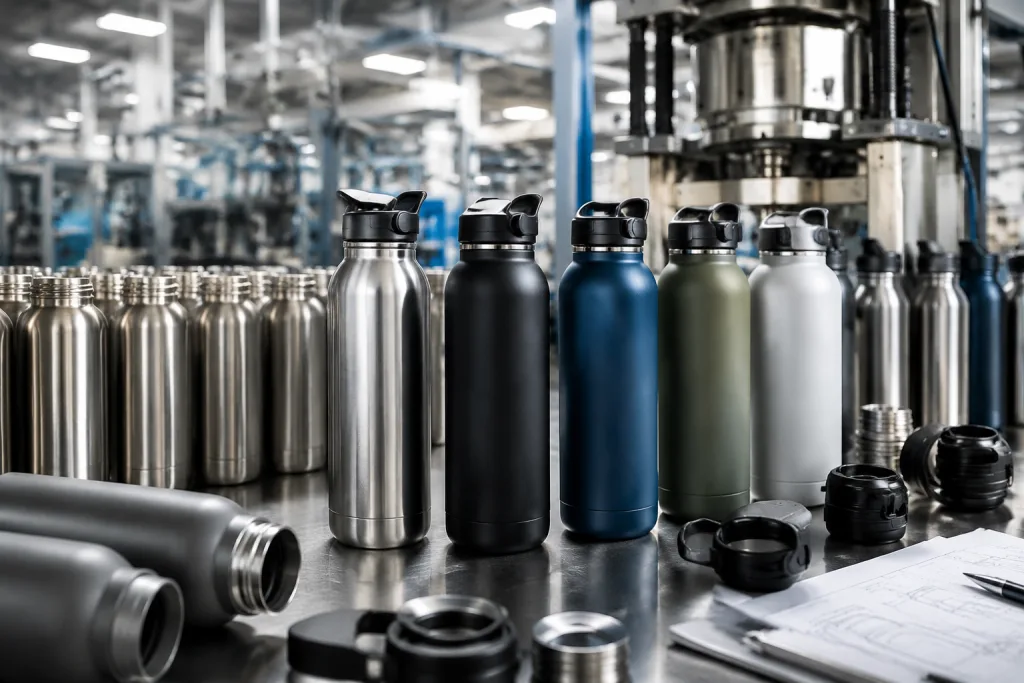
Key Takeaways
- For most launches, 3 bottle families cover 80% of gym demand: Tritan sports bottles, stainless vacuum bottles, and shaker bottles from 500-750 ml
- Typical MOQ in Zhejiang, China starts at 1,000 pcs per color for stock molds, while fully custom lids or bodies often move to 3,000-5,000 pcs
- Silk screen works for low-cost branding at about USD 0.08-0.18 per color, while laser or wrap printing suits higher-end custom gym water bottle lines
- A practical production lead time is 25-35 days after sample approval, with AQL 2.5 inspection and leak testing on 100% of assembled lids
You can buy a cheap bottle anywhere. That part is easy. The hard part is picking a gym water bottle customizable enough for your brand, tough enough for daily gym use, and still priced so the margin survives freight, logo cost, and retail box packing. We see buyers start from a nice-looking shape, then the line gets blocked by a 2.0 mm wall that feels soft, a lid hinge that fails on drop test, logo ink rubbing off after 200 dishwasher cycles, or a 5,000 pcs MOQ that does not fit a first launch. This is the wrong question to ask: “What is your cheapest bottle?” The better question is what still works after the buyer flagged leaks and breakage claims.
The practical way is to compare formats side by side: material grade, wall thickness in mm, lid structure, print limits, and carton loading. Real gym use matters. A bottle that looks clean in a render can fail fast on a treadmill shelf or in a spin studio crate. In Zhejiang, China, serious buyers usually work through it this way, with drop test data, sample comments, and carton math on the table. At BottleForge Industrial in Hangzhou, Zhejiang, we run into the same issues every month across bulk sports water bottle, custom shaker bottle, and custom fitness water bottle programs; QC pulled one sample last month because the PO had the logo position typed as 15 mm higher than the approved artwork.
The real buying decision
Sourcing a gym water bottle customizable for a fitness brand or gym chain is not a style pick. You are buying a defect rate, a freight cost per carton, a print process, and the repeat-order math behind it. New buyers often start from the render. On our line in Hangzhou, we start from use case, leak risk, and how many units fit in a 58 x 38 x 42 cm master carton.
A bottle for a premium training club is not the same item a supplement brand needs, and it is definitely not the same as a distributor gym water bottle program shipping mixed SKUs to wholesalers. A flip-top Tritan bottle works for front-desk retail because it is light, easy to carry, and often lands 18-25% lower in FOB than stainless at the same 700 ml size. A stainless custom sports water bottle fits better when the pitch is temperature retention and shelf value; the wall thickness alone changes the feel in hand. A custom logo shaker bottle or custom made shaker bottle makes more sense if users mix protein daily and need a wire whisk or mixing insert. We have seen buyers push stainless for every project, and this is the wrong question to ask.
- Front-desk gym retail: low breakage matters first, then logo visibility, then a retail-ready box. We usually check drop risk at 1.0 m and watch for scuffing on silk print samples.
- Event giveaways: unit cost has to stay tight, lead time has to move fast, and carton efficiency decides freight. A 500 ml single-wall bottle often ships 48 pcs per carton, which changes the math fast.
- Supplement brands: custom shaker bottle formats in 600-700 ml are common because users care more about mixing performance than insulation. QC pulled one sample last month where powder stuck under the lid thread, and the buyer flagged it right away.
- Distributor sports water bottle business: mold stability, repeatable colors, and packaging flexibility drive reorders. If Pantone matching drifts between runs or the PO typo swaps black lids for navy, the line slows down and claims start later.
If you are comparing a bulk fitness water bottle project against a bulk shaker bottle project, ask one blunt question first: what does the end customer do with the bottle three times a week? Lift before work, commute on the train, mix supplements after training, or carry water all day. That answer cuts spec time fast. It narrows lid style, body material, and even whether 600 ml or 750 ml is the safer buy.
Head-to-head spec table
Here’s the side-by-side table most buyers ask us for when they compare a customizable gym water bottle line. These figures are normal for stock-tooling export orders from China factories, based on runs we ship every month, not showroom samples with a 50 pcs setup hidden off the quote.
| Type | Typical Capacity | Body Spec | FOB China | MOQ | Best Fit |
|---|---|---|---|---|---|
| Tritan sports bottle | 600-1000 ml | Single wall, 0.7-0.9 mm | USD 1.60-2.80 | 1,000 pcs | Gym chains, events, entry retail |
| PP shaker bottle | 500-700 ml | Single wall, 0.8-1.2 mm | USD 0.75-1.50 | 3,000 pcs | Supplement brands, bulk shaker bottle orders |
| Stainless vacuum bottle | 500-750 ml | 18/8 inner + outer, 0.4/0.5 mm | USD 3.20-5.80 | 1,000 pcs | Premium retail, membership kits |
Now the trade-offs.
Tritan sports bottle
For a first order, this is usually the safe pick. It is BPA-free, light in hand, and color matching is more stable than buyers expect if the factory runs a proper Pantone chip check at the line. For a custom fitness water bottle used on gym floors, this format gives the cleanest cost-to-look ratio. We’ve seen 1,000 pcs trial orders go through with fewer arguments on freight, breakage, and shelf presentation. If you ask for the “cheapest bottle,” that is the wrong question to ask.
PP shaker bottle
If the end user mixes powder, use a shaker. Don’t push a standard bottle into that job. A customized shaker bottle with whisk ball or mixing grid fixes the actual use case, and supplement brands know how to sell that add-on fast. The weak point is perceived value, and QC pulled the sample more than once for resin odor when a buyer insisted on shaving cost below the safe range. We’ve seen this go sideways at 3,000 pcs if the PO only says “natural PP” and does not lock the grade.
Stainless vacuum bottle
This fits a customized sports water bottle set at USD 19.99 retail and up. Freight costs more. Decoration is less forgiving on curved surfaces, especially when the logo sits across a seam and the buyer flagged a 1.5 mm print shift on the first sample. Still, the margin is better, the gift value is stronger, and 18/8 stories are easy for distributors to sell. For fitness water bottle accounts in Europe and North America, stainless is still the simplest premium option, though the math doesn’t work for every promotion.
Use-case fit by channel
Not every bottle sells through every channel. Buyers running distributor shaker bottle or distributors fitness water bottle programs usually ask us for a 4-6 SKU ladder, while a single-brand ecommerce seller may only need 2 core items and one seasonal color.
For gym chains, the best customizable fitness water bottle is usually a 700-900 ml Tritan bottle with a carry loop, wide mouth, and one-hand lid. Members use it on the gym floor, in classes, and on the commute home. Weight matters. So does fast refill at water stations. We run these with a 55-63 mm mouth on the line because ice fill and cleaning both get easier. A bulky stainless option looks premium on the shelf, but we have seen buyers flag it after treadmill trials because it feels heavy in the cup holder.
For supplement brands, a custom made shaker bottle in 600-700 ml with embossed ounce/ml markings, a wire whisk, and a leak-resistant screw lid is usually the right call. If your team is buying a bulk gym water bottle but the end user is mixing pre-workout, complaints show up fast. Wrong product, not bad factory. QC pulled one sample last month where the lid passed drop test but the mixing result was poor, and that is the problem the buyer actually cared about.
For premium fitness brands, a custom gym water bottle in stainless, typically 550 ml or 650 ml, works best as a lifestyle product, not a pure workout bottle. Matte powder coating, laser logo, and individual box packaging support higher retail pricing. We usually ship these in 1 pc white box or color box, and the retail math does not work if you treat them like a low-price club bottle.
You do not need one hero bottle for every sales channel. You need the right bottle for each margin structure.
Typical channel matching looks like this:
- Gym chain POS: Tritan customizable sports water bottle, 700-900 ml, low to mid FOB, usually from a shared mold program.
- Protein and supplements: custom logo shaker bottle or customized shaker bottle, 600-700 ml, with clear ml/oz marks and whisk.
- Corporate wellness packs: bulk sports water bottle in stock colors with 1-color print, often 1000 pcs MOQ per color.
- Premium DTC fitness brand: custom sports water bottle in vacuum stainless, gift box optional, usually with tighter logo position checks.
- Wholesale/distributor business: standardized molds with market-specific decoration and insert cards, because one PO typo on artwork can hold the full run.
This is where China sourcing helps if your supplier has enough range. A factory running multiple bottle families can help you rationalize SKUs instead of forcing one mold into every project. That is the wrong question to ask anyway. The better question is whether the supplier can cover Tritan, shaker, and stainless without resetting your QC standard every time.
Decoration limits nobody explains
Branding sells the bottle, but decoration is where a lot of claims start. If you need a customized gym water bottle, match the logo process to the bottle surface, the abuse level, and the target cost. This is the wrong question to skip. On our line, QC usually checks first-art panels against the approved logo size before mass print, because a 2 mm shift already shows on a clean bottle wall.
For Tritan and PP bottles, standard silk screen is still the common choice. The cost is low, setup is simple, and it fits one-color or two-color graphics without pushing the unit price. Typical pricing is around USD 0.08-0.18 per color per position at production scale. The weak point is rub resistance. If bottles will be dropped into gym bags with keys, zippers, and shaker balls, do not sell it as a forever-clean print. We have seen buyers flag this after a 500-piece promo run, then the issue was not printing quality at all; it was the wrong expectation.
Heat transfer and full-wrap printing give stronger shelf impact for customizable sports water bottle designs with gradients, photo-style artwork, or full-body branding. Cost is higher, often USD 0.20-0.45 extra depending on artwork coverage. Registration is tighter too. A wrap that looks fine on a PDF can drift on a curved bottle if the fixture is off, so we normally check seam overlap and run a first-piece approval before the line goes faster.
For stainless, laser engraving is durable and clean. It fits premium custom gym water bottle and custom fitness water bottle programs better than surface print if the buyer wants low complaint risk. Powder-coated bottles can also take screen print, but adhesion and scratch resistance need checking by cross-hatch tape test and handling simulation. QC pulled one sample last month where the powder texture was too rough, and the edges of the logo started breaking after tape pull. That is why "can you print on it" is not enough.
Ask these decoration questions early
- What is the printable area in mm, not just a mockup image?
- Will the logo sit on a flat panel or a tapered panel?
- Is Pantone matching included, and what is the accepted tolerance?
- Does the bottle need dishwasher claim language? Most printed bottles should avoid that promise.
- Will the same logo method scale across future bulk gym water bottle repeat orders?
At export level, artwork approval should be tied to a physical pre-production sample, not only a PDF. We ship too many repeat programs to pretend screen position, logo size, and color read the same on paper and on the bottle. This matters more for distributor sports water bottle accounts, where one shifted logo can affect a whole market batch. We have even seen a PO typo swap left-hand and right-hand print position, and that kind of mistake gets expensive fast.
MOQ, tooling, and lead time
This is where buyers burn time. They ask for a fully customizable shaker bottle or customizable gym water bottle, then back off once they see the mold cost. In most cases, stock tooling with custom decoration is the better fit. Different math. We run both routes, and this is the wrong question to ask at the start: “Can you make it fully custom?” Ask what can stay on existing tooling first.
For stock molds, a workable MOQ is usually 1,000 pcs per color for Tritan or stainless bottles and around 3,000 pcs for shaker bottle models. Some orders can be split across 2-3 colors if the total volume still fits a carton-efficient run, such as a 24 pcs master carton without odd leftovers. At our Hangzhou, Zhejiang operation, monthly capacity is over 400,000 units across stainless, Tritan, and shaker categories, so repeat orders are easier to slot than first-time buyers think. The line is the easy part; locking artwork and packaging specs is usually what slows the first PO.
Fully custom tooling changes the economics fast. A new lid mold can cost around USD 3,000-8,000. A new body mold may go much higher depending on size and complexity. We have seen buyers push for a custom cap hinge, then drop the idea after the first 3D drawing review showed an extra 0.8 mm wall section and a longer tool trial cycle. If you only need a branded look, not patented structure, keep the tooling closed and put the budget into color, finish, packaging, and decoration. That is usually the better spend.
Lead times in China are easier to control once you split development from production. QC pulled the sample, the buyer flagged logo size, and the whole schedule moved 4 days. That happens all the time.
- Sampling from stock mold: 5-10 days
- Pre-production sample with logo: 7-12 days
- Mass production: 25-35 days after approval and deposit
- New mold development: usually 35-60 days before production timing even starts
If your launch is seasonal, especially for gym membership campaigns or January fitness pushes, back-calculate from vessel ETD, not from PO date. We have seen projects lose 12 days vs 18 days just on approval flow, depending on whether the barcode position and carton marks were confirmed in the first round. One Europe buyer even had a PO typo on the ship mark line, and we had to recheck 860 cartons before loading.
For FBA or distributor shaker bottle projects, do not forget carton drop specs, FNSKU labels, and pallet height limits. A 1.6 m pallet cap sounds minor until the buyer flagged it after packing and we had to restack. Packaging details delay shipments just as fast as production. We ship plenty of these orders, and this part goes sideways more often than the molding does.
How to control quality in China
Quality control on a bulk sports water bottle order is not hard. It has to be written down. If a supplier only says “we check before shipment,” that is not a quality plan; on our line, QC pulled the sample and matched it against a signed checklist with defect photos, carton spec, and a 1.2 m drop test note.
For a reliable custom sports water bottle or customized fitness water bottle program, lock the inspection standard before deposit, not after tooling starts. AQL 2.5 is a common standard for finished goods inspection, with tighter internal limits on leak defects because one leaking lid can kill a whole promotion. We run 100% leak testing on assembled bottles as standard, especially flip lids and shaker lids, usually with an air-pressure fixture and a 30-minute upside-down hold. For vacuum stainless bottles, random insulation testing and weld inspection should sit inside final QC; a simple check is 95°C hot water fill and temperature read after 6 hours, and we have seen bad bottom welds show up only at this stage.
Material compliance matters as much as appearance. A clean logo means nothing if the paperwork fails. For Europe, ask for REACH-related material declarations and food-contact test support where required, and make sure the report matches the exact lid resin, color, and SKU on the PO. For North America, depending on channel, you may also need ASTM-related packaging considerations or retailer-specific chemical restrictions. If you target kids or youth fitness programs, the bar goes up fast; one buyer flagged a straw odor issue on a youth bottle order even though the print and color were fine, so this is the wrong question to ask if you are only comparing unit price.
- Critical checks: leakage, odor, thread fit, lid alignment, burrs, logo position, coating adhesion.
- Document checks: carton marks, barcode scan, inner pack count, country-of-origin marking.
- Compliance checks: BPA-free claim support, stainless grade declaration, test report validity.
Good factories in Zhejiang, China usually understand BSCI, ISO-style documentation flow, and third-party inspection routines, but you still need your own approved standard with photos, tolerances, and pass/fail notes. For distributor gym water bottle and distributors shaker bottle buyers, consistency across repeat orders matters more than one clean pilot run. We ship against retained golden samples, Pantone chips, and signed logo position drawings with a ±1.5 mm print tolerance, because the buyer will notice if order one is matte navy and order three comes back gray-blue. That one habit saves months of back-and-forth later.
The shortlist that usually wins
If you need to move from research into purchasing, keep the opening range tight. Most fitness brands and gym chains launch cleanly with 3 SKUs, not 8. We have seen buyers ask for six lid styles on the first PO, and this is the wrong question to ask.
Start with a 750 ml Tritan customizable gym water bottle for general training use. Pair it with a leak-resistant lid, a carry loop, and 1-color or 2-color print. We run this as the volume piece for front-desk sales, membership bundles, and promo orders; on the line, the 1-color screen print setup is faster and scrap stays lower than full-wrap decoration.
Then add a 600-700 ml custom shaker bottle for supplements. Use ounce/ml marks, a mixing accessory, and a wide mouth that is easy to clean. If your customer base uses powder, this SKU usually sells faster than a generic bottle because the use case is obvious. QC pulled samples last quarter where the scale marks were 2 mm off center, and the buyer flagged it at once, so this item needs clean tooling. That is why bulk shaker bottle and custom logo shaker bottle projects stay active year-round.
Then add a 550-650 ml stainless custom sports water bottle for premium positioning. Keep decoration simple: powder coat plus laser logo is usually enough. The math does not work if you pile on 3 decoration techniques for a small MOQ. This bottle supports a higher MSRP and fits influencer kits, VIP memberships, and seasonal gifting; for stainless, we usually ship laser logo samples first because color approval moves faster than a full painted mockup.
If you are a distributor fitness water bottle buyer or handling distributors gym water bottle programs, this same structure also works on the commercial side. One opening-price SKU, one functional shaker SKU, one premium stainless SKU. Three molds, three price bands, and broad channel coverage. We have seen this go sideways only when a buyer mixes too many cap threads into one program and then the carton labels do not match the PO.
The target is not maximum customization. The target is higher sell-through with lower avoidable complexity. Experienced buyers sourcing in China usually stick to that logic, and that is how repeat business gets built. We ship more repeat orders from disciplined 3-SKU launches than from oversized first assortments.
Get the right gym bottle spec first
Send your target price, volume, and sales channel. We will recommend the bottle format, branding method, MOQ, and lead time that actually fit.
Frequently asked questions
What bottle type is best for a first gym water bottle customizable order?
For a first order, a 700-900 ml Tritan sports bottle is usually the safest choice. It covers the broadest gym use case, keeps FOB cost around USD 1.60-2.80, and often starts at 1,000 pcs per color from China stock molds. Compared with stainless, freight is lower. Compared with a shaker, the audience is wider. If your brand is supplement-led, then a 600-700 ml custom shaker bottle may be the better first SKU. The right choice depends on whether your customer is drinking water during training or mixing powder before and after training. Start with the actual use case, not only the visual style.
How low can MOQ go for custom gym water bottle projects?
For stock molds, 1,000 pcs per color is a realistic MOQ for many Tritan and stainless styles in Zhejiang, China. Shaker bottles are often higher, around 3,000 pcs, because lid and accessory assembly is less flexible at small runs. If you ask for a fully custom body or lid, MOQ can move to 3,000-5,000 pcs and tooling cost may add USD 3,000-8,000 or more. If your launch volume is still uncertain, use an existing mold and customize color, print, packaging, and inserts first. That gives you a custom made look without forcing full tooling economics too early.
What branding method lasts longest on a custom fitness water bottle?
Laser engraving on powder-coated stainless usually lasts the longest in real gym use. It handles abrasion better than standard screen print and looks cleaner on premium bottles. On Tritan or PP, silk screen is the lower-cost option at roughly USD 0.08-0.18 per color, but it will show wear sooner if bottles are thrown into gym bags daily. Heat transfer or wrap decoration gives stronger visual impact, usually adding about USD 0.20-0.45, but durability depends on surface prep and handling. If durability is a priority, ask for adhesion testing, a physical sample, and honest care instructions instead of broad dishwasher claims.
What quality checks should I require before shipment?
At minimum, require 100% leak testing on assembled lids, AQL 2.5 final inspection, logo position checks, and packaging verification. For shaker bottles, also check thread fit, mixing accessory count, and odor level after assembly. For stainless vacuum bottles, request random insulation testing plus finish and weld review. On the compliance side, ask for BPA-free support documents, stainless grade declaration such as 18/8, and food-contact testing support when needed for your market. Good buyers also approve a golden sample before production and keep that sample for repeat-order comparison. That is especially important for distributor sports water bottle and distributor shaker bottle business.
How long does production usually take from sample approval?
For stock-mold projects, mass production usually takes 25-35 days after final sample approval and deposit. Sampling itself is often 5-10 days, and a logo sample can take another 7-12 days depending on decoration. If you need new tooling, add roughly 35-60 days before standard production timing starts. Shipping time is separate, so buyers in Europe and North America should plan backward from required arrival date, not PO date. If your order includes retail boxes, FNSKU labels, or mixed SKUs for gym chains, allow a few extra days for packaging confirmation. Most delays come from artwork and packaging approvals, not actual molding.