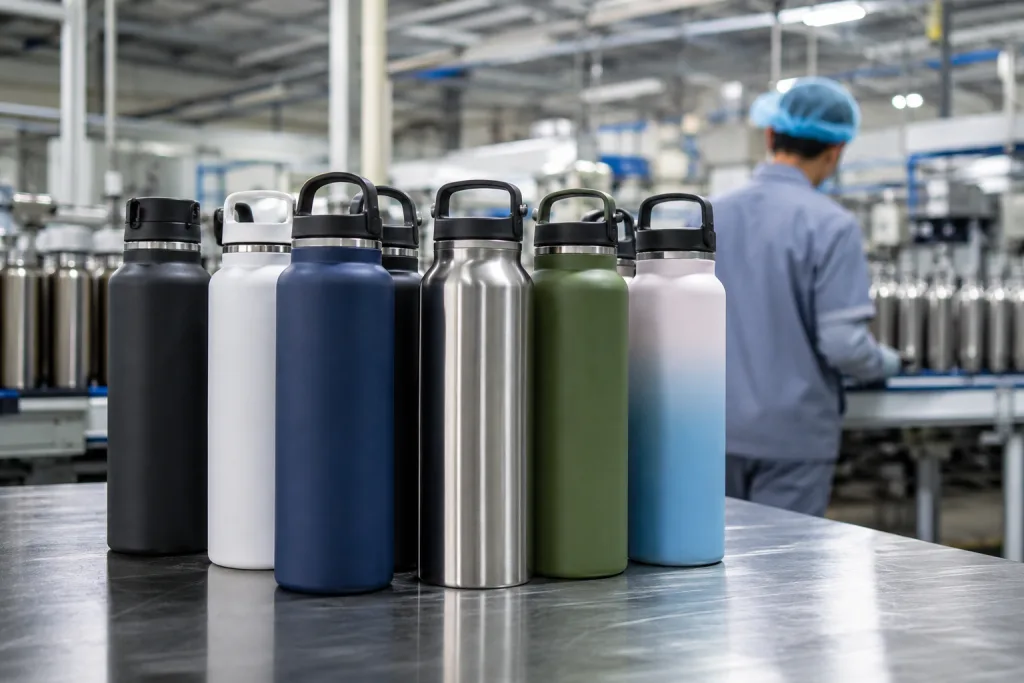
Key Takeaways
- For most gym water bottle custom programs, MOQ starts at 1,000-3,000 pcs per color, with logo setup from USD 80-150 and unit pricing from about USD 1.20 to 6.80 FOB China.
- A 700-900 ml single-wall Tritan or PE sports bottle usually gives the best cost-to-volume ratio for bulk fitness water bottle and bulk sports water bottle promotions.
- Stainless vacuum bottles reduce condensation and improve premium retail value, but add 25-40% carton weight and typically need 35-45 days lead time.
- For shaker projects, choose leak-tested lids and 18/8 or PP component compatibility first; custom logo shaker bottle complaints are usually lid-related, not body-related.
You are not buying a bottle. You are buying margin, member experience, and return risk. For fitness brands and gym chains, a gym water bottle custom project often starts with the wrong question: stainless, Tritan, or shaker. On the line, that choice is only step one. The trouble shows up after the PO lands—leak complaints at 1.2 m drop test, odor retention after protein use, logo wear after 300 dishwasher cycles, and carton loading that misses the target by 8 pcs per master carton.
The better way to source in China is side-by-side sampling, not catalog photos. In Zhejiang, we usually see buyers run 3 or 4 bottle platforms against real use cases: front-desk retail, welcome kits, supplement bundles, or distributor gym water bottle programs. QC pulled samples last month where the buyer flagged a lid fit issue at 0.5 mm tolerance, and that is exactly why this goes sideways if the spec table is weak. If you want repeatable margins, ask for the right spec table, a realistic MOQ like 1,000 or 3,000 pcs, and a factory in China that ships in 12 days vs 18 days without letting QC slide.
Start with the use case
The costliest sourcing mistake is picking the bottle first and asking where it will go later. A custom gym water bottle for a chain welcome pack is a different SKU from a custom sports water bottle for retail shelves, and it is not the same as a custom shaker bottle packed with protein powder. We’ve seen this go sideways: the buyer approved a 750 ml body, then flagged the shelf depth after the sample reached their store. If the use case is off, the math doesn’t work.
For fitness brands and gym chains, we usually split demand into four working lanes. This part needs to be clear before the first sample goes on the line.
- Front-desk resale: cleaner decoration, tighter complaint control, target FOB often USD 2.50-6.80. Buyers in this lane usually ask for better print edge quality, and QC pulled the sample before mass run if the logo shifted more than 1 mm.
- Membership onboarding: hard budget cap, larger volume, target FOB often USD 1.20-3.20. MOQ pressure starts here fast, usually 3,000-5,000 pcs per color.
- Supplement bundle: shaker format, printed measurement marks, target FOB often USD 1.10-2.40. The common pushback is leak risk around the flip cap and fit of the mixer ball or grid insert.
- Distributor programs: repeat SKUs with fewer surprises, and carton loading matters more than a new shape. We often check outer carton drop performance first because one crushed corner can trigger complaints across 200 stores.
A bulk gym water bottle order for a gym chain usually runs better with simple tooling, common lid threads, and 600-750 ml capacity. A bulk shaker bottle for e-commerce subscriptions needs tighter leak control and consistent fit for the mixer ball or grid insert; we normally check thread engagement by hand on the line and then do a 30-minute inverted test. A custom fitness water bottle for a premium studio can carry double-wall stainless and powder coating, since the shelf price has room for it. This is the wrong question to ask if you start from color first.
In Zhejiang, China, buyers who lock the use case first usually cut sampling from 3-4 cycles to 1-2. That saves 10-14 days. We ship faster because the mold choice, print method, and carton split get fixed early, not argued over after the second sample. If your target is a customizable gym water bottle line for multiple locations, decide up front whether every branch uses one SKU or you need variable logo runs. That changes MOQ, print process, and carton split planning on day one; we had one PO last quarter with the branch code typed wrong, and it forced a relabel check across 1,200 pcs.
Set your price ceiling, complaint tolerance, and sales channel first, then talk about color chips or packaging.
Spec table: bottle types head to head
This is the comparison most buyers ask for first on a gym water bottle custom project. Start with target margin and freight cost, then check how the bottle gets used on the gym floor. We’ve seen buyers chase the wrong spec, then QC pulled the sample and the grip feel was off after one treadmill session.
Main options compared
- Single-wall Tritan sports bottle: 650-850 ml, body wall 0.7-0.9 mm, FOB USD 1.80-3.20, MOQ 1,000-2,000 pcs.
- Single-wall PE squeeze bottle: 500-750 ml, wall 0.6-0.8 mm, FOB USD 1.20-2.10, MOQ 3,000 pcs.
- Double-wall stainless bottle: 500-750 ml, inner 18/8 with 0.4 mm inner and 0.5 mm outer wall typical, FOB USD 3.80-6.80, MOQ 1,000 pcs.
- PP shaker bottle: 600-800 ml, wall 0.8-1.0 mm, FOB USD 1.10-2.00, MOQ 2,000-3,000 pcs.
For a bulk sports water bottle used in events or chain-wide promotions, PE and Tritan usually make the math work. A 40HQ load carries more units, and landed cost stays under control. If the brief is a customized sports water bottle with stronger gift value, stainless is the safer call, even with the higher FOB. For a custom made shaker bottle, PP is still the standard because the lid fit is stable on the injection line, and we run that combo every week.
Perceived value is not a small issue. A customizable fitness water bottle in Tritan usually looks cleaner on shelf than a soft squeeze bottle, especially in clear smoke or matched Pantone colors. A customizable shaker bottle sends a supplement signal right away. Some yoga buyers flagged that as too aggressive; one training-chain client asked for the shaker ball to be packed loose in a 0.04 mm PE bag because members expected it.
At BottleForge Industrial in Hangzhou, Zhejiang, typical output for sports and shaker programs can reach 300,000 units per month across standard lines, but each SKU runs at a different pace. Standard molds move fast. A fresh lid tool, custom color matching, or a silicone insert will slow the line, and we’ve seen this go sideways when the PO had one cap color typo. In China sourcing, the bottle body is rarely the bottleneck. Lids, screen printing registration within 1.5 mm, and gift-box packing are usually what push lead time from 12 days to 18 days.
Which format fits your buyers
Fitness buyers ask for “the best bottle,” but that is the wrong question to ask. We usually split it into 4 buying channels on our side of the line. For end-user retail, a customized gym water bottle needs good hand feel, easy cleaning, and no sharp mold parting line at the grip area. For a distributor fitness water bottle program, the buyer usually pushes on repeatability, carton count, and damage rate in transit. For supplement brands, shaker performance comes first. QC pulled a sample last month because the lid torque was fine, but the mixer grid rattled after 200 shake cycles.
- Gym chains: choose 650-750 ml Tritan or stainless with carry loop and one-hand lid. We run this format a lot because front-desk resale needs simple SKUs.
- Fitness e-commerce brands: choose 700-900 ml, strong branding area, and mail-safe packaging. Ask for a drop test standard, not just “good packing.”
- Supplement brands: choose 600-700 ml PP or stainless shaker with mixer grid and leak-tested cap. Mouth diameter around 85-90 mm works better for powder loading.
- Wholesale and distributor programs: avoid risky novelty shapes and use stack-efficient bodies. The math doesn’t work if the bottle looks unique but ships 18% fewer units per carton.
A bulk fitness water bottle project for 50 gym locations usually runs better with 2 body colors and 1 lid family, not 8 colors and 3 lid styles. We’ve seen this go sideways. One PO even had a lid color typo that created 600 pcs of slow stock. A distributor gym water bottle buyer in Europe may ask for multilingual carton marks, EAN label control, and outer carton weight under 15 kg. A distributor sports water bottle buyer in North America often checks pallet height, FNSKU placement, and Amazon FBA prep before they approve the sample.
For shaker lines, the split is simpler. A customized shaker bottle for protein brands should prioritize scale marks, wide mouth diameter around 85-90 mm, and verified leak testing under filled, shaken conditions. We test with water fill, 10 hard shakes, then cap-down hold for 30 minutes. A custom logo shaker bottle for merch programs can give up some mixing performance if the bottle is mainly a promo item, but make that call on purpose. If the buyer flagged clumping before, do not pretend a basic insert will fix it.
We also see a clear gap between distributors fitness water bottle programs and direct-to-brand orders. Distributors usually want lower-risk evergreen SKUs with broad appeal, stable carton dimensions, and fewer finish options; 3 Pantone-heavy variants at MOQ 3,000 each is where stock starts to hurt. Brand owners often accept a higher unit cost to get a more distinctive customizable sports water bottle, like a deboss logo panel or a custom loop color. Neither approach is wrong. The spec just needs to fit the channel.
Branding methods that survive gym use
Gym use beats up decoration fast. Bottles get dropped from benches, run through wash cycles, scraped on steel racks, and jammed into car cup holders. If you are ordering a custom gym water bottle or customized fitness water bottle, print method is not a side detail. On our line, QC pulled samples with logo wear after 200 bag-rub cycles, while the bottle body was still fine.
The common options are:
- Silkscreen: lowest cost, usually USD 0.05-0.12 per color per position, good for simple logos on PE, PP, and stainless.
- Heat transfer: better for multi-color graphics, usually USD 0.12-0.30, but adhesion quality depends on surface prep.
- Laser engraving: ideal for stainless, premium look, usually USD 0.10-0.25.
- Digital print: useful for short runs or complex artwork, but not always the toughest option for heavy abrasion.
For a custom fitness water bottle carried in gym bags, powder-coated stainless with laser logo is the safest mainstream choice. We ship this combo every month because it takes abuse better than most printed finishes. For a customizable gym water bottle in Tritan, one-color silkscreen usually gives the cleanest commercial result at scale, especially on straight-wall bottles where the screen stays stable within about 0.5 mm registration. Full-wrap graphics look good in approval photos. Then the buyer flagged one hairline scratch, and the claim started. We have seen this go sideways.
On shaker lines, lid printing is the wrong place for the logo because that area gets the most hand friction and cap-to-cap rubbing in carton packing. Put the logo on the body if the mold layout allows it. If you want a custom made shaker bottle with gradient color effects or translucent body matching, ask for pre-production color samples under D65 light reference and natural light. We normally check both at the sample table before sign-off. China factories can match Pantone closely, but translucent resin always shifts slightly based on wall thickness, whether the body is 2.2 mm or 2.8 mm.
In Zhejiang production, the safest commercial route is usually one logo position, one approved Pantone family, and one abrasion test standard agreed before mass production. This sounds conservative, but the math works. If you are a distributors shaker bottle buyer supplying multiple resellers, that discipline cuts later arguments. We have had POs with a color typo on the lid callout, and that alone delayed sample approval by 3 days. Overcomplicated artwork usually shows up as slower approval, higher reject rate on the line, and more rework at packing.
Compliance, QC, and defect control
If your bottles are going into Europe or North America, compliance is part of the sourcing spec, not a sales slide. For a customized sports water bottle or customized gym water bottle, ask about food-contact testing, resin traceability, and line control before deposit. We have seen buyers wait until the PI is signed, then ask for LFGB, and the schedule slips 9 days while QC pulls retained samples from the shelf.
The baseline paperwork is usually clear. EU buyers ask for REACH-related declarations and, where the product calls for it, LFGB or other food-contact test reports. US buyers often ask about California Proposition 65. For kids-oriented styles, ASTM-related points can come into play. BSCI and ISO 9001 are good factory documents, but this is the wrong question to ask if you stop there; an audit report does not tell you whether the pink lid on PO #BT-2147 has odor after molding or whether the print survives the rub test.
On inspection, practical buyers set AQL before production starts, not after the first claim. A common standard for drinkware export is AQL 2.5 for major defects and 4.0 for minor defects. On gym bottle programs, major defects usually mean leaking, cracked lids, wrong print, wrong color, or contamination inside the bottle. Minor defects are lighter issues, like a 3 mm surface mark outside the agreed visual zone. We run this by lot number, and the buyer flagged it more than once when the visual standard was never signed.
You should also define functional checks:
- Leak test: 100% inline or sampling by lot, especially for shaker lids. On flip-top caps, we often use a 30-minute inverted hold on the line.
- Drop test: packed sample drop at 76 cm or agreed carton standard. Carton corner damage matters as much as bottle breakage.
- Dishwasher claim: only if the material and print process support it. The math does not work if a buyer wants low-cost silk print and a dishwasher-safe claim on the same bottle.
- Odor check: important for PP and PE bottles after production. QC pulled the sample right off the sealing table before boxing for this one.
At our Hangzhou operation in Zhejiang, China, standard lead time is often 25-35 days for repeat Tritan or PE orders and 35-45 days for stainless or shaker projects with custom packaging. That timing is real only if artwork, test requirements, and carton spec are frozen early. We ship faster on repeats because the screen, mold setup sheet, and carton marks are already locked. A lot of delays blamed on China come from buyer-side changes after sampling, like a revised logo file, a barcode digit typo, or a carton size change after the cutter guide is approved.
If you are working with distributor shaker bottle or distributor sports water bottle programs, insist on master carton photos, barcode verification, and a final inspection report before balance payment. Better yet, ask for the scan record from the barcode gun and front/back carton shots. We have seen this go sideways when the outer mark matched the PO, but the inner units carried the old label version.
Cost drivers buyers usually miss
Most first-time buyers stare at piece price and miss the costs that decide landed margin. In a gym water bottle custom project, the gap between a clean rollout and a weak one usually sits outside the bottle. We see this on the line all the time: a PO looks fine at USD 3.20, then the outer carton jumps from 12 kg to 16 kg after packing changes and the margin is gone.
The cost drivers buyers miss most are packaging, freight cube, and SKU count. A 750 ml stainless bottle in an individual gift box can take 2-3 times the carton volume of a simple bulk sports water bottle packed in egg-crate dividers. We run cube checks before mass production, and a gift box that adds 18 mm on each side can cut pallet efficiency fast. If the program is price-sensitive, gift boxes need a retail reason. Otherwise the math doesn't work.
- Mold changes: new lid tooling can add USD 2,000-6,000 and 20-30 days.
- Color variety: each extra body or lid color may trigger MOQ per color and slower packing.
- Packaging upgrades: color boxes add direct cost and reduce carton efficiency.
- Inspection and testing: cheap compared with one full claim, but still part of the budget.
A bulk gym water bottle order for a 100-location chain should be built for repeat replenishment. That means standard mailer or white box, shared lid parts, and reorder rules the next buyer can follow without calling six people. QC pulled one sample last month where the branch code on the label was off by one digit, and that kind of small version split creates big restock pain. A customizable sports water bottle with 12 branch-specific versions looks smart at launch and ugly at reorder. We've seen this go sideways.
For supplement companies buying a bulk shaker bottle, check the insert choice early. Stainless mixer balls, plastic grids, and integrated agitators do not fail the same way, and buyers push back hard once complaint photos start coming in. We had one case where the buyer flagged a loose-fit grid at 1.5 mm play inside the cup; the insert was cheap, but repacking and replacements were not. If you are buying for distributors gym water bottle or distributors shaker bottle channels, ask for a cost split by bottle, print, packing, and pallet load. This is the right question to ask because margin usually leaks from the pack-out, not the steel.
The simple rule is this: the best customizable fitness water bottle is not the one with the longest feature list. It is the one the end customer uses for 6 months without a complaint and the one you can reorder from China at the same spec 90 days later. Same lid, same print position, same carton count. That is what scales.
How to brief a factory properly
If you want a fast, accurate quote on a custom sports water bottle or customized fitness water bottle, your RFQ needs more than a logo file and a rough idea. We see this every week. The buyer sends one AI file, then the line stops on basic questions: 600 ml or 750 ml, single-wall or double-wall, screen print or heat transfer, white box or color box. A clear brief cuts back-and-forth and gives you cleaner numbers on MOQ, sampling, and lead time.
A workable RFQ should include capacity, target retail channel, material preference, decoration method, packaging type, compliance market, and order forecast. Do not just say you need a customized gym water bottle. That is too loose. Say you need, for example, a 700 ml Tritan body, flip lid with carry loop, one-color silkscreen, packed 1 pc/polybag/white box, 5,000 pcs initial order, FOB Ningbo, target ship date in 40 days. If you know bottle diameter or height, add that too—2 mm can decide whether an existing mold works or you pay new tooling. This is the wrong question to ask: “What is your best price?” First lock the spec, then ask price.
For shaker projects, specify whether you need a custom shaker bottle with mixer ball, grid, or no insert; whether ounce and milliliter marks are required; and whether the bottle is intended for cold use only. If you are a distributor fitness water bottle or distributors fitness water bottle account supplying multiple customers, also request plain-pack options and generic carton marks for easier allocation. We ship these mixed programs all the time. One PO even had “grey” and “gray” split as two items, and the buyer flagged it only after carton labels were printed. Put carton mark wording in the RFQ if you run multi-customer stock.
- Ask for: MOQ by color, sample charge, tooling cost, production lead time, carton size, GW/NW, and loading qty per 20GP and 40HQ.
- Confirm: leak test method, print adhesion standard, and AQL criteria.
- Request: compliance documents before deposit, not after shipment booking.
China factories can move quickly when your brief is specific. In Zhejiang, it is realistic to get standard sample feedback in 3-7 days and pre-production samples in 7-12 days depending on printing and packaging. On our side, QC pulled the sample after a 1-meter drop test and lid torque check before we sent photos. If your target is a premium custom logo shaker bottle or stainless custom sports water bottle, give extra time for coating and decoration approval. A powder-coated body with laser logo is not the same schedule as a stock-color Tritan bottle: 12 days vs 18 days is normal. Freeze the spec once. We have seen this go sideways when buyers change print position after sample approval, and the math doesn't work in their original ship window.
Get your gym bottle spec reviewed now
Send your target price, quantity, and use case. We will suggest the right sports or shaker platform from Zhejiang production with practical MOQ and lead time.
Frequently asked questions
What is a realistic MOQ for gym water bottle custom orders?
For standard models, a realistic MOQ is usually 1,000 pcs for stainless vacuum bottles, 1,000-2,000 pcs for Tritan bottles, and 2,000-3,000 pcs for PP or PE shaker and squeeze bottles. The real limit is often color, not just total quantity. A factory may accept 3,000 pcs total, but still require 1,000 pcs per body color and 500-1,000 pcs per lid color. If you want custom packaging, the MOQ for boxes can add another 1,000-3,000 sets. In China, lower MOQs are possible for stock colors and simple one-color logos, but the FOB price usually rises by 8-15% because production efficiency drops.
Which bottle type is best for a gym chain membership giveaway?
For most gym chains, a 650-750 ml single-wall Tritan or PE bottle gives the best balance of cost, weight, and daily usability. If your target landed cost is tight, PE squeeze bottles can work around USD 1.20-2.10 FOB. If you want a cleaner premium look, Tritan at roughly USD 1.80-3.20 FOB is usually the better choice. Stainless only makes sense when the bottle is part of a higher-value welcome kit or retail upsell. For chain rollouts across 20 or more locations, keep to 1-2 body colors and one lid family. That reduces dead stock, simplifies replenishment, and usually cuts packing errors by a noticeable margin.
How do I choose between a custom gym water bottle and a custom shaker bottle?
Choose based on user behavior, not trend. A custom gym water bottle is better for general hydration, member gifts, studio retail, and broad brand appeal. A custom shaker bottle is better if your brand sells protein, pre-workout, or recovery products. Shaker bottles usually run 600-800 ml, often in PP, and need stronger leak control because users shake aggressively. Water bottles are simpler, usually lower complaint risk, and easier to sell across mixed fitness audiences. If more than 30% of your customers buy supplements from you, a shaker can make sense. If the bottle is mainly merch or a welcome item, a standard sports bottle is usually safer and easier to reorder.
What compliance documents should I ask from a China bottle factory?
For Europe, start with food-contact compliance support such as LFGB-related or relevant material test reports, plus REACH-related declarations where applicable. For North America, ask about Proposition 65 awareness and any market-specific food-contact test history. Also request factory-level documents like BSCI or ISO 9001 if your procurement policy requires them, but do not treat audits as product compliance. For each program, confirm exactly which SKU, color, print, and component set the test report covers. Reports on a different lid or resin grade are not enough. If you are importing from Zhejiang or other China regions regularly, standardize this checklist before sampling so you do not lose 1-2 weeks chasing paperwork later.
How long does production usually take for bulk sports and shaker bottles?
For repeat orders on standard molds, production is commonly 25-35 days after deposit and artwork approval for Tritan, PE, and simpler PP styles. Stainless vacuum bottles and more complex shaker programs usually need 35-45 days, especially if powder coating, laser marking, or custom gift boxes are involved. Sampling often takes 3-7 days for stock samples and 7-12 days for pre-production samples with print. Add time if you need new tooling, third-party lab testing, or split shipments. The biggest delay factor is usually not factory capacity. It is late approval of artwork, carton marks, or packaging details. Freeze the spec early if you need reliable shipping dates.