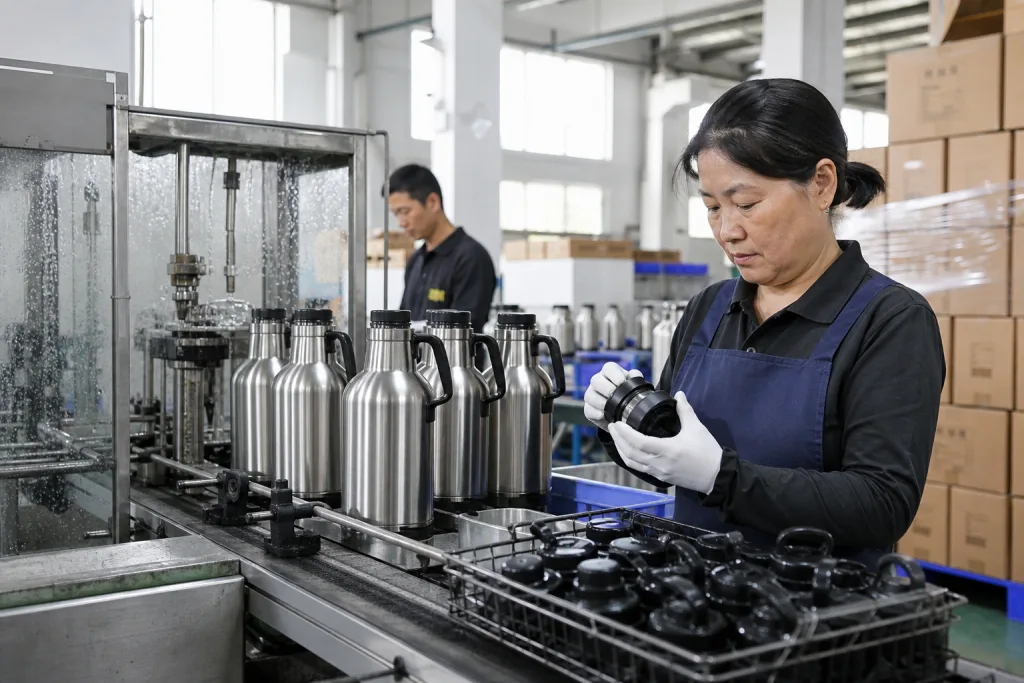
Key Takeaways
- A practical growler wholesale MOQ is usually 1,000-3,000 pcs per color for custom finishes
- 64 oz stainless growlers typically use 0.5-0.6 mm inner steel and 0.4-0.5 mm outer steel
- FOB China price gaps of USD 1.00-2.50 often come from cap design, vacuum yield, and carton spec
- Confirm AQL, REACH/LFGB/FDA needs, and 24-hour leak testing before paying the deposit
Growler wholesale looks simple until the first 2 quotes land. One supplier offers a 64 oz stainless growler at USD 5.20 FOB Ningbo. Another quotes USD 7.80 with the same photo. The gap is not just margin. On the line, we check 304 stainless with an XRF gun, wall thickness with a 0.01 mm micrometer, cap thread fit, vacuum yield, carton drop protection, and whether the factory counts a pinhole weld mark as a defect or waves it through.
If you buy bulk drinkware for retail, brewery merchandising, corporate gifts, or outdoor channels, asking “what is your best price?” is the wrong first question. BottleForge Industrial ships from Hangzhou, Zhejiang, and we see the same China sourcing mistakes about 30 times a season: vague drawings, no AQL agreement, weak leak testing, and packaging built for a warehouse instead of a parcel network. QC pulled one growler sample last month after a buyer flagged wet master cartons; the inner cap gasket was 0.4 mm undersized, and the math on returns did not work.
What are you really buying?
A growler is not just a large bottle. For procurement, it sits between drinkware bulk, brewery packaging, and outdoor hydration, so define the use before you argue over capacity. A beer growler wholesale project for taproom refills needs carbonation retention, low odor pickup, and a cap that still seals after 500 open-close cycles on the thread gauge. A camping bulk canteen line needs dent resistance, handle comfort, and caps that clip cleanly to a 6 mm carabiner. A gift-channel wholesale growler is more about finish, logo position, and whether the retail box survives a 12 kg carton stack. We saw this go sideways once: the buyer approved a photo, then flagged the first pre-production sample because the handle knocked against the body during a shake test.
Most B2B buyers ask for 32 oz, 40 oz, or 64 oz. For stainless growler bulk, 64 oz is still the most common commercial size; we run more tooling checks on that body than the smaller sizes. The usual construction is double-wall 304 stainless steel, vacuum insulated, with a PP or stainless-lined cap and silicone gasket. For markets in Europe and North America, specify food-contact compliance at RFQ stage: FDA for the U.S., LFGB or EU 1935/2004 for Europe, and REACH for coating or surface materials when applicable. QC pulled a 64 oz sample last month where the gasket looked fine by eye, but the Shore A reading was 52 instead of the requested 60, and the cap leaked after pressure testing.
Do not send only a product photo and ask for “best price.” That is the wrong question to ask. A factory in Zhejiang, China can quote three different versions from the same image, and the cheap one will usually hide in steel thickness, cap lining, or coating grade. We once received a PO that said “SUS304 inner / SUS210 outer”; that typo cost two days of email checking before the line could book material. Ask for:
- Capacity by brimful and usable fill, such as 1,900 ml brimful for a 64 oz model, with the test method stated
- Steel grade, usually SUS304 inside and SUS304 or SUS201 outside depending on budget, plus the requested mill sheet
- Inner and outer wall thickness, for example 0.5 mm inner and 0.45 mm outer, checked with a micrometer after cutting
- Cap material, gasket hardness, thread type, and whether the cap is tethered
- Finish type: powder coating, spray paint, electro-polish, brushed steel, or laser engraving, with logo size in mm
If the supplier avoids these points, the quote is not ready for comparison. It is just a number, and the math does not work once sampling, rework, and carton failures start showing up.
RFQ checklist before price negotiation
Your RFQ should read like a small technical file, not a one-line “send best price” email. This protects you when comparing canteen wholesale specs against beer tumbler wholesale and growler wholesale suppliers in China. We’ve seen this go sideways: after deposit, QC pulled the sample and found the liner changed from 304 stainless to a lower-cost option because the RFQ never named the steel grade.
Start with commercial basics. State annual forecast, first order quantity, target ship date, destination port, and selling channel; a brewery gift pack and an Amazon carton do not run the same packing line. For BottleForge Industrial, a normal MOQ is 1,000 pcs for an existing mold with one standard color, 3,000 pcs for a custom powder color, and 5,000-10,000 pcs if you need a new cap or body tooling. Our Zhejiang production partners run around 350,000 stainless drinkware units/month across bottles, tumblers, and growlers during regular season, but capacity gets tight before Q3 promotional shipments. Last June, one PO typed “Ningbo” in the header and “Shanghai” in the shipping marks, which cost the buyer 2 days of paperwork before booking.
Then lock the product variables. A wholesale canteen for hiking and a beer growler in bulk for brewery resale may look close, but they should not share the same cap without review. Beer users complain fast about leaks, metallic odor, and poor pour angle; outdoor users care more about dents, strap feel, and whether a 64 oz body fits a side pocket. The buyer flagged it. If you also source alcohol flask bulk or alcohol flask wholesale bulk, do not assume the same food-contact test package covers growlers, because coatings, gaskets, and inner surface area change the test cost and timing. On the bench, we check cap fit with a thread gauge and do a 100% water leak spot check on new gasket lots before the line scales up.
Use this RFQ checklist:
- Capacity: 32 oz, 40 oz, 64 oz, or metric equivalent; confirm fill line, brimful volume, and carton weight if freight cost is tight
- Insulation target: 12 hours hot / 24 hours cold, or your own test method with starting water temperature, room temperature, and pass/fail limit
- Logo: laser engraving, silk screen, heat transfer, embossing, or full-wrap print; send Pantone code, logo size in mm, and artwork format
- Packaging: plain white box, color box, kraft box, or e-commerce drop-test carton; tell us if you need 1.2 m drop test or mailer packing
- Inspection: AQL level, critical defects at 0, and acceptable cosmetic limit; define scratch length, dent size, and logo offset in mm
- Trade terms: FOB Ningbo/Shanghai, EXW Hangzhou, or CIF destination; name the port, forwarder, and whether batteries or inserts are packed together
Once these are fixed, price negotiation becomes practical. The wrong question is “how cheap can you make it?” Ask which spec changes move cost by USD 0.20, which ones risk claims, and which ones add 12 days instead of 18 days to the schedule.
What should a fair price include?
A workable wholesale growler quote should break out unit price, tooling, sample charge, packaging, testing, and freight basis. One line is a trap. If the buyer changes from a screw cap to a swing cap, adds a 350 gsm retail sleeve, or moves from laser logo to powder coating plus screen print, we need to see which cost moved. Last month QC pulled the sample after the PO said “black lid” but the artwork file showed silver; a clean quote saved 2 days of back-and-forth.
As a rough export reference, a 64 oz double-wall stainless growler in drinkware wholesale volume often lands between USD 5.50 and USD 9.50 FOB China, depending on steel, finish, cap, carton, and inspection requirements. A basic stainless finish with laser logo is cheaper. A matte powder coat with custom Pantone, stainless-lined swing cap, individual color box, and ISTA-style carton protection costs more. Beer growler wholesale bulk projects for breweries usually sit in the middle, unless they ask for premium caps or gift packaging. On our line, a color box adds roughly 35-45 g paper weight per unit and slows packing from about 900 pcs/hour to 650 pcs/hour.
Be careful when a quote is lower by USD 1.00 or more. The math usually does not work. We have seen it go sideways through 0.38 mm outer steel, SUS201 outside not disclosed, single-wall bottles sold as insulated, soft gaskets that smell after hot-water testing, skipped vacuum checks, or cartons below 5-ply strength. A low price can pass for a 1-day local event giveaway. It is the wrong question for retail returns or Amazon-style parcel movement.
Ask the supplier to confirm what is included in the quoted FOB price: logo setup, export carton, inner box, polybag, desiccant, spare gasket, and third-party test support. We normally mark these items on the PI line by line, because one missing spare gasket bag can hold a 3,000 pcs shipment at final inspection.
For bulk growler and beer tumbler in bulk programs, check whether barcode labels, FNSKU labels, suffocation warning bags, or master carton marks are included. These small items can add USD 0.05-0.25 per unit and several days to lead time. Price them before production starts. We ship cleaner that way, and the warehouse team does not need to relabel 80 master cartons because the buyer flagged a 1-digit SKU typo.
How do you control quality?
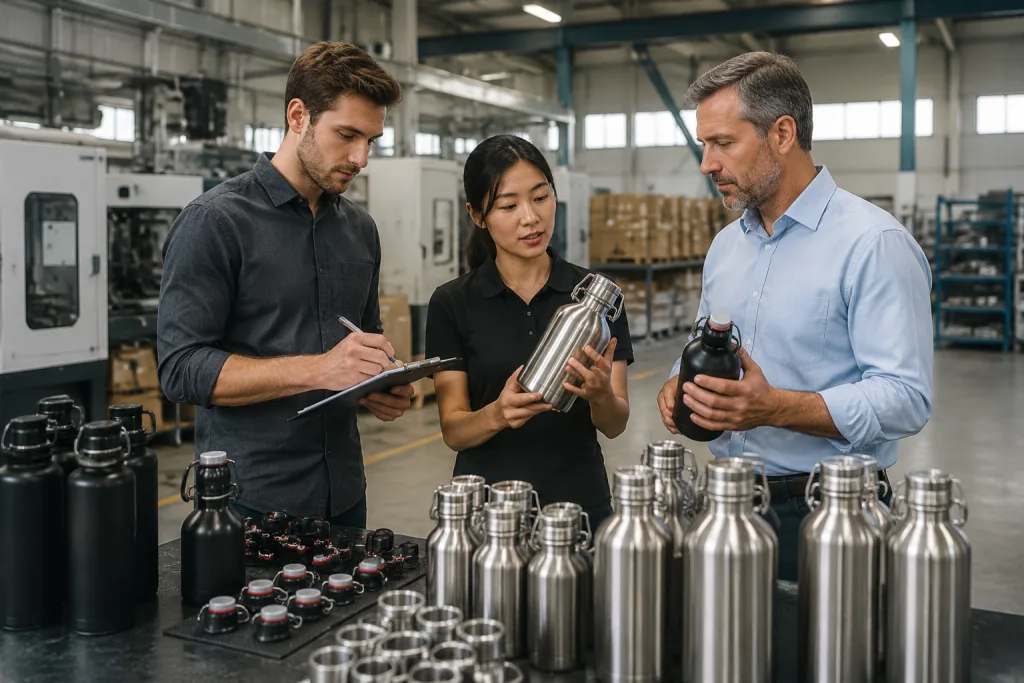
Quality control for growler wholesale starts before the first body hits the polishing line. Final inspection is too late; the risk is already welded, coated, packed, or printed into the order. We run incoming 304 stainless thickness checks with a micrometer, then in-process vacuum checks, cap assembly torque checks, and finished goods inspection. For most drinkware bulk orders, use pre-production samples approved in writing, then AQL inspection before balance payment. Get the approval name on the sample card. We once had a buyer flag a logo because the PO said “matte black” but the artwork file said “satin black.” Small typo, big argument.
A typical AQL plan for wholesale drinkware is General Inspection Level II, with AQL 0 for critical defects, 2.5 for major defects, and 4.0 for minor defects. Critical defects include sharp edges, contamination, broken glass when an accessory is included, severe leakage, and packaging that can injure warehouse staff. Major defects include poor vacuum performance, wrong logo, color mismatch over the signed tolerance, cap thread failure, and visible dents over 1.5 mm on the front face. Minor defects include small specks under 0.3 mm, light hairline scratches outside the logo area, or carton print variation within the approved limit. QC pulled the sample from line 3 last month and found 7 lids with gasket flash; the cartons looked fine, but the caps failed the hand-tight leak check.
For stainless growlers, test these points before shipment:
- Leak test: Fill, invert, and shake for 30 seconds; for beer growler bulk orders, add pressure simulation where cap design allows
- Vacuum test: Use hot water or a thermal imaging check after 3 minutes to catch failed insulation
- Odor test: Check the cap gasket and inner steel separately, then confirm no residual drawing oil after washing
- Coating adhesion: Run a cross-hatch or 3M tape test on powder-coated surfaces before packing starts
- Drop test: Carton drop from 76 cm or buyer-specified height for e-commerce, with the filled carton at actual gross weight
Factories in China are not equal on inspection discipline. A glossy showroom proves almost nothing. Ask for inspection photos from the production line, not finished marketing images shot under soft lights. If you are buying the best wholesale drink bottle for a serious retail program, pay for a third-party inspection when the order value supports it. The math doesn’t work if you save USD 180 on inspection and replace 2,000 leaking units later. We’ve seen this go sideways: one loose cap insert, 46 cartons reworked, shipment pushed from 12 days to 18 days.
Which logo method fits growlers?
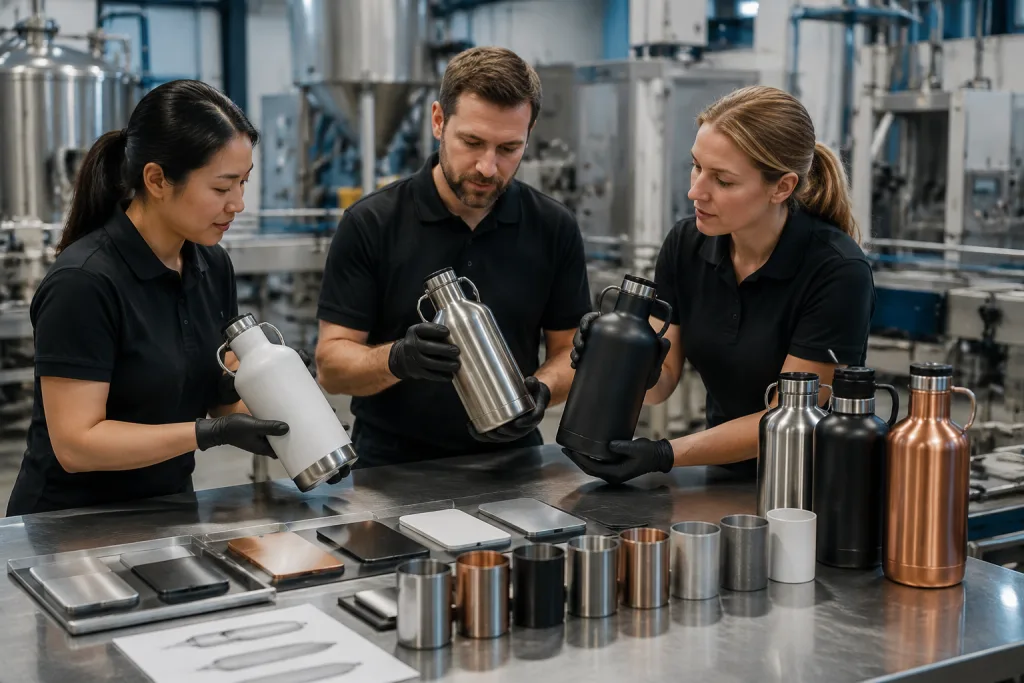
Logo choice changes the look and the reject rate. For growler wholesale, we usually steer stainless steel jobs to laser engraving. It has no ink migration, holds up against abrasion, and suits brewery logos and outdoor brand marks better than most print methods. QC still checks depth and placement with a 0.02 mm caliper gauge, because a logo sitting 3 mm off-center gets flagged fast. The limit is color: laser gives a metal tone, not a bright Pantone match.
Silk screen makes sense for simple one- or two-color artwork on powder coating. It keeps cost controlled, often around USD 0.08-0.20 per position depending on size and volume. The math does not work for curved zones, 1.2 mm fine text, or artwork expected to survive 50 dishwasher cycles. Heat transfer and water transfer can make full-color branding, but test abrasion and adhesion before ordering beer tumbler wholesale bulk or growler bulk for retail shelves. We have seen this go sideways when the buyer approved a pretty pre-production photo, then QC pulled the sample after a 3M tape test lifted the corner.
For premium drinkware wholesale projects, some buyers pick embossing or debossing on a silicone boot, stainless badge, or cap top. Nice effect. Not cheap. This adds tooling cost, commonly USD 150-800 depending on part complexity, and may increase MOQ from 500 pcs to 1,000 pcs on the line. It pays off when you are building a permanent product range, not a one-time Oktoberfest promo with a PO typo in the logo name.
Artwork files should be vector AI, EPS, or PDF. Confirm logo size in millimeters, position from base or shoulder, and orientation relative to handle or cap. For multi-SKU programs that include canteen bulk, alcohol flask in bulk, and beer growler in bulk, make one branding standard sheet with print height, safe area, Pantone code, and handle-facing direction. It stops the products looking like they came from 3 different factories. A good China factory asks these questions before sampling. A careless one prints whatever file you send and blames the artwork later.
Packaging is not an afterthought
About 70% of bulk drinkware complaints we see start after the goods leave the factory gate. A growler is heavy, tall, and easy to dent at the shoulder; QC pulled one 64 oz sample last month with a 1.8 mm flat spot after a loose inner box test. If the pack is built only for full-pallet shipping, it can fail when distributors split cartons, retailers cross-dock, or e-commerce warehouses relabel single units. Match the pack to the real route. No guessing.
For standard wholesale growler shipments, we run one unit in a polybag or tissue wrap, then a white or kraft inner box, then 12 pcs per 5-ply export carton. For heavier 64 oz units, 6 pcs per carton may reduce crushing and handling damage. The line checks inner box fit with a 2 mm gap target, because too much free space turns the carton into a dent machine. If you sell through online channels, ask for corner protection, tighter inner fit, and drop-test data. A carton that saves USD 0.12 per unit can cause a 3% dent claim rate. The math doesn't work.
Labeling needs to start before the PO is locked. North American orders may require UPC, FNSKU, carton content labels, country of origin marking, and Prop 65 review depending on materials and claims. We had one buyer flag a PO typo where “Made in China” was on the carton mark but missing from the inner box label; that held the booking for 2 days. European orders may need importer information, recycling marks, language-specific warnings, and food-contact symbols. If you are buying beer growler wholesale for alcohol-related use, do not make pressure or fermentation claims unless the product is designed and tested for that use.
For mixed programs such as wholesale canteen and beer tumbler bulk, plus alcohol flask wholesale, standardize carton marks and pallet height with exact SKU, color code, and carton count format. It makes warehouse receiving easier. We usually cap pallet height at 1.6 m for these orders, because taller stacks look efficient on paper but get messy at the loading dock. At BottleForge Industrial in Hangzhou, Zhejiang, we normally ask buyers to approve a packaging dieline and carton mark before mass production. This one step prevents about 8 expensive, boring problems per season.
Final supplier check before deposit
Before you pay a 30% deposit, make the supplier prove they know the growler spec and can hold it on the line. Ask how they check wall thickness at the body, how they match the cap thread, and who signs off the coating color under a D65 light box. We use a digital caliper on the neck finish because 0.3 mm off can already make a cap feel loose. For growler wholesale, the lowest price is rarely the safe price unless the item is plain stock, packed in a standard carton, and you accept a higher defect risk.
Ask for a dated quotation with full specification, sample photos, MOQ, lead time, payment terms, Incoterms, and validity period. A normal lead time is 25-35 days after deposit and sample approval for existing molds, plus 5-10 days for custom packaging proofing. New tooling or special caps can add 20-45 days. If the supplier promises 15 days for a custom powder-coated 64 oz growler during peak season, push back. We have seen this go sideways: the buyer approved matte black, QC pulled the sample, and the first carton came out with a semi-gloss finish because the coating code was typed wrong on the PO.
Use this deposit checklist:
- Approved physical sample or sealed reference sample
- Signed specification sheet with steel grade, thickness, cap, coating, and packaging
- Compliance plan for FDA, LFGB, REACH, BSCI, or buyer-specific audits
- AQL inspection standard written into the purchase order
- Clear rule for handling rejected goods, shortages, and delayed shipment
- Confirmed shipping marks, HS code, and FOB port
The best wholesale drinkware programs are boring in the right way: no mystery carton marks, no 11 p.m. argument about cap leakage, no debate over what “approved” meant. Boring is good. Whether you call it growler bulk, canteen wholesale, or drinkware wholesale, the work stays the same. Put the product into numbers, confirm the production route, inspect before shipment, and keep the factory accountable in writing. On our floor, if the carton drop test fails at 76 cm, the math does not work and the goods should not leave FOB Ningbo just because the vessel closes Friday.
Send your growler RFQ for a factory review
Share capacity, logo, packaging, and target price. We will return a practical specification check and FOB China quotation.
Frequently asked questions
What MOQ should I expect for growler wholesale from China?
For an existing stainless growler mold, expect 1,000 pcs per order as a practical starting MOQ, usually with one standard color or stainless finish. Custom powder coating often starts at 3,000 pcs per color because coating lines need setup time and color change cleaning. New cap tooling, silicone boots, or body molds can push MOQ to 5,000-10,000 pcs. If you want mixed colors in one bulk growler order, ask whether the factory treats each color as a separate MOQ. Some Zhejiang factories allow 500 pcs per color when the total order reaches 3,000 pcs, but the unit price will usually be higher.
How long does a beer growler wholesale order take?
For existing molds, plan 25-35 days for mass production after deposit and approved sample. Add 7-14 days for pre-production samples if you need custom color, logo, or packaging. If third-party food-contact testing is required, add another 7-10 working days depending on the lab and test scope. Sea freight to the U.S. or Europe can take 25-45 days port to port, not including customs and inland trucking. A safe project calendar for beer growler wholesale bulk is 70-100 days from RFQ to warehouse arrival.
Is stainless steel or glass better for growler bulk programs?
Stainless steel is better for most B2B growler bulk programs because it resists breakage, ships better, and supports vacuum insulation. Glass gives a clean traditional look and lets users see contents, but breakage risk and carton cost are higher. For outdoor, brewery merchandising, and corporate drinkware bulk, 304 stainless steel is usually the safer choice. If you choose glass, confirm wall thickness, pressure limits, and carton drop performance. For stainless, confirm SUS304 inner steel, passivation or electro-polish quality, and a cap gasket that does not hold odor after beer contact.
Can one supplier handle canteen bulk, beer tumblers, and alcohol flasks?
Yes, but only if the supplier has the right production network and quality system. Stainless bottles, beer tumbler bulk, and alcohol flask wholesale may share forming, polishing, coating, and logo processes, but they use different molds, caps, and testing requirements. A factory strong in vacuum bottles may not be good at small hip flasks, and the reverse is also true. Ask for recent production photos, capacity by category, and inspection reports. For multi-category wholesale drinkware orders, combine packaging standards and artwork rules, but keep separate specifications for each product.
What certifications should I request before ordering wholesale growlers?
At minimum, request food-contact documentation for the market you sell into. For the U.S., FDA-related material compliance is common. For Europe, ask about LFGB, EU 1935/2004, and REACH where coatings or plastic parts apply. If your retailer requires social compliance, ask whether the facility has BSCI, Sedex, or similar audit experience. Do not accept a random certificate without checking product scope, date, material, and factory name. For orders above USD 10,000-15,000, it is reasonable to request updated testing on the exact material and coating used for your production batch.