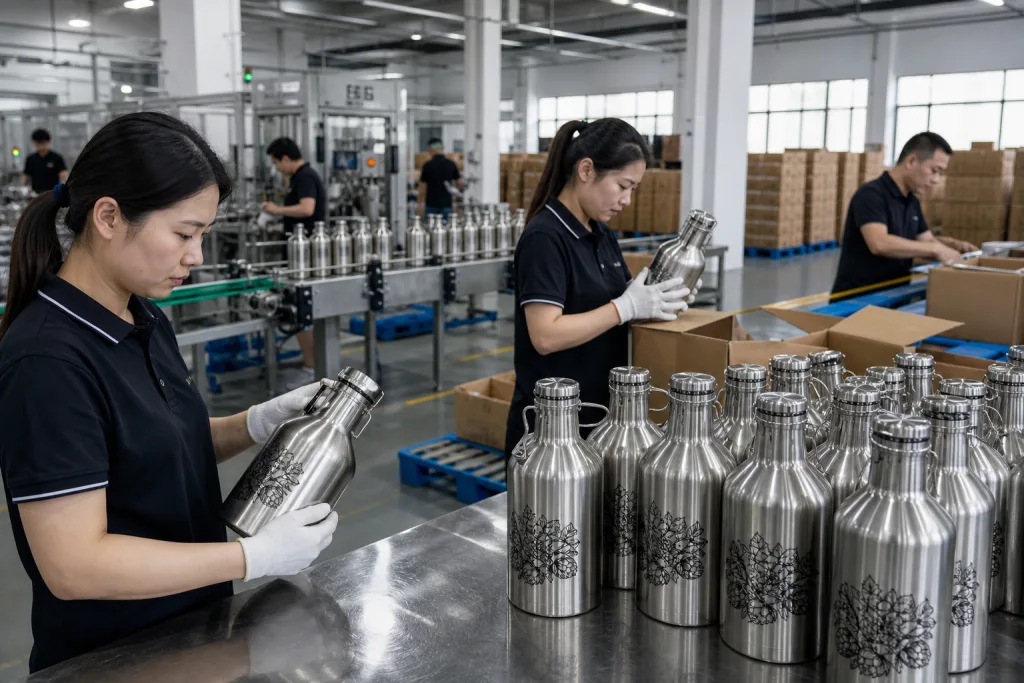
Key Takeaways
- A 64 oz custom growler usually lands at USD 4.80-9.50 FOB China at 1,000-3,000 units, depending on steel gauge and lid type.
- Most Zhejiang canteen factory lines run 30,000-80,000 units/month, but promotional orders still need a 15-30 day sampling window.
- For retail-grade leakage control, ask for 100% lid fit testing and AQL 2.5 general inspection, not just a visual check.
- Laser engraving lasts longer than one-color print on powder-coated stainless, especially for customized growler campaigns with repeated washing.
If you are buying growler promotional drinkware, the hard part is not finding a logo spot. The hard part is making unit price, decoration life, and shipping math work on a real campaign. A 64 oz stainless growler can look perfect in sample form, then fall apart when your team asks for 5,000 units at FOB Ningbo or FOB Shanghai with carton limits and no room for dents.
We see this all the time in Zhejiang and across China: buyers start with a branding idea, then end up choosing between vacuum insulation, single-wall steel, powder coat, laser engraving, or screen print. The right call depends on how the bottle gets used, whether you need custom drinkware for retail or a giveaway, and whether the supplier can hold lid fit, thread tolerance, and leak test results. QC pulled the sample on a 2 mm cap gap before. That is the wrong question to ask if you start with artwork; ask the product questions first, then the print spec.
What are you really buying?
Before you compare quotes, pin down the use case. A growler promotional item is not just a container for drinks; it is a branded piece that has to survive carton drops, pallet stacking, and the buyer’s first complaint email. If it is a giveaway, USD 3.50-5.50 is a normal target. If you want retail shelf appeal, the budget usually moves to USD 6.50-12.00 FOB, because the lid finish, coating, and box all need to hold up under store handling.
Ask four questions: capacity, insulation, closure type, and decoration method. We ran this comparison on a 48 oz sample last month, and the 0.7 mm wall looked fine until QC pulled the sample after the lid gasket failed a shake test. A 32 oz bottle cuts freight weight, but 64 oz sells the growler story better. A vacuum model adds 25%-40% to cost versus single-wall steel, and that is the math, no way around it. For brands buying custom growler products, the right question is not “What looks good?” It is “What will your customer keep using without sending it back?”
- 32 oz: lower carton weight, easier to pack in promo kits, and cheaper on air freight.
- 64 oz: better shelf presence, fits beer and cold brew positioning, and usually gives the buyer a stronger retail story.
- 18/8 stainless steel: the standard we run for durable custom drinkware, with better corrosion resistance than lower grades.
- Powder coat or matte paint: better grip in hand, but the line needs an adhesion check before mass production.
How should you screen suppliers?
I’ll tighten the prose, keep the HTML intact, and make it sound like a buyer-facing factory note with concrete production details.Do not start with the lowest quote. Start by checking whether the factory actually runs customizable drinkware at scale. A real canteen factory or canteen manufacturer will give you monthly output, in-house decoration steps, and the inspection flow without reading from a script. In Zhejiang, we usually see 2-4 production lines, metal forming or bottle assembly records on file, and a normal MOQ of 1,000-3,000 units per design for a promo run.
When you talk to canteen suppliers or canteen distributors, ask for BSCI or a similar social audit, REACH for EU orders, food-contact test reports if you need them, and carton drop-test records for export. If the vendor cannot tell you whether the lid gasket is silicone or TPE, stop there. We’ve seen that one go sideways fast. The same applies to custom canteen orders and custom drinkware programs: vague answers usually mean the line is outsourced and QC only sees the final box.
Good procurement is boring. You want a supplier that can explain wall thickness, coating thickness, and the test method in plain language, not one that keeps saying “premium quality.” We once had a buyer flag a PO typo on the color code, and the whole batch had to be held at packing.
A competent canteen supplier in China should also quote on the same terms: FOB, lead time, sample cost, and print setup fee. Without that, you cannot compare a canteen promotional offer to the real landed cost. Ask for the lid tooling fee too; on a 1,000-piece order, that number changes the math.
Which materials make sense?
For a growler, the material choice drives most of the cost and risk. We run 18/8 stainless as the default for a durable customized growler; that spec still gives export buyers the fewest surprises. Single-wall steel can shave weight for a promo run, but it gives you zero temperature hold. We had one buyer flag this after a 72-hour ice test on the line: the bottle looked fine, the product did not.
For buyers comparing canteen customizable options, wall thickness matters more than many teams expect. Typical stainless body thickness sits at 0.5 mm to 0.8 mm. At 0.5 mm, freight is easier and the unit price drops, but dent resistance falls fast; at 0.6 mm to 0.7 mm, the math works better for customized canteen and customized drinkware programs. If you want a premium feel, ask for brushed steel or powder coat, then check adhesion with cross-hatch tape and an abrasion rub, not just a pretty sample photo.
Glass and plastic can work on some beverage projects, but for true growler promotional use, stainless wins because it takes impact better. A good canteen vendor or canteen vendors in China should send a material spec sheet with steel grade, finish, and gasket material before you place the PO. We’ve seen this go sideways when a buyer accepted a typo on “silicone” as “silicon”; QC pulled the sample, and the seal failed on the first pressure check.
What decoration survives use?
I’ll rewrite the section to sound like a factory-side sales engineer, keep the HTML exactly as-is, and make the prose more concrete and buyer-facing.Decoration is where a lot of buyers either overspend or leave the spec too loose. On a powder-coated body, laser engraving usually gives the longest wear; it does not peel, and it stays sharp on matte black, navy, or dark green. We ran one line test with a 65 mm logo on 304 stainless, and the buyer flagged the edge clean-up only after the first wipe test. If you need a bigger full-color brand hit, screen printing or UV print can work, but write the wash cycle and abrasion target into the PO. No guesswork.
For a customizable canteen or customized canteen campaign, the decoration has to match the sales channel. Retail cartons can carry laser, etching, or embossed marks. Trade-show giveaways usually go with one-color screen print because the first look matters more than 2-year life. When buyers ask for canteen custom and custom canteen options, we give the same straight answer: if the product will be hand-washed every week, choose laser or baked-on print; if it will sit in a kit, print is enough. The math does not work the other way around.
Practical checklist:
- Ask for logo size in mm, not “large” or “small.”
- Confirm one-color print, two-color print, or laser engraving before sampling.
- Request a pre-production proof on the exact surface finish.
- Test alcohol wipe and dishwasher resistance if the user will reuse it.
That approach works for both custom drinkware and canteen promotional orders.
How do you judge MOQ and lead time?
I’ll rewrite the section in place, keep the HTML intact, and make the copy sound like a factory-side sales engineer wrote it.MOQ is where a lot of first-time buyers burn days. A Zhejiang factory may quote 1,000 units for a standard custom growler shell, then the number jumps to 3,000 once you add a new lid, a printed carton, or a matte coating. Ask one direct question: does the MOQ sit per color, per lid style, or per artwork file? We’ve seen a PO typo on this point turn a 2,000-unit plan into a 6,000-unit headache.
Lead time needs to be split into pieces, not guessed as one block. Sample work usually takes 7-12 days, mass production for a plain promo run is often 25-35 days after sample approval and deposit, and new tooling or a complex lid can push it to 40-50 days. A strong canteen factory will say that straight, with no “subject to schedule” fog. If they dodge the numbers, the launch date is already at risk.
For a distributor canteen program or distributor drinkware catalog order, ask for a rolling production schedule and a carton-ready date. If you need FNSKU labels or retail barcodes, add 3-5 days for labeling and final packing. QC pulled the sample on one run because the outer carton mark missed 2 mm, and the buyer flagged it before the goods left the line. That small check saves a warehouse refusal later.
What should your checklist include?
I’ll rewrite the section in-place, keep the HTML structure intact, and tighten the sourcing language so it sounds like a factory-side sales engineer wrote it.Use a procurement checklist before you approve any growler promotional PO. We run this on the line before sample sign-off, because one typo on the PO can turn into a 12-day delay. Start with the product spec, then packaging, then compliance. If the supplier is in China, ask for the same packet we send export buyers in Zhejiang: spec sheet, inspection record, and carton mark-up.
Checklist for buyer approval:
- Capacity in oz and ml, plus the actual fill tolerance, usually ±3%.
- Material grade, wall thickness in mm, and surface finish.
- Lid type, gasket material, and the leak test method we use on the sample.
- Decoration method, artwork file format, and proof approval.
- FOB price, MOQ, lead time, and sample charge.
- Inspection standard: AQL 2.5 or stricter if retail-bound.
- Compliance: REACH, food-contact, and any market-specific documents.
- Carton spec: units per carton, drop-test handling, and master carton weight in kg.
We use the same checklist for a canteen manufacturer, canteen manufacturers, or a canteen distributor selling a wider customizable drinkware range. This is the right question to ask. Good sourcing depends on clean follow-up and hard numbers; QC pulled the sample, the buyer flagged the lid, and we fixed it before mass production.
Send your spec, get a real quote
Share capacity, decoration, and target market. We will price the custom growler, confirm MOQ, and map a realistic China lead time.
Frequently asked questions
What is a realistic MOQ for growler promotional orders?
For a standard stainless growler promotional order, 1,000 units is common if the body and lid are existing molds. If you want a new lid, unique finish, or custom carton, 3,000 units is more realistic. Mixed colors can raise the effective MOQ because many canteen suppliers treat each color as a separate run. In Zhejiang, a typical canteen factory can handle smaller trial quantities, but the unit cost usually climbs by 12%-20% below standard MOQ. Always confirm whether the MOQ applies per SKU, per artwork, or per color.
Should I choose laser engraving or print?
If you need a durable branded finish for a custom growler, laser engraving is usually the safer choice. It does not peel and holds up better to repeated washing. One-color screen print is cheaper and works fine for canteen promotional campaigns, but it can wear faster on abrasive use. On a powder-coated body, laser is often the best value at 1,000-5,000 units. If you need full-color art, use UV print or screen print and ask the supplier for rub testing, especially if the product goes to retail.
What price should I expect from China?
For a 64 oz stainless custom drinkware growler from China, a practical FOB range is USD 4.80-9.50 depending on steel thickness, lid type, and decoration. Simple single-wall models are lower; vacuum insulated versions are higher. If you add custom packaging, printed inserts, or a retail box, budget another USD 0.35-1.20 per unit. A better canteen manufacturer in Zhejiang will quote clearly by component, which makes it easier to compare with canteen vendors and distributor drinkware offers.
How do I check quality before shipment?
Ask for a pre-shipment inspection using AQL 2.5 for general defects and a stricter leak test if the growler is insulated. Request photos of random cartons, logo placement, lid torque, and gasket fit. For export orders, also confirm carton drop test history and whether the factory uses 100% leak testing or sample testing. A strong canteen supplier should give you inspection records, not only a packing list. If the order is retail-bound, ask for barcode verification and carton count reconciliation before release.
Can one supplier handle canteen and growler programs?
Yes, if the supplier is a real canteen factory or canteen manufacturer with metal bottle capability and in-house decoration. Many Zhejiang factories handle both custom canteen and custom growler lines, especially when the body material is stainless steel. The important part is not the product name; it is whether the plant controls forming, polishing, coating, and final QC. A capable canteen distributor can also manage mixed drinkware programs, but you still need factory-level proof of quality, lead time, and monthly output. Ask for 30,000-80,000 units/month capacity if your order is ongoing.