Key Takeaways
- A practical custom growler MOQ is usually 500-2,000 units, with sample lead time around 7-10 days and mass production around 25-35 days.
- For stainless growlers, 18/8 body material and 0.5-0.8 mm wall thickness are the normal buying baseline; thinner walls save cost but hurt dent resistance.
- A good QC plan checks leakage at 100% of capped units, plus AQL 2.5 for appearance and AQL 4.0 for minor packaging defects.
- FOB China pricing for a 64 oz stainless custom growler often starts around USD 3.20-6.80 depending on finish, logo method, and lid type.
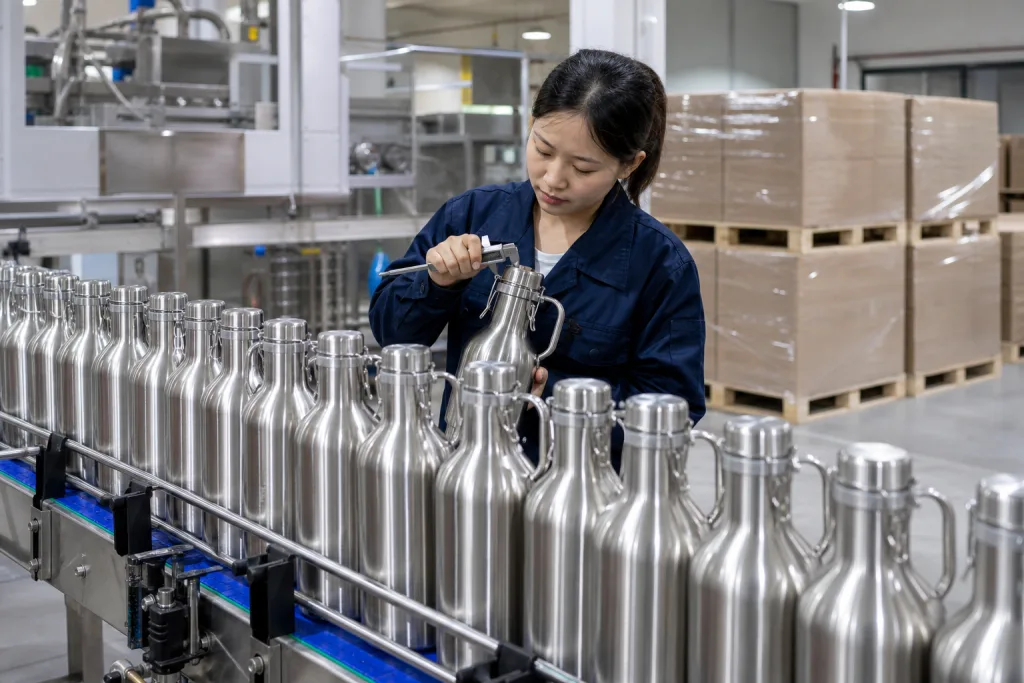
You are not buying a “growler” in the abstract. You are buying a container that has to survive filling, capping, packing, freight, retail handling, and a few thousand impatient customers. That is why serious growler manufacturers start with wall thickness, lid sealing, coating adhesion, and carton drop tests. On our line, QC pulls the sample before we pack the first 200 pcs.
If you are sourcing from Zhejiang or anywhere else in China, the real question is whether the supplier can repeat the same result on 5,000 units as cleanly as on 50 samples. In Hangzhou, we see buyers lose margin when they treat custom drinkware like a promo trinket. A custom growler order is closer to a small industrial program: lock the spec, approve the sample, inspect the first lot, then scale. That is the difference between a distributor growler program that works and one that comes back as returns. One buyer once flagged a 2 mm lid gap on a PO typo, and the math did not work after that.
Start with the use case
I’ll rewrite the section with tighter B2B language, keep the HTML untouched, and make the use case first so it reads like a factory-side sales engineer wrote it.Before you compare growler manufacturers, write down what the product has to do in the market. A taproom retail growler is not the same job as a distributor item sold through a gift catalog, and it is not the same as a canteen promo piece handed out at a trade show. Start the spec with capacity, finish, lid style, and whether the unit is for cold fill, carbonation, or dry goods branding. We run into bad briefs every week when that part gets skipped.
For a typical B2B custom growler order, the common sizes are 32 oz, 64 oz, and sometimes 128 oz. If you are selling into beverage retail, 64 oz is the safer size because it fits shelf expectations and carton count. If you are building a customizable growler line for a canteen distributor or drinkware distributor, a wider SKU mix makes sense: brushed stainless, powder coat, matte black, plus a stainless or PP lid. Keep the launch tight. Every extra color or lid type adds one more inspection check, and QC pulled the sample more than once when a buyer tried to launch six variants at once.
In Zhejiang, we still see buyers jump into decoration before they finish the usage brief. That is the wrong order, and it usually ends in a re-sample. A clean brief should answer: hot or cold use, carbonation yes or no, target shelf life, logo area size in mm, and whether the customer wants a premium retail look or a low-cost canteen promotion. If you cannot explain the use case in one paragraph, the factory cannot quote it cleanly. We saw a PO last month with a typo on the finish code, and that cost three days on the line.
Choose the right body material
I’ll keep the HTML structure intact and rewrite the prose to sound like a factory-side sales engineer, with concrete specs and fewer generic phrases.Most growler manufacturers start with stainless steel, and the reason is simple. We run 18/8 stainless steel first, usually marked SUS304 on the spec sheet. It holds up in transit, takes custom branding well, and gives a clean base for a customized growler or customized drinkware program. For the body, 0.5 mm to 0.8 mm wall thickness is the normal band. At 0.5 mm, you cut weight and cost. At 0.7 mm or 0.8 mm, the canteen customized piece feels sturdier in hand and takes dents better on the line.
If you are buying a custom canteen or customizable canteen for a wider drinkware line, do not treat all stainless as the same. Ask for the material certificate, finish spec, and weld polish data for the inner seam; that seam is where flavor issues start if QC misses a rough spot. We saw a buyer flag a 0.3 mm wall deviation on a 5,000-piece order, and the math did not work after rework and carton damage. A factory can quote USD 0.20 lower by shaving material, but the complaint rate will eat that saving fast. You are buying consistency, not just metal.
- 18/8 stainless: best balance of cost and durability
- 0.5 mm wall: lower cost, lighter shipping weight, easier to dent
- 0.7-0.8 mm wall: better hand feel and stronger retail positioning
- Powder coat: better grip and branding than plain brushed steel
If you need a canteen supplier for a broader assortment, make the factory hold the same finish across every lot. We ship by batch, and a gloss shift of 5% or a print drift of 1 mm will show up fast when the buyer compares pallets. Customizable drinkware only works when color, gloss level, and print quality stay inside tolerance.
Lock the lid and seal
I’ll keep the tags exactly as-is and rewrite only the prose inside, with a more hands-on factory-sales tone and tighter, more specific leak-testing language.Most leakage starts at the closure, not the bottle body. For growler manufacturers, the lid is where the buyer should be picky. A stainless screw lid with a silicone gasket is the common commercial pick. On cold-fill beverage jobs, we make the line test every lid on a torque fixture and run upside-down leak checks. If the lid takes too much torque to seal, packing slows. If it seals too loose, returns go up.
Ask what the lid is made of: PP, stainless, or a hybrid. For a custom growler line with premium shelf appeal, a stainless top cap with a silicone seal usually wins. For a canteen distributor handling corporate gifts, a simpler PP lid cuts cost and keeps the order open to more SKUs. The buyer flagged this on a 500-piece trial last quarter. Ask for sealing data, not sales copy. “Tight seal” means nothing unless the sample passes a 30-minute inversion test at room temperature with zero leakage.
Practical rule: if the closure cannot pass a 24-hour upright and inverted leak test on sample units, it is not ready for production.
This is where canteen suppliers and canteen vendors overpromise. The right canteen factory will show you the gasket material, the compression fit, and the replacement cycle if the lid goes into retail. QC pulled the sample after a 2 mm gasket shift on one run, and that saved us a batch headache. If you sell through Amazon or wholesale channels, one weak lid can wipe out the margin on the whole carton.
Decorate for retail, not ego
I’ll keep the tags and structure, then tighten the prose for a factory-floor sales voice with concrete pricing and one or two insider details per paragraph.Decoration should follow the sales channel, not the buyer’s ego. For a 500-unit distributor canteen order, one-color silkscreen is usually enough. For a retail growler launch, laser engraving or a powder coat with laser reveal sells cleaner on shelf. A canteen customizable program only works if the finish survives carton rub and hand carry. We’ve seen cheap print fail after one case pack; that math does not work.
Decoration pricing in China is simple if you ask for the right quote. A one-color logo on a stainless growler usually adds USD 0.12-0.35 per unit. Laser engraving runs about USD 0.20-0.60, depending on logo size and fixture setup. Full-color wrap or tight registration artwork costs more and makes sense only above 1,000 units. If you want a customized canteen or customized drinkware line for retail, send vector files and Pantone codes, not screenshots with blurry edges.
Growler manufacturers in Zhejiang will usually ask for a decorated sample before production. Do not skip it. QC pulled a brushed-steel sample on our line last month, and the logo shifted 2 mm because the shoulder curve was sharper than the mock-up. If you are buying as a canteen manufacturer partner or canteen distributor, insist on a signed pre-production sample. One approved sample beats 300 bad cartons and a week of back-and-forth on the PO typo.
- Silkscreen: best for simple logos, low cost, fast setup
- Laser engraving: durable, premium, no ink wear
- Powder coat + print: stronger retail look, higher cost
- Full wrap: strong shelf impact, tighter alignment control
Build a QC plan that catches damage
I’ll rewrite the section in-place, keep the HTML structure intact, and make the prose sound like a factory-side sales engineer wrote it.If you want a production order to land cleanly, set QC before the line starts. For custom growler orders, we usually lock in dimensional checks, leak checks, coating adhesion, logo position, and carton drop testing before mass production. For appearance, AQL 2.5 is a solid line for major defects, while AQL 4.0 works for minor cosmetic marks if the buyer signs off. Leave defect levels vague, and every inspector will use a different yardstick.
A proper QC flow for a canteen factory in China is simple: confirm raw material, approve the decorated sample, inspect the first article, run in-line checks, then inspect the packed cartons. On a 10,000-unit order, we sample across the full run, not just the first pallet. QC pulled a sample from the last 800 units once and found a 0.6 mm lid gap from tooling wear. That is the kind of miss that turns into a claim later. The math does not work if you pretend late-run drift will fix itself.
Ask for these checks in writing:
- 100% leak test on capped units
- Drop test on master cartons from 76 cm or 30 inches
- Visual inspection under standard light
- Logo registration and color consistency check
- Packaging compression test for export cartons
If you source as a canteen supplier or canteen vendor to downstream retailers, insist on photo evidence from the pre-shipment inspection. We ship a lot of orders where the buyer flagged a PO typo on carton marks, and that small slip turned into a warehouse delay. AQL helps, but photos and retained samples save the argument when a cracked base or rubbed logo shows up after arrival.
Negotiate the commercial terms
I’ll rewrite the section in place, keeping the HTML tags intact and tightening the commercial language so it sounds like a factory-side sales engineer.Commercial terms decide whether the quote holds up. A low unit price can bury extra charges in decoration, lid work, packing, or carton specs. For a real FOB China quote on a custom growler, split the body, lid, decoration, and packaging on the sheet. Don’t take a single flat number. A 64 oz stainless custom growler may sit at USD 3.20-4.10 FOB for brushed steel, one-color logo, and a plain box; a powder-coated version with laser engraving can land at USD 5.20-6.80. We’ve seen buyers flag a USD 0.18 lid upgrade after the PO was already signed. The math stops working fast.
MOQ needs the same treatment. In Zhejiang, we usually run 500 units for stock body + custom logo, and 1,000-2,000 units for full color changes or special lid mixes. A canteen manufacturer can mix SKUs if the shell stays the same, but every variant adds setup time and check loss. Ask for real monthly output, not a brochure number. A line that ships 80,000-120,000 units a month is easier to plan around than a factory that says “big capacity” but only has one line running and a 48-minute changeover on the powder coat booth.
Payment terms and delivery milestones need to be written down before sample approval. Standard terms are 30% deposit and 70% before shipment, with sample lead time at 7-10 days and bulk lead time at 25-35 days, depending on season. If your retail launch sits on a fixed calendar, book line time early. QC pulled a sample once because the PO said “matte black” and the buyer meant “soft-touch black,” and that typo cost three days. Save 5 cents a unit if you want, but miss the ship date and the season is gone.
Send your spec, get a real quote
Share capacity, lid type, logo file, and target MOQ. We will price the order clearly and flag QC risks before production starts.
Frequently asked questions
What MOQ should I expect from growler manufacturers?
For a standard custom growler, a realistic MOQ is 500-1,000 units if you use an existing body and add logo only. If you want a customized growler with a new color, special lid, or retail box, expect 1,000-2,000 units. Some Zhejiang factories will quote lower, but the unit price usually jumps. For buyers testing market demand, ask for one sample round and one small pilot lot before scaling.
How much does a custom growler cost FOB China?
A basic 64 oz stainless custom growler often starts around USD 3.20-4.10 FOB China with simple decoration and a basic box. Powder coating, laser engraving, or premium lids can move that to USD 5.20-6.80. The biggest cost drivers are wall thickness, lid material, coating process, and carton requirements. If the quote does not separate these items, you are not comparing apples to apples.
What QC checks should I require?
At minimum, require 100% leak testing on capped units, random AQL inspection for appearance, logo alignment checks, and carton drop tests. For a retail program, ask for AQL 2.5 on major defects and AQL 4.0 on minor defects. A proper canteen factory should also provide first article approval and pre-shipment photos. If the factory refuses clear defect criteria, that is a red flag.
Can I order both custom canteen and growler SKUs together?
Yes, and it can help your freight and procurement efficiency. Many canteen manufacturers in China run related drinkware shapes on the same schedule if the material and decoration methods overlap. A custom canteen, customizable canteen, and custom growler can share carton standards or print methods, which lowers setup waste. The key is to avoid too many finishes in one order, because every extra SKU adds inspection and packing complexity.
How long does production usually take in China?
For a normal project with approved artwork, sample lead time is usually 7-10 days and bulk production is about 25-35 days. If you need a new mold, special coating, or a very busy season slot in Zhejiang, the timeline can stretch. Build in time for pre-production sample approval, especially if you are a canteen distributor or distributor drinkware buyer with a fixed launch date. Shipping time is separate and depends on port and destination.