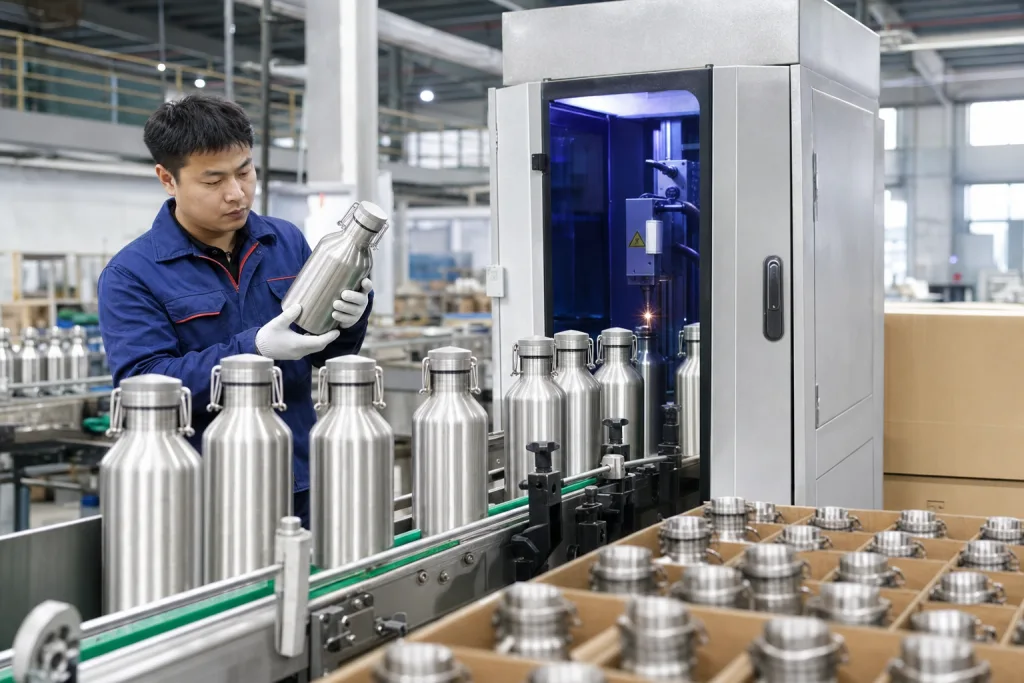
Key Takeaways
- A 0.4 mm wall-thickness miss can turn a 64 oz growler into a dent-prone return item.
- Ask for AQL 2.5 visual inspection, torque checks, and 100% leak testing on lids and spouts.
- MOQ for custom growler projects is typically 1,000 units, with 25-35 days lead time after sample approval.
- FOB pricing for standard stainless custom growler models often starts around USD 2.80-4.60 depending on finish, lid, and capacity.
Most growler projects go wrong for plain reasons: a lid that leaks after 200 cycles, a powder coat that chips in transit, or a neck tolerance that passes on paper and turns into a carton of returns. If you buy from a growler manufacturer in China or Zhejiang, you are not just buying a bottle shape. You are buying control over wall thickness, weld quality, finish adhesion, and how the cartons ride through shipping.
So the right question is not “Can you make it?” It is “What breaks first, how do we stop it, and what goes into the spec before the line starts?” At BottleForge in Hangzhou, Zhejiang, we run 180,000 units per month across drinkware lines, and the jobs that stay smooth are the ones where the buyer pins down the failure modes early. QC pulled the sample on one project after a 0.3 mm neck drift, and that saved a lot of grief. The rest turn into costly rework.
Where growler projects fail first
I’ll rewrite the section in place, keep the HTML exactly as-is, and make the prose sound like a factory-side sales engineer wrote it.The first failure is usually boring. The sample passes, then the line drifts by 0.2 mm on the neck thread, or QC pulled the gasket from a cheaper compound that goes hard after three dishwasher cycles. A growler manufacturer should tell you which part breaks first on each build: body, cap, seal, coating, carton, or print. If they cannot, they are selling a shape, not a controlled product.
For stainless custom drinkware, the weak points are easy to predict. A 304 body still dents if the gauge is too thin. A 201 body saves cost, but humid storage can turn that into corrosion claims. A double-wall custom growler can look clean and still fail when vacuum retention slips on the line. We run it the simple way: lock the material grade, minimum wall thickness, and vacuum hold target in writing. A buyer once flagged a PO typo on “0.05 mm”; the math does not work, and that kind of miss goes straight into rejects.
- Body thickness: set a minimum, such as 0.5 mm for standard stainless growlers.
- Thread match: confirm lid thread pitch against the actual production mold.
- Seal life: require at least 500 open-close cycles in pre-production testing.
- Carton test: define drop test height, usually 80 cm for export packs.
If you are comparing a canteen factory and a growler factory, ask one thing: can they put numbers on these risks? A supplier that only talks about finish is not enough. You want tolerances, test data, and an AQL 2.5 callout, not adjectives.
Leakage is a spec problem
I’ll rewrite the section in place, keep the HTML structure unchanged, and make the prose sound like a shop-floor sales engineer—not generic copy.Leakage is the costliest failure. One bad seal kills trust fast. Buyers usually blame the lid, but the real issue is often neck roundness, gasket compression, or a cap torqued past spec that distorts the sealing face. We run into this on the line all the time. A growler manufacturer has to test the full closure stack, not just the cap, or the math does not work once distributor drinkware channels start hitting chargebacks and shelf pulls.
For screw-top stainless growlers, lock down the torque window and the sealing material on the PO. Silicone gaskets usually beat generic rubber for heat and odor resistance. If you are ordering a customized growler for beer, kombucha, or cold brew, do not let the factory swap gasket material without sign-off. Ask for a 24-hour upside-down leak test and a hot-fill or cold-crack check tied to your use case. If the lid has a carry handle, QC pulled the sample under load with a 5 kg weight, not by hand.
Leak prevention is not a marketing feature. It is a stack of tolerances: thread, gasket, torque, and neck geometry.
When buying from canteen distributors or a canteen vendor network, push for a written QC plan. We ship export orders with AQL 2.5 for appearance, 100% leak test for closures, and sample retention from each shift. One PO typo on a gasket code can turn into a week of rework. That is the baseline if you want customized drinkware that stays quiet after delivery.
Coatings fail before metal does
I’ll rewrite the section in-place, keeping the HTML tags and list structure intact, while making the prose read like a factory-side sales engineer.Powder coat and paint are where a lot of custom canteen and custom growler programs go sideways. The metal can be fine, but if pretreatment is weak, the finish chips when cartons rub, scratches in packing, or starts peeling after one dishwasher cycle. We have seen buyers in North America and Europe skip the test sheet, then the buyer flagged the first pallet after QC pulled the sample. Ask for adhesion test data, salt-spray references, and the exact pretreatment line sequence. If the factory cannot walk you through alkaline wash, phosphating, and curing temperatures, you are guessing.
For stainless drinkware, 80-120 micron powder coat is a normal range for retail use. Below that, the finish looks thin and wears early. Above that, fine details like laser logos and tight-radius features start to soften. On one canteen customizable run, the buyer wanted four colors on the same shell, and the line showed every inconsistency at once. That is the math: if the coating spec is off by 20 microns, the decoration plan gets messy fast.
- Adhesion: ask for cross-hatch test results or equivalent internal test data.
- Curing: confirm oven temperature and dwell time, not just “baked properly.”
- Logo durability: separate silkscreen, laser engraving, and UV print requirements.
- Packaging rub: use inner sleeves or dividers for coated surfaces.
A canteen promotional order often fails here because the buyer wants the lowest unit price and forgets the finish is what pays for the claim later. We run this check on every coated sample: if the sleeve spec is 0.3 mm short, the carton rub shows up before shipping. If you need canteen customized for retail, corporate gifting, or distributor canteen programs, tell the factory the handling chain in plain words before the goods leave the line.
The label and logo trap
I’ll rewrite the section in-place, keep the HTML tags unchanged, and tune the wording to sound like a factory-side sales engineer.Logo issues are rarely about the logo. They show up when a buyer signs off on a flat PDF and never checks curve distortion, the 8-12 mm print loss near the seam, or whether a laser mark will disappear on matte black. We run into this on the line all the time. If a canteen manufacturer has export experience, it should push back on risky artwork. That is competence, not resistance.
For custom drinkware, pick the decoration process by use and finish. Silkscreen fits bold spot colors. Laser engraving gives a permanent mark and works on bare stainless. UV print handles fine detail, but it needs a stable surface and the right topcoat. On a custom canteen, a logo too close to the shoulder or weld line can shift after forming. We saw one buyer flag a PO because the logo sat 6 mm from the shoulder, and the math did not work for decoration clearance.
We use a lock-step approval flow: digital mockup, curved-line proof, blank sample, then decorated sample. If your canteen supplier skips the decorated sample, you are taking a blind risk. That is the wrong question to ask—“can you print it?” is easy, “will it hold on every SKU?” is the one that matters. Keep artwork simple, keep line weight above 0.3 mm, and do not assume the same logo size works on both 32 oz and 64 oz bodies. QC pulled the sample, and the difference was obvious.
Packaging failures are still product failures
I’ll rewrite the section in place, keep the HTML intact, and tighten the prose so it sounds like a factory-side sales engineer.Most buyers split packaging off as a separate line item. That is the wrong question. A growler can pass QC on the line and still show up dented if the carton spec is soft or the insert fit is loose. Export cartons need corner support, real drop resistance, and a pack count that makes pallet math work. We’ve seen a 12-pack spec that looked fine on paper turn into a 9-layer crush problem at warehouse intake. If you sell through a canteen distributor model, the package spec should be as tight as the product spec.
For ocean freight out of China, humidity and vibration are part of the route. A custom growler with a coated finish should go into a sleeve or bag to cut rub marks. Double-wall builds need divider inserts or molded pulp so the bottles do not kiss metal-on-metal. For premium canteen promotional orders, printed cartons help shelf appeal, but the board still has to hold. The buyer flagged one mockup because the print area cut into the top flaps by 6 mm. Ask for ISTA-style drop testing, or at least an internal packed-sample test with the same carton and insert.
- Inner protection: sleeve, bag, or tray depending on finish.
- Outer carton: 5-ply or 7-ply based on pack weight.
- Pallet stack: define max layers to reduce crush risk.
- Labeling: add FNSKU, barcode, and carton marks if you sell through retail or Amazon channels.
If your canteen vendors quote product only and skip packaging, they are not quoting landed performance. Good packaging adds a few cents. Bad packaging costs refunds, rework, and lost days. We’ve had a PO typo on carton count turn a clean shipment into a hold at the forwarder, and the math did not work at all.
How to spec a safer custom order
I’ll rewrite the section in-place, keeping the HTML tags and structure intact while stripping the AI-ish phrasing and adding tighter factory-floor detail.The safest way to source from a growler manufacturer is to put the failure modes into the purchase order. Start with material, capacity, wall thickness, closure type, finish, and test methods. Then set the limits for leak rate, coating adhesion, print tolerance, and carton damage. This is boring work. It is also what keeps a 500-piece trial from turning into a rework mess.
A practical spec sheet for a customized growler should call out: 18/8 stainless steel body, minimum 0.5 mm wall thickness, food-contact compliant gasket, 24-hour leak-free target, powder coat thickness of 80-120 microns, and AQL 2.5 visual acceptance. If you run a canteen customizable project, add logo position drawings with measurements from the base and shoulder, plus the exact screen size in mm. For wholesale orders, list unit carton and master carton dimensions, because a 40HQ shipper lives or dies on cube efficiency.
For buyers in Europe and North America, ask for REACH documentation, LFGB or FDA-relevant material declarations, and if needed ASTM-related performance references. If you are comparing canteen manufacturers, check whether they can hold repeat orders in Zhejiang or broader China without color drift or lid mismatch. We’ve seen a buyer flag a 1.2 mm cap gap on the second run; the math does not work if shipment two is worse than sample one.
Practical buying rule: ask the factory to quote your project with a sample lead time, production lead time, and QC checkpoint list. QC pulled the sample here because the thread gauge missed one turn on the lid. If they cannot give you a clear timeline, you are not dealing with a real canteen factory.
What a real factory should show you
I’ll rewrite this section in place, keep the HTML structure intact, and tighten the language so it reads like a factory-side sales engineer wrote it.A serious canteen factory should show more than a catalog. Ask for process proof: incoming material traceability, in-line inspection records, vacuum test logs, coating cure records, and a clear CAPA trail when something goes wrong. If a growler manufacturer is export-ready, they know BSCI expectations, audit support, and why a German buyer asks for documents before they ask for price.
At BottleForge in Hangzhou, Zhejiang, our regular custom drinkware runs at MOQ 1,000 units, 25-35 days after sample sign-off, and monthly capacity of about 180,000 units. That number matters because repeatability matters. On the line, we keep thread tooling stable, track finish batches, and hold color drift to a narrow window so your reorders do not come back off-shade or loose on the cap. We’ve seen small canteen suppliers skip this check, and the buyer flags it fast.
Use the factory visit or video audit to check three things: whether operators are measuring critical points with calipers, whether bad parts are separated at once, and whether the final QC line has a written record. A good canteen vendor will not dance around the details. They will show you what they test and what they reject, and QC pulled the sample should match the spec sheet.
If you are buying custom canteen, customized canteen, or custom growler SKUs for wholesale, ask the hard question: can the factory repeat the same result 10,000 times, not just once? The math does not work any other way. That is what protects margin in China sourcing and keeps your downstream market from dealing with leaks, fit issues, and PO typos that turn into delays.
Send your growler spec for a real quote
We will review your material, lid, finish, and packaging requirements, then quote a production-ready custom growler plan from Zhejiang.
Frequently asked questions
What MOQ should I expect from a growler manufacturer?
For most custom stainless growler programs, a realistic MOQ is 1,000 units per design and color. Some canteen manufacturers will quote 500 units, but pricing usually jumps 15-30% and lead times are less stable. If you need multiple logos or packaging variants, keep the MOQ separate from the carton spec. For a canteen customized project, ask whether the factory can combine SKUs in one production run without mixing labels or lids. That detail matters more than the headline MOQ.
How do I reduce leak risk on a custom growler?
Lock the closure system first: lid material, gasket compound, neck thread, and torque range. Then require a 24-hour upside-down leak test on production samples. We also recommend 100% leak testing for every unit before packing on export orders. If the growler is for carbonation-sensitive drinks, ask for a pressure or retention test. A canteen supplier that only checks appearance is not enough for distributor canteen or distributor growler programs.
What finish holds up best on customized drinkware?
For daily-use custom drinkware, powder coating in the 80-120 micron range is usually the safest balance of durability and cost. Matte finishes hide small handling marks better than glossy finishes, while laser engraving stays permanent on bare stainless. If you choose a canteen promotional item, avoid ultra-thin coatings because they chip during bulk packing. Ask the factory for adhesion testing and a rub test on the exact finish you plan to sell.
What documents should I request from China suppliers?
At minimum, ask for food-contact material declarations, REACH-related compliance documents for Europe, and the factory’s QC checklist with AQL criteria. If you are importing into the US, confirm any FDA-relevant material statements. A good canteen vendor in Zhejiang should also provide production photos, carton dimensions, and a sample retention record. If the buyer is retail-focused, ask for barcode or FNSKU labeling support before production starts.
Can one factory handle canteen and growler projects?
Yes, if the factory has the right tooling and line control. A capable canteen factory or canteen manufacturer can often produce both canteen custom orders and custom growler SKUs, but you should verify wall thickness control, lid compatibility, and finishing capacity. The risk is not capability alone; it is process separation. If the same line handles coated and uncoated items, ask how they prevent cross-contamination, color drift, and packing mix-ups across canteen distributors and drinkware buyers.