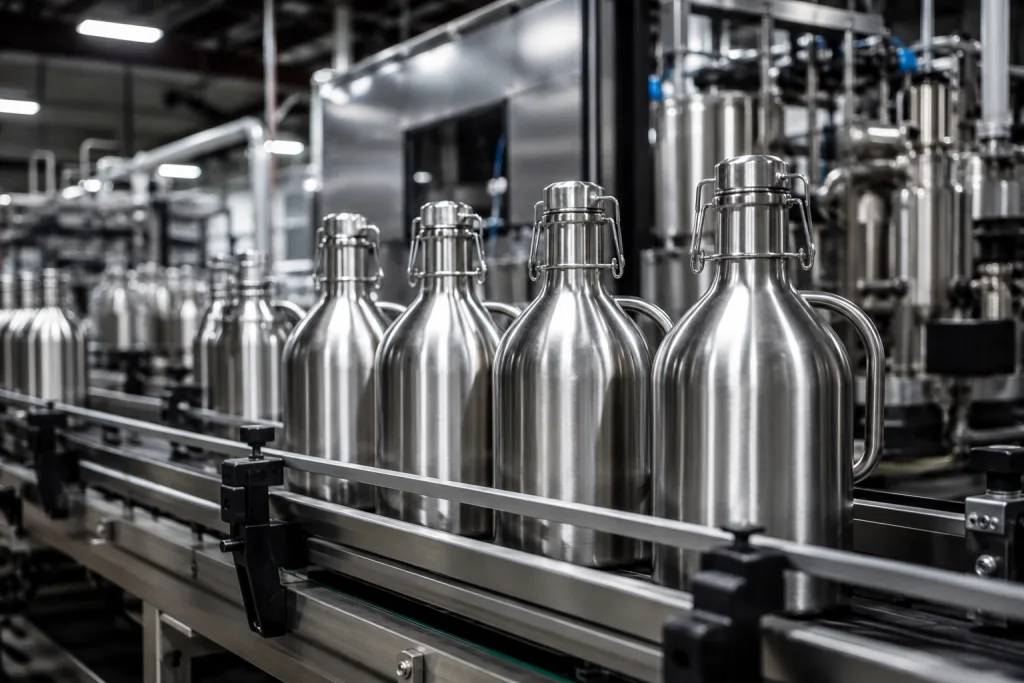
Key Takeaways
- A practical growler factory direct MOQ is usually 500-1,000 pcs per size, while new mold caps or uncommon finishes can push MOQ to 3,000 pcs
- 304 stainless works for most custom growler orders, but 316 or electropolished interiors make sense for acidic beverages and longer hold times
- Typical production lead time from Zhejiang, China is 25-35 days after sample approval, plus 3-7 days for final AQL inspection and export booking
- For B2B resale, 64 oz insulated growlers often land at USD 6.80-9.80 FOB, while 32 oz single-wall units can be closer to USD 3.20-4.60 FOB at volume
You are not buying a growler for a consumer shelf test. You are buying a vessel that has to survive filling lines, parcel abuse, decoration limits, and margin math. On our line, that talk gets practical fast: thread finish, wall thickness, leak rate at 0.2 MPa, and whether the order should be a growler at all or a custom canteen or travel bottle.
At BottleForge Industrial in Hangzhou, Zhejiang, China, we hear the same question from three buyer groups all week: breweries, outdoor brands, and distributor drinkware programs. The real question is which specification fits the sales channel, and this is where buyers often start in the wrong place. A 64 oz customized growler for taproom retail is a different job from a 32 oz canteen promotional run for a canteen distributor in Europe. QC pulled samples last month where a PO even mixed those two uses in one line item. Compare factory options side by side, and the buying call gets a lot clearer.
What factory direct really changes
Buying growler factory direct changes more than the invoice. The first shift is cost structure: if you buy through a canteen supplier or canteen vendor sitting behind two trading layers, we usually see 8% to 20% added before freight. The second shift is spec control, and that matters more on the line. Once the build sheet is signed before production, we run to that sheet instead of chasing email screenshots and a PO typo on logo position.
For a custom growler or customizable growler program, the build sheet needs to spell out the steel grade, vacuum target, neck thread tolerance, cap gasket material, coating system, logo process, individual pack, barcode placement, and carton drop requirement. This is where buyers either save themselves or get burned. If those points stay vague, the lowest-cost assumption fills the gap, and QC pulled the sample too late to fix it cheaply. We have seen distributor growler projects go sideways because one retail account wanted a softer gasket smell profile and another flagged barcode placement by 6 mm.
A real canteen factory or canteen manufacturer in China should talk in operating numbers, not sales talk. Our Hangzhou, Zhejiang plant typically runs 400,000 units per month across insulated bottles, growlers, and tumblers, with common growler MOQ starting at 500 pcs per color and 1,000 pcs per design. Ask what they run, what the neck thread tolerance is, and how they handle rework if vacuum loss shows up at final inspection. If a supplier avoids numbers and only says they are flexible, that is the wrong answer. The buyer flagged this with us once on a competitor quote, and the math did not work.
- Better for you: tighter control of specs, packaging, and compliance files such as REACH, LFGB, or California Proposition 65 screening, especially once the factory has approved dielines and carton marks in hand.
- Harder for you: you need to lock decisions earlier, because the factory will ask for artwork files, pantone references, carton marks, and testing level before mass production, often before the first pre-production sample is sealed off.
- Most useful for: custom drinkware, customized drinkware, and customizable drinkware programs built for repeat orders, forecast buys, and stable replenishment instead of one-off spot buys.
If your program is small and opportunistic, a canteen distributor may still be the right route. If your program repeats every 60 to 90 days, factory direct usually wins. We ship cleaner that way.
Head-to-head spec table
Here’s the comparison table most buyers ask us for after the first quote round. This is where the spec sheet starts to matter more than the sales pitch, and where the wrong question to ask is “which one is best” instead of “which one will actually sell through.”
| Spec | 32 oz single-wall | 64 oz vacuum | 128 oz heavy-duty |
|---|---|---|---|
| Typical FOB | USD 3.20-4.60 | USD 6.80-9.80 | USD 12.50-18.00 |
| MOQ | 1,000 pcs | 500-1,000 pcs | 300-500 pcs |
| Body material | SS304, 0.5 mm | SS304 double wall, 0.45/0.4 mm | SS304 double wall, 0.6/0.5 mm |
| Hold performance | Not insulated | 12-24 h cold | 24-36 h cold |
| Best decoration | Silkscreen, laser | Powder coat, laser, wrap print | Laser, decal, emboss |
| Best use | Event, promo, entry retail | Taproom, outdoor, ecommerce | Camping, team, premium retail |
The 32 oz single-wall option is the price play. We ship this one for canteen promotional campaigns, seasonal merch, and souvenir-led accounts where nobody expects cold hold after 2 hours. On the line, the straighter body gives the screen-print fixture fewer headaches, so artwork registration is usually easier on canteen customizable artwork programs. We have also seen buyers push for vacuum at this size, then back off once the target retail misses by USD 4-5.
The 64 oz vacuum style is the volume runner and the most common custom growler request we see. In our factory, this is the shape buyers reorder fastest because it lands in a workable retail band, feels solid in hand at around the mid-shelf standard, and gives enough cold retention for breweries, gifting programs, and outdoor channels. QC pulled the sample more than once on wrap print alignment, so if you are a canteen distributor or one of the canteen suppliers feeding 6 or 8 dealers, this is still the safest stock shape as long as artwork approval is tight.
The 128 oz heavy-duty version is a niche item. Freight per unit runs high, carton count drops fast, and the math doesn’t work unless your customers already sell oversized gear. We’ve seen this go sideways when a PO forecast looked good on paper but the buyer flagged the fill weight after seeing the first packed sample at over 2 kg. If your channel is camping stores, tailgate programs, or premium outdoor chains, the size can justify itself. A canteen manufacturer or canteen factory should tell you straight if the forecast is real or just optimism.
Material and closure decisions
Most sourcing failures start at the neck and cap, not the bottle body. Buyers spend time on Pantone matching and laser logo position, then the complaints come from drips, pressure burps, or cross-threading after the first shipment. On our line, QC pulled a sample last month with a 1.2 mm thread start burr, so for any customized growler, get the thread specification, cap material, and gasket hardness in writing. This is the right question to ask.
For body material, SS304 is the standard for custom drinkware and custom canteen programs. It is cost-effective, easy to source in Zhejiang and across China, and acceptable for most beverage contact applications. SS316 costs more, typically adding USD 0.40 to 1.20 per unit depending on size, and we usually see buyers choose it for acidic fills, salt exposure, or a spec sheet that already calls out stronger corrosion resistance.
Cap styles compared
- Screw cap with silicone gasket: lowest cost and simplest to run on the line, usually the safest choice for mass production; common MOQ is 3,000 pcs per color for distributor growler programs.
- Flip-top cap: better shelf look, but it has more parts, and leak risk goes up fast if hinge alignment is off by even 0.5 mm; one buyer flagged this after a drop test.
- Handle cap: fits outdoor and gym channels well, especially when your customizable canteen or growler needs one-hand carry; check handle load rating before you ship.
Wall thickness matters. A common double-wall build uses 0.45 mm outer and 0.4 mm inner. That works for mainstream retail. If you need a rugged customized canteen or customized growler for rough transport, ask whether 0.5 mm or 0.6 mm outer wall is available. The unit cost goes up, but dent resistance is better, and we have seen 0.6 mm bodies hold shape after carton corner hits that marked 0.45 mm stock.
Do not accept “food grade” as a complete answer. You need the steel grade, gasket material, and test scope spelled out.
For buyers working with canteen manufacturers or canteen suppliers, this is also where you confirm odor testing, weld appearance, and whether the interior is standard, electropolished, or ceramic-coated. We check inner welds with a borescope on some orders because a clean outside bead tells you little about the inside finish. Those choices affect cleaning perception and repeat purchase rates more than most catalogs admit, and we have seen this go sideways when a PO said only “inside polished” with no finish standard.
Branding methods versus sales channel
The right decoration method is usually decided by the sales channel, not by the logo mockup. A taproom shelf growler, an Amazon FBA unit, and a promo canteen move through different hands, different cartons, and different complaint patterns. We’ve seen this go sideways when a buyer approved the same finish for all 3 and then flagged scuffing after the first 500 units hit the line.
Silkscreen is the low-cost pick for simple art, usually one or two spot colors. On standard volumes it may add USD 0.08 to 0.20 per unit. It fits custom canteen, canteen custom, and entry-level customized drinkware programs where the target price is tight and the MOQ needs to stay workable. The weak point is abrasion resistance. On powder-coated bodies, if the ink system is not matched to the surface, QC pulled the sample and saw rub marks after a basic tape-and-rub check.
Laser engraving is cleaner and holds up better in use. It usually adds USD 0.12 to 0.35 per unit depending on position and size. For premium custom growler or customized canteen programs, this is usually the safer call because the complaint rate stays lower over a 6- to 12-month sell-through. If you ship into outdoor retail or a distributor canteen item with long shelf life, laser makes sense. Buyers push back on the extra cents, but the math doesn’t work if returns start over logo wear.
Powder coating with laser reveal gives the product a stronger shelf look and lifts perceived value. It also hides small handling marks better than raw brushed steel. Coating consistency is the part to check. Ask the canteen vendor or canteen manufacturer about coating thickness, usually 60 to 80 microns, and whether they run cross-hatch adhesion checks. On our side, the line also checks color drift against the approved chip before mass run, because a 1-shade mismatch gets flagged fast in retail packs.
- Promotional channel: single-wall body, silkscreen, white box. This is the cost-first build, and it works if the PO is for events, giveaways, or short campaign runs.
- Retail channel: vacuum body, powder coat, laser mark, printed color card. Shelf impact matters here, and buyers usually want cleaner finish control on visible panels.
- Ecommerce channel: vacuum body, scratch-resistant finish, barcode-controlled packout, tighter carton fit. This is the wrong place to save 3 cents on packing if the unit can move 8 to 10 mm inside the box.
If you manage a canteen distributors network, standardizing decoration across SKUs cuts approval time and reduces mixed-carton mistakes. We ship these programs every season, and the common failure is not unit cost. It is the wrong logo file on one SKU, or a PO typo that puts black print on navy powder coat. That matters more than saving a few cents on one artwork position.
Use-case fit by buyer type
Not every buyer should order the same growler. This is the wrong question to ask. Start with channel, reorder cycle, and how many complaints your team can absorb before the account starts pushing back. On our line, the same body can pass drop check and still fail the buyer later because the cap opening feels wrong in hand.
Brewery and taproom buyers usually land on a 64 oz vacuum insulated custom growler with powder coat, a basic screw cap, and a laser logo. It sells better at premium shelf price, holds cold longer, and still packs cleanly in master cartons. We run MOQ at 500 to 1,000 pcs, and repeat orders often ship in 25 to 30 days from Zhejiang. One factory detail matters here: QC pulled the sample last month and found a 0.3 mm logo shift on a black powder-coated body, which the buyer flagged right away.
Outdoor brands often compare a customizable growler against a customizable canteen, and for good reason. If the liquid stays with the user all day instead of getting finished fast at camp or trailhead, a custom canteen shape with a narrower mouth and integrated handle usually works better than a classic growler body. We have seen this go sideways when the brand chose the growler look first and only checked carry comfort later. This is where canteen customizable and canteen customized options overlap with growlers. On sample review, the caliper usually tells the story fast: a slimmer bottle silhouette rides easier in a side pocket than a wide growler belly.
Promotional product buyers should be blunt about budget. If your target landed cost is below USD 5.00 before duty, the math doesn't work for a fully insulated customized growler. You are usually looking at single-wall or a simpler custom canteen instead. A canteen promotional brief is often cleaner with standard stock colors and one-color print, not special coatings. We ship plenty of these with a 1-color screen print, and the common pushback is not decoration quality but carton count on a rushed PO.
Distributors need range discipline. If you are a distributor growler or distributor canteen seller supplying multiple accounts, too many neck finishes and cap types create spare-part confusion fast. Better to keep one 32 oz and one 64 oz platform, then change only finish and logo. That is how experienced canteen distributors and canteen vendors keep forecasting cleaner. We have even seen a PO typo swap cap thread specs, and the line had to stop for recheck before packing.
Private label importers should think hard about carton density. A product that looks good but ships poorly will eat margin. Ask for units per carton, carton gross weight, and pallet efficiency before approving the sample. We usually add one more check at this stage: actual carton size in cm and gross weight in kg after drop-test packing, not just the estimate from the first quote.
MOQ, lead time, and quality control
Factory direct sourcing gets decided on shop-floor control. A sharp sample means little if the production line drifts; last month our QC pulled a 1.2 mm logo shift on a pre-mass sample that looked fine in photos.
For standard growler factory direct orders, MOQ is commonly 500 pcs for insulated stock colors and 1,000 pcs for custom color or print-heavy programs. New caps, custom handles, or unusual lid tooling can raise MOQ to 2,000 or 3,000 pcs. Sample lead time is often 7 to 12 days for existing shapes and 15 to 20 days if you need color matching or new packaging. We run these numbers against the actual tooling list, because this is the wrong question to ask if the buyer has added a new cap mold and a custom mailer at the same time.
Mass production from China is normally 25 to 35 days after deposit and artwork approval. During peak season, especially from August to November, add another 7 to 10 days. If a canteen factory promises 15-day shipment for a fully customized drinkware run during peak, ask how many lines they run, whether 304 stainless is in stock, and if carton printing is booked; we have seen this go sideways after a PO typo delayed artwork signoff by 2 days.
Quality checkpoints worth insisting on
- Incoming material: steel grade confirmation and coating batch control. We check mill certs against the PO and record coating batch numbers before the drums hit the line.
- In-line checks: vacuum retention, thread fit, logo position, color delta. QC pulled the sample for lid torque and thread fit with a go/no-go gauge, not just a hand feel.
- Pre-shipment: AQL 2.5 major / 4.0 minor, leak test, carton drop test. On export orders, we usually add a 1-meter carton drop and 100% leak spot check on the final packed lot.
- Compliance file: REACH, LFGB or FDA-related migration screening, and if needed BSCI or ISO audit records. Ask to see the current file set, not a 2-year-old PDF from another SKU.
For ecommerce projects, ask for barcode verification, FNSKU placement accuracy, and pack weight consistency. Amazon buyers flag label drift fast; our pack-out team uses a placement jig so the FNSKU stays within spec, and we check carton weight by batch to catch missed straws or the wrong insert.
If you are buying from Zhejiang, China, logistics planning matters too. Ningbo and Shanghai routing can swing freight by 8% to 15% in peak weeks, and the math does not work if the factory is 180 km from port but still promises the same trucking cost in both directions.
Get your growler specs reviewed by our factory team
Send your target price, capacity, logo method, and packaging brief. We will suggest the right growler or canteen platform with MOQ and lead time.
Frequently asked questions
What is a realistic MOQ for a growler factory direct order?
For a standard stock-shape insulated growler, 500 to 1,000 pcs per size is realistic from a China factory. If you want a custom pantone body, gift box, and printed manual, 1,000 pcs is a safer planning number. If you need a new mold cap, special handle, or non-standard base, MOQ often moves to 2,000-3,000 pcs because of tooling and production setup loss. For single-wall promotional styles, some factories accept 1,000 pcs, but decoration minimums can still apply by artwork. Always ask whether MOQ is per SKU, per color, or per order total. That detail changes your landed cost more than buyers expect.
Should I choose a growler or a custom canteen for my product line?
Choose a growler when the selling point is larger capacity, brewery association, gifting, or social-use occasions. Common sizes are 32 oz, 64 oz, and 128 oz. Choose a custom canteen when daily carry, narrower form, cup-holder compatibility, or fitness/outdoor use matters more. In practical terms, a 64 oz customized growler suits taprooms and premium merch; a 20-40 oz customizable canteen suits broader retail. If you are a canteen distributor or distributor growler buyer serving mixed accounts, carry one of each platform instead of forcing one shape into every channel. The visual identity can stay consistent while the use-case fit improves.
How much should I budget for a customized growler from China?
At common B2B volumes, a 32 oz single-wall unit may run about USD 3.20-4.60 FOB China. A 64 oz vacuum insulated customized growler is more commonly USD 6.80-9.80 FOB, depending on coating, cap style, and packaging. A larger 128 oz unit can move into USD 12.50-18.00 FOB. Add roughly USD 0.08-0.20 for basic silkscreen, USD 0.12-0.35 for laser, and USD 0.30-0.90 for color box packaging. If you request 316 steel, ceramic interior, or gift-set presentation, costs rise quickly. Ask for a quote with FOB, carton dimensions, and net/gross weights together, not as separate follow-up emails.
What quality standards should I ask a canteen manufacturer or growler supplier for?
Start with an agreed AQL level, usually AQL 2.5 for major defects and 4.0 for minor defects on finished goods. Then ask for leak testing, vacuum performance verification, coating adhesion testing, and food-contact compliance documents relevant to your market, such as REACH or LFGB for Europe. If you sell into North America, ask about California Proposition 65 screening and any requested ASTM-related packaging safety expectations. For social compliance, some buyers also require BSCI audit status. On the product side, confirm steel grade, gasket material, and whether the interior is standard or electropolished. A serious canteen factory in Zhejiang should be used to these requests and answer with documents, not generic promises.
How long does production usually take for custom drinkware orders?
For existing models, pre-production samples usually take 7-12 days after artwork and color details are confirmed. Mass production for custom drinkware is typically 25-35 days after sample approval and deposit. Add 3-7 days for final inspection, carton marking confirmation, and export booking. In peak season, especially before holiday shipping windows, another 7-10 days is common. If you have complex pack-out requirements such as FNSKU labels, multilingual inserts, or assorted-color master cartons, mention them at quotation stage because they affect line time. A factory saying '30 days' without clarifying sample approval, testing, and booking is often quoting only the production window, not the full shipment timeline.