Key Takeaways
- A standard growler distributor order should lock MOQ at 3,000 pcs, with 25-35 days production after sample sign-off
- For branded drinkware, keep wall thickness, lid torque, and drop test criteria in the PO, not just the artwork file
- AQL 2.5 on major defects is realistic for export custom growler orders when cartons and closures are checked separately
- FOB China pricing for simple stainless custom canteen or growler programs often starts around USD 2.40-4.80 per unit depending on finish and print
You are not buying a “bottle.” You are buying a repeatable product that has to survive freight, branding, filling, warehousing, and customer handling without embarrassing your team. Miss the lid spec, the coating thickness, or the carton drop test, and the problem shows up in Europe or North America after shipment, not in the sample room. We’ve seen that one go sideways on a 1.2 mm wall growler.
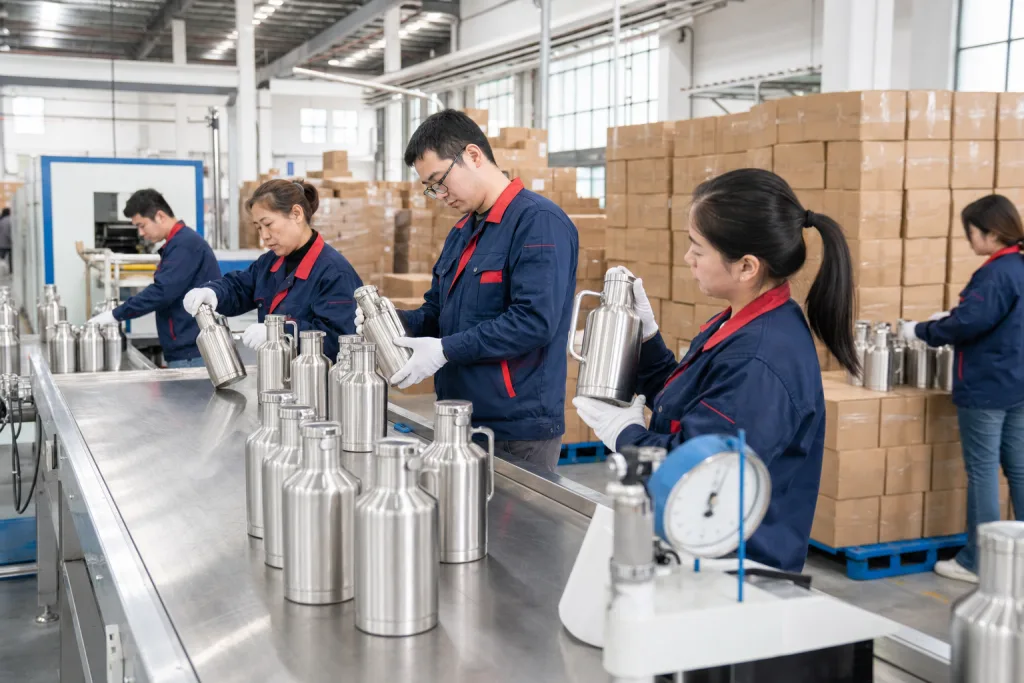
At BottleForge in Zhejiang, we run custom drinkware orders from first drawing to packed cartons, and the pattern is always the same: the buyer wants margin, the brand wants a clean finish, and the distributor wants no claims. For a custom growler order, lock the body material, cap system, decoration method, AQL 2.5, and shipping terms before production starts. We ship 600,000 units a month, with MOQ at 3,000 pieces and a 25-35 day lead time after sample approval. The math does not work if you change the print file after QC pulled the sample.
Start With the end use
I’ll rewrite this section in-place, keep the HTML exactly as-is, and tighten the sales-engineer tone with concrete sourcing details and cleaner buyer language.Before you ask for a quote, lock down how the growler will be used. A growler distributor selling to breweries has different specs than a canteen distributor packing outdoor kits or a promotional buyer chasing 5,000-event volume. A 32 oz stainless growler for draft beer needs a tight mouth finish, a leakproof lid, and a coating that survives ice buckets; a 64 oz retail version needs a stronger handle, a heavier base, and carton spacing that keeps the cap from taking a hit in transit. We have seen the buyer flag a 1.5 mm lid gap on the line. That order got stopped fast.
Write the use case into the inquiry: retail resale, brewery taproom, corporate gifting, or distributor drinkware bundle. Then set the numbers. We usually ask buyers to confirm:
- Capacity: 500 ml, 750 ml, 32 oz, or 64 oz
- Body material: 304 stainless steel, 18/8 grade, or glass
- Wall thickness: 0.5 mm, 0.6 mm, or 0.8 mm depending on price point
- Closure: screw cap, swing top, or insulated lid
- Finish: powder coat, matte paint, or bare brushed steel
This step saves two weeks of sample churn. The math does not work if you leave it vague. From Zhejiang, a good supplier will push for these calls before tooling or decoration starts, because QC pulled the sample once the mouth diameter missed the spec by 2 mm. That is not bureaucracy. It keeps a custom order from looking fine on screen and failing at fill-line speed.
Lock the spec sheet first
I’ll rewrite the section to sound like a factory-side sales engineer, keep the HTML structure intact, and tighten the spec language with concrete shop-floor detail.A serious custom canteen or custom growler order starts with a spec sheet the factory can build from on the first pass. Keep the drawings tight. If you want a customized canteen with print, state the artwork position in millimeters, the Pantone code, and the allowed shift. If you want a customizable growler, say whether one body can cover multiple SKUs or whether each capacity needs its own neck and shoulder geometry. The wrong question is “can you make it?” — the math only works when the spec is clear.
For stainless programs, ask for these numbers in writing:
- Body thickness tolerance: ±0.05 mm is practical for stable output
- Cap liner temperature range: at least -10°C to 120°C for cold chain and hot wash exposure
- Leak test: 100% of closures checked with inverted hold for 30 seconds
- Drop test: 1.2 m onto plywood or equivalent, based on your packing spec
For branded work, custom canteen requests often fail because the buyer approves the art and skips the substrate. A glossy powder coat takes laser engraving differently from a matte finish. We had one PO typo on a 500 ml run — the buyer wrote “laser” on the sample approval, then asked for UV transfer on the mass order, and QC pulled the sample before the line started. A canteen manufacturer in Hangzhou or Ningbo will ask for Pantone, logo size, and decoration sequence because silkscreen, laser, and UV transfer each have different yield and unit economics. That matters if you are pricing a distributor canteen program at FOB China and trying to stay under a USD 5 target.
Price the order like a buyer
I’ll rewrite this section in a more buyer-side, factory-floor voice and keep the HTML exactly as-is. Then I’ll quickly sanity-check that I didn’t break the tag structure or any numbers.If you are a growler distributor, landed cost matters more than a factory “nice sample.” A stainless custom drinkware order from Zhejiang usually lands in this band: simple brushed body with one-color print at USD 2.40-3.10 FOB, powder-coated body with laser logo at USD 3.20-4.20 FOB, and insulated double-wall growler at USD 4.80-7.50 FOB, depending on vacuum pull and carton spec. These are trade numbers. Use them to check margin before you send the PO.
Use the quote to split out the real cost drivers:
- Raw material: 304 stainless usually runs above 201 by a clear margin
- Decoration: one-color silk screen is cheaper than multi-pass print or laser on a curved body
- Packaging: white box, color box, and mailer cartons can swing cost by 0.20-0.60 USD
- Inspection: third-party QC, AQL sampling, and carton drop testing add cost, but they cut claim risk
We’ve seen canteen distributors underprice the sample and then eat the loss on freight or replacement lids. Ask the canteen factory to quote by component, not only by finished unit. If the lid comes from a separate vendor canteen channel or a sub-supplier, you want that line item before you place a 10,000-piece PO. QC pulled a sample once and found a 1.2 mm lid gap; the buyer flagged it, and that batch never shipped. In China, that transparency beats a cheerful email.
Sample, test, then approve
I’ll rewrite the section in-place, keep the HTML tags intact, and tighten the sales-engineer tone with a few concrete factory details.Do not sign off on a sample just because the logo sits straight. A custom canteen or other customized drinkware sample has to pass the checks your channel will actually see. For breweries and outdoor retailers, leaks and finish damage are the two failures that cost money fast. If you ship to North America, check carton marks, customs labels, and whether the pack works with FNSKU or retailer barcodes.
Ask for three sample categories:
- Pre-production sample with final decoration and closure
- Color sample or Pantone master for coated finishes
- Packed sample in a production carton for drop and compression checks
We usually run a quick buyer test: fill, invert, shake, wipe, and heat-cycle. If the item is insulated, check condensation and temperature hold over 6 hours. For a customizable canteen with powder coat, wipe the finish with a wet cloth, then hit one spot with a mild solvent. If you are doing a canteen promotional run, that test can save you from shipping a weak coating into a distributor network. In our Zhejiang plant, QC pulls the sample against signed photos, measured dimensions, and a written sample reference. That keeps the line honest later.
QC the order at the factory
I’ll rewrite the section in-place, keep the HTML tags untouched, and tighten the prose so it sounds like a factory-side sales engineer.Your QC plan should match the sales channel, not the mood of the day. For export custom drinkware, AQL 2.5 major and 4.0 minor is common, but we tell buyers to split out closure leakage and print defects as critical checks. A growler distributor does not want 1 bad cap batch inside 1,000 clean-looking units. If the cap fails, the order fails commercially. Simple.
At BottleForge, we run three control points on standard orders. QC pulled the sample with a caliper, then the line kept moving.
- Incoming material check for stainless coil, lid components, and packaging board
- Inline inspection for seam, weld, logo placement, and coating coverage
- Final random inspection before carton sealing and pallet wrap
For a canteen distributor order, verify that the canteen manufacturers’ production route does not mix SKUs on the same line without a clean reset. We’ve seen this go sideways on a 5,000-piece run: logo drift on one SKU, cap mismatch on the next, then the buyer flagged carton count errors. If you are buying from a canteen supplier in Zhejiang or elsewhere in China, ask for photo evidence at each stage and put the master carton spec in the PO. “Packed 24 pcs/carton, 12 kg gross, outer carton ECT 44 minimum” is the kind of line that saves a dispute later.
Ship it without damage
I’ll rewrite the section in place, keep the HTML intact, and tighten the language so it sounds like a real factory-side sales engineer.Shipping is where distributor drinkware orders lose money. The product can pass factory QC and still arrive dented because the carton spec was too soft or the pallet pattern was sloppy. For a growler distributor, that hurts fast. Dented shoulders and scratched coating show up at retail, and one bad outer carton can trigger returns across three or four wholesale accounts.
Build the packing spec for transit, not hope. On the line, we check 0.5 mm carton board and run a quick compression test before we sign off. For standard stainless growlers, use individual polybags or paper sleeves only if they do not trap moisture. Use inner dividers for coated surfaces. Ask for:
- Carton compression target for ocean freight stacking
- Drop test photos from the actual factory packout
- Pallet height and wrap method for warehouse receiving in Europe or North America
- Container loading plan if you are mixing SKUs
If you buy on FOB China terms, the factory’s job ends at the port, but your claim risk starts after that. We’ve seen the buyer flag a PO typo on carton count and the whole inbound check go sideways. Good canteen suppliers in Zhejiang still send pallet photos, HS code support, and carton count records because the sale is not finished until the buyer books clean receiving. That is the gap between a canteen factory that ships and a canteen manufacturer that keeps repeat orders moving.
Send your growler spec for a fast quote
We’ll check the build, MOQ, decoration, and carton details before production so your Zhejiang or China order ships clean.
Frequently asked questions
What MOQ should I expect from a growler distributor supplier?
For a standard stainless growler or custom canteen program, a realistic MOQ is 3,000 pieces per design and color. If you need multiple lid styles, expect the MOQ to rise by component. Some canteen suppliers will offer 1,000 pieces for a sample run, but the unit price usually climbs 15-30%. For distributor drinkware, I would budget around 25-35 days production after sample approval, plus 5-7 days for packing and pre-shipment inspection. If the order needs new tooling, add 15-20 days.
How do I compare canteen manufacturer quotes correctly?
Compare on the same basis: material grade, wall thickness, print method, carton spec, and trade term. A quote for 304 stainless at 0.6 mm is not comparable to 201 stainless at 0.5 mm, even if the price looks close. Ask each canteen manufacturer for FOB China price, sample lead time, payment terms, and AQL level. For a canteen customized order, also confirm whether the cap, gasket, and box are included. That is where many hidden costs appear.
What QC checks matter most for customized growler orders?
Leak testing, coating adhesion, logo placement, and carton strength matter most. I treat closure leakage as critical: every unit should be inverted for at least 30 seconds during line checks, then sampled again in final inspection. For printed units, check color shift against the approved Pantone or artwork master. For export orders, use AQL 2.5 major and 4.0 minor as a baseline, then tighten if the product goes into premium retail or brewery merch.
Can I order custom drinkware with mixed styles in one container?
Yes, but mix it carefully. A container can take multiple custom drinkware SKUs if the carton dimensions are compatible and the loading plan is fixed before production ends. For example, a growler distributor can combine 32 oz and 64 oz units, but each SKU should have its own carton mark, barcode, and tally sheet. Mixed loads are common for canteen distributors, but they require stronger documentation. If your warehouse uses FNSKU or retailer labels, confirm labeling at the factory to avoid rework.
What makes a canteen promotional order fail after approval?
Usually it is not the logo. It is the details around it. A canteen promotional order fails when the lid leaks, the coating scratches too easily, the carton collapses in transit, or the print shifts on curved surfaces. If you are buying from a canteen vendor or canteen supplier in China, force a pre-production sample, a packed sample, and written QC criteria into the PO. For repeat programs, keep the approved sample reference, carton spec, and decoration method unchanged unless you intentionally re-spec the item.