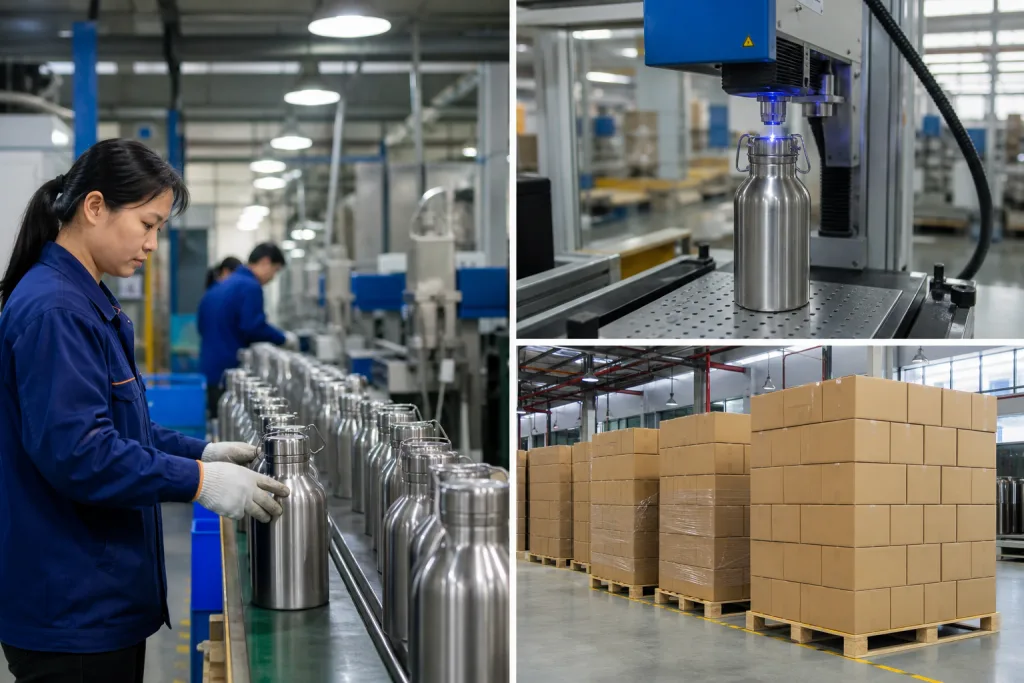
Key Takeaways
- A 64 oz stainless growler in 18/8 with 0.6 mm wall is a common B2B baseline; thinner than 0.5 mm often feels cheap and dents faster.
- Typical MOQ from a Zhejiang canteen factory starts around 1,000 pcs per design, with 25-35 days lead time after sample approval.
- FOB China pricing for a basic customized growler often lands around USD 4.20-7.80 depending on lid, coating, and print method.
- For export, ask for REACH, food-contact declarations, and AQL 2.5/4.0 inspection terms before you confirm the order.
If you are buying growler customized drinkware for retail, promotions, or channel resale, “looks good” is not a spec. A 64 oz stainless growler can pass a sample check and still fail in the field because the wall is too thin, the lid leaks after 500 cycles, or the coating chips in carton rub. We see this on the line in Zhejiang every week. The first quote is easy; the real job is matching capacity, gauge, sealing, finish, and print method to how you will sell it.
This guide breaks the spec sheet line by line so you can buy custom drinkware with fewer surprises. You will see where 0.15 mm matters, where it does not, and why a canteen manufacturer in China should give MOQ, FOB pricing, and lead time in plain numbers, not sales talk. If you need a custom growler, a customizable growler, or even a canteen customized for a broader line, the buyer impact usually lands in the same place: material, closure, finish, testing, and factory control. The wrong question is “can you make it?” The right one is “what will QC pull after 300 cycles?”
Start With Capacity, Not Decoration
I’ll rewrite the section in-place, keeping the HTML tags and headings intact while making the prose sound like a real factory-side sales engineer.The first line on a growler spec sheet is capacity. That drives body diameter, carton size, freight, and how the bottle lands in a retail planogram. A 32 oz custom growler ships easier and costs less to decorate; a 64 oz or 128 oz growler customized for beer programs has better shelf presence and a stronger price point. For B2B buyers, the right size comes from channel, not taste. Outdoor stores usually start with 32 oz and 64 oz. Bars, breweries, and promo jobs usually start at 64 oz.
Do not let a supplier jump straight to logo methods before they confirm net capacity and overflow capacity. We’ve seen a 64 oz bottle that held 1,850 ml and another that held 1,900 ml; they looked the same on the sample table, but the carton insert and cap thread changed. QC pulled the sample, and the buyer flagged the mismatch before we packed 3,000 pcs. A canteen supplier should also say whether the listed capacity is filled to the brim or usable volume. That detail matters in distributor drinkware programs where buyers compare ounces on the label. If your range includes canteen custom sizes, keep the spec family tight so reorders don’t force new shelf labels.
Buyer impact: the wrong capacity gives you the wrong freight rate, the wrong retail price, and the wrong shelf fit. We run specs by finished capacity first, then decoration and packaging. That is the cleanest way to compare a custom canteen, a customized canteen, or a customized drinkware line without turning the PO into a guessing game.
Material Grade Changes the Story
I’ll rewrite the prose in place, keep every tag intact, and tune it to sound like a factory-side sales engineer. Then I’ll do a quick pass to make sure the tone, numbers, and line-level details fit the brief.For a stainless growler, 18/8 stainless steel is the spec we run when the buyer wants fewer complaints later. It is the clean spot for corrosion resistance, taste neutrality, and forming on the line. If a factory pushes 201 to cut price, that is an indoor-only play, and the math does not work for export beer programs. QC pulled the sample after a 48-hour salt spray check, and the safer call for export is 304 or 18/8 because it handles beer, carbonated drinks, and acidic cleaners better. A Zhejiang canteen factory should state plainly whether the inner body is 304, whether the outer shell is 304, and what the weld seam looks like after polishing.
Wall thickness is not a side detail. At 0.4 mm, the body feels light, but we’ve seen it dent in carton drop tests and come back as a buyer complaint. At 0.5 mm to 0.6 mm, the hand feel is better and the reject rate during packing usually falls. Go past 0.7 mm and you add metal cost and freight weight fast, with little payoff on shelf. For a 64 oz custom growler, 0.6 mm is the number we usually put on the PO.
If your range includes aluminum or powder-coated drinkware, the same rule holds: check the base metal, the coating thickness, and the food-contact surface. One buyer once flagged a PO typo that listed “matte black” but skipped the 70 μm coating spec, and that caused a sample mismatch. Canteen manufacturers in China often run more than one line, so ask for a material declaration, not just a price. If you are sourcing from Zhejiang, ask for mill certificates or a batch traceability statement; that is standard work, not a special favor.
Lid Design Decides Return Rate
I’ll rewrite the prose in-place, keep the HTML tags untouched, and tune the tone to sound like a factory-side sales engineer.The lid decides whether a growler customized program holds margin or feeds returns. A wide-mouth stainless growler with a plain screw cap looks cheap on paper, but a cap that fails on carbonated drinks or after repeated opens is a headache. We run torque checks on the line for a reason. Ask one direct question: does the closure use a silicone gasket, can the gasket be removed, and has the thread pitch passed retention testing? If the lid starts weeping after 30 opens, the savings on decoration disappear fast.
There are three closure choices that actually hold up in the market. The basic screw cap sits at the low end on cost, keeps MOQ friendly, and works for distributor promos where the buyer is chasing unit price. The swing-top brings stronger shelf appeal, but it adds parts, slows assembly, and gives you more chances for a bad seal; we’ve seen that go sideways on small orders. The vacuum-style insulated cap fits premium custom drinkware better, especially when the buyer is selling temperature hold. For a canteen customizable line, push-pull and straw lids show up sometimes, but those belong on sports bottles, not growlers.
Ask for a simple test set: 24-hour water inversion, a 2-meter drop test on carton-packed units, and 50 open-close cycles before packing release. QC pulled the sample on one order because the cap spun loose at cycle 37, and that saved a claim later. A good canteen factory in China should show those records without drama. If the supplier cannot explain the lid build in plain language, the sample is not ready for distributor launch. The math does not work if the closure is a gamble after PO release.
Finish and Print Drive Shelf Value
I’ll rewrite the three paragraphs in a sharper sales-engineer voice, keep the HTML tags intact, and preserve the pricing numbers and structure.Decorating a custom growler is not only about logo size. Finish sets the first read on quality before the buyer even picks it up. We run powder coating most days because it covers small surface marks, gives better grip, and gives QC a clean base for laser engraving or silk screen. A brushed stainless finish reads more brewery-floor, while gloss looks polished but scratches fast in transit; we’ve seen that go sideways on 12-pack shipouts.
For artwork, match the decoration method to the buyer promise. Laser engraving holds up under heavy handling, so it fits a canteen distributor order that moves through warehouses and retail shelves. Silk screen is cheaper for larger logos and works when the print panel is flat enough. Heat transfer and 3D print look sharp, but they add process risk, and the line slows down on rework. If you need canteen promotional items, keep the art simple and the color count low; the math doesn’t work once you add a fourth color and extra setup.
A practical pricing frame helps here. On a 1,000-piece order, a single-color silk screen might add USD 0.12-0.25 per piece, while laser marking may add USD 0.18-0.40 depending on logo area. Powder coating can add USD 0.35-0.90 per piece versus bare steel. That is why a canteen vendor should quote decoration as a separate line, not bury it in the base unit price. If you are comparing customizable drinkware options, ask for a clean split: body, lid, finish, logo, and packaging; we once caught a PO typo that mixed lid print into body print, and the buyer flagged it before sample approval.
Insulation Specs Affect Real Use
I’ll rewrite the three paragraphs to sound like a real factory-side sales engineer, keep the HTML intact, and strip the AI-ish phrasing.If the growler is vacuum insulated, ask for the real retention numbers, not a nice sentence on a spec sheet. We want the test setup on paper: 20°C room temp, 95°C fill water, 80% fill level, same lid, same start time. A proper result looks like 6 hours hot and 24 hours cold, maybe 8 and 30 if the lid is tight. If the supplier cannot give that protocol, the number is noise.
Double-wall construction usually pays back in slower condensation and a cleaner premium feel. That is what sells in retail, brewery gift packs, and office promo runs. I saw a buyer push back on this with a price-only brief, then QC pulled the sample and the bare-wall bottle was sweating at 18 minutes on the bench. For a tight budget, a single-wall custom canteen or custom growler works. For a branded brewery line, the FOB math supports vacuum insulation.
Check the seam and weld points. Bad internal polishing leaves odor and residue, and we have seen that go sideways after the first wash cycle. Ask if the inner weld is passivated, then ask for an odor check after a 24-hour detergent soak. On our line, we use a 2.5 mm probe and a flashlight at the neck; if the sample still holds smell, it fails. That is a small request with a big payoff for imported custom drinkware, because buyers catch smell before they notice the print.
MOQ, Pricing, and Lead Time
I’ll rewrite the prose in place, keep the HTML tags intact, and make the copy sound like a factory-side sales engineer wrote it. Then I’ll do a quick pass for the banned filler words and keep the numbers concrete.MOQ is where buyers get caught out. For a standard growler customized with a plain logo, the factory floor number is usually 1,000 pcs per design, and we can sometimes do 500 pcs if the body is a stock shape and the print stays simple. Once you ask for new tooling, a PMS color match, or a fresh lid, the math changes fast. One of our QC guys once pulled a sample and found a 1.2 mm lid gap, and that job got pushed back a week. A Zhejiang canteen line may run 120,000 to 300,000 units a month, but that does not mean every custom shape gets a slot right away.
Pricing needs a clean spec. For FOB China, a basic single-wall growler with one-color print often lands at USD 4.20-5.50; a powder-coated or vacuum-insulated version with better packaging usually sits at USD 5.80-7.80; add a custom box, insert, or multi-step decoration and the quote moves up again. Those numbers are not a promise, but they keep the budget honest. We’ve seen buyers flag a rock-bottom quote, then find the supplier skipped coating thickness, test reports, or even carton inserts. That is the wrong question to ask if the sample already looks thin on paper.
Lead time is usually 25-35 days after sample sign-off for standard orders, and 40-55 days when tooling or a tricky finish is involved. If you need barcode labels, carton marks, and FNSKU stickers for Amazon or retail routing, add 5-10 days for packing prep. One PO typo on a carton mark can cost a day on the line, then another day in rework. If a distributor needs split shipments, say it before we cut the first production batch. It is cheaper to lock that into the schedule than to break pallets in the warehouse later.
Compliance and QC You Should Demand
I’ll rewrite the section in-place, keep the HTML intact, and tighten the prose so it sounds like a factory-side sales engineer.For export to Europe and North America, compliance is not optional. A solid custom drinkware supplier should hand over food-contact declarations, REACH material support, and test reports that match your market. If you sell into the US, state-level rules can still bite through certain channels. We’ve had buyers flag a PO because the batch number was missing on the document. Do not take a verbal promise from a canteen vendor. Ask for papers with batch reference, product name, and test date.
Inspection terms matter just as much. For mass production, AQL 2.5 for major defects and AQL 4.0 for minor defects is a common starting point. For leak-sensitive items, tighten the closure check and seal check; the math does not work any other way. State whether inspection happens in-line, at final packing, or by a third-party inspector. If you work with canteen distributors or a distributor canteen program, build a sample approval record with photos of print position, cap torque, and carton drop condition.
QC should cover coating adhesion, odor check, thread alignment, and carton compression. If a canteen manufacturer says “we check quality” but cannot name the test, that is a red flag. On our line, QC pulls samples, checks torque with a torque meter, and logs the result by lot. In Zhejiang, the better factories talk in process terms: incoming inspection, in-process control, final random inspection, and packing verification. That is the shortlist language you want from a canteen suppliers lineup.
Send your growler spec for a fast quote
Share capacity, material, lid, finish, and target market. We’ll quote MOQ, FOB price, and lead time from Zhejiang without padding the numbers.
Frequently asked questions
What MOQ should I expect for a growler customized order?
For most standard shapes, expect 1,000 pcs per design. If the body is a stock tool and the print is simple, some Zhejiang factories will accept 500 pcs, but unit price usually rises by 10-20%. If you need a new lid, special finish, or custom box, plan on 2,000 pcs or more. MOQ is not only a factory number; it also reflects coating line setup, carton planning, and QC time.
How much does a custom growler usually cost FOB China?
A basic single-wall custom growler with one-color print often lands around USD 4.20-5.50 FOB China. A vacuum-insulated or powder-coated version usually sits around USD 5.80-7.80, depending on lid type, artwork, and packaging. If you add laser engraving, gift boxes, or retail inserts, budget another USD 0.30-1.20 per piece. Always ask for the base body price and decoration price separately.
What material is best for canteen customized drinkware?
For stainless programs, 18/8 or 304 stainless is the best default because it balances corrosion resistance, taste neutrality, and export acceptance. For a cheaper promotional line, some canteen manufacturers offer 201 stainless, but that is usually better for low-expectation indoor use. If you are building a premium canteen customized line, ask for 0.5-0.6 mm wall thickness and batch material traceability.
How do I choose between laser engraving and silk screen?
Choose laser engraving if you want durability and a premium industrial look. It is better for a canteen distributor or distributor drinkware program where the product gets handled a lot. Choose silk screen if your logo is simple, you want lower cost, and the artwork area is large enough for clean ink coverage. On 1,000 pcs, silk screen may add only USD 0.12-0.25 per piece, while laser can be USD 0.18-0.40.
What QC checks should I require before shipment?
At minimum, ask for leak testing, lid torque checking, coating adhesion, odor inspection, and carton drop testing. For acceptance criteria, AQL 2.5 major and AQL 4.0 minor is a common baseline. If the product is vacuum insulated, request retention test data with defined conditions. A good canteen factory in China should also provide pre-shipment photos and carton marks, especially if you are shipping to Europe or North America.