Key Takeaways
- A 64 oz customizable growler usually starts at MOQ 500 pcs and FOB USD 4.20-8.60 depending on lid, finish, and packaging
- For hot-fill or cold-chain use, 304 stainless with 0.4-0.5 mm wall thickness is the practical baseline
- A leak test spec should be written at 50-60 kPa for 5-10 minutes, not left as 'no leakage' in the PO
- A Zhejiang canteen manufacturer with 80,000 units/month can hold 25-35 day lead times if artwork is confirmed fast
If you buy growler customizable drinkware for retail, promotions, or distributor programs, the trap is simple: the sample looks clean, then the spec sheet hits your margin, return rate, and freight bill. A 64 oz stainless growler can look cheap at FOB China and still fail if the wall is too thin, the coating scuffs in transit, or the lid starts leaking after 45 days. We have seen that go sideways on the line.
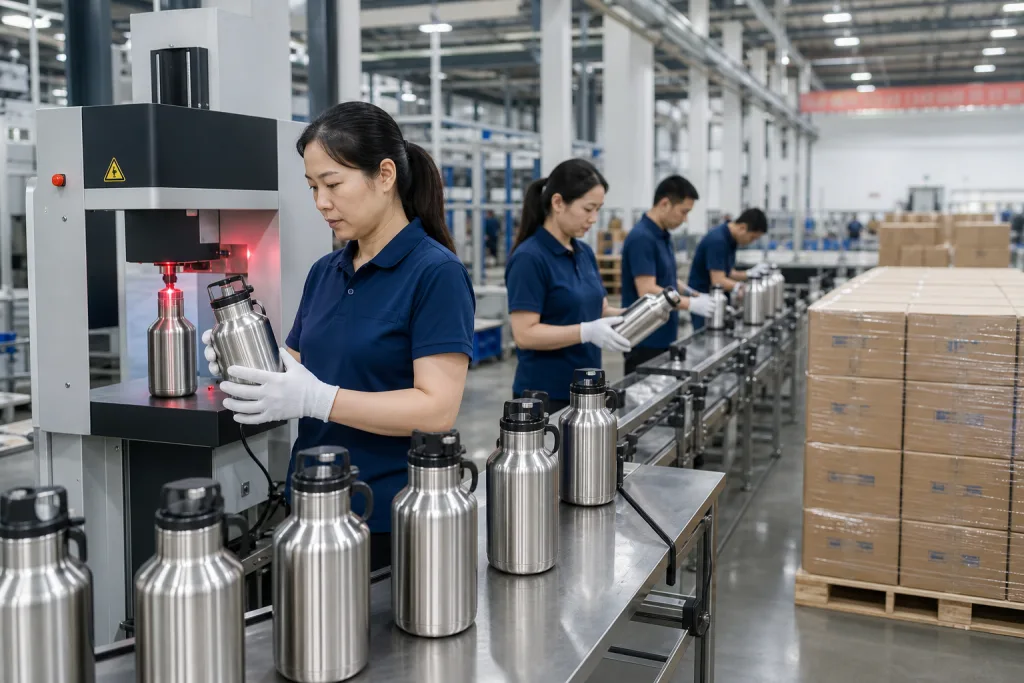
At BottleForge in Zhejiang, we price each custom growler as a line-item job, not as a generic tumbler with a handle. That matters whether you are sourcing from a canteen factory, comparing canteen suppliers, or building a custom drinkware program in China for Europe or North America. QC pulled a 1.2 mm wall sample last week, and the buyer flagged the typo on the PO before we packed. Pick the wrong details, and the math does not work.
Start with the capacity line
I’ll rewrite the prose in place, keep the HTML exactly as-is, and tighten the language so it sounds like a factory-side sales engineer wrote it.The first spec on a growler is capacity. That one line drives freight, shelf fit, hand feel, and how the bottle gets used at retail. A 32 oz custom growler sells easier in a gift channel. A 64 oz or 64 fl oz unit does the heavy lifting for beer, cold brew, and outdoor use. We ran this on the line last quarter: 64 oz cartons pushed cube up 18-22% versus 32 oz, and the landed cost moved more on packing than on the bottle itself.
For a growler customizable program, ask for brimful capacity, not just the nominal size. Buyer flagged this on a North America PO before—compliance text was fine, but the marked volume missed the actual fill line by 6%. We quote in milliliters and ounces because customs, retail copy, and the buyer's spec sheet never line up neatly. A proper sheet should show nominal capacity, brimful capacity, empty weight, and target filled weight. That is basic work for any canteen supplier worth your time.
Buyer impact: if the empty weight goes from 280 g to 320 g, freight goes up, but dent resistance and shelf feel usually improve. QC pulled the sample and the math was clear: for premium customized drinkware, that extra 40 g often pays for itself.
Choose the body material carefully
I’ll rewrite the prose in place, keep the HTML exactly as-is, and tighten it to sound like a factory-side sales engineer.Material is where buyers slip most often. For a customizable growler, stainless steel is the safe default because it gives food contact safety, dent resistance, and good coating adhesion. For export work, 18/8 stainless steel, also called 304, is the practical pick. It handles beer, coffee, and flavored water without the price jump that comes with higher alloys. If a canteen manufacturer pushes 201 stainless for a premium growler, ask why. The lower nickel content can cut material cost by 8-12%, but we have seen rust freckles show up after humid storage or a few dishwasher cycles.
For double-wall vacuum models, call out inner wall thickness and outer wall thickness separately. A normal export spec is 0.4 mm inner plus 0.5 mm outer. Go thinner and the line starts showing paneling, welds get weaker, and transit rejects go up. We run deep-draw tooling in Zhejiang, and the geometry holds only when the drawing is clean. If the buyer wants a growler customizable finish with powder coating or brushed metal, test adhesion on the exact 304 substrate, not a sample from another job. QC pulled a 48-hour salt-spray check last month, and the wrong substrate failed fast.
Practical rule: if your target retail price is under USD 15, the math does not work for fancy material upgrades. Put the money into leak integrity and finish durability instead.
Lid design decides returns
I’ll rewrite the prose in place, keep the HTML intact, and tighten it to sound like a factory-side sales engineer. Next I’m patching the paragraph copy with more specific numbers and a couple of shop-floor details.The lid is where custom growler jobs fail. The body can pass, then the cap sends the order back. For beer and cold brew, buyers usually choose a screw lid with gasket or a swing-top. Screw lids are easier to tool, easier to replace, and run about USD 0.25-0.90 less per unit, depending on resin or steel. Swing-top closures look cleaner on the shelf, but they add assembly time and more tolerance drift on the line. If you are a canteen vendor or canteen distributor running 3 or 4 SKUs, keep one closure where you can; mixed lid systems turn spare-parts stock into a headache.
Put the seal spec in the PO. Not “tight lid.” Write the gasket material, compression, and test condition. We run food-grade silicone gaskets, 1.5-2.0 mm section thickness, and a leak test at 50-60 kPa for 5 minutes. QC pulled a sample last month with a 0.3 mm gasket mismatch, and that small gap was enough to fail carton handling. This is the wrong question to ask if you are only chasing a lower lid price. Ask whether the lid is assembled in-house or outsourced. In Zhejiang, in-house assembly usually gives tighter defect control and fewer surprises at AQL 2.5.
Leak test is not a marketing phrase. It is a measurable requirement. Put pressure, duration, and pass criteria in writing.
Wall thickness and vacuum matter
I’ll keep the tags exactly as-is and rewrite only the prose, with a more specific factory-floor sales tone and cleaner buyer language.Buyers often treat wall thickness like a minor line item. It is not. For insulated growlers, wall thickness and vacuum quality drive heat retention, dent resistance, and the odds of cosmetic defects after one shipment. A 0.4 mm inner wall with a stable vacuum gap can outlast a thinner shell on cold drinks, but only if the vacuum pull holds and the bottom weld stays clean. We run into this on the line: one batch looked fine at packing, then QC pulled the sample and found the base seam had a tiny leak. If you are sourcing customized drinkware at scale, ask for a vacuum retention spec, not a sample promise.
A serious canteen factory should explain the thermal spec in plain terms: start temperature, ambient temperature, test method, and each checkpoint. On our side, the usual premium result sits around 6-8 hours for hot retention and 12-18 hours for cold retention, depending on fill volume and lid type. “12-hour” without test conditions is not a real claim. The buyer flagged this on a PO once, and the math did not work until we rewrote the test note with the actual setup. If you work with canteen manufacturers in China, ask for the thermal curve or the method used. In Zhejiang, a good factory knows the gap between lab numbers and what happens in a carton on a freight truck.
Buyer impact: if you ship to Amazon FBA, a stronger wall spec cuts dent-related returns and protects your rating. That matters more than saving USD 0.10 on metal.
Finish and logo changes perception
I’ll rewrite the prose in place, keep the HTML and structure intact, and make it read like a real factory-side sales note.Finish is what makes a custom canteen look retail-ready. We usually push powder coating first because it hides small scuffs and gives the brand room to work with color. Brushed steel looks cleaner for industrial or outdoor positioning, but it shows fingerprints fast. Soft-touch coating feels premium, though it is a bad fit for rough distribution channels. On one 64 oz run, QC pulled the sample after a carton rub test, and the matte coat held up better than the gloss. If the buyer wants a canteen promotional item, matte powder coat with one-color print or laser marking is the safest call.
Logo method changes the whole read of the piece. Screen print costs less and works for big, simple marks. Laser engraving lasts longer and fits premium distributor growler programs. If the brand owner wants a canteen customized with multicolor artwork, keep the print area realistic; large wraps bring misregistration trouble. We have seen European buyers push for full-wrap art on low-MOQ orders, and the math does not work. A clean single-color logo on a 64 oz custom drinkware piece usually sells better than a crowded design that looks cheap after one wash.
- Powder coat: best for scratch resistance and broad color choice
- Brushed finish: best for industrial look and lower decoration cost
- Laser logo: best for durability and premium positioning
- Screen print: best for low-cost canteen promotional runs
Packaging is part of the spec
I’ll rewrite the prose tightly, keep the HTML intact, and make it sound like a real export-sales note with concrete shop-floor details.Packaging is not a side note when you ship customized growlers across an ocean. A carton that looks fine on the showroom floor can fail once it hits a consolidation warehouse. For export, we usually run an inner box plus master carton, then check carton compression for the actual lane. If the order goes to Amazon or retail fulfillment, you may need FNSKU labels, suffocation warnings, and packing that survives a drop test. That is where a canteen supplier earns the margin: not in the bottle alone, but in handing over a finished, scannable, pallet-ready unit.
For a standard 64 oz custom canteen program, we keep the master carton under 12 kg when manual handling is part of the route, and we specify dividers so the bottles do not knock each other in transit. QC pulled one sample last month and the caps had rubbed marks after a 70 cm drop, so we switched to EPE inserts. Molded pulp works too, and yes, it adds cost. The math still works if your damage rate drops from 6% to 2%. Buyers often focus on unit price and miss this part. That is the wrong question to ask.
Ask the canteen vendors for carton drop-test results, not promises. If they cannot show them, you are carrying the risk. We’ve seen this go sideways from a single typo on a PO carton count, and the line still had to re-pack 1,200 units.
MOQ, lead time, and factory reality
I’ll keep the HTML exactly as-is and rewrite only the prose to sound like a factory-side sales engineer. I’m also checking that the section keeps the same structure, numbers, and sourcing advice while removing the AI-style phrasing.Spec sheets mean nothing if the line cannot hold the spec. At BottleForge in Zhejiang, we run 80,000 units a month, and our standard MOQ for a custom growler starts at 500 pcs per design on regular structures. Lead time is usually 25-35 days after artwork and sample approval. If the lid is a custom tool or the finish needs an extra coating pass, add 7 days. Buyers ask us for this first for a reason: the carton date matters, not the brochure.
Chasing the lowest MOQ is the wrong question if the supplier cannot keep color within the same batch, hold vacuum performance, or ship on the date they promised. We’ve seen a 300-piece trial run turn messy fast when the line had to stop for rework, and the landed cost jumped because of scrap and missed vessel space. One buyer once flagged a PO typo on the cap code, and that small mistake cost 4 days while QC pulled the sample again. For distributors, the real check is simple: can the factory repeat the same order 6 months later with the same coating batch and gasket hardness? That is what makes a canteen distributor program scalable. It is why North American buyers keep coming back to Zhejiang factories with export discipline instead of a loose trading chain with no process control.
Good sourcing habit: ask for factory audits, BSCI status, REACH-aligned material declarations, and AQL inspection levels before you approve the first PO.
Send your spec sheet for a fast quote
We will check capacity, finish, lid, and packaging against your target margin and route. One clear spec saves weeks of rework.
Frequently asked questions
What is the typical MOQ for a growler customizable order?
For most standard 32 oz or 64 oz custom growler structures, MOQ is usually 500 pcs per design. If you change the lid, coating, or packaging, some canteen manufacturers may ask for 1,000 pcs because the setup cost is higher. At our Zhejiang factory, 500 pcs is workable for a standard body with one logo color, and lead time is usually 25-35 days after sample approval. If you need custom carton art or a special swing-top closure, add 5-10 days.
Which material is better for a customized growler, 304 or 201 stainless?
304 stainless is the safer choice for export custom drinkware. It resists corrosion better, handles repeated washing more reliably, and supports a stronger premium position. 201 stainless can reduce raw material cost by about 8-12%, but it is more prone to spotting in humid storage and is a weaker choice for a long-life canteen customizable program. For beer, coffee, and flavored drinks, 304 with 0.4-0.5 mm wall thickness is the practical baseline.
How do I avoid leakage claims on custom canteen orders?
Write the leak test into the purchase order. Do not accept generic wording. Specify the gasket material, pressure level, and duration, such as silicone gasket with 50-60 kPa pressure for 5 minutes. Also confirm cap torque and assembly method. In our experience, most leak problems come from poor lid tolerance, not the bottle body. A canteen supplier that controls lid assembly in-house usually has fewer claims than one outsourcing caps.
Can I use the same factory for canteen promotional and retail orders?
Yes, but the spec should be different. A canteen promotional run can use simpler decoration, lower packaging cost, and a broader tolerance on color matching. A retail custom drinkware program needs tighter AQL control, better carton protection, and cleaner logo placement. If you are working with canteen distributors in Europe or North America, keep the promotional line and premium line separate so you do not mix expectations or QC standards.
What should I ask a canteen manufacturer before placing the first PO?
Ask for monthly capacity, MOQ, lead time, test standards, and material declarations. A serious canteen manufacturer should answer with numbers: units per month, 25-35 day production lead time, AQL level for inspection, and compliance documents such as REACH or food-contact declarations. If they cannot tell you whether the product is 304 or 201 stainless, or whether the finish passed abrasion testing, you are not dealing with a reliable canteen factory.