Key Takeaways
- Typical stainless steel growler MOQ starts at 500-1,000 units per SKU, while custom color plus logo usually becomes efficient at 2,000 units
- FOB China pricing for a 64 oz double-wall growler commonly lands around USD 6.20-10.80 depending on steel grade, lid set, and print method
- Production lead time is often 25-45 days after sample approval and deposit, with new mold parts or custom lids adding 10-20 days
- AQL 2.5/4.0 inspection, REACH-contact material checks, and leak testing should be written into the PO before mass production starts
You can get a growler quote in 24 hours. That part is easy. The harder part is checking whether the price still holds after tooling, logo printing, testing, and freight are added. We have seen first-time buyers miss this and pay for it later. A growler that looks cheap at 500 units can cost more at 3,000 once QC pulled the sample and found light wall thickness, a leaking lid, or a print that rubbed off after the carton drop test.
If you are sourcing from Zhejiang or another part of China, split the job into three checks: unit cost, MOQ structure, and production calendar. This is the right way to compare a bulk growler, a bulk canteen, or a wider drinkware PO; guessing off one FOB number is the wrong question to ask. On our line, buyers often flag the jump from 500 pcs to 3,000 pcs, but the real gap is usually setup cost, decoration choice, and lead time—12 days versus 18 days changes the math fast. The numbers below reflect how export factories in Zhejiang usually quote, schedule, and control this category.
What moves the growler price
When you ask for a growler buy in bulk quote, the first number is just the opening number. We usually build cost from five parts: bottle body, cap system, finish, decoration, and packaging. Break those out line by line on the RFQ. If not, two suppliers can quote the same wholesale growler and ship two different builds; we have seen a PO where the buyer wrote “black matte” and the line packed plain stainless.
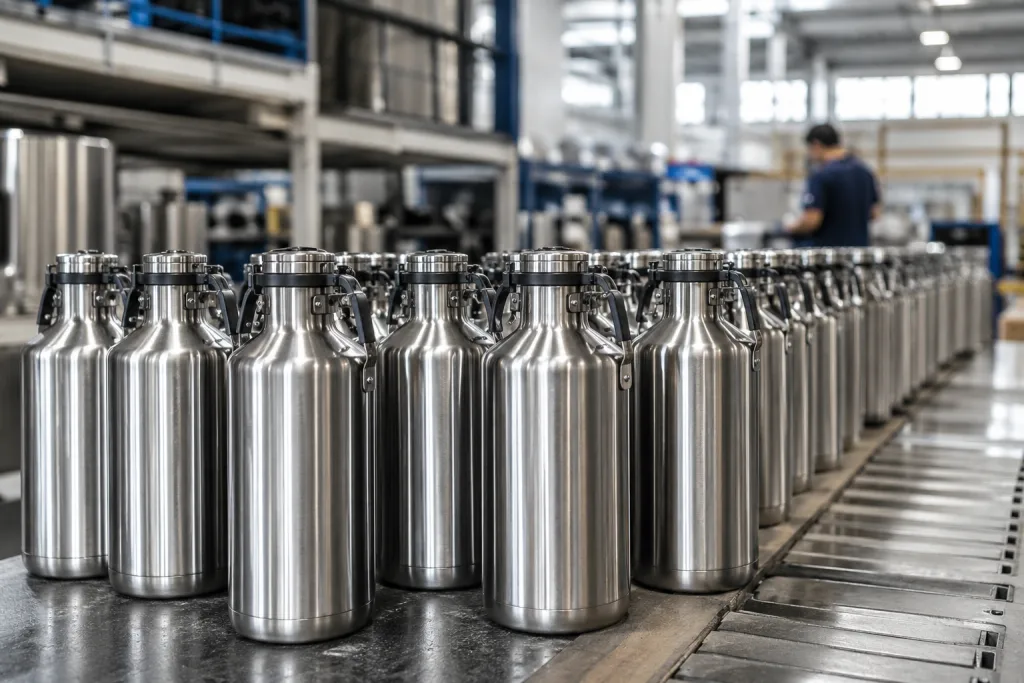
For the bottle body, stainless steel grade and wall thickness move the price first. Most export orders run 18/8 stainless steel inside and outside. A single-wall 64 oz beer growler bulk item can start around USD 3.20-4.80 FOB China at 1,000 units. A double-wall vacuum version is more often USD 6.20-10.80. Material weight changes the math fast. An outer wall at 0.5 mm and inner wall at 0.4 mm will cost less than a body using 0.6 mm and 0.5 mm, and on our floor QC checks random body weight against the tech pack before vacuum sealing. Put weight tolerance on the drawing. If you skip it, you may get a lighter bottle than expected.
Cap choice is the next driver. A simple screw lid with PP and silicone parts is cheaper than a swing-top or handle lid. If you want a pressure-style seal for beer freshness, expect an upcharge of roughly USD 0.35-1.10 per unit depending on hardware. Buyers ask for “freshness” and “low cost” in the same sentence; this is the wrong question to ask because the seal design decides both cost and complaint rate. Powder coating usually adds USD 0.28-0.60 compared with plain stainless. Special finishes such as Pantone-matched matte, rubber paint, or electroplating cost more, and we have seen this go sideways when the buyer flagged color variance after the first 200 pcs off the line.
Decoration is where buyers miss budget most often. A one-color silk screen may add only USD 0.08-0.18. Laser engraving is often USD 0.12-0.30. Full-wrap transfer or digital print can add USD 0.35-0.90, especially on textured surfaces. The same cost logic applies if you are comparing drinkware bulk, wholesale canteen, or the best wholesale drink bottle options across a wider line. On decorated orders, we usually ask for a signed logo size in mm because QC pulled the sample more than once and found the art was approved at the wrong scale.
- Low-cost build: single-wall body, standard screw lid, plain carton; common MOQ 1,000 pcs
- Mainstream build: double-wall vacuum, powder coat, silk screen logo; this is what we ship most often
- Premium build: custom lid, gift box, laser mark, tighter color tolerance; expect slower approval on pre-production samples
MOQ tiers that change the math
MOQ is not just a factory rule. It changes landed cost fast. In Zhejiang, plenty of stainless bottle plants can run 500 pcs on the line, but the math is weak until coating, screen printing, and packing are loaded properly. For a standard growler bulk model already in production, 500 units per size and color is usually a trial level. We see 1,000 units per SKU more often because the setup waste is easier to absorb. Once the buyer wants custom Pantone coating, individual box artwork, barcode labels, or mixed accessory sets, practical MOQ usually moves to 2,000-3,000 units. On our side, the powder coating line changeover alone can eat 30-40 minutes, so this is the wrong question to ask if you only want the lowest starting number.
A simple way to think about it:
- 500 units: workable for a stock shape with stock lid and a 1-color logo; QC still watches decoration closely because small runs show setup loss faster
- 1,000 units: better unit cost, and the decoration setup is steadier once the line runs past first-pass adjustment
- 2,000-3,000 units: custom packaging starts to make sense, especially when the gift box supplier asks for a 2,000 pc print run
- 5,000+ units: now you have room to negotiate component buying, spare lids, and tighter master carton loading such as 12 pcs instead of 10
For example, a 64 oz double-wall beer growler wholesale project at 500 units may quote at USD 8.90 FOB. The same bottle at 2,000 units may fall to USD 7.45-7.90 because coating loss, printing setup, and carton procurement spread better over volume. That gap is normal. We have seen buyers push back on 2,000 pcs, then accept the higher 500 pc price and find out the freight-per-unit math doesn't work. If you also run a sister item such as a beer tumbler bulk SKU or a canteen bulk bottle on the same purchase order, some factories in China will combine steel and packaging buying power even when the products run on separate lines. We ship this way often, but only if the PO details are clean; last season one buyer flagged a carton mark issue that came from a single digit typo in the barcode list.
This matters for brand owners building a range, not a single bottle. If your catalog includes wholesale drinkware, canteen wholesale, and bulk canteen programs, ask whether the supplier allows mixed-item MOQ by finish family. A brushed 304 stainless group is easier to combine than one brushed SKU plus one rubber-coated SKU because the lines and material loss are different. At our Hangzhou, Zhejiang production network level, standard MOQ typically starts from 1,000 units per model, but annual blanket orders can often be split into release shipments with lower per-drop quantities. We have done 1,000 pcs monthly against a 12,000 pc blanket order, and the buyer got cleaner stock flow without paying small-run pricing.
Do not ask only for the factory MOQ. Ask for the MOQ where your target cost actually becomes achievable.
Lead time from quote to vessel
Lead time is the part buyers misread most. We see quotes with “25 days” on the first page, then the PO gets stuck on artwork, sample approval, or one 0.3 mm thread change on the cap. For a realistic growler wholesale schedule, break the job into approval stages and ask what starts only after your sign-off. A stocked bottle with a one-color logo moves fast. A custom item with a new cap, revised box, and compliance testing does not. This is the wrong question to ask: “What is your fastest lead time?” Ask what will hold the line.
Typical schedule for repeat structure
- Quotation and spec confirmation: 1-3 days
- Artwork review and pre-production layout: 2-4 days
- Sample making: 5-10 days
- Sample courier to Europe or North America: 3-7 days
- Mass production: 25-35 days after approval and deposit
- Final inspection and booking: 3-5 days
That puts most repeat-structure orders at 40-55 days before cargo is ready ex-factory or FOB China. In peak windows, add 7-15 days and do not argue with it; the math doesn’t work if the vacuum line is already full. Before summer outdoor season and Q4 gifting, Zhejiang factories making drinkware wholesale products usually run coating and vacuum stations close to capacity, and booking slips even when production is finished.
Add one custom point and the clock changes. A new lid tool or modified neck finish adds 10-20 days for mold work and trial runs, and QC pulled one trial here because the cap torque was out of range after the first spin test. Custom color boxes add 5-7 days if the printer is not holding your board stock. Third-party lab testing for food-contact materials adds another 5-12 days depending on the protocol. If you ship to Amazon, FNSKU labeling, carton drop-test requirements, and appointment scheduling add time after production ends. We have seen this go sideways over one PO typo on carton marks.
The same timing logic applies if your range also includes beer tumbler wholesale, beer tumbler in bulk or alcohol flask bulk. Small stainless items look faster on paper because they use less steel. On the floor, that is not always true. Special plating, leather-wrap assembly, or hand-fit accessory parts can slow the line more than a standard growler body. Ask for a day-by-day critical path with dates for sample sign-off, bulk start, inspection, and booking, not one shipment date the buyer flagged and nobody can defend later.
Cost ranges by product type
Procurement teams usually ask for target numbers before they approve samples. The ranges below are not fixed across every factory, but they match export-grade buying from China at normal commercial volumes. We are talking FOB pricing, standard export cartons, and routine QC on the line, not gift-box retail packs. On our side, a standard master carton check includes carton drop condition and gross weight against the packing list before shipment.
- 64 oz single-wall growler: USD 3.20-4.80 at 1,000 units
- 64 oz double-wall vacuum growler: USD 6.20-10.80 at 1,000 units
- 32 oz vacuum growler: USD 5.40-8.60 at 1,000 units
- 18-22 oz beer tumbler bulk item: USD 2.20-4.30 at 2,000 units
- 8 oz alcohol flask in bulk: USD 1.10-2.40 at 3,000 units
- 20-32 oz canteen wholesale bottle: USD 3.00-6.20 at 1,000-2,000 units
What moves a quote to the high end? Heavier steel gauge, copper plating for longer vacuum hold, custom lid parts, harder welding points, or retail-ready packing. A gift box with EVA insert can add USD 0.65-1.80 by itself. We have seen buyers focus on body price and miss the cap build; that is the wrong question to ask if the lid has 4-5 plastic and silicone parts. If you need a beer growler wholesale bulk set packed with a strap, a cleaning brush, or cups, break out each item on the quote. Bundled pricing hides margin, and we have seen this go sideways after sample approval.
Compare product families straight. One wholesale drinkware supplier may post a sharp growler price, then make it back on cartons, labels, or sample charges. Another may run a clean alcohol flask wholesale bulk program at 3,000 pcs MOQ but have weaker yield on large vacuum bottles because the neck and shoulder welding are less forgiving. Ask for net weight, carton size, packing qty, and gross weight on every quote. QC pulled the sample on one order last year because the PO said 24 pcs per carton, but the transit carton drawing showed 20 pcs. Freight cost per usable liter usually tells you more than unit price alone.
As a factory benchmark, larger Zhejiang plants can run more than 300,000 stainless units per month across tumblers, flasks, canteens, and growlers. That does not mean every line is open. We ship plenty of common tumblers fast, but growler neck welding and special cap assembly are separate bottlenecks. A line may have capacity on straight-body items while the growler station is backed up 12 days versus 18 days on a peak-season schedule.
Quality checks worth paying for
A low unit price does not save you if 4% of the shipment leaks, or if the powder coat chips before the cartons reach retail. On bulk growler orders, the losses usually start before mass production: wrong silicone hardness, a loose thread gauge result, a weld line QC pulled but nobody stopped the line. You do not need a heavy QC system. You need the right checkpoints written into the PO, with clear pass/fail limits.
Start with incoming material control. Check the stainless grade declaration, verify silicone and PP parts against the approved sample, and lock the coating adhesion standard before coating starts. Then watch the line: weld appearance, thread fit with a go/no-go gauge, and vacuum performance. For final inspection, many buyers use AQL 2.5 major / 4.0 minor. That works for most drinkware bulk orders. Premium retail buyers often tighten appearance limits to 1.5 mm paint flaws while leaving functional checks at the standard level. We have seen this go sideways when the PO says “good finish” and nothing else.
- 100% leak test on capped bottles
- Vacuum retention spot check after 6-12 hours
- Coating adhesion cross-hatch test
- Logo position and Pantone tolerance check
- Carton drop test if shipping e-commerce
If the product touches beverages, ask for REACH and LFGB-supporting raw material declarations for the EU, and FDA-relevant food-contact documentation for the US market where applicable. That is basic paperwork, not a bonus. On one PO, the buyer typed “LFBG” instead of LFGB, and the document check stalled for 2 days while both sides argued about the request. For children’s items, ASTM or CPSIA is a separate route and usually not part of a growler program. Social compliance such as BSCI can matter if your customer asks for it, but it does not replace product QC.
The same inspection logic applies when a program expands into wholesale canteen, alcohol flask wholesale, or beer tumbler wholesale bulk. Your supplier should show defect photos, rework rules, and carton marking controls before first production. If the buyer flagged a barcode size issue at 38 mm on the outer carton, that should already be in the packing spec. Waiting until the container is booked is the wrong move.
How to place the first PO
The smoothest first order is almost never the most customized one. If this is your first China buy, and especially your first run in Zhejiang, cut the variables on PO #1. We usually suggest one existing mold, one body color, one logo method, and standard export packing unless retail presentation is a hard launch requirement. Less to juggle. On the line, that means fewer setup changes and fewer chances for QC to pull a sample with the wrong print position by 3 mm.
A workable first PO for a growler buy in bulk program looks more like this: 1,000 units of one 64 oz vacuum model, two carton marks, one laser logo, leak-test requirement, AQL standard, and FOB Ningbo or Shanghai terms. That is a clean start. If sell-through is there, PO #2 is the place for gift boxes, accessory kits, or a second lid style. We have seen buyers chase a USD 0.20 target at launch, then lose 12 days on approval changes and repacking. The math doesn't work.
Payment terms in this category are commonly 30% deposit and 70% balance against inspection or copy B/L, though stronger buyers sometimes push for other terms after 2 or 3 repeat orders. Your PO needs to spell out steel grade, capacity tolerance, body weight, finish code, logo size, packaging spec, inspection level, and shipping mark layout. Put it in writing. Last month a buyer flagged a PO typo where matte black and satin black were mixed on the same sheet, and that sort of mistake turns a claim into an argument fast.
If your line plan also includes alcohol flask in bulk, beer growler in bulk, or a cross-category drinkware wholesale assortment, lock the release dates early. Mixed containers only run smoothly when every SKU has approved artwork and cartons ready on time. We ship these combinations often, and one delayed flask carton or one tumbler lid approval can hold the full booking at the warehouse. We have seen this go sideways.
Buyers who handle this well treat the factory like an operations partner, not just a quote machine. That is the right habit. A solid first wholesale growler order builds a sourcing program with repeatable cost, lead time, and quality, and it starts with a PO detailed enough that both sides are checking the same spec sheet at final inspection.
Get a practical growler bulk quote
Send your target size, quantity, logo method, and delivery window. We will reply with MOQ tiers, FOB pricing, and realistic lead time from Zhejiang, China.
Frequently asked questions
What is a realistic MOQ for growler buy in bulk if I am launching a new brand?
For a new brand, a realistic starting MOQ is 500-1,000 units per SKU if you choose an existing mold and a standard lid. At 500 units, your factory may limit you to one stock color and one simple logo method. If you want custom Pantone powder coating, printed gift boxes, or accessory bundles, the practical MOQ usually moves to 2,000 units. In China, many suppliers quote low MOQs to win the inquiry, then recover cost through setup fees or higher unit pricing. Ask for three brackets: 500, 1,000, and 2,000 units. That shows where the cost curve changes. For a 64 oz vacuum growler, you may see USD 8.90 at 500 units, USD 8.10 at 1,000, and around USD 7.50 at 2,000 FOB.
How long does a bulk growler order usually take from approval to shipment?
If the bottle shape and lid are already in the factory line, mass production normally takes 25-35 days after sample approval and deposit. Add 5-10 days for pre-production samples and 3-7 days for courier delivery if you need physical approval in Europe or North America. Final inspection and booking usually need another 3-5 days. That puts a standard order at roughly 40-55 days total before ocean transit. If you add a new cap, custom box insert, or lab testing, add 10-20 days. Peak season in Zhejiang and other China production hubs can also stretch schedules by 7-15 days, especially for powder coating and packaging suppliers.
What should I expect to pay for a wholesale growler compared with a canteen or flask?
A 64 oz single-wall wholesale growler often lands around USD 3.20-4.80 FOB China at 1,000 units. A double-wall insulated version is more commonly USD 6.20-10.80. By comparison, a 20-32 oz canteen wholesale bottle is often USD 3.00-6.20, while an 8 oz alcohol flask wholesale bulk item may be USD 1.10-2.40 at 3,000 units. Growlers cost more because they use more steel, larger cartons, and sometimes more complex caps. If you compare quotes, request body weight, steel grade, cap material, and carton pack-out. A lower unit price can disappear quickly if the supplier uses lighter gauge steel or oversize cartons that raise freight cost.
Which quality checks matter most on beer growler wholesale bulk orders?
The critical checks are leak resistance, vacuum retention for insulated models, coating adhesion, and thread fit. For most buyers, a good baseline is AQL 2.5 for major defects and 4.0 for minor defects, plus 100% leak testing before packing. Ask the factory to confirm stainless grade, silicone seal specification, and logo adhesion method before production starts. If you are selling into the EU, request REACH-related material declarations; for the US, ask for food-contact compliance support documents relevant to the components used. If cartons are going into e-commerce channels, add drop-test requirements. These controls matter more than cosmetic details because one leaking shipment can wipe out the savings from a cheap FOB price.
Can I combine growlers with beer tumblers or alcohol flasks in one purchase order?
Yes, and it often helps if you are building a broader drinkware wholesale range. Many China suppliers can combine a beer growler in bulk program with beer tumbler wholesale bulk or alcohol flask bulk items in one order, but you need to understand the MOQ by product family. A factory may accept 1,000 growlers, 2,000 tumblers, and 3,000 flasks under one commercial order while still producing them on different lines. The benefit is shared freight planning, fewer payment batches, and sometimes better packaging pricing. The risk is schedule misalignment. If one SKU is waiting on artwork or cartons, the container can be delayed. Use one master timeline with sample approval dates, packaging deadlines, and inspection windows for each SKU.