Key Takeaways
- A typical stainless growler bulk MOQ is 500-1,000 pcs, with lead time around 25-35 days after sample approval.
- For insulated beer growler wholesale orders, 18/8 stainless with 0.5 mm inner and outer walls is a safer baseline than thinner 0.4 mm builds.
- Ask for AQL 2.5 major / 4.0 minor inspection, plus leak testing at 30-50 kPa for pressurized lids and growler caps.
- A Zhejiang factory with 80,000+ units/month capacity can handle drinkware wholesale programs better than small workshops that only do one-off custom jobs.
If you are buying growler bulk, do not treat it like a simple bottle order. A 64 oz stainless growler for a brewery, a branded beer growler wholesale run, and an alcohol flask wholesale bulk order fail for different reasons: lid leaks, weak coating adhesion, bad welds, or a spec sheet that looked fine until the first 500 units hit your warehouse. We have seen a buyer sign off on a 0.5 mm wall, then the seam split on drop test after QC pulled the sample.
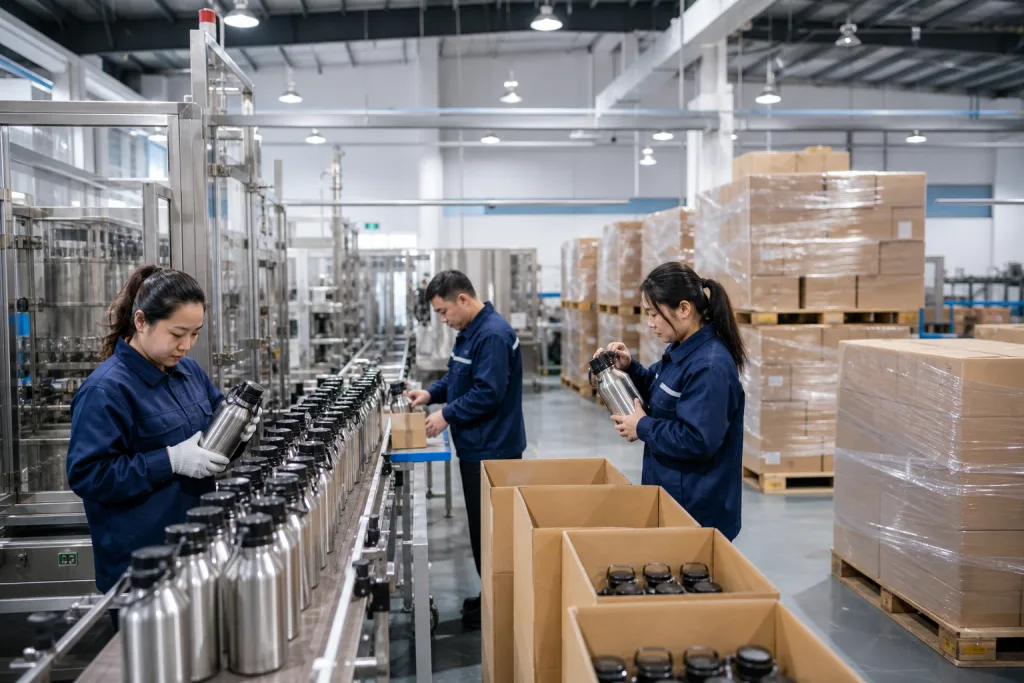
In Zhejiang and across China, the factories that do this well talk in thickness, finish, seal structure, and test standards. Not colors. Not logo placement. That is the level you need if you want drinkware bulk pricing without paying for hidden defects later. A good supplier in China should give you a clear MOQ, a real monthly capacity, and test reports you can audit, not marketing copy. We run one line with a 12-day lead time versus 18 days when the cap liner spec changes, and the buyer usually flags the same issue: the math does not work if the factory cannot show numbers.
Start with the use case
Before you talk about finish or logo placement, define what the bottle has to do on the line. A bulk growler for a taproom giveaway is not the same part as a beer growler wholesale item packed for retail, and neither behaves like a bulk canteen for hiking stores. If the brief stays vague, we quote the easiest spec, not the right one. We have seen that go sideways fast.
For beverage brands and breweries, we split the job into three buckets: cold-fill storage, retail display, and field use. Cold-fill storage can run with a simpler lid and fewer parts. Retail needs a cleaner surface, tighter carton protection, and decoration that stays aligned within 1 mm. Field use pushes you toward a tougher powder coat, thicker steel gauge, and a lid that can take 200-plus openings without loosening. That is why wholesale growler sourcing starts with the channel, not the color. The buyer who skips this usually comes back with a sample complaint on week 2.
Ask these questions up front:
- Is this for beer, tea, water, or mixed beverage service?
- Will it be carried loose, boxed, or shelf displayed?
- Do you need insulated or single-wall construction?
- Is the priority beer growler wholesale bulk cost, or premium retail presentation?
If you want the right wholesale drink bottle for a beverage launch, the factory has to see the channel math. In Zhejiang, the better suppliers ask for target price, expected annual volume, and packaging method before they quote. QC pulled a sample last month because the PO said 12 oz and the buyer meant 16 oz. That is a good sign, not pushback.
Read the material spec line by line
The material line is where a buyer saves $0.20 and pays $2.00 later in returns. For stainless drinkware wholesale programs, 18/8 or 304 stainless is the base spec we run. It gives better corrosion resistance and less metallic taste. If a supplier pushes 201 steel for a bulk drinkware order, ask why. We saw this go sideways on a 5,000-unit PO when the buyer flagged rust spots after salt-spray testing. Lower material cost can work for short-run promo pieces. It is the wrong call for retail-grade wholesale drinkware.
Wall thickness matters more than most new buyers expect. On a 32 oz or 64 oz growler, 0.5 mm inner wall is a practical floor for rigidity. We check it with a micrometer at the line, not by eye. Some budget units come in at 0.4 mm, and they dent in transit and on store shelves. For insulated models, do not stop at the vacuum bottle copy on the carton. Ask for vacuum leak rate data or a thermal retention claim tied to test conditions.
For non-stainless programs, the material choice shifts again. Glass wholesale canteen orders need annealing data and impact protection in the carton spec. Tritan or other copolyester products are lighter, but chemical resistance and flavor neutrality still need proof. If the product will be used as an alcohol flask bulk or alcohol flask in bulk item, confirm food-contact compliance and gasket compatibility with ethanol-based liquids. One PO typo changed “Tritan” to “tritan,” and QC pulled the sample because the resin grade was never stated. China factories that sell across categories often mix terms loosely, so get the exact resin grade, steel grade, and coating system in writing.
Closures decide your return rate
Most leaks come from the closure, not the bottle body. For growler bulk orders, the lid spec should state thread type, gasket material, torque target, and any venting or pressure behavior. We had one buyer send a PO with “cap same as sample” and no torque callout; QC pulled the sample after 3 warehouse drops and two hot-cold cycles, and it started weeping at the seam. Good factories in China test the closure as a set, not as a loose part on the desk.
For stainless growlers, the usual choices are screw caps, swing-top mechanisms, and tethered lids. Screw caps are the safest pick for high-volume growler wholesale orders because the line can run them faster and QC can check them with a torque wrench in seconds. Swing-tops look nicer on shelf, but they add parts, extra assembly, and more failure points. We’ve seen that go sideways on a 5,000-piece order when the buyer wanted a lifestyle look but still expected zero returns. If the brief is promo or taproom retail, use them. If the math is the priority, keep it simple.
Do not accept a verbal promise of leak-proof. Ask for:
- Leak testing at 30-50 kPa for sealed units
- Torque spec for threaded caps
- Gasket material, usually silicone or TPE
- Drop test result from 1.0 m or 1.2 m
For beer growler wholesale programs, this is not optional. A leaky cap triggers retail complaints fast and drags down margin on the first claim. The wrong question to ask is whether the lid “looks tight” in hand; the only thing that matters is whether it holds after a real run through packing, transit, and shelf abuse.
Decoration affects both cost and yield
Decoration is where a lot of buyers lock in a brand look and then wonder why yield drops on the line. For beer tumbler bulk or beer tumbler wholesale, we choose the method by substrate and end use first, then talk about price. Screen printing works for a 1-color or 2-color mark. Laser engraving gives a clean metal finish on stainless and holds up better in use. Heat transfer and UV printing bring more detail, but they also bring more scrap risk.
On powder-coated bottles, the coating becomes part of the decoration. A 0.3 mm rough coat can hide hairline scratches, and it can also blur a fine logo. QC pulled the sample on one run and flagged a thin edge on the icon. We had to redo the plate. If your brand spec is strict, ask for a pre-production decoration proof on the actual bottle, not a PDF mockup. That PDF approval has burned more than one program.
In Zhejiang, factories with mature export lines quote decoration apart from bottle cost. That is normal. It lets you compare a best wholesale drinkware quote against a low headline price that turns into expensive post-processing later. Ask for the number of print positions, the color tolerance, and the dishwasher test result if the item will be reused. We ship these checks every week, and a buyer once sent a PO with the logo position written as “center-ish”; the math does not work.
If the artwork needs more than two exact PMS colors on curved stainless, stop and check the risk. We have seen that go sideways on a 500 pcs pilot and on a 20,000 pcs re-order. A single strong logo is often the better commercial call for wholesale drink bottle retail channels. Cleaner piece. Better yield.
Check packaging before you price
Packaging is not a side note when you buy canteen wholesale or wholesale canteen volumes. We’ve seen a buyer save $0.08 per unit on carton board, then eat dents, print rub, and one pallet collapse on a 40HQ. Ugly math. A growler or canteen needs proper internal support, especially on matte, powder-coated, or dark finishes where scuffs show fast.
For export shipments from China, I want three things in the pack spec: individual protection, master carton strength, and pallet pattern. Individual protection can be a polybag, molded pulp, or insert tray; on the line, we check the insert fit with a 2 mm gap, not by guesswork. Carton strength should match the lane, and for heavier insulated units we ask for 5-ply or equivalent. Pallet pattern has to match your warehouse receiving, not just the factory’s favorite stack.
If you sell on marketplaces, the pack plan needs barcode discipline from day one. For Amazon-style programs, build the label zone into the carton and inner pack early, because the buyer will flag a crooked FNSKU on the first inbound. FNSKU placement, suffocation warnings if needed, and carton marks must be locked before mass production starts. This matters just as much for drinkware wholesale as it does for alcohol flask wholesale bulk. The wrong box spec turns a low-cost item into a return pile.
Ask for a packaging drop test and a transit simulation if the route includes long ocean freight plus cross-dock handling. We run that test with a 1.2 m drop and check corner crush after 12 drops; QC pulled the sample if the lid pop-opened once. A serious Zhejiang supplier will take that request in stride.
Audit the factory like a buyer
If you are placing a real bulk growler program, you are not buying a SKU and walking away. You are checking a factory system. In China, plenty of trading companies can send a fast quote, but the line behind that quote decides whether your next order matches the sample. We ask for monthly output, QC flow, and which certificates sit on file before we even talk price.
A solid export factory in Zhejiang may run 80,000 to 120,000 units per month across bottle lines, with separate stations for stamping, polishing, coating, assembly, and final inspection. That does not make it a safe supplier by itself. It does tell you the plant has room for repeat business. On a 5,000-unit bulk drinkware launch, 25-35 days after sample sign-off is a fair target. We have seen buyers push for 18 days, and the math does not work unless you cut QC or pay for a hot line.
Ask for documents, not promises:
- BSCI or equivalent social compliance if your customer requires it
- REACH and food-contact declarations for Europe
- Material traceability by lot
- AQL plan, ideally 2.5 major and 4.0 minor
- Photo or video of the final inspection line
Some buyers get stuck on certificates and miss production discipline. That is the wrong question to ask. You want both. A factory that handles wholesale drinkware and growler wholesale should be able to show the path from raw tube to packed carton, with QC pulled the sample and checked the weld seam at 0.8 mm. That is what you are paying for when you source from Zhejiang or elsewhere in China.
Send your growler spec for a factory quote
We will check material, MOQ, closure, and packaging line by line before you commit. Faster quotes, fewer surprises, cleaner China sourcing.
Frequently asked questions
What MOQ should I expect for growler bulk orders?
For most stainless growler bulk programs, a normal MOQ is 500 to 1,000 pieces per design and color. If you need custom logo, custom lid color, or special coating, 1,000 pieces is easier to price cleanly. For simple stock items, some Zhejiang factories can do 300 pieces, but unit cost rises fast. If you want mixed SKUs in one shipment, ask whether the factory can combine production by shell while keeping separate decoration. That is often the best way to control cost without bloating inventory. For true retail-scale wholesale growler programs, 3,000+ units usually unlocks better packaging and freight efficiency.
What price range is realistic for a custom beer growler wholesale order?
A plain stainless beer growler wholesale unit can start around USD 3.20 to 5.80 depending on capacity, wall thickness, and lid type. Insulated double-wall versions with powder coating and a better closure often land around USD 6.50 to 11.50 ex-works. Laser engraving, premium packaging, and special finishes can add USD 0.20 to 1.20 per unit. If a quote looks far below that range, check whether the supplier used 201 steel, thinner gauge metal, or a cheaper gasket. The lowest price is often the most expensive choice once returns and replacements are counted.
What QC checks matter most for drinkware bulk sourcing?
For drinkware bulk and drinkware wholesale orders, start with leak test, visual inspection, coating adhesion, and dimensional checks. For growlers, I also want a closure torque check and a drop test. AQL 2.5 major and 4.0 minor is common for export programs, but the key is what the factory actually checks before packing. Ask for material certificates, especially for stainless grade and food-contact parts. If your customer is in Europe, REACH declarations and traceability by lot are helpful. For North America, consistent packaging and barcode accuracy matter just as much as the bottle itself.
Can I source alcohol flask wholesale bulk and growlers from the same factory?
Yes, if the factory already handles stainless forming, welding, polishing, and coating. Many Zhejiang factories do both growler and alcohol flask wholesale bulk programs because the core metalwork is similar. The difference is in shape, cap structure, and compliance expectations. For flasks, gasket compatibility and leak resistance become more important because the liquid may be higher-proof. For growlers, volume retention and mouth size are more relevant. You can often combine tooling knowledge and decoration setup, but you should still approve each SKU separately. Do not assume one production line equals one identical QC standard.
What lead time should I budget for a new custom wholesale drinkware order?
For first-time custom wholesale drinkware orders from China, budget 7-10 days for sample making, 3-5 days for sample approval, and 25-35 days for mass production after approval. If your decoration is complex or your packaging is fully custom, add another 5-7 days. Ocean freight from Zhejiang to Europe or North America then depends on the lane, but the factory timeline is usually the part buyers underestimate. If you need a launch date, lock the artwork and carton spec early. The fastest way to miss a date is to keep changing logo size after the pre-production sample is approved.