Key Takeaways
- Start with 4 decisions first: insulation, capacity, decoration, and packaging; this cuts quotation revisions by 30% to 50%
- Typical MOQ for custom stainless steel growler bottle wholesale is 500 to 1,000 pcs per size, with 25 to 35 day lead time after sample approval
- A workable factory quality plan should define AQL 2.5 for major defects, 4.0 for minor defects, plus 100% leak testing before packing
- For stable margin, compare landed cost by decoration and carton efficiency; a cheaper unit price can still raise total cost by 6% to 12%
Growler bottle wholesale orders rarely fail because a catalog photo looked good. The trouble shows up later on the line: a lid leaks after thermal cycling, powder coating gets scratched in transit, a 3,000 pcs MOQ leaves slow stock in the warehouse, or the shipper fails a 76 cm drop test and landed cost jumps by 9%. For procurement managers and brand owners, the job is not just finding a supplier. The job is locking the trade-offs early enough to protect margin and delivery.
If you are sourcing from Zhejiang, China, or other parts of China, start with four decisions: insulation structure, capacity with neck style, decoration method, and packaging plus compliance level. We have seen buyers spend 10 days comparing quotes before confirming whether they want vacuum double wall or single wall, and that is the wrong question order. Once those points are fixed, pricing, MOQ, and lead time are much easier to compare across factories. That is how you avoid buying a bulk growler that looks fine in a sample photo while QC pulled the sample and already saw weak market performance coming.
Decide the bottle architecture first
If you are buying growlers for beer, cold brew, outdoor retail, or promo channels, do not start with color or logo. Start with bottle architecture. A 64 oz double-wall vacuum bottle runs like a different item from a single-wall 1.8L canteen program, even if the body profile on the CAD looks close. This choice drives steel grade, wall thickness, lid build, insulation target, and the unit price the buyer will accept. We’ve seen this go sideways when a PO says “growler bottle, matte black” and nothing else.
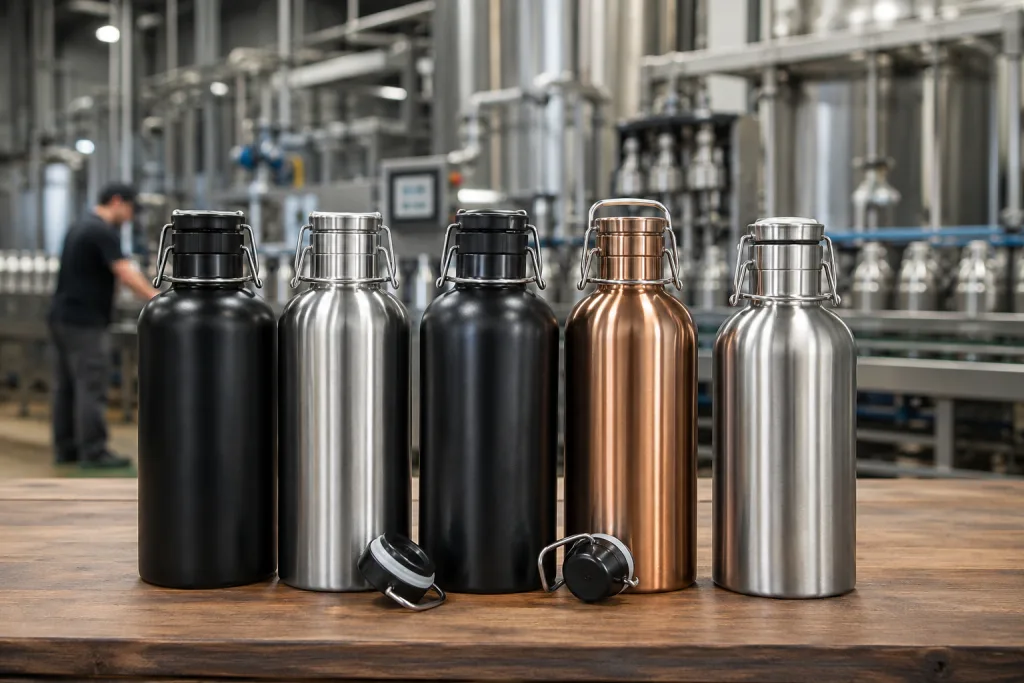
For most wholesale growler programs, the base spec is food-contact stainless steel with 18/8 interior, usually called SUS304. On export orders to Europe and North America, this is still the safe mainstream pick for odor control, corrosion resistance, and compliance work. Single-wall builds cost less and ship lighter—on one 40HQ load, the freight math changed by 12% in a recent 64 oz program—but they fit ambient liquids or short hold times better. Double-wall vacuum is the standard for premium beer growler orders, outdoor gift sets, and branded drinkware because it gives you insulation claims and a stronger shelf story. This is the wrong question to ask: “Which one looks better?” Ask which structure matches the use case and target margin.
- Single-wall stainless: lower cost and lower weight, often used for entry-level drinkware orders, event programs, or MOQ-sensitive runs starting at 1,000 pcs.
- Double-wall vacuum: higher unit cost, stronger thermal retention, and a better fit if the buyer wants premium wholesale drink bottle positioning and thicker hand-feel on the line.
- Typical capacity range: 32 oz, 40 oz, 64 oz, and 128 oz for some niche commercial use.
- Common wall thickness: 0.4 mm inner and 0.5 mm outer on standard vacuum models; heavier builds may go to 0.5/0.5 mm.
Neck design matters. A wide mouth makes filling and cleaning easier, but beer channels need a cap system that controls leakage and slows CO2 loss. Swing tops look traditional, and buyers ask for them all the time, but screw caps with silicone gaskets are easier to scale, torque-test, and inspect at production level. QC pulled the sample on one run because the gasket seat was off by 0.6 mm, and that small miss is enough to create leak complaints. If you also sell adjacent lines such as wholesale canteen, bulk canteen, or beer tumbler wholesale bulk, keep lid families and surface finishes aligned. That cuts tooling cost, carton count, and packaging mistakes.
You are not buying a shape. You are buying a performance package: steel, insulation, cap, gasket, and process control.
Match MOQ to your sales channel
The second decision is volume strategy. New buyers often push for the lowest MOQ, and this is the wrong question to ask. For growler bottle wholesale, the better target is the MOQ that fits your sales channel and your reorder speed. Buy too little, and your unit cost jumps because powder coating setup, screen setup, carton print plates, and final inspection labor get spread over fewer pieces. Buy too much, and the savings disappear into storage fees, slow-moving stock, and old packaging sitting in the warehouse.
In Zhejiang, China, a workable MOQ for custom stainless growlers is usually 500 pcs per color per size for standard molds, and 1,000 pcs if you want more complex decoration or exclusive packaging. Plain stock-color programs sometimes go lower, but only when the factory already has matching lids, seals, and boxes on the shelf. On our side, a line running 300,000 units a month across tumblers, sports bottles, and growlers is normal for mixed drinkware wholesale planning. Standard sample lead time stays at 7 to 10 days, and mass production is usually 25 to 35 days after deposit and artwork approval. If the buyer adds a new gift box with a 3 mm E-flute insert, expect more back-and-forth before we ship samples.
Channel-based MOQ logic
- Distributor programs: keep more colors, split volume across more SKUs, and stick with standard export cartons so the line runs faster.
- Brand retail: take the higher MOQ when the shelf price supports custom coating, cleaner logo application, or a better box. The math works better there.
- Promotional projects: chase the target price early, lock artwork fast, and avoid decoration steps that slow approval. We have seen one PO typo on logo size hold a full print run.
- Amazon FBA or e-commerce: check carton dimensions, FNSKU labeling, and replenishment timing from day one. QC pulled the sample more than once because the outer carton missed the label position mark.
If you are combining wholesale growler with wholesale drinkware, alcohol flask wholesale bulk, or beer tumbler in bulk in one container, ask the factory to quote mixed-SKU loading efficiency. Sometimes a lower MOQ on each SKU is possible if the total order value is strong enough to keep the slot open on the line. This is common in China when the supplier wants to fill one production window with related items and avoid idle capacity. Ask how MOQ changes by finish too. Powder coating, custom pantone painting, laser engraving, and gift box packaging each hit break-even at different volumes. We check this by process, not by guesswork, and the buyer usually flags gift box MOQ first because the carton supplier may ask for 1,000 sets.
The practical question is simple: how many weeks of stock do you want to carry? Give a clear number—8 weeks, 12 weeks, not “we will see later.” If that answer is fuzzy, the MOQ discussion stays fuzzy, and pricing moves around every time the spec changes.
Compare cost beyond the unit price
A growler bottle wholesale quote looks cheap fast if you stare at FOB unit price only. That is the wrong question to ask. Compare total landed cost per sellable piece instead: bottle, cap, finish yield, inner pack, master carton count, inspection, testing, container loading, and claim rate. We have seen a factory come in USD 0.25 lower per piece, then lose that gap because the carton fit was poor and QC pulled 7 leaking samples from a 200 pcs check.
For standard stainless growler wholesale projects from China, a broad FOB range might look like this: single-wall 64 oz around USD 4.20 to 5.80, double-wall vacuum 64 oz around USD 6.80 to 9.80, depending on steel weight, cap style, finish, and packaging. On the line, a heavier body from 0.5 mm to 0.6 mm steel changes cost fast. Premium lids, copper plating for improved vacuum retention, textured powder coating, and custom color cartons all push the number up. Ask what each extra dollar buys, not just where the quote lands.
- Decoration cost: silk screen is cheaper at volume; laser engraving costs more but avoids ink adhesion issues. We usually see this come up after a tape test fails on a matte powder coat sample.
- Cap assembly: metal-lined or insulated caps add cost but improve premium feel. Buyers flag this when the cap weight jumps by 40 g and freight math changes.
- Carton efficiency: changing bottle geometry can alter pcs per carton and pcs per container. A 2 mm wider base can cut loading from 1,800 pcs to 1,620 pcs in one container.
- Claim risk: poor gasket consistency can create returns that erase initial savings. We have seen Shore hardness drift on silicone gaskets turn into leak complaints after shipment.
If you also source canteen wholesale, alcohol flask bulk, or beer tumbler bulk from the same supplier, use shared components where possible. Shared lid diameters, gasket specs, and color systems cut tooling risk and make spare parts easier to manage. For example, if two products can use the same 63 mm cap family, your replacement parts program gets simpler and cheaper. We run this setup often, and it saves headaches when a PO has one lid code typed wrong.
Ask every supplier to quote the same basis: FOB Ningbo or Shanghai, same capacity, same steel grade, same finish, same packaging, and same test standard. Zhejiang factories are used to detail at this level. If a supplier stays vague, assume the quote is incomplete. That is where cost surprises start, and we have seen this go sideways on drop-test requirements alone.
Set compliance and quality gates early
The third buying decision is your quality and compliance line. Set it before sampling. If you wait until a leaking sample lands on your desk, you are already paying for the mistake. For Europe and North America, most growler bottle wholesale programs need a clear material-compliance file for food-contact use, then packaging and labeling checks that match the market you sell into. Buyers usually ask us for REACH, LFGB-related material testing, FDA-contact declarations, or California Proposition 65 screening, depending on the channel and item. For children’s products, ASTM or CPSIA matters more. For adult growlers and wholesale drinkware, the main gate is still food-contact and chemical limits. We have seen POs delayed 12 days because the label file was approved late, not because the bottle failed lab testing.
At production level, the quality plan needs numbers. “Good quality” tells the line nothing. This is the wrong question to ask. A usable plan is tied to defect levels, test method, and sample size, and QC pulled the sample against the signed limit, not someone’s mood on inspection day. On our floor, that usually means the cap torque and leak setup are confirmed before mass production, and the check sheet is printed at the packing station.
- AQL standard: major defects at 2.5, minor defects at 4.0.
- Leak test: 100% cap-on leak inspection before packing.
- Vacuum test: batch testing plus random retention checks on insulated models.
- Coating adhesion: cross-hatch or tape test after curing.
- Drop test: usually 1 corner, 3 edges, 6 faces depending on packaging spec.
If your order includes growler bulk together with wholesale canteen or alcohol flask in bulk, do not assume one QC sheet covers all of it. It won’t. A flask can have weld-line visibility issues and a tighter neck tolerance, sometimes within 0.3 mm if the cap fit is sensitive. A beer tumbler wholesale order usually needs stricter rim-finish checks because the customer touches the lip directly and the buyer flagged sharp-edge risk before. Good factories in China split IQC, in-process QC, and final random inspection. End-of-line checking alone is too late; we have seen this go sideways after 3,000 pieces were already packed.
Ask about social and system compliance too if your retail customer requires it. BSCI audits, ISO 9001 process discipline, and a real corrective-action record matter once volume moves from 2,000 pieces to 20,000. They do not guarantee a perfect product. They do make root-cause work faster when something fails, whether it is a coating adhesion miss or a PO typo that swapped brushed finish for spray black.
Choose decoration that survives real use
Brand owners often rush decoration decisions, then pay for it later. On growler bottle wholesale, finish choice changes more than shelf look. It hits defect rate, lead time, and after-sales claims. We have seen approval samples pass in the meeting room, then come back with rub marks after 12 days of retail handling or two rounds of washing. On the line, QC pulled the sample and the logo still looked fine under film—after packing test, the weak finish showed up fast.
For standard drinkware wholesale and beer growler wholesale bulk, powder coating is still the finish we run most because it cuts fingerprints and gives better hand feel. Typical powder coat thickness runs roughly 60 to 90 microns. Matte textures usually hide scratch lines better than gloss; this is easy to see under a 500 lux inspection lamp. If the logo needs crisp metallic detail or stronger abrasion resistance, laser engraving is a safer choice than silk screen. It does cost more per unit, and on darker 304 stainless surfaces the contrast is sometimes weaker than buyers expect. The wrong question to ask is which decoration looks best on day one. Ask how it looks after carton rub, wash test, and cap loading.
What to consider before approving artwork
- Logo position tolerance: define acceptable offset in millimeters, not just “centered”. We usually ask buyers to write ±1.5 mm on the PO, because “centered” starts arguments later.
- Color control: specify Pantone reference and acceptable variation. If you do not lock this, batch 1 and refill batch 2 can drift enough that the buyer flags it at inbound check.
- Wash resistance: state whether hand wash only or repeated commercial cleaning is expected. A 50-cycle wash test tells us more than a pretty mockup.
- Surface handling: ask how parts are protected between coating, logo printing, and packing. We use PE bags and carton dividers on some programs because bare contact on the transfer table has scratched finished bodies before.
If you are building a wider bulk drinkware collection that includes canteen wholesale, beer tumbler wholesale, or alcohol flask wholesale, keep the decoration family consistent across the line. Matte black, navy, or one custom Pantone program across 3 to 5 SKUs reads cleaner in a catalog and saves time on refill runs. We ship plenty of mixed programs from Zhejiang, and the coating recipe stays tighter when the factory is matching one visual standard instead of chasing five similar blues. We have seen this go sideways when one PO says matte navy and the next says dark blue.
Do not approve decoration from a digital mockup alone. Ask for a pre-production sample on the actual bottle body, with the real coating and cap. That extra 5 to 7 days is cheaper than fixing 1,000 pieces later. We normally ask for one packed sample too, because a finish that passes bench review can still get marked once it goes through poly bag, carton, and drop test.
Packaging is part of the sourcing decision
Most buyers leave packaging to the end. We’ve seen this go sideways. In growler bottle wholesale, packaging changes freight cost, breakage rate, label compliance, and how the warehouse team handles each carton on the floor. For distributor business, a brown box is often enough. For DTC, premium retail, or Amazon, packaging becomes a cost line you need to quote early, not after the bottle sample is approved. Last month a buyer flagged a 3 mm carton bulge because it broke their shelf-ready pack standard.
The common options are simple: egg-crate divider in master carton, individual white box, color box, or gift box with a protective insert. Divider pack usually gives the best freight math. A color box looks better on shelf, but it adds carton cube, hand-packing time on the line, and one more print approval round where PO typos show up. On a 64 oz insulated wholesale growler, moving from divider-only packing to individual color box can shift total packaging cost by USD 0.45 to 1.10 per unit, depending on board grade and finish. We run edge-crush checks on the carton board because the math does not work if the box collapses in stacking.
- For distributor business: focus first on carton strength, barcode scan accuracy, and how fast the team can load 24 cartons per pallet layer.
- For e-commerce: confirm FNSKU placement, suffocation warnings if needed, and transit drop performance. QC pulled the sample before mass run on one order because the label sat across the carton seam.
- For retail shelves: check print sharpness, insert fit, and front-facing presentation. A loose EVA insert by 2 mm makes the bottle rattle, and buyers complain fast.
If you are combining beer growler bulk, beer tumbler in bulk, and wholesale canteen in one order, ask for a packing matrix before approval. This is the right question to ask early. You need carton dimensions, gross weight, net weight, and quantity per carton for each SKU. That is how you model container loading and inland warehouse cost before the order is locked. We ship mixed containers every month, and a small packaging change can improve container utilization by 5% to 8%. On one 40HQ plan, changing one insert style let us load 12 days earlier because we avoided a second carton size and packed faster.
For export from China, also confirm whether your supplier can handle palletizing, carton marks, country-of-origin labeling, and retailer routing instructions. The bottle is only half the job. A factory might make a clean 304 stainless body, then miss a simple shipping mark or print the origin label on the wrong panel. We’ve had buyers send back a mark-up over one missing “Made in China” line. A supplier that can produce the bottle but cannot execute the shipping marks correctly is not ready for large-scale drinkware bulk supply.
Questions to settle before you place PO
Once the sample is signed off, you are close to placing the PO. This is where smart buyers slow down. We’ve seen more disputes from loose wording than from actual production mistakes. If the PO says only “black 64 oz growler with logo,” the line, QC, and packing team will each read it a different way. On our floor, even a 3 mm logo shift gets flagged if the approved file shows a fixed centerline.
Your purchase order and approved sample file should lock the following points: exact capacity, steel grade, body construction, cap material, gasket color, finish code, logo size and position, packaging method, barcode placement, carton spec, inspection standard, and shipping term. Put the tolerance and responsibility in writing too. State who pays if the master carton fails a drop test at 76 cm, or if logo position moves beyond the approved limit. Good Zhejiang suppliers accept this because it cuts arguments later. Frankly, this is the right question to ask before deposit, not after the buyer flagged a packing issue.
- Payment terms: common export terms are 30% deposit and 70% before shipment. For new buyers, we often see this tied to approved pre-production sample and final QC report.
- Production timing: count from artwork and sample approval, not from first inquiry date. A clean PO can mean 12 days for sample confirmation versus 18 days when cap color, carton mark, or logo file keeps changing.
- Inspection point: pre-shipment inspection before balance payment is standard practice. Many buyers use AQL 2.5, and QC pulled the sample from packed cartons, not only from the production table.
- Spare parts: ask for extra caps and gaskets at 1% to 2% of order volume. On a 5,000-piece order, that usually means 50 to 100 sets, which saves trouble when a few units get damaged in local distribution.
If you plan to grow from wholesale growler into broader wholesale drinkware, canteen bulk, or alcohol flask wholesale lines, pick a supplier that can scale with you. Managing one capable factory group is simpler than splitting compliance files, carton standards, and QC reports across three small vendors. We ship accounts like this every month, and we’ve seen this go sideways when one vendor uses a different barcode position or even copies the PO typo into the carton mark. Procurement is not about chasing the lowest first quote. The math doesn’t work if your order doubles from 3,000 pieces to 6,000 and the second supplier cannot hold the same spec.
Get a growler sourcing quote you can actually compare
Send your target capacity, decoration, packaging, and quantity. We will quote clear MOQ, FOB pricing, testing scope, and lead time from Zhejiang, China.
Frequently asked questions
What is a normal MOQ for growler bottle wholesale?
For standard stainless steel molds, a realistic MOQ is 500 pcs per size and color for simple custom orders, and 1,000 pcs if you need custom packaging, multiple logo positions, or special finishes. Some stock-color programs can go down to 300 pcs, but your decoration options will usually be limited. If you are mixing wholesale growler with wholesale canteen or beer tumbler bulk in one shipment, some factories in China will accept lower per-SKU quantities as long as the total order value is strong enough to fill a production slot. Always ask whether MOQ is based on body color, logo color count, or packaging type, because those details change the real minimum.
How much does a bulk growler usually cost from China?
A standard FOB China range for a 64 oz stainless growler is often USD 4.20 to 5.80 for single-wall and USD 6.80 to 9.80 for double-wall vacuum, depending on steel weight, cap style, finish, and packaging. A powder-coated body with one-color silk screen and plain export carton will sit near the lower-middle range. Add laser engraving, copper-plated insulation, retail color box, or premium caps and the price rises quickly. The better comparison is landed cost, not just FOB bottle price. Packaging, inspection, and freight utilization can easily add another 10% to 20% to your real cost per sellable unit.
What tests should I require for beer growler wholesale orders?
At minimum, ask for 100% leak testing, visual inspection, and dimensional checks on every order. For insulated beer growler wholesale bulk programs, add vacuum retention checks, coating adhesion testing, and random drop testing on packed cartons. A practical final inspection standard is AQL 2.5 for major defects and 4.0 for minor defects. For market compliance, request material declarations and any food-contact testing relevant to your destination, such as REACH-related screening, LFGB-related requirements, or FDA-contact support documentation. If your cap has silicone seals, include odor and fit checks because gasket inconsistency is one of the most common causes of claims.
Should I choose screw cap or swing top for a wholesale growler?
For most B2B programs, screw caps are easier to scale and inspect. They are simpler for factories to source in volume, easier to leak-test consistently, and usually lower risk during transport. Swing tops can give a more traditional beer image, but they add component complexity and more tolerance points in assembly. If your target is practical retail, gifting, or outdoor use, a screw cap with a food-grade silicone gasket is often the safer choice. If you are focused on a specialty beer aesthetic, a swing top can work, but you should sample it under transport vibration and repeated open-close cycles before placing 500 to 1,000 pcs or more.
Can one supplier handle growler wholesale, canteen wholesale, and alcohol flask bulk together?
Yes, if the supplier already runs a broader stainless steel drinkware line rather than only one niche item. Many Zhejiang factories that produce wholesale drinkware can also support wholesale canteen, alcohol flask wholesale, and beer tumbler wholesale in the same program. The advantage is shared QC systems, consolidated shipping, and more leverage on mixed-SKU MOQ. The risk is assuming all categories are equally strong. Ask for category-specific experience, monthly output, and recent sample references. A capable factory should explain differences in welding, polishing, coating, and leak control across these products instead of claiming they are all basically the same.