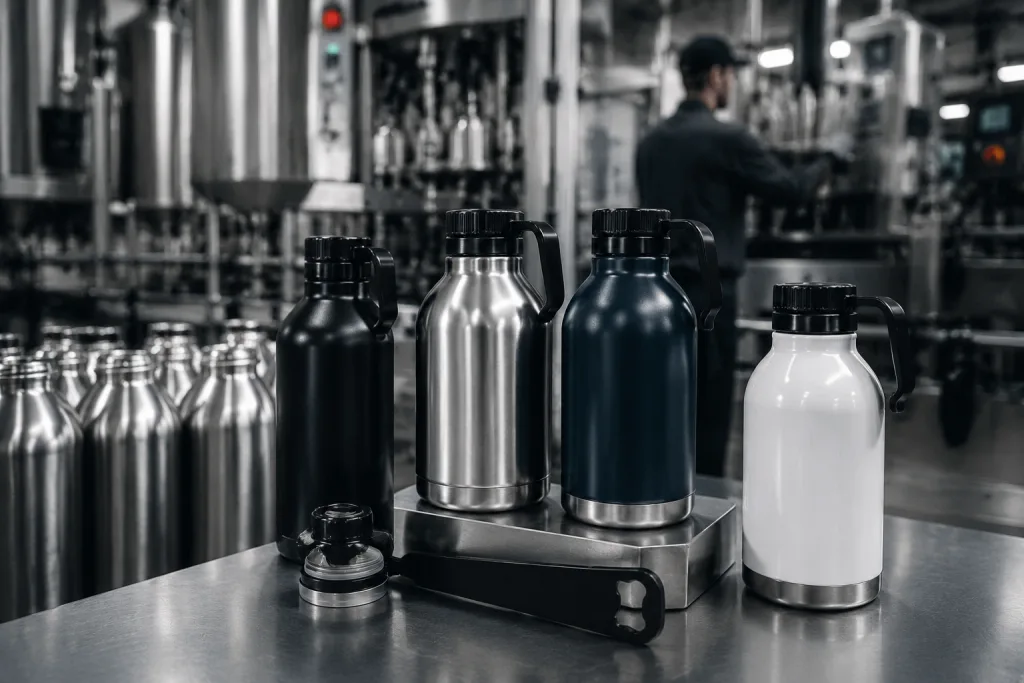
Key Takeaways
- A 64 oz growler in 304 stainless with copper vacuum and powder coat commonly lands at USD 4.80-7.20 FOB China at 1,000-3,000 pcs, depending on decoration and lid set
- Body thickness changes dent resistance fast: 0.5 mm outer wall and 0.4 mm inner wall are common commercial specs; dropping to 0.4/0.3 mm cuts cost but raises complaint risk
- Private label MOQ is usually 500-1,000 pcs per color per size, while fully new molds often start around USD 1,500-4,000 and add 20-30 days
- Standard production lead time from Zhejiang is often 25-35 days after sample approval and deposit, with AQL inspection before balance payment
You rarely lose money on a growler from one big miss. It usually leaks out through small spec lines that looked harmless on the quotation sheet: 18/8 versus “stainless steel,” 0.5 mm versus 0.4 mm body, a cap liner that shifts taste after 48 hours, or a print method that scratches off before one retail season ends. We’ve seen QC pull a sample with a 0.42 mm body on a digital gauge after the PO called for 0.5 mm, and that gap changed the feel in hand right away. If you are buying growler bottle private label for a brand, retail chain, brewery program, or distributor drinkware range, the photos are the wrong place to spend your attention.
At BottleForge Industrial in Hangzhou, Zhejiang, we see new buyers lock onto shape and logo first, then scramble when MOQ, carton drop risk, REACH paperwork, or lead time starts moving the real cost. One buyer flagged a clean-looking FOB quote, then found the master carton failed a 76 cm drop test because the divider board was too soft. China is still the practical sourcing base for this category, but you need to read a spec sheet like a buyer, not a shopper. We run quotes line by line for this reason. Check every item for commercial impact before you approve sampling, or the math doesn’t work.
Start with capacity and use case
The first line on the spec sheet is usually capacity. Most buyers treat it like a basic choice. That is the wrong question to ask. A 32 oz growler moves differently from a 64 oz custom growler, and a 1.9 L brewery model changes freight math, shelf depth, and how the bottle feels after one fill. If you are building growler bottle private label for craft beverage, outdoor retail, or corporate gifting, capacity sets the job for the whole project: carton size, steel weight, cap torque, and grip comfort. On our line, a bigger body can add 120-180 g of 304 stainless and push the master carton from 6 pcs to 4 pcs fast.
For B2B orders, the common range is 18 oz, 32 oz, 40 oz, 64 oz, and 128 oz. In North America, 64 oz is still the anchor size for customized growler programs; we ship more RFQs on that size than any other, often at MOQ 1,000 pcs per color. In Europe, 1 L and 1.5 L usually move faster because the format feels familiar and fits daily urban use better. If you are also buying general custom drinkware, this matters because the growler may sit beside a custom canteen or travel bottle range. You want the family look to match, but the size logic should not. We have seen buyers force one lid style across 3 bottle shapes, and the math does not work.
What you should ask before sampling
- Nominal capacity vs brimful capacity: a “64 oz” item may be 1,900-2,000 ml brimful. Ask for both numbers on the drawing and PO, because QC pulled the sample before on a brief that listed only “64oz” with no ml note.
- Empty weight: a 64 oz unit often sits around 780-1,050 g depending on wall thickness and handle design. That weight changes freight cost and hand feel, so ask for the actual gram range, not “standard weight.”
- Mouth diameter: 45 mm, 55 mm, and 80 mm openings change filling speed, cleaning, and insulation performance. We check this with a caliper at incoming inspection because 2 mm off at the neck will affect cap fit.
- Use scenario: cold retention, hot retention, carbonated beverage compatibility, or simple transport container. Buyers mix these up all the time, then flag the sample later because the venting or seal setup was wrong.
A buyer spec that only says “64 oz stainless growler with logo” is incomplete. A usable factory brief says capacity, mouth size, finish, target FOB, market compliance, and carton limit.
If you are a canteen distributor or one of the larger canteen distributors expanding into growlers, use case alignment matters more than design novelty. A good distributor growler SKU gets repeat orders because it fits a real refill program or gifting brief. Looks alone do not save a weak spec. We have seen this go sideways when the buyer picked a wide 80 mm mouth for appearance, then found the packed height missed the retail shelf limit by 12 mm.
Steel grade and wall thickness
This is where weak quotes usually hide. Most private label growlers use 18/8 stainless steel, listed as SUS304 in China. For normal beverage contact, SUS304 is the standard commercial spec we run every day. If a supplier writes only “stainless steel” and skips the grade, ask again. This is the wrong question to skip. We have seen buyers come back after salt-spray complaints because a low-cost canteen factory slipped 201 stainless onto a non-contact ring or base cover, and QC found tea-stain rust after 48 hours of moisture exposure. Some premium or coastal-use programs ask for 316 on selected parts, but for most retail programs the math does not work.
Then check wall thickness. Typical double-wall vacuum growlers in Zhejiang are built around 0.4 mm inner plus 0.5 mm outer, sometimes 0.4/0.4 mm on aggressive pricing. Single-wall promotional items may run lighter. On our line, QC checks body gauge with an ultrasonic thickness meter before polishing. The buyer impact is simple:
- 0.5 mm outer wall: better dent resistance in parcel shipping and warehouse handling; this matters on master cartons that take a 1A drop test hit.
- 0.4 mm outer wall: lower steel cost and lower weight, but dent marks show faster, and the buyer flagged this on a 3,000-piece promo order last year.
- Thicker base area: improves stability, especially on larger 64 oz and 128 oz bodies; we usually watch the base ring flatness within 0.8 mm.
If you are sourcing canteen custom and growler items from the same canteen manufacturer, insist on consistency by category. A supplier that makes excellent 500 ml bottles may still struggle with larger cylindrical bodies if vacuum control and base forming are not stable. We have seen this go sideways. One factory shipped clean 500 ml samples, then the 64 oz body showed base rocking at final inspection because the forming die was tuned for smaller diameters. That is why asking for cross-sections or body gauge confirmation is not overkill.
In our Zhejiang production planning, larger insulated growlers normally need tighter vacuum yield control than standard sports bottles. On a 64 oz body, a 0.2 mm forming drift shows up fast in seam appearance and base balance. We ship plenty of standard bottles with no issue, but growlers are less forgiving. A serious canteen supplier or canteen manufacturers group should state target gauge, grade, and vacuum structure directly. If the answer is vague, the sample room usually tells the real story.
If you want a low complaint rate, do not chase the absolute lowest steel weight. Saving USD 0.18-0.35 per unit can easily cost more in transit damage and post-sale claims. We had one buyer push for lighter bodies to hit a target FOB, then QC pulled the sample after carton compression and found two dented shoulders out of 24 pcs. Cheap on paper. Expensive after claims.
Vacuum structure, lid system, retention
Growler bottle private label usually lives or dies on lid performance. Buyers spend hours on Pantone and miss the cap assembly. Then the claims come in: leaks, odor transfer, or pressure issues. We split these projects into single-wall transport growlers, double-wall vacuum insulated growlers, and carbonation-oriented growlers with pressure-control features. They are different builds. On our line, the first thing QC pulled on one failed sample was the lid thread gauge, not the body finish. They are not interchangeable.
For mainstream customized drinkware, double-wall vacuum with copper coating on the inner wall is still the common premium structure. A realistic factory spec may claim cold retention of 24 hours and hot retention of 12 hours under controlled test conditions. That wording is fine if the method is written down. Ask for fill temperature, ambient temperature, and hold time. We’ve seen suppliers print “24H cold” with no test sheet behind it, and the math doesn’t work. In production, vacuum loss often shows up first at the bottom weld after a 70°C water check.
Cap details that affect your order
- Thread design: coarse threads close faster, but tolerance control matters. We usually check thread fit with a go/no-go gauge, and a 0.2 mm drift is enough to create cross-thread complaints.
- Liner material: food-grade silicone is standard; poor liners cause odor transfer. Buyers have flagged a “rubber smell” before, and the issue was the liner batch, not the 304 stainless body.
- Handle style: integrated lid handle reduces parts count, side handle improves carrying on larger formats. On 1.9 L formats, some buyers still prefer a side handle because a full bottle gets heavy fast.
- Leak test: ask for 100% air-pressure or inverted water test on assembly line for insulated models. If the factory only does random checks, this is the wrong question to skip.
Some buyers also ask if the growler can hold carbonated beverages. The honest answer is simple: only if the design was developed for that purpose. A standard vacuum growler is not automatically a pressure vessel. If you need that use case, say so at RFQ stage and confirm test method. We have seen POs marked “for beer” with no pressure requirement listed, then the buyer flagged venting later. That goes sideways fast. This is where an experienced canteen vendor or canteen vendors network helps, because not every bottle line in China understands pressure-related risk.
If your range also includes a customizable canteen or customizable growler family, keep lid architecture rational. Shared cap platforms can reduce MOQ pressure and spare-part complexity. At BottleForge Industrial, our standard MOQ for private label often starts at 500 pcs for stock colors and 1,000 pcs for custom body colors, with pilot runs depending on decoration. Factory capacity is around 300,000 units per month across drinkware categories, but cap sourcing often determines the real schedule more than body production. We run into this every season: body lead time is 12 days, but a custom PP cap with a new mold texture can push it to 18 days.
Surface finish and decoration limits
Decoration is where buyers ask for the impossible on curved stainless, then want the same target price. We see this every week on the line. The common routes are powder coating, spray painting, silk screen printing, heat transfer, laser engraving, or a paired process like powder coat plus laser mark. If you are buying customized canteen, custom growler, and other customizable drinkware in one collection, keep one finish family across the range. Trying to force every effect onto every SKU is the wrong question to ask, especially once the handle radius and neck curve start limiting print area by 3-5 mm.
Powder coat is the safe default for mid- to upper-range growlers. It covers light handling marks better than glossy spray paint, and the grip feels better in hand. Standard powder coat on stainless often adds around USD 0.25-0.60 versus plain stainless, depending on color and order volume. We run 180-220°C curing on the line, and darker colors usually pass touch-up review more easily than pale matte tones. Soft-touch, metallic, pearlescent, and speckled finishes cost more, and QC pulled the sample more often on these because pinholes, shade shift, and orange-peel texture show up faster.
For logos, silk screen is still the low-cost choice for simple one-color artwork, but it wears faster than engraving on bottles that get washed and knocked around. Laser engraving gives a cleaner long-term result, but you lose color. Heat transfer wraps can carry richer artwork, though buyers need realistic expectations on cylindrical bodies with handles or neck curves. We have seen wrap alignment drift 1.5-2.0 mm near the seam area, and the buyer flagged it even though the print itself was sharp.
- Silk screen: best for 1-2 color logos, MOQ friendly, lower setup cost; mesh count and logo stroke width matter more than most POs show.
- Laser engraving: strong premium look, highly durable, usually slower throughput; on brushed bodies, the contrast depends on the base finish.
- Heat transfer: useful for promotional graphics, but inspect seam area and edge adhesion; we normally do a tape pull check on the sample.
If your buyer brief says canteen promotional or canteen customizable, separate promo standard from retail standard on day one. They are not the same, and this is where projects go sideways. A promotional event item may pass with slight shade variation. A retail shelf program will not. That changes your quality standard, approved color tolerance, and inspection level. In Zhejiang and wider China sourcing, we have seen 7 out of 10 decoration disputes come from vague artwork approval, missing Pantone callouts, or no written cosmetic standard—not from bad manufacturing. Sometimes the PO even has a typo in the logo size, and nobody catches it until mass production.
For private label, approve a pre-production sample with the final pantone reference, logo position drawing, and finish notes. Put the logo height, distance from the base, and orientation on paper—8 mm off-center is enough to trigger a claim on a retail order. Without that, you are arguing taste after production instead of checking facts before production.
MOQ, tooling, packaging, freight math
Most first-time buyers ask for MOQ like there is one clean number. There isn’t. You need at least four: product MOQ, color MOQ, decoration MOQ, and packaging MOQ. For growler bottle private label, a factory may quote 500 pcs MOQ on an existing mold, but that usually means one stock color, one logo process, and a standard export carton. We see buyers miss this on the first RFQ all the time. Switch to a custom Pantone body color, a retail gift box, or a unique lid, and the working MOQ often moves to 1,000-3,000 pcs. On our line, even a simple silk-screen setup has its own minimum because QC pulled the sample and the ink coverage changed on a curved wall.
New molds are a separate cost bucket. If you want a new shoulder profile, custom handle, or proprietary cap, expect tooling in the USD 1,500-4,000 range for moderate complexity, sometimes higher if multiple components are involved. Add roughly 20-30 days for tooling and sample iteration. We’ve seen this go sideways when a buyer asks about mold cost first. The calendar is the bigger issue. If your launch is tied to holiday retail or a brewery opening, 20 days on a tool trial plus 7 days on courier samples can hurt more than the tooling invoice itself. Last month one cap sample came back with a 0.3 mm thread mismatch, and that alone cost another revision round.
Packaging changes the math fast. Standard export packing is usually individual polybag, egg-crate or divider support as needed, then master carton. Retail gift boxes look better on shelf, but they add cube, raise freight, and create more drop-test failures if the insert design is weak. For Amazon FBA or club-store programs, you may also need barcode labeling, suffocation warning language, FNSKU application, or carton weight limits under 15-18 kg. This is the wrong question to ask: “What is your cheapest box?” Better ask what passes transit testing and still ships well. We run into buyer pushback here because a pretty box that fails a corner drop at 76 cm is not cheap anymore.
Ask your supplier for these numbers
- Units per carton: often 12 or 24 pcs depending on size; ask for both pack-out options if the bottle diameter is close to a carton break point.
- Carton dimensions and gross weight: needed before you compare FOB and landed cost; freight math changes fast with a 5 cm taller carton.
- Spare ratio: 0.5%-2% extra parts or units can save trouble on large orders; we ship this more often on decorated lids and replacement caps.
- Packaging drop standard: especially for e-commerce channels; ask what test level they actually ran, not just “drop tested.”
A good canteen manufacturer or canteen suppliers group will discuss cube efficiency early. Large growlers eat container space fast. Sometimes lowering height by 3-5 mm or changing handle orientation improves container loading enough to offset a small tooling adjustment. The math does work there. We’ve loaded samples both ways and seen a layout move from 1,680 pcs to 1,920 pcs in the same container plan. That is practical sourcing. Not theory.
Compliance paperwork and inspection discipline
If you buy for Europe or North America, compliance starts before you place the PO. It is a sourcing filter. For food-contact stainless drinkware, buyers usually ask us for REACH, LFGB, or food-contact migration testing, and some retail channels add California Proposition 65 review. For children-related assortments, ASTM or CPSIA can come into scope, though most growlers are adult-use. Larger chains also screen the factory side: BSCI audits, ISO-style SOP records, and social compliance checks. On our line, QC will pull the BOM and confirm the lid silicone grade before mass production. Skip that step and we have seen orders stall for 12 days while the buyer waits on missing paperwork.
The better question is not “Do you have certificates?” The right question is “Which report covers this exact build?” A report for a plain stainless bottle does not cover a powder-coated, screen-printed, silicone-sealed private label growler by default. The material stack has to match. The decoration has to match. The contact parts have to match. We have had buyers flag this after production because the PO said “black logo” but the approved sample used a different ink system. That is the wrong stage to find it.
Set inspection terms before deposit. Standard trade flow from China is deposit, production, pre-shipment inspection, then balance before shipment. A lot of professional buyers run AQL 2.5 for major defects and 4.0 for minor defects, but channel requirements do vary. Define critical defects in writing: leak, sharp edge over a 0.3 mm burr, wrong logo position, unstable base, coating peel, odor, rust, failed carton mark, or incorrect barcode. We ship smoother when this list is locked early; if it stays vague, the math doesn’t work once 3,000 pcs are packed.
- During production check: best for first orders, new tooling, or a new cap assembly. We usually check thread fit with a go/no-go gauge and cut one sample for seal review.
- Pre-shipment inspection: verify quantity, workmanship, function, labeling, carton marks. QC pulled the sample from finished goods, not from the top row only.
- Retention samples: keep a signed golden sample in both buyer and factory files. Write the PO number clearly; we once got a sample back with one digit wrong and it wasted half a day.
A disciplined canteen factory in Zhejiang should be comfortable with third-party inspection and material traceability on core parts. This is basic work. If a canteen vendor pushes back on simple inspection language, treat it as a commercial warning sign. Reliable canteen suppliers know clear QC rules cut disputes on both sides, and they should be able to show which 304 stainless lot and which lid supplier went into your order.
How to compare suppliers without guessing
After you collect five quotes from China, the sheets can look close and the risk can be miles apart. Compare them line by line. Build a one-page matrix with capacity, steel grade, inner and outer wall thickness, vacuum method, cap material, finish, logo process, MOQ, sample charge, lead time, carton spec, test scope, and payment terms. Put the wall thickness in mm, not “standard,” because we’ve seen 0.4 mm vs 0.5 mm change dent rate on the line. Then score the items that affect your margin and claim rate, not the lowest unit price on day one. Cheap is the wrong question to ask.
If you are building a broader program with custom canteen, canteen customized lines, or a distributor canteen assortment, ask each supplier what they actually run well. Some canteen manufacturers are strong on standard insulated bodies and weak on decoration consistency; the buyer flagged Pantone drift on a 3,000-unit reorder last spring. Some canteen supplier teams turn samples in 6 days but miss mass-production timing once the polishing line backs up. Some canteen manufacturer groups quote low and subcontract too many steps. We’ve seen this go sideways. You want a supplier whose steady process fits your channel, not a sales promise.
For example, a brewery merchandise buyer may want low MOQ, repeat orders in 18 days instead of 30, and laser marks that stay clean after 500 dishwasher cycles. A retail chain may care more about audit readiness, carton compliance, and color consistency across 10,000 units; QC pulled the sample once because the Delta E was over 1.0. A canteen distributor moving into growlers may care most about shared lids and finishes with current SKUs, down to a 63 mm neck match. These are different buying models.
At BottleForge Industrial in Hangzhou, Zhejiang, a normal sample cycle for an existing model is about 7-10 days, and mass production usually runs 25-35 days after deposit and artwork approval. That is standard factory timing. We ship on that rhythm every week. If a supplier promises a fully customized growler project in 12 days, ask what they are skipping: mold correction, color approval, vacuum hold test, or carton drop test. The math doesn’t work otherwise.
The right growler bottle private label partner is not the factory that says yes to every request. It is the one that tells you where the spec helps, where it cuts margin, and where the tolerance is real — for example, a brushed finish lot can shift slightly batch to batch, and a PO typo on logo position can cost 8 days. That is the conversation to have before you place the PO.
Send your growler spec sheet for a real quote
Share capacity, finish, logo method, target MOQ, and market. We will review the spec line by line and flag cost, compliance, and lead-time risks.
Frequently asked questions
What is a realistic MOQ for growler bottle private label?
For an existing growler shape, realistic MOQ is usually 500 pcs if you accept a stock body color and standard carton, or 1,000 pcs per color for a custom powder-coated body. If you add a custom lid color, retail gift box, or multi-color decoration, the practical MOQ may rise to 1,000-3,000 pcs. A fully new mold is different: tooling can run USD 1,500-4,000 and usually adds 20-30 days before bulk production. In China, some factories quote low MOQs to start the conversation, but once artwork, packaging, and cap details are confirmed, the working MOQ changes. Ask for MOQ by SKU, color, print method, and packaging separately so you can compare suppliers properly.
Which stainless steel spec should I put on the PO?
For most B2B growler programs, specify food-contact SUS304 stainless steel for both inner and outer body unless you intentionally want a different commercial structure. Also state the wall gauge if it matters to you; common double-wall specs are 0.4 mm inner and 0.5 mm outer, while lower-cost builds may drop to 0.4/0.4 mm. On the PO, do not write only “stainless steel.” Include body grade, lid contact-part material, liner material, and whether the item is vacuum insulated or single wall. If your channel has stricter compliance needs, add REACH or LFGB-related requirements and require the report to match the exact finished construction, including coating and silicone parts.
How long does private label production usually take from China?
For an existing model from Zhejiang or other mature China drinkware clusters, sampling often takes 7-10 days after artwork and color reference are confirmed. Bulk production is commonly 25-35 days after sample approval and deposit for a 1,000-5,000 pc order. Add around 5-10 days in peak season or if you need special coating, gift boxes, or third-party inspection scheduling. A new mold project usually adds 20-30 days before mass production even starts. Sea freight then depends on route, but many North America and Europe buyers plan sourcing on a 60-90 day total window from RFQ to arrival. If a supplier promises much less, check whether they are excluding decoration, packaging, or testing.
Can a standard insulated growler hold carbonated beverages?
Not automatically. Many standard vacuum growlers are designed for beverage transport and temperature retention, not for pressure retention. If your use case includes beer, kombucha, or other carbonated liquids, you need to state that at RFQ stage and confirm whether the cap system and body design were tested for that purpose. Ask for the test method, pressure conditions, and any usage limits. A normal silicone-sealed screw cap may pass leak testing but still not be intended as a pressure-rated closure. This is a common sourcing mistake. If carbonation matters, do not assume that “insulated stainless growler” equals “carbonation safe.” The product has to be engineered and documented for that application.
What inspection standard is normal for custom drinkware orders?
For private label drinkware, many importers use AQL 2.5 for major defects and 4.0 for minor defects, with critical defects set at zero tolerance. For growlers, critical defects usually include leakage, sharp edges, missing or wrong logo, unstable base, wrong barcode, rust, or serious odor. On a first order, it is smart to run a during-production check plus a pre-shipment inspection before balance payment. You should also keep a signed golden sample covering finish, color, logo placement, and packaging. The point is not to make the factory nervous. The point is to remove guesswork. Good suppliers in China usually welcome clear QC rules because they reduce argument after shipment.