Key Takeaways
- A workable MOQ for a custom growler is often 1,000 to 3,000 pcs per size, while laser logo samples can be ready in 5 to 7 days
- 304 stainless is standard for food contact, but 316 upgrade adds cost of roughly USD 0.35 to 0.90 per unit depending on size and finish
- For vacuum growlers, common production lead time from Zhejiang, China is 25 to 40 days after sample approval and deposit
- Set AQL 2.5 for major defects and confirm REACH, LFGB, or ASTM testing before mass production, not after booking space
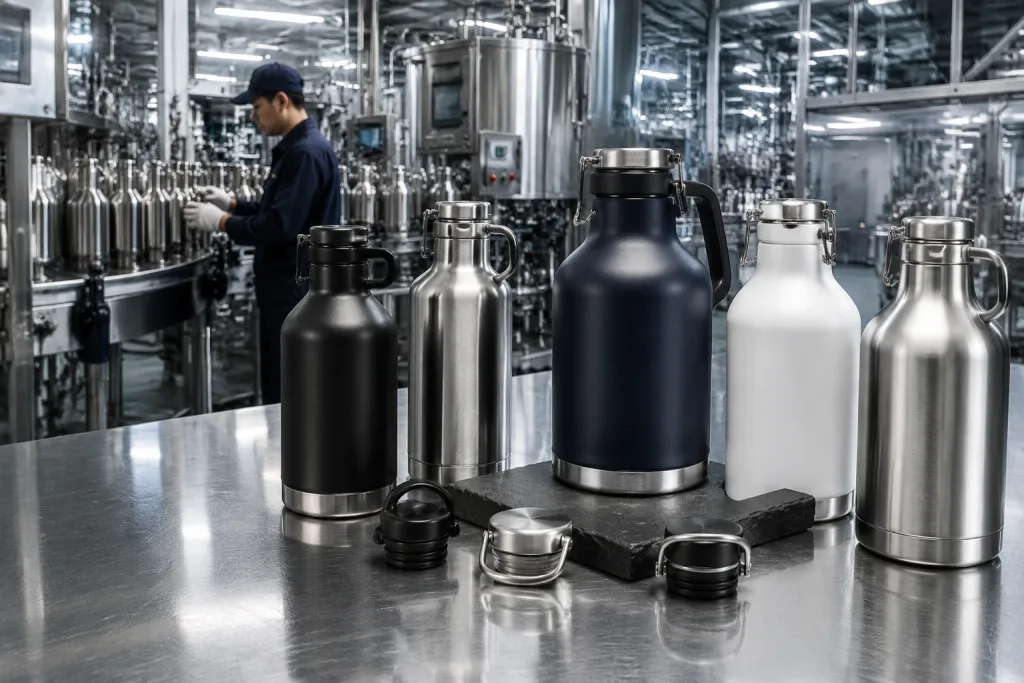
You can find a growler bottle OEM fast. That is not the hard part. The hard part is finding a factory that quotes the exact spec, holds the powder coat you signed off on, and ships without last-minute trouble on lab testing, carton marks, or leakage claims. We see this on the line all the time: the sample looked fine, then QC pulled the sample again at 60°C hot-fill and found seepage at the lid gasket. A growler looks simple until the spec sheet starts stacking up—304 stainless, 38 mm or 64 mm mouth, vacuum or single wall, coating code, logo process, and drop-test height.
If you buy custom drinkware for retail, promotions, or a distributor drinkware program, the small lines on the PO decide whether the order runs clean. A buyer once flagged one typo in a carton mark after 12,000 pcs were packed, and the rework cost more than the logo plate. In Zhejiang, plenty of factories say they make bottles and tumblers. Fewer can tell you why a 0.4 mm inner wall dents faster than 0.5 mm during vacuuming, or why the same custom growler needs one packing setup for Amazon FBA and another for a canteen distributor pallet load. That is the practical filter. The wrong question is not “Can you make this?” It is “What fails first, and how do you control it?”
Start with body material
The first item on the spec sheet should be body material, not logo color. On our side, for a growler bottle OEM manufacturer, that usually means 18/8 stainless steel, also marked SUS304. That is the standard for beer growlers, water growlers, and premium custom drinkware because the cost and performance line up: good corrosion resistance, stable welding on the line, and no surprise jump at quotation stage. If a supplier writes only “stainless steel,” ask them to correct it on the PI. We have seen this go sideways over one missing word, then QC pulled the sample and the mill cert did not match.
For food-contact parts, ask for each component to be listed separately: outer wall, inner wall, lid shell, and silicone seal. A normal structure is 304 inner and outer, PP or stainless lid components, and LFGB-grade or FDA-grade silicone gasket. If you fill acidic beverages, kombucha, or hold product for long dwell time, ask whether 316 is available for the inner wall. This is not needed on every program. Still, on a few customized growler projects, it cut complaint risk, and the buyer flagged fewer taste-transfer issues after 72-hour hold checks.
- Common wall thickness: 0.4 mm inner / 0.5 mm outer for mid-range vacuum growlers.
- Heavy-duty option: 0.5 mm inner / 0.5 mm outer for better dent resistance.
- Typical cost effect: adding 0.1 mm to the inner wall can raise unit cost by 3% to 7%.
The same rule applies if your range extends beyond growlers into custom canteen, customizable canteen, or canteen promotional SKUs. A serious canteen factory or canteen manufacturer should state steel grade by component and issue a material declaration. If they cannot, they are not ready for Europe or North America. This is the wrong question to ask too late. Zhejiang factories with steady export volume usually keep REACH and LFGB paperwork ready because these checks are routine; we ship against them every month, and the file is often pulled before the first 500 pcs pilot run.
Capacity, mouth, and fill use
Capacity is not a brochure line. It drives tooling, carton count, neck spec, and whether the bottle runs like a daily hydration SKU or a true growler. The common growler sizes are 32 oz, 64 oz, and 128 oz, with 64 oz being the volume most buyers request for custom growler programs. On our line, brimful capacity and usable fill are never the same; on one 64 oz model, brimful tested 1960 ml while sellable fill stayed at 1900 ml. Put both on the spec sheet. If you skip that, QC pulls the sample later and the buyer flags an avoidable mismatch.
Mouth diameter decides more than new buyers expect. A 38 mm to 45 mm mouth is common for narrow-mouth bottles. A 60 mm to 80 mm mouth is more practical for growlers because filling heads fit better, brush cleaning is easier, and ice loading is less awkward. We have seen brewery buyers push back on 45 mm mouths after pilot use because refill speed at the counter was too slow. If your end market includes breweries, cafes, and refill stations, go wider. If your audience is outdoor retail, a slimmer profile packs better on shelf, but this is where the wrong question gets asked: people chase silhouette first and forget refill use.
What you should lock before sampling
- Nominal capacity: for example 64 oz / 1900 ml
- Brimful tolerance: usually plus or minus 3%
- Mouth inner diameter and thread type
- Base diameter for cupholder or shelf fit
- Target filled weight limit for end users
This is where adjacent search terms like canteen custom, customized canteen, and customizable growler start mixing together on real POs. A canteen supplier may offer the same capacity family across bottles, flasks, and growlers, but the lid architecture changes the actual use. We usually map this by shared body tooling, neck tooling, and cap set; sometimes the PO says “same as canteen lid” and the thread spec is off by 1 mm, which turns into sampling delays. If you are a canteen distributor or distributor growler account serving both retail and promotional channels, ask the OEM to show what is shared tooling and what is new tooling. That tells you whether your “new” item is standardized, semi-custom, or fully custom. It also tells you how realistic the MOQ and lead time really are. We have seen this go sideways when a buyer expects stock MOQ pricing on a fresh cap mold.
A 64 oz vacuum growler that looks good on a render can still fail your channel if the mouth is too narrow for fast refill or the handle geometry is uncomfortable at 2.5 kg filled weight.
Insulation structure and heat retention
If the spec sheet says vacuum insulated, ask how the body is built and how the line checks it. A proper double-wall vacuum growler uses two stainless shells welded at the neck and base, then the air between the walls is pulled out and sealed. On our line, QC will usually check the weld seam and neck alignment first because a 0.3 mm offset can turn into vacuum loss later. Some factories add copper coating on the inner outer-wall surface to improve thermal performance. That can add about USD 0.15 to 0.30 per unit, depending on size. If your retail claim is 12-hour cold retention or better, that upcharge can make sense. If not, the math doesn't work.
For growlers, cold retention matters more than heat retention, but the real issue is test condition. A serious growler bottle OEM manufacturer should state the method in plain terms: starting liquid temperature, ambient room temperature, fill rate, and measurement interval. We have seen buyers flag a “24 hours cold” claim, then find the factory tested half-fill instead of full-fill. Without the method, “keeps cold 24 hours” is brochure copy.
- Common test setup: 95°C hot water or 4°C cold water, 23°C ambient, measured after 6, 12, and 24 hours.
- Typical 64 oz vacuum growler result: cold under 10°C after 12 hours; warm above 50°C after 8 to 12 hours, depending on lid type.
- Non-vacuum single wall: lower cost, faster MOQ access, no serious insulation claim.
Lid leakage often matters more than insulation. This is the wrong question to ask if the buyer only focuses on wall structure and ignores the cap. Swing-top, screw cap, and tethered lid systems each come with their own failure points. Swing-top looks traditional, but there are more hardware tolerances to control, and we have seen latch force drift after drop tests from 80 cm. Screw cap is simpler to run in mass production and usually holds up better in freight abuse. For a customized drinkware program shipping to canteen distributors or canteen vendors across North America, easier replacement and lower field-failure rates usually beat nostalgic appearance.
If you also source a custom canteen or customized canteen line from the same canteen factory, ask whether insulation welding, vacuum holding, and leak testing are done in-house. A Zhejiang plant shipping 600,000 to 800,000 units per month should be able to tell you its standard without hesitation—100% air-pressure leak check, plus random thermal retention verification every batch, for example. We ship with that kind of control on the line, and the buyer pushback usually comes when a factory cannot say what pressure it uses or how long the hold test runs. If the answer is vague, treat the insulation claim as unproven.
Surface finish drives brand perception
Most disputes we see on custom drinkware are cosmetic. The growler holds water fine, but QC pulled the sample and found uneven powder coat, color drift from the approved chip, or a logo walking 2 mm off center. That is why surface finish needs its own checkpoint on the PO. Standard options for a customizable growler include powder coating, spray painting, brushed steel, mirror polish, electroplated accents, plus textures such as hammertone and soft-touch.
Powder coating is still the finish most buyers pick. It covers small handling marks better than spray paint, and on the line we usually get steadier color from lot to lot on bigger runs. The questions to ask are simple: coating thickness, adhesion, and color tolerance. Ask for 60 to 80 microns and cross-hatch adhesion test results. If you are matching Pantone, expect some shift between batches and between different bottle shapes; we've seen the same lid and body read differently under a light box.
Logo methods by use case
- Silkscreen: cost-focused option, usually 1 to 2 spot colors, the math works best above 1,000 pcs
- Laser engraving: cleaner premium look on powder coat, no ink migration risk, usually USD 0.08 to 0.25 extra
- Heat transfer: better for multi-color artwork, but the line setup is less forgiving and registration gets flagged fast
- Embossed badge or metal plate: stronger fit for premium customized growler launches, though MOQ and assembly cost go up
For a canteen promotional order, buyers usually push price first and want the logo turned fast. For a private-label line, this is the wrong question to ask. Shelf display exposes every speck, scratch, and print shift. A capable canteen manufacturer in China should define viewing distance—commonly 30 cm to 50 cm under standard light—and sort defects by AQL. That tells you more than “high quality finish” on a sales PDF. We have had buyers flag a dust nib at 40 cm, so this standard needs to be written down before mass production.
For reference, MOQ for custom color is often 1,000 pcs per color per size. Stock-color bodies with laser logo can sometimes start at 300 to 500 pcs. That is a practical way to test a new market before you commit to a full canteen customized or custom growler range, especially if the first PO already has a color-code typo or mixed artwork versions.
Compliance, testing, and inspection rules
If you sell into Europe or North America, compliance is not paperwork you tack on 3 days before we ship. It needs to be locked in at quotation. A growler bottle OEM manufacturer should confirm the target market, material set, and age grading before pricing starts, because a 304 stainless body with a silicone gasket is not reviewed the same way as a powder-coated gift set. For adult drinkware, the usual checks are REACH, LFGB, FDA food-contact compliance, and California Proposition 65 screening where relevant. For children’s items, ASTM and CPSIA matter more, though we do not see that often on growlers. This is the wrong question to ask late—if the buyer flagged compliance after artwork approval, we have seen projects slip 12 days vs 18 days just from retesting.
Testing needs to cover chemical risk and physical use. Chemical work usually includes overall migration, heavy metals in coatings, phthalates in seals where relevant, and BPA declarations for polymer parts. Physical checks usually include leak test, handle pull test, coating adhesion, salt spray for metal trim, drop test, and dishwasher performance if you claim it on the box. On the line, QC pulled the sample and ran a 30-minute inverted leak check before packing approval; that catches more trouble than a nice-looking photo ever will.
- Pre-production sample approval: confirm color against the signed chip, logo size, key dimensions in mm, and packaging details before mass run
- In-line inspection: check welding, coating coverage, print position, and lid fit while the line is running, not after 2,000 pcs are finished
- Final random inspection: usually AQL 2.5 major / 4.0 minor
- Carton check: verify barcode, FNSKU, country-of-origin mark, and drop resistance; we have seen one PO with the FNSKU typo break the whole shipment booking
Ask whether the canteen supplier or canteen factory has BSCI, ISO 9001, or audit history from major retailers. An audit does not mean zero problems, but it does show the factory knows how to control records, version labels, and sample sign-off. The stronger Zhejiang export plants already run with third-party labs like SGS, TUV, or Intertek, so they can give you a straight timing window instead of guessing. Routine food-contact testing is often 5 to 10 working days. If the item has 4 components, a custom coating, and a printed decal, the math does not work the same way.
If you are one of 6 canteen distributors or canteen vendors buying similar shapes from the same region, do not assume one set of paperwork moves across every SKU. The same bottle body with a new coating, new decal, or new gasket compound can trigger fresh confirmation. We have seen this go sideways after a buyer changed only the seal material from clear silicone to black silicone at the last sample stage. That is where customized drinkware delays usually start.
MOQ, tooling, packaging, and delivery
The commercial lines on the spec sheet decide if a project gets approved or dies in sourcing. MOQ is the first checkpoint. For an existing 64 oz growler mold with custom color and logo, 1,000 pcs per size per color is the number we usually run, and buyers still push back on it. For stock-color bottles with simple laser marking, some lines can take 300 to 500 pcs if the marking jig is already set. New lid tooling, a new base shape, or a changed handle structure is where the math often stops working: MOQ moves to 3,000 to 5,000 pcs, and tooling charges land at USD 800 to USD 5,000 depending on complexity and cavity count.
Lead time needs to be split by stage. One blanket promise is the wrong question to ask. A disciplined canteen manufacturer or canteen supplier will usually quote something like this, and the dates hold better when QC pulled the sample before production booking:
- Artwork layout: 1 to 2 days
- Pre-production sample: 5 to 10 days
- Mass production: 25 to 40 days after deposit and approval
- Lab testing if needed: add 5 to 10 working days
- Sea freight from China: often 25 to 40 days to EU or US ports
Packaging is where new buyers burn margin fast. A brewery gift box, an e-commerce mailer, and a master carton for canteen distributors are not interchangeable, and we’ve seen this go sideways after a buyer flagged crushed corners in a 1.2 meter drop test. If you sell on Amazon, lock the FNSKU label location, carton weight limit, and drop protection before sampling. If you sell through distributor growler or distributor canteen channels, pallet efficiency and carton burst strength matter more than shelf look. Common export carton specs are 5-ply corrugated, 10 kg to 15 kg carton weight, with drop-tested dividers for coated bottles.
At BottleForge-style production scale, a Zhejiang factory running around 700,000 units per month can absorb repeat orders faster than a small workshop, but only after your spec is frozen on paper. The line moves fast. One late change to finish, logo process, or insert card can reset approval, and sometimes it is something small like a PO typo in the logo position note or a 2 mm change on the insert. The practical rule is simple: if the spec line affects a purchase order, put it in writing before deposit. That applies whether you are buying a custom canteen, customized canteen, customizable drinkware item, or a full growler program from canteen manufacturers in China.
Send your growler spec for a real factory review
Share capacity, material, logo method, target price, and packaging needs. We will check MOQ, compliance risk, and lead time from Zhejiang, China.
Frequently asked questions
What MOQ should I expect from a growler bottle OEM manufacturer?
For an existing growler design, the normal MOQ is 1,000 to 3,000 pcs per size per color. If you choose a stock body color and laser logo, some factories in China can go down to 300 to 500 pcs. If you need a new lid, custom handle, or unique base mold, MOQ usually rises to 3,000 to 5,000 pcs and may include tooling from about USD 800 to USD 5,000. You should also ask whether MOQ is based on finished goods, body color, or packaging style. That detail matters because a buyer may think 1,000 pcs total is possible, while the factory means 1,000 pcs for each colorway.
Which stainless steel grade is best for a custom growler?
For most B2B programs, SUS304 or 18/8 stainless is the right baseline for both inner and outer walls. It is proven, widely available in Zhejiang, and cost-efficient for vacuum growlers, custom canteen lines, and broader custom drinkware ranges. If your product holds acidic beverages for longer periods, a 316 inner wall can be worth considering. The usual added cost is around USD 0.35 to USD 0.90 per unit depending on body size and finish. Ask the supplier to specify each component separately: inner wall, outer wall, lid contact parts, and gasket material. “Food grade stainless” by itself is not enough for a serious purchase order.
How do I compare leak-proof claims between suppliers?
Ask for the exact test method, not a yes-or-no answer. A better supplier will state the lid structure, test angle, internal pressure if used, and pass criteria. For example, a factory may perform 100% leak checks after assembly, then do random inverted tests for 30 minutes and transport-vibration checks on final cartons. Screw-cap growlers generally give more consistent sealing than swing-top designs because there are fewer tolerance points. You should also confirm whether leakage testing is done before or after logo curing, because heat and handling can affect gasket fit. For retail and distributor drinkware programs, one leakage complaint rate above 1% is already expensive once returns and relabeling are included.
What compliance documents should I request before placing mass production?
For Europe, start with REACH and LFGB where relevant to food-contact parts and coatings. For North America, ask for FDA food-contact declarations and Proposition 65 screening if your channel requires it. Also request a material list for steel, plastic, silicone, and coating. If the product is for general adult use, that is often enough, but if it touches kids’ channels then ASTM or CPSIA may become relevant. On the factory side, ISO 9001 and BSCI are useful operating signals, though not substitutes for product tests. A standard third-party test cycle is usually 5 to 10 working days in China. Build that into the timeline before booking vessel space.
How long does a customized growler order usually take from sample to shipment?
A practical schedule is 5 to 10 days for pre-production samples, then 25 to 40 days for bulk production after sample approval and deposit. If you add custom packaging, lab testing, or peak-season booking pressure, total readiness can stretch to 45 to 55 days before departure. Sea freight from China to the US or Europe often adds another 25 to 40 days depending on port and season. If your supplier promises mass production in 15 days for a new color, new logo, and retail gift box, you should question how much of the work is actually confirmed. Stable canteen suppliers usually quote a bit longer but hit the date more reliably.