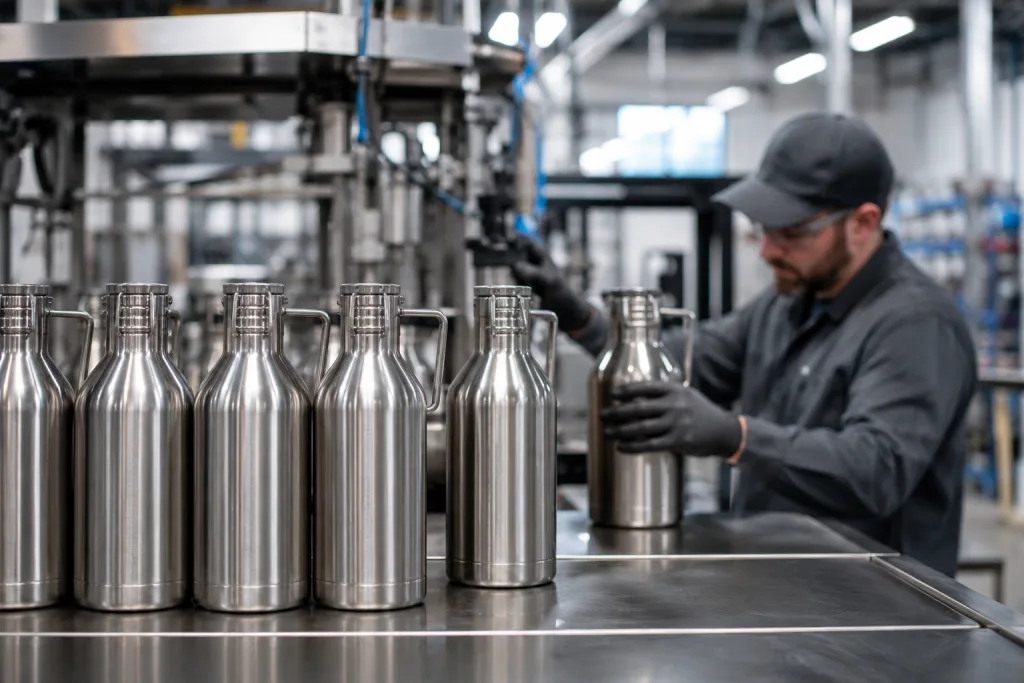
Key Takeaways
- For a 64 oz stainless growler, normal MOQ is 1,000 to 3,000 pcs per color, with repeat orders often dropping to 500 pcs on stocked bodies
- 304/18-8 inner steel with 0.4-0.5 mm body thickness is the safe commercial baseline; 201 steel usually creates more complaint risk than it saves in price
- A realistic custom sample timeline is 7-12 days and bulk lead time is 30-45 days after deposit and artwork approval
- AQL 2.5 for major defects and leak testing at 100% are more useful than broad promises about quality
You can pull 10 growler quotes in one afternoon. That is easy. The expensive part comes later, when a 64 oz custom growler at USD 4.85 FOB China lands with a 3% leak rate, shoulder dents from a 1.2 m drop during carton handling, powder coat chips at the base, and cartons that miss cube by 8 mm so the pallet count slips. We ship this stuff every week, and this is the wrong question to ask: who is cheapest on page one. A unit at USD 5.35 can cost less after claims, rework, and dead stock.
If you buy for retail, promo, or distribution in Europe or North America, read the growler spec sheet like the factory does. On our line, QC pulled the sample and went straight to wall thickness, thread fit, and weld finish before talking about price. In Zhejiang, China, the better suppliers are usually not the ones with the lowest opening quote. They are the ones that can explain why a 0.5 mm wall, 304 inner, and 48-hour lead test matter to shelf damage, return rate, and repeat orders. We have seen buyers flag a nice-looking pre-production sample, then miss that the PO listed the wrong carton count, and the math did not work by the time the goods hit the warehouse.
Start with body capacity and dimensions
Buyers looking for growler bottle manufacturers often start with surface finish or logo position. Wrong starting point. Start with volume, body diameter, total height, and empty weight. Those four specs decide carton count, shelf fit, and whether the end user carries the bottle after week one. On our line, QC pulled a 64 oz sample that was 14 mm taller than PO spec just because the swing cap sat higher than the screw lid version.
The commercial sweet spots are usually 32 oz, 40 oz, 64 oz, and 128 oz. For Europe, 1 L and 1.9 L are easier to position than ounce-based labeling. A typical 64 oz double-wall stainless custom growler runs around 115 to 125 mm body diameter, 280 to 320 mm height depending on cap style, and 650 to 900 g empty weight. If a factory quote omits weight, ask for it on day one. We ship sample cartons by courier every week, and an extra 120 g on the bottle turns into a bigger freight jump than new buyers expect. This is the wrong question to ask: “Can you make it lighter?” Ask how much weight changes after wall thickness, base shape, and lid system are locked.
Diameter matters more than a lot of first-time buyers expect. A wide 128 oz body can look strong in a rendering, but if the packed carton drops pallet efficiency by 8% to 12%, the math doesn't work. We have seen buyers flag a bottle that fit the artwork brief but failed a standard 1200 x 1000 mm pallet pattern by one column. Retail chains look at shelf footprint. Promo buyers look at hand feel and carry comfort. A customizable growler for brewery merchandise is not the same body as a custom drinkware item for corporate gifting.
If you also buy custom canteen lines, ask whether the same body tooling family can support both growlers and canteens. A capable canteen factory in Zhejiang, China may already run matching lid platforms, neck threads, and shared carton standards. We have seen this cut development time to 12 days vs 18 days on repeat projects, especially when the neck gauge and carton drop-test target stay the same. One floor detail here: the thread check is usually done with a go/no-go gauge before painting, not after, because rework at that stage wastes time for a distributor drinkware program.
- Ask for: body diameter, total height with cap, opening diameter, net weight, carton cube, plus units per carton. Ask for the figures in mm, g, and cbm, not just a rendering.
- Watch for: oversized gift-box proposals that look better in the sales sheet but kill freight efficiency. One buyer sent a PO with “1 pc/color box” typed twice, and the outer carton pack-out changed without anyone catching it.
Steel grade, wall thickness, and real durability
The next lines on the spec sheet tell you fast whether the bottle is built for repeat use or just to win the quote. For stainless growlers, the normal export standard is 304 stainless steel, also called 18/8, on the inner wall. The outer wall is often 304 too, though some cost-down projects switch to 201 outside. We see that on entry orders from 3,000 pcs up. If you sell into North America or premium EU channels, 304 inside and outside is the safer call. QC usually checks the coil tag against the PO before the line starts, because one wrong steel code creates a mess later.
Wall thickness is where pricing games start. You will see 0.35 mm, 0.4 mm, or 0.5 mm on the body. For a 64 oz customized growler, 0.4 mm inner and 0.5 mm outer is a solid commercial build. A 0.35 mm body may cut FOB by USD 0.12 to 0.25, but dent claims climb fast in distribution. We have seen cartons arrive with shoulder dents after drop tests and parcel sorting. If your channel includes ecommerce, the math often does not work on the thinner body. This is the wrong place to save cents.
Why buyers should care: wall thickness affects vacuum stability, dent resistance, thread integrity, and how the bottle feels in hand. It also changes powder coat consistency and laser marking clarity, especially around the shoulder radius. On the floor, we check neck threads with a go/no-go gauge; thin material shows problems there first. A serious canteen supplier or canteen manufacturer should be able to show incoming steel COA data and explain exactly where they use 201 versus 304. If they say “same same” on all grades, keep pushing. We have seen this go sideways.
For most B2B programs, the cheapest body is rarely the cheapest delivered product. A dent rate of even 1.5% can erase the unit savings from downgraded steel.
If your range extends beyond growlers into a customizable canteen or canteen custom line, align steel specs across SKUs where you can. Shared material standards make third-party testing for REACH, LFGB, or FDA-contact requirements easier to manage, and they keep your claims page cleaner for end users. We run mixed-SKU test plans all the time, and standardizing 304/304 across the line saves re-check work. One buyer even flagged a PO typo that mixed 201 and 304 on sister items; catching that before production saved 18 days of back-and-forth.
Insulation performance and closure system
I’m rewriting the section in place, keeping the HTML exactly intact and tightening the sales-engineer tone. I’ll preserve all numbers and tags, and I’m checking for any repo-specific instructions only if I need them.Most buyers ask, “How many hours hot and cold?” That question is fine, but it is not enough. For growlers, cold retention usually matters more than hot retention, especially for brewery, outdoor, and lifestyle channels. A workable benchmark for a 64 oz vacuum-insulated bottle is 24 hours cold usable and up to 36 to 48 hours with ice retention in controlled tests. If a supplier claims 72 hours cold on a standard body, ask for the test method, fill temperature, room temperature, and whether the result came from a production sample. We have seen the math fall apart when QC pulled the sample from a pre-production flask instead of the line.
The closure system matters as much as the vacuum. You usually choose from screw cap, loop cap, bamboo top, sports cap adaptation, or swing-top style. For growlers, a leak-resistant screw cap with a food-grade silicone gasket is still the most commercial option. A swing-top looks authentic, but it adds parts, assembly variation, and a higher chance of transit damage if the carton drops from 800 mm. That is the wrong place to get romantic.
Questions worth asking your factory
- Is the cap thread common across 32 oz, 40 oz, and 64 oz bodies?
- Are silicone seals Shore A tested and food-contact compliant?
- Is leak testing done at 100% or by sampling only?
- Can replacement caps be ordered at 500 pcs MOQ?
A professional canteen vendor or canteen vendors group often treats caps as a separate sourcing risk because cap failures create disproportionate complaints. If you run a distributor growler or canteen distributor business, standardizing neck finish across multiple SKUs lowers your spare-parts burden. We ship plenty of replacement lids after the first order, and buyers hate paying air freight for a 28 g cap. That matters once customers start asking for lids instead of whole units.
From Zhejiang export factories, standard leak tests usually add little cost if they are built into QC. The delay starts when a cap changes after sample approval. Change a cap after artwork is locked, and your lead time can stretch from 35 days to 45 days because the decoration fixture and drop-test packout may need to be redone. One PO typo on the cap color code can do the same damage.
Surface finish and branding lines that matter
This is the point where a custom growler stops looking like a stock SKU and starts reading as your product. Common outer finishes we run are powder coating, spray paint, brushed stainless, electroplated color, and, on a few projects, soft-touch. For most OEM orders, powder coating is still the safest commercial choice. It covers scuff marks from carton packing, holds color lot to lot, and pairs cleanly with screen print or laser engraving. On our line, the buyer usually notices the shoulder first.
Ask for coating thickness and adhesion test data. A solid target is around 60 to 80 microns for powder coat, checked with a dry film gauge, with cross-hatch adhesion tested to acceptable internal standard. We have seen 45-micron coating chip on the shoulder radius during drop checks, and 90-micron coating start to crowd the thread area. That hurts cap fit and logo edge definition. The math does not work if the finish looks good on day 1 but fails after 3 weeks in transit.
Decoration options usually include silk screen, heat transfer, laser engraving, and digital print. For a one-color brewery logo on 1,000 pcs, silk screen is usually the lowest-cost option. For dishwasher-wear resistance and a cleaner premium look, laser is the safer call. Full-wrap graphics sell well in mockups, but this is the wrong question to ask if the body has a tight radius or a tapered wall. QC pulled the sample on one job because artwork drifted 2 mm at the seam, and the buyer flagged it right away.
If your project sits closer to canteen promotional or event gifting, the decoration method often matters more than the bottle body. A buyer ordering a canteen customized or customized drinkware run for a campaign often misses logo setup limits, Pantone shift on textured coats, and carton mark rules for 2 or 3 split destinations. We have even seen a PO typo send the wrong mark to the outer carton, which turns into a warehouse argument fast.
- Screen print: lower setup cost, good for simple logos, moderate abrasion resistance; MOQ often starts at 1,000 pcs per color.
- Laser engraving: premium look, no ink wear, best on powder coat or brushed steel; we usually check depth and contrast on first-off samples.
- Heat transfer: broader graphics, but verify scratch resistance on production samples; a tape test and rub test should be standard.
A factory making 300,000 to 500,000 units per month in China should be able to show you decoration defect standards by type: misprint, color variation, ghosting, and position tolerance in millimeters. Ask for that before PO, not after a claim. If they cannot show a limit like ±1.5 mm for logo position, we have seen this go sideways.
MOQ, tooling, lead time, and quote math
Now the numbers that decide if a project can run. For standard stainless growler bodies, normal MOQ is 1,000 pcs per size per color for custom coating and logo. We have seen buyers push for 500 pcs on a 2-color print, but that usually works only on stock colors or when the line has a gap to fill. A new mold for a fresh body shape starts around USD 2,500 and can go past USD 8,000 once the cap thread, handle, and leak-test fixture change.
Sample timing should be clear. Stock sample: 2 to 3 days. Pre-production sample with custom color or logo: 7 to 12 days. Bulk lead time: 30 to 45 days after deposit, sample approval, and final artwork confirmation. If a supplier says 18 days for a fully customizable drinkware project and the other quotes sit at 35 days, the math does not work; QC pulled the sample, and something got skipped.
Quote math needs to split body cost, cap cost, decoration, packaging, and test fees. A clean quote for a standard 64 oz vacuum bottle might show:
- Body with standard cap: USD 4.60 to 5.80 FOB Ningbo
- One-color silk screen: USD 0.08 to 0.18
- Laser logo: USD 0.12 to 0.25
- Color gift box: USD 0.45 to 0.95
- Drop test pack upgrade: USD 0.05 to 0.12
This is where the wider program matters. If you source growlers plus a customizable canteen, canteen customizable, or custom canteen series from the same canteen suppliers, we can often combine steel buying, artwork setup, or carton sourcing on one PO. One buyer once left a typo on the carton spec, and the reprint cost wiped out the savings from haggling USD 0.05 off the bottle body. For a distributor canteen buyer, that is the wrong question to ask.
Compliance, QC plan, and claim prevention
Most disputes in custom drinkware do not start in the sample room. They start after the container lands, when the buyer opens 12 cartons and finds the shipment does not match the approved sample, logo file, or packing note. That is why the spec sheet needs a QC section, not only product specs. On our line, QC pulled the sample and checked it against the signed BOM before sealing the first 50 pcs.
At minimum, ask the supplier to confirm the inspection standard and defect classification in writing. Most export buyers we ship to run AQL 2.5 for major defects and AQL 4.0 for minor defects at final random inspection. For critical items like leakage, some buyers require zero acceptance and 100% leak testing. That is a fair ask for growlers and high-capacity insulated bottles. We usually test with a 0.03 MPa air-pressure setup and a water bath, and this is the wrong place to save 0.02 USD per unit.
Compliance depends on the sales market, not on what the factory says is "normal." EU buyers often ask for REACH-related declarations and LFGB or equivalent food-contact support, depending on the retail channel. North American buyers may ask for FDA-contact readiness, California Proposition 65 awareness, and ASTM or CPSIA checks when the item is sold as a kids-related product. Social compliance requests such as BSCI and factory process certifications such as ISO 9001 come up on a regular basis. We have seen POs with "LFBG" typed by mistake, so the exact wording on the request matters.
A good canteen supplier in China should be fine with third-party testing and pre-shipment inspection. A better one will tell you where claims usually start: welding marks at the shoulder seam, vacuum loss after the oven test, coating chips within 8 mm of the base, logo position drift, or carton drop damage from weak corner support. Last quarter, one buyer flagged 3 recurring issues on a matte black run, and we traced 2 of them back to curing temperature drift on the coating line. If a supplier cannot name their recurring defects, the math does not work.
For canteen distributors, canteen manufacturer partners, or private-label importers, the simplest claim-prevention move is to lock a golden sample and a written packing spec. Write down carton burst strength, inner partition requirement, barcode placement, and palletization if needed. Add small details too: outer carton mark size, 70 mm x 50 mm label position, and whether each bottle needs a PE bag. We have seen this go sideways because one PO missed "do not stack over 5 layers," and the damage showed up after the goods left Zhejiang and hit rough inland handling.
Packaging details buyers often overlook
Packaging looks dull right up to the first container arrival: bottles are fine, retail boxes are crushed, and the buyer files a claim. For growlers, inner protection usually matters more than outer carton print. A common packout is 1 polybag, 1 white box, and 1 export carton. That works for some wholesale jobs. It often fails in ecommerce, gift sets, or domestic parcel handling after import. On our line, QC pulled a sample last month where the bottle passed, but the white box corner collapsed after a 76 cm drop.
If you sell through Amazon or direct-to-consumer channels, ask one direct question: will this bottle pass an ISTA-style drop test with this exact packout? If not, add honeycomb paper, molded pulp, or corrugated dividers and price it properly. The extra USD 0.10 to 0.30 per set is usually cheaper than a returns rate above 2%. We have seen buyers push back on USD 0.12, then lose the math at a 3.4% return rate.
Barcode control is another avoidable miss. Your factory should place the item barcode, carton mark, and, if needed, FNSKU labels exactly to your packing instruction. Ask for photo confirmation before mass packing starts, and ask the team to check scan position with a handheld gun, not by eye. We ship jobs where one PO line had the FNSKU 8 mm too low, and the buyer flagged it before loading. A strong canteen vendor or canteen manufacturer treats this as routine work.
Mixed orders matter too. A lot of buyers do not purchase only growlers. They also need a customized canteen, a sports bottle, or a tumbler range. If your canteen distributors or distributor drinkware business runs assorted SKUs in one container, ask the factory to standardize carton footprints across product families, such as 485 x 325 mm master cartons where possible. This is not a small detail. We have loaded a 40HQ with 4 to 6 cbm more just by cleaning up carton sizes and pallet overhang.
The best packaging question is simple: what claim rate has this exact packout produced before? Ask for shipment history by channel, not a guess from the sales side. This is the wrong question to answer with “should be okay.” A factory in Zhejiang with real export volume should be able to tell you the result, and often show photos from prior inspections or a drop-test record from the packaging bench.
Get a growler spec review before you place PO
Send your target size, artwork, and quantity. We will mark up the critical spec lines, MOQ, testing needs, and packaging risks within 1 business day.
Frequently asked questions
What MOQ should I expect from growler bottle manufacturers for a custom order?
For a standard stainless 32 oz to 64 oz growler with custom color and logo, expect MOQ of 1,000 to 3,000 pcs per size per color. If the factory has a stocked body and cap, some will do 500 pcs with one-color print, but usually not for a first order. New tooling for a unique body shape can require 3,000 to 5,000 pcs to make commercial sense, plus tooling cost from about USD 2,500 upward. If you are also buying a custom canteen or other customizable drinkware in the same order, some China suppliers will combine production planning and give you more flexibility on mixed SKUs.
Which steel grade is safest for a commercial custom growler?
304 stainless steel for the inner wall is the standard baseline you should target. For North America and Europe, many buyers prefer 304 inner and 304 outer, especially on premium retail programs. Some factories quote 201 on the outer wall to save roughly USD 0.10 to 0.25 per unit, but that is less attractive for wet or hard-use channels. On body thickness, 0.4 mm inner and 0.5 mm outer is a practical build for a 64 oz customized growler. Thinner walls can reduce cost, but they raise dent risk and can make the bottle feel cheap in hand.
How do I compare quotes from a growler factory without being misled by price?
Ask every supplier to break pricing into body, cap, decoration, packaging, and test fees. Then compare empty weight, steel grade, wall thickness, leak test method, and carton details line by line. A quote at USD 4.85 FOB may look better than one at USD 5.25, but if the cheaper version uses thinner steel, lower-grade coating, or weaker carton packout, your landed cost can end up higher. Also compare lead time honestly: 7 to 12 days for a pre-production sample and 30 to 45 days for bulk is normal. If a supplier in China promises much faster on a fully customized drinkware order, verify what they are leaving out.
What quality checks should a canteen manufacturer or growler supplier perform before shipment?
At minimum, you want 100% leak testing, vacuum retention checks by batch, appearance inspection, logo position check, carton drop verification, and barcode confirmation. For final inspection, many importers use AQL 2.5 for major defects and 4.0 for minor defects, but leakage should be treated more strictly. Ask whether the factory can support third-party inspection before balance payment. If you buy from Zhejiang or elsewhere in China regularly, also request a golden sample and written defect standards. That reduces disputes about coating scratches, dents, print ghosting, and cap fit once the order reaches your warehouse.
Can one supplier handle growlers, canteens, and other custom drinkware in one program?
Yes, if the factory has broad enough tooling, decoration, and QC capability. Many stronger canteen manufacturers in Zhejiang, China build growlers, sports bottles, tumblers, and custom canteen lines using shared cap systems and similar powder-coat processes. That can help you consolidate MOQs, simplify testing, and reduce development time by about 5 to 10 days on related SKUs. It is especially useful for a canteen distributor or distributor growler business that sells across multiple channels. The key question is whether the supplier manages mixed-order planning well, not just whether they have a large catalog.