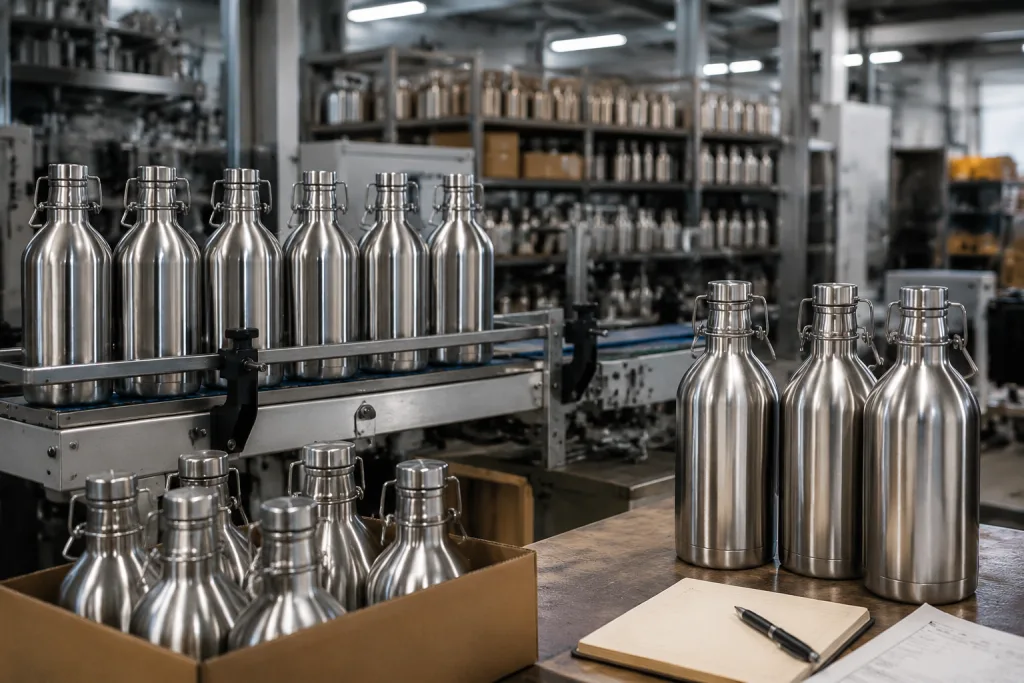
Key Takeaways
- A workable MOQ for custom growlers is usually 500-1,000 units per SKU, while stock-color trials can start around 300 units.
- FOB pricing for a 64 oz stainless customized growler often lands around USD 4.80-8.50 depending on steel grade, finish, and decoration.
- Normal lead time is 25-40 days after sample approval, with mass production capacity often above 300,000 units/month in Zhejiang factories.
- Ask for AQL 2.5 inspection, REACH/LFGB or FDA-contact compliance, and leak-test records before you place a repeat order.
You are not just buying a stainless steel bottle. You are buying repeatability: 0.4 mm wall thickness that matches the approved sample, lids that still pass a vacuum leak check after 90 days in transit, print that survives 300 dishwasher cycles, and lead times your sales team can quote without getting burned. We see this on the line all the time. A buyer gets a sheet with 12 low quotes, but no one lists the lid torque spec, the weld polish standard, or what QC pulled from the pre-shipment sample.
For distributors and brand owners in Europe and North America, the wrong question is who is cheapest. Ask who can build the right custom growler, or a broader custom drinkware line, with stable quality, workable MOQ from 1,000 pcs, and paperwork that holds up in a compliance review. In Zhejiang, China, and across the wider China supply base, there is a big gap between a trader, a canteen supplier, and a factory that can run your program without surprises. We have seen this go sideways over a one-line PO typo, a missing LFGB test report, or a cap thread that was 0.3 mm off.
What are you really buying?
With a growler bottle distributor, you are buying a supply-chain setup, not a bottle alone. We see 3 common models on the floor: a trading company that buys across 20 to 40 factories, a canteen factory that runs its own tube cutting and welding line, or a hybrid team in China that develops the item in-house and sends out one process like powder coating or laser engraving. This sounds small. It is not.
Most B2B problems start when buyers assume these models ship the same way. They do not. If you need a stock item with a one-color logo, a canteen vendor or canteen distributor is often enough. If you need a customizable growler with a new lid, Pantone-matched finish, retail box, barcode label, and multi-market compliance files, ask who owns the mold, who checks incoming 304 stainless with a micrometer, who signs off weld quality, and who releases final AQL 2.5. This is the wrong question to skip.
- Factory-direct advantage: tighter control of welding, vacuum hold time, and corrective action on the line after QC pulled the sample.
- Trading advantage: broader product range if you also load a custom canteen, sports bottle, tumbler, plus glass bottle in the same 40HQ container.
- Hybrid advantage: a practical balance if the Zhejiang team handles export files well and chases detail fast—like fixing a PO typo before mass production starts.
A serious supplier should give you hard numbers fast: monthly output, normal MOQ, sample time, lead time. In Zhejiang, a capable stainless drinkware factory may run 300,000 to 500,000 units per month, set MOQ at 1,000 pcs per color, finish pre-production samples in 7-10 days, and quote 30-35 days for bulk after deposit and artwork approval. If someone gets vague here, we have seen this go sideways.
If a seller cannot explain steel grade, insulation structure, leak testing, or which defects count under AQL 2.5, that is your answer. A dependable custom drinkware partner should know the leak test pressure, the weld reject points, and why QC flagged a scratched shoulder at final inspection. If they cannot explain that, you are looking at a quote sheet, not a supplier.
How do you qualify a supplier fast?
Procurement managers need a fast filter. You do not have time to audit 20 canteen suppliers in full. We’ve seen buyers cut that list to 3 in one afternoon with a short screen, then spend the real time on the factories that actually run growler production. Start simple.
Use this first-pass screen
- Product focus: Ask what they make every week on the line. Do they run growlers, flasks, and wide-mouth insulated bottles, or are they mostly gift traders buying from 6 different workshops? QC pulled this apart for one buyer last month after the supplier mixed 2 lid sources on the same PO.
- MOQ clarity: Ask for MOQ by body color, lid type, and logo process. A real factory answers with numbers like 500 units per color or 1,000 units for laser logo on one Pantone body, not “depends.” If they cannot break MOQ down by process, the quote is not ready.
- Compliance: Ask for REACH, LFGB, FDA, or Prop 65-related material declarations where needed. On our side, this usually means pulling the 304 stainless and silicone records by item code, not sending a generic PDF from 2021.
- Social and quality systems: BSCI, ISO 9001, and documented incoming/final inspection are common minimums. Ask to see the actual inspection form; if the form shows AQL 2.5, thread check, and vacuum hold record, you are talking to a team with a system.
- Factory evidence: Ask for production photos and short line videos. You want to see the weld station, vacuum chamber, powder coating line, and packaging area, plus one unglamorous shot like thread gauges on the bench. This is the right question to ask early.
Then ask one practical question: who handles corrective action if there is a 4% leak failure in final inspection? This is where weak suppliers go soft. A canteen supplier with no factory control usually gives a vague reply. A canteen manufacturer or canteen factory should explain the actual steps: sealing ring replacement, thread gauge check, torque adjustment, or weld-process review. We ship CAPA replies with photos from the line because the math does not work if you wait until the next order to fix it.
If the sales contact only talks about logo options and never about process control, keep looking.
This matters beyond growlers. A lot of buyers start with a custom growler, then add a customizable canteen or a customized drinkware gift set within 2 seasons. We have even seen a PO typo on lid code turn one SKU into three carton marks, so supplier discipline matters fast. You want a supplier that can grow into a broader distributor drinkware relationship, not one that has to relearn your standards on every PO.
As a rule, keep your shortlist to suppliers that answer technical questions within 24-48 hours and send structured quotations with FOB term, carton data, net/gross weight, and sample charges in USD. If a quote comes back without carton size in cm or gross weight in kg, the buyer flagged it for a reason. That detail usually tells you how the order will run.
What specs should be fixed before quoting?
Bad quotes usually start with a loose RFQ. Ask 6 suppliers for a “custom growler” without fixing the build, and you will get 6 different products back on paper. We see this on the line all the time: one factory prices 0.4/0.5 mm vacuum, another slips in lighter steel, another swaps the lid set. Then the price comparison means nothing.
Before you request pricing from a growler bottle distributor, lock these points first:
- Capacity: 32 oz, 64 oz, or 128 oz. Put one target size on the RFQ, not “multiple sizes if possible.”
- Material: 18/8 stainless steel, usually SUS304 for body and inner wall. If you need 316 for special use, say it now because the math changes fast.
- Insulation: single wall or double wall vacuum. This is the wrong question to leave open.
- Body thickness: common ranges are 0.4 mm inner and 0.5 mm outer for mid-grade vacuum growlers. If the buyer flagged dent risk before, ask for the actual mm on the quote.
- Mouth type: wide mouth for easier filling and cleaning. A 55 mm mouth and a 78 mm mouth do not quote the same way.
- Lid system: screw cap, flip handle, bamboo top, or steel cap with silicone seal. We have had POs with “bambo lid” typed on them, and then everyone spent 2 days confirming the same part.
- Finish: spray paint, powder coat, brushed, electro-polished, or full-wrap print. Powder coat usually needs its own sample pull because texture and color shift show up fast.
- Decoration: silk screen, laser engraving, heat transfer, digital print, or embossing. QC pulled the sample once for a 1.5 mm logo shift, and the buyer still rejected it.
- Packaging: white box, color box, PDQ, or mailer-tested carton. If you need an ISTA-style drop standard, state it before quote, not after carton size is fixed.
These same principles apply if you are also sourcing canteen custom items, a customizable canteen line, or a customized canteen for retail packs. Buyers mix terms like canteen custom, canteen customizable, and canteen customized every week. The factory issue stays the same: each open variable widens cost spread and delivery risk. We have seen this go sideways over one undecided lid insert.
For example, a 64 oz customizable growler in SUS304 double-wall vacuum with powder coat and 1-color screen print may quote at USD 5.60-6.80 FOB Ningbo at 1,000 units. Change that to copper-plated vacuum layer, custom mold lid, gift box, and laser plus screen combo, and you can move to USD 7.80-9.20 fast. On our side, that usually means extra tooling review, a second print fixture, and longer sample approval.
If you want accurate quotes from China, send artwork files, Pantone references, target market, packaging sketch, and any retail drop-test requirement at the start. We run quotations faster when the inputs are fixed. A clean RFQ can save 7 days versus 14 days of back-and-forth, and you get numbers your purchasing team can submit without guessing.
Where do MOQ and price really move?
Most buyers chase unit price first. That is the wrong question to ask. In stainless custom drinkware, price moves on steel weight, vacuum build, lid parts, surface finish, print method, and packing labor. On our line, a 0.1 mm wall change or a heavier lid with a silicone gasket can shift cost faster than people expect.
Here is the practical pattern you will see from a capable canteen manufacturer or canteen supplier in China:
- Stock mold + stock color + one logo: lowest entry, often MOQ 300-500 units. We run these fastest because the spray line stays unchanged and QC pulled the sample from existing master cartons.
- Stock mold + custom Pantone powder coat: usually MOQ 500-1,000 units because of paint setup and minimum coating run. Buyers push back on this all the time, but the math doesn't work if the coating batch is too small.
- Custom packaging: can add 500-1,000 unit MOQ if the box is offset printed. A small typo on a PO can hold artwork for 2 days, especially if barcode size or inner tray dimensions are missing.
- New lid or body mold: tooling can range from USD 1,500 to USD 8,000 depending on complexity. We have seen lid projects go sideways over one hinge pin or thread tolerance, so this cost range is normal.
For distributors, this matters because your first order is rarely your biggest order. We ship plenty of launch orders at 500 units, then the same buyer comes back for a custom canteen or a bundled customized drinkware set after sell-through data comes in. A supplier that lays out MOQ straight helps you stage cash, test the market, and avoid sitting on 2,000 pieces you did not need.
Reasonable target pricing for planning purposes:
- 32 oz single-wall growler: about USD 2.20-3.80 FOB
- 64 oz vacuum insulated growler: about USD 4.80-8.50 FOB
- Premium finish or retail gift set: add USD 0.60-2.00
- Laser engraving: often USD 0.08-0.25 per position
- Color box: often USD 0.35-0.90 depending on structure
Watch out for prices that sit 15-20% below the market without a clear reason. In Zhejiang and other China clusters, that usually means lighter steel, weaker powder coat, lower-grade silicone, or line items missing from the quote. We have seen incoming inspection find thin coating at the handle weld and silicone odor issues on bargain lids. Cheap POs become expensive claims.
What quality checks prevent expensive surprises?
If you import customized drinkware at container level, one bad batch can erase the margin on a 40HQ. We’ve seen lids leak after a 1.2 m invert test, shoulders arrive dented from weak inner trays, handle welds crack at the joint, powder coat shift 1–2 shades off the approved chip, and barcodes fail at inbound because one digit on the PO was typed wrong. “Good quality” is the wrong question to ask. Lock the inspection points before the line starts.
Your quality checklist should cover three stages, and each one needs a named check with a pass/fail standard.
Before production
- Approved golden sample signed against artwork and color reference; we usually seal one sample in the QC room and one on the line for cross-check
- Packaging approval with carton marks and barcode layout, including outer carton size, print position, and scan test before the first 500 pcs
- Material confirmation for SUS304/SUS201 usage by component; QC pulled the sample and checked the body, inner wall, and cap contact parts separately
During production
- Thread fit check and torque check on caps; on our line we run random checks every 30 minutes so cross-thread issues show up before 2,000 pcs pile up
- Weld inspection on handle or side seam if applicable; this matters on growlers, and we’ve seen this go sideways when the buyer flagged a loose handle only after packing
- Powder coat adhesion and color consistency checks, including tape test and visual comparison under the same light box
Final inspection
- AQL 2.5 major / 4.0 minor, or your company standard
- Leak test, usually inverted or pressure-based depending on design; 30 minutes upside down is common for screw-lid growlers
- Vacuum retention spot check for insulated models; if the reading drifts early, the math doesn’t work on the full shipment
- Drop test on packaged unit if selling into retail or e-commerce; we normally test one master carton from 76 cm
- Barcode scan and carton quantity verification; this sounds basic, but one mixed carton count can trigger chargebacks fast
If you are shipping to Amazon or major retail, add FNSKU placement rules, carton dimension limits, and pallet requirements before mass production starts. Do it before artwork release, not after. A canteen distributor or distributor canteen supplier focused on wholesale often skips these details unless you push hard on the packing spec.
Ask for defect photos from prior inspections. Good canteen manufacturers and canteen factories usually have a file of rejected parts ready—scratched coating, off-center logo, weld burn mark, collapsed carton corner. That tells you more than a polished showroom does.
How should you plan samples and timelines?
Most lead-time slips start in sampling. Buyers sign off the artwork, then leave the powder coat texture, carton drop spec, or cap torque open, and the factory has to guess on the line. We’ve seen this go sideways after a sample passed color but the buyer flagged the lid feel at 1.8 N·m torque, which pushed production back 6 days.
A workable schedule for a custom growler or customizable drinkware order looks like this:
- Quotation and technical review: 2-4 days
- Artwork mockup and sample payment: 2-3 days
- Pre-production sample: 7-10 days for stock mold, 15-25 days with new tooling
- Sample revision if needed: 5-7 days
- Mass production: 25-40 days after approval and deposit
- Final inspection and booking: 3-7 days
For seasonal demand, count back from the day your warehouse needs to receive goods, not the vessel ETD. Ocean freight from China to Europe can run 30-40 days port to port, and to North America often 20-35 days depending on route and congestion. Then add customs clearance, inland delivery, and 2-3 buffer days, because one missed CY cut-off can turn a 12-day gap into 18 days.
This matters even more if you are buying a distributor growler item plus a canteen promotional line or a broader canteen customizable collection for Q4 gifting. The wrong question to ask is “What is the average lead time?” Ask by SKU and finish. A brushed body, a matte powder coat, and a printed gift box do not move through the same station, and one coating line running 3,000 pcs can hold the full shipment.
Tell the supplier what date cannot move. If your catalog deadline is fixed, say it on day one and put it on the PO. We ship smoother when the split is logical: start bulk body production after sample approval, then close carton copy and insert details in parallel. QC pulled a sample last month where the outer carton PO had “stainles” typed instead of “stainless,” and that small miss still cost a reprint.
Good planning saves more time than chasing emails every day.
What should you ask before placing the PO?
At the PO stage, some buyers think the hard work is done. It is not. This is the point where you lock the order or leave space for disputes later, and we see the buyer flagged on a typo in the PO more often than on the sample itself. The last review needs to be blunt and specific.
- Incoterm: FOB Ningbo, FOB Shanghai, or another agreed term
- Payment: common structure is 30% deposit, 70% before shipment
- Tolerance: clarify quantity tolerance, usually plus/minus 5% unless fixed
- Inspection: define whether third-party inspection is required before balance payment
- Claims window: set a written timeline such as 15-30 days after receipt
- Spare parts: add extra lids or seals, often 1-2% for safety
Also confirm whether your supplier is acting as a canteen factory, canteen manufacturer, canteen distributor, or canteen vendor on the paperwork. That choice affects who answers when a cap torque issue shows up on the line. We run into this all the time: if the factory name and the export company name do not match the PO, the claim gets slow fast.
If you plan to extend the line into custom canteen, customized canteen, or custom drinkware assortments, ask for component standardization. Shared lid threads, shared box sizes, and common carton counts can cut MOQ pressure and make spare-parts control cleaner. QC pulled the sample twice on a 38 mm lid once because the carton spec on the PO did not match the outer box drawing.
The best growler bottle distributor for you is not the one that says yes to everything. It is the one that tells you early where the risk is, what will cost more, what can be standardized, and what lead time is realistic from Zhejiang, China. That is how repeat business gets built in this category, and the math does not work any other way.
Get a practical quote for your growler program
Send your target capacity, finish, logo method, MOQ, and market. We will review feasibility, pricing, and lead time from Zhejiang, China within 48 hours.
Frequently asked questions
What MOQ should I expect from a growler bottle distributor?
For a stock-mold growler with standard lid and one-color logo, 300-500 units is possible, especially if the supplier already runs that body in China. For a custom Pantone finish, retail box, or mixed decoration, MOQ usually moves to 500-1,000 units per SKU. If you need a new lid, base, or body mold, the practical MOQ may start at 1,000-3,000 units plus tooling. The right question is not just MOQ for the bottle. Ask MOQ separately for body color, logo process, packaging, and spare lids. That gives you a real landed-cost picture and avoids surprises when the canteen manufacturer tells you the bottle MOQ is 500 but the printed box MOQ is 1,000.
Is it better to buy from a factory or a trading company?
It depends on your program complexity. If you buy one or two stainless items and need tight quality control, a direct canteen factory or canteen manufacturer usually gives better process visibility. You can ask about wall thickness, vacuum rate, leak testing, and AQL without layers of communication. If you buy a mixed line such as growlers, tumblers, kids bottles, and glass items, a trading company can simplify consolidation and reduce admin work. The best option for many importers is a hybrid supplier in Zhejiang, China that manages exports professionally but has stable factory control for key categories. Ask who owns sampling, who approves corrective action, and who signs off final inspection. That tells you more than the company label.
What tests matter most for custom growlers?
Start with the basics: leak test, vacuum retention for insulated models, coating adhesion, odor check, and carton drop resistance if the product is for retail or e-commerce. For market access, ask for applicable food-contact documentation such as LFGB for Germany or broader EU requirements, REACH declarations, and FDA-related material statements for the US where relevant. If children might use the product, ASTM-related review may also matter depending on the item and packaging claims. Operationally, require final inspection to AQL 2.5 major and 4.0 minor unless your standard is stricter. On larger orders, many buyers also request 1-2% spare seals or lids. That small addition can save a lot of after-sales cost.
How long does a custom drinkware order usually take?
For a stock body with normal decoration, expect about 7-10 days for pre-production sample and 25-35 days for mass production after approval and deposit. If you add a new mold, bamboo lid development, or custom retail packaging, the timeline can stretch to 40-55 days. During peak season, especially from August to November, coating and packaging lines in China get busy, so book earlier than you think you need. For Europe or North America, do not forget freight time. Ocean shipping can add another 20-40 days depending on destination and port conditions. If your catalog launch is fixed, count backward from warehouse arrival and build in at least a 7-day buffer for inspection and booking.
How can I reduce risk on a first order with a new supplier?
Keep the first PO simple. Use a stock mold, one body color, one logo position, and standard export carton if possible. That lets you evaluate the supplier’s real execution without too many variables. Ask for a paid sample that matches bulk specs, then approve a golden sample for production reference. Put AQL standard, leak-test requirement, packaging marks, and claim window in the PO. If the order is above roughly USD 5,000-10,000, consider a third-party final inspection before balance payment. You can also request production photos during key stages and buy 1-2% spare lids or seals. A disciplined first order tells you quickly whether the supplier can grow into a long-term custom canteen or distributor drinkware partner.