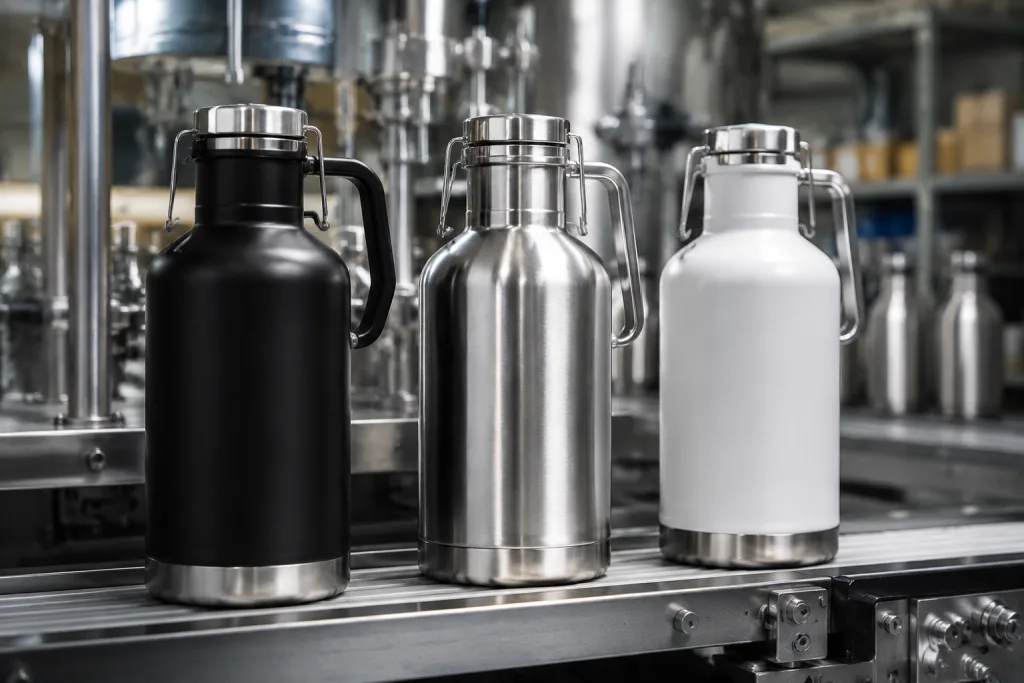
Key Takeaways
- Stock-body growler bottle customized orders often start at 500-1,000 pcs, while new mold projects usually need 3,000-5,000 pcs.
- FOB pricing for a 64 oz stainless custom growler commonly ranges from USD 3.80 to USD 8.90 depending on steel grade, lid, finish, and decoration.
- Pre-production sampling takes about 5-12 days for stock items, but 20-35 days if you add new tooling or special packaging.
- AQL 2.5 inspection, leak testing, and packaging details can change total cost by 3%-8% even when bottle specs stay the same.
You already know the artwork is not the hard part. Pricing is. We’ve seen a growler bottle customized project look fine on the first sheet, then samples, freight, and a carton change push landed cost 20% higher than the buyer planned. A quick quote on a custom growler usually misses the real cost drivers: lid structure, steel grade, print method, and carton pack. Last month one buyer flagged a 6 pcs master carton after sending a PO for 12 pcs, and the math broke fast.
If you buy custom drinkware for retail, promotions, or distribution, you need a cost and lead-time model you can use on day one. This is the wrong question to ask: “What’s your best price with my logo?” Ask how the factory runs the body, cap, decoration, and pack-out. That matters more. If your supplier base includes a canteen factory, several canteen manufacturers, and a canteen distributor offering similar shapes, the tooling rules can be miles apart even on a 304 stainless body. In Zhejiang, China, the gap between a simple stock body and a fully customized growler can mean 12 days versus 45 days, and USD 3.80 versus USD 8.90 FOB. On the line, a 0.3 mm change at the neck or a new cap mold can be the difference.
Where the price really moves
When you ask for a growler bottle customized quote, the first number is usually a budget marker, not the job cost. Real FOB moves on five things: capacity, body build, lid, decoration, and packing. For a standard 32 oz or 64 oz custom growler from Zhejiang, China, buyers usually see USD 3.80 to USD 8.90 FOB at 1,000 pcs. Big spread, yes. It comes from actual factory inputs, not sales padding. On our line, a 64 oz body runs through a different forming setup than 32 oz, and that alone changes cycle time.
Material moves price first. A single-wall 18/8 stainless body may save USD 0.70-1.20 per unit versus vacuum insulated double-wall construction. If you move from 0.4 mm outer wall and 0.3 mm inner wall to a heavier 0.5/0.4 mm build, add another USD 0.25-0.45 depending on size. Lid cost comes next. A basic screw cap is cheaper than a swing-top, and a stainless cap with silicone seal costs more than a standard PP closure. We check wall thickness with a micrometer after forming; if the buyer flagged dent risk before, this is the wrong place to shave cents.
Decoration is where buyers miss the math. A one-color silkscreen logo might add only USD 0.08-0.18 per unit, while laser engraving can add USD 0.12-0.30. Powder coating with a Pantone-matched finish may add USD 0.35-0.80, and wrap graphics or special texture finishes push it higher. For retail programs, finish usually sells better than an upgraded logo process. QC pulled the sample once because the powder coat gloss was 8 points off the approved chip, and the buyer noticed that faster than the logo size.
- Basic stock growler: USD 3.80-4.80 FOB
- Vacuum insulated custom growler: USD 4.90-6.80 FOB
- Premium customized growler with custom lid and gift box: USD 7.20-8.90 FOB
If a canteen supplier gives you a low unit price, check the missing items first. Ask whether that price includes leak test, individual polybag, export carton drop standard, and logo setup. We have seen POs with "gift ox" typed instead of "gift box," and then packing cost got argued for three days. A lot of canteen vendors and canteen suppliers quote body price first, then add the project cost after sampling. We've seen this go sideways.
MOQ tiers change your options
MOQ is not just a quantity line on the quote. It decides what kind of growler bottle customized project we can run on the line. For an order based on an existing mold, a lot of canteen manufacturers in China will take 500 pcs for a plain body, or 1,000 pcs for color plus logo. At that level, you are usually picking from existing capacities, lid systems, and standard powder coat colors already hanging in the spray booth.
Once you ask for a customizable growler with a unique lid, an embossed logo panel, or a custom bottom shape, MOQ jumps fast. New tooling for caps or body parts usually starts at 3,000-5,000 pcs. If the project needs a new mold set, tooling can run from USD 2,000 for a simple cap change to USD 8,000 or more for a new stainless body line. We have seen buyers push for custom tooling at 1,000 pcs, and the math does not work. QC pulled a cap sample last month that was 0.4 mm off on thread fit, and that small miss is enough to stall a whole custom closure project.
Promotional buyers ask all the time if canteen custom or canteen promotional orders can run at 300 pcs. Sometimes yes, usually only on stock SKUs with limited decoration, like one silk-screen logo on a standard 64 oz body. If you are a distributor drinkware buyer or distributor growler program manager, this is the wrong question to ask. Better to balance SKU count against workable MOQs than split one PO into 6 colors and 4 lid options, then watch the freight and carton count go sideways.
Typical MOQ structure
- 300-500 pcs: stock color, simple logo, limited item choice; usually one existing carton and no inner-egg-crate change
- 1,000 pcs: normal starting point for customized canteen or growler with finish and logo; this is where we ship most first orders
- 2,000-3,000 pcs: better carton customization, tighter color consistency, lower unit cost; the powder coat line runs more stable here
- 3,000-5,000 pcs: entry level for closure modifications or partial tooling; this is where a new lid insert or base detail starts to make sense
At BottleForge-style factory scale, monthly output can exceed 300,000 units across bottles, tumblers, and canteens, but MOQ still depends on the specific process line. A canteen manufacturer may be flexible on body inventory and rigid on lid assembly because the lid line uses separate fixtures and leak-test setup. Ask for MOQ by component, not just by finished product. We have had buyers flag a finished-goods MOQ, then miss that the lid supplier wanted a higher run on its own PO.
Lead time is mostly process time
Buyers hear “25 days production” all the time. That is only one slice of the schedule. On a growler bottle customized program, lead time is artwork sign-off, sample making, steel and lid planning, line time, inspection, and vessel booking. Miss one step and the ship date moves. We see this on the floor: the laser logo file is approved at 4 pm, but the Pantone note on the PO is wrong, so sampling loses a day.
For a stock-body customized growler, normal timing looks like this:
- Quotation and artwork check: 1-3 days
- Pre-production sample: 5-7 days
- Sample courier transit: 3-5 days to Europe or North America
- Mass production: 25-35 days after sample approval and deposit
- Final inspection and loading: 2-4 days
So the full order cycle is usually 36-50 days before ocean freight. Add custom packaging and you usually add another 5-10 days, because the carton supplier runs on a separate schedule and we still need to match the 62 mm neck area print position to the insert die-line. Add new tooling and the total cycle moves to 45-70 days. Some buyers ask only for the factory lead time. That is the wrong question to ask.
Zhejiang factories get squeezed at the same points every year: stainless steel allocation, powder coating line load, and the rush before holidays. We run into this before Chinese New Year and again from August to October when space gets tight. Last season, a buyer flagged a one-week slip after deposit, but the issue started earlier because the coating line was already full. A reliable canteen factory or canteen vendor should say this up front, not after money lands.
If your PO date is fixed by a retail launch, work backward from the ex-factory date, not from the day you ask for the first quote.
For Amazon FBA or distributor canteen programs, barcode position and carton marks usually add 1-2 days. Sounds small. It is not. QC pulled the sample, found the outer carton label 8 mm off the approved layout, and that single approval miss pushed loading past vessel cutoff by a full week.
Decoration and packaging add hidden cost
The bottle is seldom the full cost. Decoration and packaging move landed cost fast, and buyers often miss that on customized canteen, custom canteen, or customizable canteen programs for gift, outdoor, or premium retail. We see this on the line all the time: a clean bottle quote looks fine, then the buyer adds a gift box, a Pantone callout, and a barcode on the PO, and the math doesn't work.
Silkscreen is still the low-cost standard on a lot of stainless bottles. It suits simple 1-color logos and can stay under USD 0.20 per unit on volume. Laser engraving gives a cleaner premium look and holds up better in abrasion tests, but it usually runs a bit higher. Heat transfer or full-wrap graphics can add USD 0.35-0.90 depending on artwork complexity and reject risk. QC pulled the sample more than once for wrap misalignment over 2 mm, so this is the wrong question to ask: not “Which decoration looks best?” Ask which decoration your tolerance and budget will support. If your brand guide calls for exact Pantone matching on powder coat, allow sampling time and settle tolerance limits early.
Packaging has the same tradeoff. An egg-crate master carton is the low-cost option. A white box with barcode label may add USD 0.18-0.30. A full-color gift box can add USD 0.45-1.20, plus more carton volume and higher freight. For North American e-commerce, an ASTM-style drop-resistant pack may be worth the spend, but it changes both unit cost and cube. We ship plenty of these in 5-layer corrugated cartons, and once box height grows by 12 mm, the pallet count shifts.
- Polybag + export carton: lowest cost; solid for bulk distribution and faster packing on the line
- White box: cleaner retail presentation with a moderate cost increase; common choice at 1,000 pcs MOQ
- Color box + inserts: better shelf impact, but higher packing labor and more inspection points for insert fit
If you work with canteen distributors or a canteen distributor network, standardize packaging early to cut dead stock. If you buy from several canteen manufacturers, lock carton specs first. We've seen this go sideways: mixed pallet heights, barcode zones printed 15 mm off spec, and warehouse rework because one PO used the wrong carton mark.
How to compare suppliers fairly
Buyers often collect 4 quotes from a canteen supplier, a canteen factory, a canteen manufacturer, and a trader, then try to rank them line by line. That is the wrong question to ask. The hard part is not getting prices. It is normalizing what each supplier actually included.
To compare a growler bottle customized offer fairly, build one spec sheet and lock the assumptions before you send the RFQ. Use the same capacity, steel grade, vacuum or single-wall structure, lid material, logo size in mm, finish, packaging, and inspection standard for every supplier. We see this go sideways when one quote is based on 304 stainless with a plain white box and another hides the cost of a color box, drop test, and barcode label. A USD 4.20 offer from one canteen vendor can end up costing more than a USD 4.60 quote once the missing items show up on revision 2.
Ask each supplier to confirm these points in writing. Email is fine. A marked-up PDF is better, especially when the buyer flagged a lid spec and the PO later showed a typo on capacity.
- Material: 18/8 or 18/10 stainless, BPA-free plastics, food-contact silicone
- Compliance: REACH, LFGB, FDA as needed by market
- Audit status: BSCI, ISO 9001, or customer-approved systems
- QC standard: AQL 2.5 or your required level
- Leak test: 100% or sampling basis
- Price term: EXW, FOB Ningbo, or FOB Shanghai
A serious canteen manufacturer in China should be comfortable answering at this level. We run into trouble when a supplier says "same as usual" and will not state wall construction, test method, or carton pack-out. QC pulled the sample more than once and found the approved bottle was 0.3 mm different on the mouth finish from mass production. If a supplier stays vague, expect the quote to move later.
Ask who controls coating, printing, and packaging on the line. Some canteen vendors assemble from outsourced parts, and that model is workable, but it adds one more timing and quality checkpoint. We ship plenty of OEM programs this way, yet the math does not work if you need tight launch dates, because 12 days vs 18 days often comes down to one outside print shop missing its slot. If you are building a distributor growler range, fewer handoffs usually means fewer surprises.
What a realistic sourcing plan looks like
If you are buying growler bottle customized items for the first time, keep the first order boring. That is the right move. Pick a stock body, a proven lid, 1 or 2 standard colors, and one simple logo process such as screen printing or laser marking. We have seen first POs go sideways over a 2 mm logo shift or a matte color signed off from a phone screen, so this is the wrong place to chase custom parts.
A practical first PO for customized drinkware often looks like 1,000-2,000 pcs split across two colors with one decoration method and standard export packaging. That range usually gets you workable FOB pricing, sample timing that stays under control, and enough volume for the line to run consistently. In our factory, QC pulled the sample after the first 50 pcs to check print position and lid fit; if the item sells, the second order is where custom boxes or exclusive coatings start to make sense.
For buyers managing a broader canteen customizable or canteen customized range, think in stages:
- Stage 1: validate bottle quality, insulation, leak resistance, and decoration adhesion
- Stage 2: optimize cost through MOQ consolidation and packaging standardization
- Stage 3: consider tooling only after reorder velocity is proven
In China, especially around Zhejiang sourcing clusters, good factories can move fast, but fast is not rushed. If you need 20,000 pcs for a chain launch, book capacity early. A 30-day lead time in a quiet month can turn into 40 days once the powder coating line is full and we are running 3 shifts on 2 ovens.
The best canteen distributors and canteen manufacturers are not the ones quoting the lowest price or the shortest lead time on day one. You want the supplier with a stable cost model, a production schedule that holds up, and fewer corrections after approval. Buyers flag this late: a typo on the PO, a barcode revision, or a carton mark change can hold shipment for 2 days. That is what makes a custom growler program commercially usable for a retailer, promotional buyer, or distributor drinkware team.
Get a practical quote for your custom growler project
Send your target capacity, artwork, packaging idea, and quantity. We will reply with a usable FOB cost range, MOQ, and lead-time estimate.
Frequently asked questions
What is the normal MOQ for a growler bottle customized order?
For an existing bottle shape, 500 pcs is sometimes possible for a plain stock item, but 1,000 pcs is the normal commercial MOQ if you want color plus logo. For a vacuum insulated 64 oz custom growler, 1,000 pcs usually gives you better decoration options and more stable unit cost. If you need a custom lid, embossed area, or other tooling change, expect 3,000-5,000 pcs minimum. Some canteen manufacturers in China may accept lower trial quantities, but that usually means fewer color choices or higher setup charges spread across fewer units.
How much does a customized growler usually cost FOB China?
A basic single-wall stock-body growler can land around USD 3.80-4.80 FOB. A double-wall vacuum insulated custom growler is more commonly USD 4.90-6.80 FOB, depending on size, steel thickness, coating, and lid. Premium projects with laser marking, swing-top or stainless cap systems, and color gift boxes can reach USD 7.20-8.90 FOB. Always confirm whether the quote includes logo setup, leak testing, inner packing, and FOB port terms such as Ningbo or Shanghai. Small omissions can change your true cost by 5% or more.
How long does production take after sample approval?
For a stock-body project, mass production usually takes 25-35 days after sample approval and deposit. Pre-production samples take about 5-7 days, and courier transit to Europe or North America adds another 3-5 days. If you add printed packaging, allow 5-10 extra days. New tooling can add 15-25 days before normal production even starts. A realistic total cycle for a growler bottle customized order is often 36-50 days, and 45-70 days if you are changing structure or building new molds.
Is it better to buy from a canteen factory or a trading company?
It depends on your project complexity and how the supply chain is managed. A direct canteen factory can give you clearer control on MOQ, production planning, and technical changes, especially for custom drinkware with coating, welding, and leak testing. A trading company can still work well if it manages QC tightly and consolidates several product lines for you. The practical test is not the company type. Ask who controls sampling, who owns the inspection process, and whether the quote covers AQL 2.5, compliance documents, and packaging details. If the answers are vague, the risk is higher.
What should I lock before asking several canteen suppliers for quotes?
Lock the specification first. That means capacity such as 32 oz or 64 oz, single-wall or vacuum insulated structure, 18/8 stainless requirement, wall thickness, lid material, finish, logo size and method, packaging style, and price term. Also state required compliance such as REACH, LFGB, or FDA, plus your inspection level like AQL 2.5. If you leave these open, quotes from canteen suppliers and canteen vendors will not be comparable. One supplier may price a lighter body or simpler cap and appear cheaper by USD 0.40-0.80, even though the product is not equivalent.