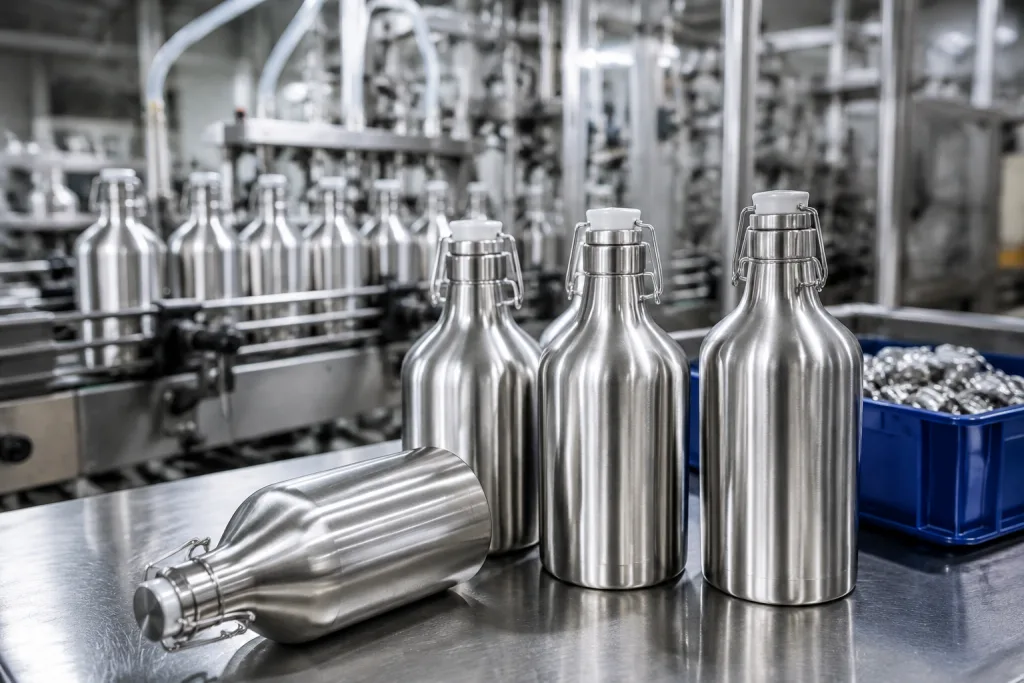
Key Takeaways
- Start with 4 decisions: capacity, insulation, decoration, and compliance; changing one can shift MOQ from 500 to 3,000 units
- Typical FOB pricing for stainless steel custom growler runs about USD 4.80-9.50 depending on size, coating, lid, and print method
- Standard production lead time is usually 25-35 days after sample approval, with pre-production samples in 7-10 days
- Set inspection terms early; AQL 2.5/4.0 and leakage testing at 100% are common for export drinkware from China
You are not buying a bottle. You are buying a spec sheet, a print process, a landed cost, and the factory routine behind it. On our line, one 0.3 mm logo shift is enough for QC to pull the sample, so a growler bottle customizable program should be judged as an operating decision, not a catalog pick. Buyers in Europe and North America usually start with capacity and logo, then get hit later by carton drop limits, powder-coat adhesion failures, or missing FDA and LFGB paperwork. We have seen this go sideways.
If you source from Zhejiang or elsewhere in China, the supply base is mature, but 7 out of 10 quotes still hide the trade-offs. A capable canteen manufacturer should show where the budget goes, how MOQ moves by process, and which claims are backed by actual test reports instead of sales talk. We ship custom drinkware for retail, gifting, and distribution, and this is the wrong question to ask if the sample alone looks good. The buyer flagged a polished sample once; the PO had the logo finish typo, and the math did not work after repacking into a 24-unit export carton.
The four decisions that control cost
For a growler bottle customizable project, cost is usually set by four early calls: vessel size, thermal construction, branding method, and compliance scope. Lock those before you ask for final pricing. We run quotes faster that way, and the carton spec, lid tool, and test plan stop moving around.
First is size. Common growler capacities are 32 oz, 40 oz, 64 oz, and 128 oz. A 64 oz customizable growler usually gives the best balance between shelf presence and shipping efficiency, but it needs a stronger handle bracket and a wider master carton than a standard custom canteen; on our line, that often means a 5 mm wider insert and a heavier drop-test setup. For outdoor retail or brewery merchandise, 64 oz is the safe starting point. For corporate gifting, a 32 oz or 40 oz body usually cuts freight cost per delivered unit. Buyers ask for the biggest body first. Often that is the wrong question to ask.
Second is construction. Single-wall stainless looks cheaper on paper, but it is not the same product as a vacuum-insulated customized growler. Single-wall 18/8 stainless may land around USD 4.80-6.20 FOB for basic runs, while double-wall vacuum with powder coat and custom lid can move to USD 7.20-9.50 FOB at 1,000 units. Do not compare them line by line. QC pulled the sample last month on a mixed-spec inquiry, and the buyer had listed both versions under one PO by mistake. Single-wall is lighter and simpler. Vacuum holds temperature longer and carries a different weld, vacuuming, and leak-test cost.
Third is decoration. A one-color silk screen on a smooth surface is the lowest-risk, lowest-cost option. We run it fast if the artwork is clean and the print area stays within the flat zone. Laser engraving is durable and clean, especially on powder coat. Full-wrap transfer or digital print looks better on retail shelves, but we have seen this go sideways: the buyer flagged a seam mismatch of under 2 mm, and the whole batch needed rework. Full-wrap graphics also raise reject risk and add days to lead time. Many canteen suppliers in Zhejiang quote decoration separately because the math does not work if you bury that risk inside the body price.
Fourth is compliance. A promotional shipment for one market may need basic food-contact declarations, while retail programs in the EU or North America often require REACH review, LFGB or FDA-relevant material documentation, and packaging checks. A serious canteen factory in China should ask where you sell before they promise anything. If they do not ask, press them. We ship to buyers who need carton drop data, barcode scan checks, and outer-box marking verified against the PO, and yes, we have caught a destination-country typo at final inspection before loading.
Pick the body spec before branding
Buyers often argue about logo size first. Wrong sequence. Pick the bottle platform first, because the body spec sets unit weight, drop performance, heat retention, and how many pieces we can load per carton. We have seen a PO held up for 9 days over a 5 mm logo shift, then the buyer realized the filled weight was already too high for their retail shelf plan.
For stainless growlers, the usual starting point is 18/8 stainless steel inside and outside. A common inner wall thickness is 0.4 mm and outer wall 0.5 mm for a mid-range insulated body. Premium bodies may move to 0.5 mm / 0.5 mm or use heavier base reinforcement. On our line, QC checks the base flatness with a gauge plate before powder coating, because a heavy base that rocks by 1 mm becomes a complaint fast. If your buyer team is also sourcing a customizable canteen line, ask whether the factory uses shared tooling across canteen customizable and growler formats. Shared neck finishes and lid systems usually cut mold cost and shorten sample timing. We run this both ways, and 1 shared lid system is often cheaper than opening 2 separate cap molds. That is the right question to ask.
Insulation choice should match use case:
- Single wall: lower FOB, lighter, better for fast-turn canteen promotional projects, not ideal for temperature retention. We usually see this on lower-MOQ runs where the buyer needs price first.
- Double wall vacuum: standard for branded retail and premium customized drinkware. This is the body we ship most, and the line checks vacuum hold after sealing.
- Copper lining or enhanced vacuum: usually only worth it if your brand sells on performance claims. If the retail shelf price does not support it, the math doesn't work.
Lid design matters more than buyers expect. A screw cap with silicone seal is simple and reliable. A swing-top or handle-integrated lid photographs well, but it adds parts, more assembly stations, and more leak points. We have had buyers flag a hinge pin looseness issue after transit drop tests, while the plain screw cap passed without drama. If you sell through a distributor growler or distributor drinkware network, simpler lids usually mean fewer after-sales claims. Replacement parts are easier too.
Ask for the filled weight and carton gross weight before approving the sample. A 64 oz insulated custom growler can easily exceed courier comfort limits in inner packs if the packaging is overbuilt. That changes Amazon FBA prep, pallet pattern, and final freight. We ship with this data on the quote sheet: unit weight, carton size, and loading quantity per 20GP and 40HQ. One buyer pushed back on a 6-piece inner pack last year, and they were right; the carton gross weight was too high for their warehouse team. Good canteen manufacturers in China give this up front. If they cannot, you are still in quotation theater, not real sourcing.
Match decoration to selling channel
The branding method should match the selling channel, not the sample-room decoration list. A brewery merch table, a corporate gifting run, and a retail shelf need different finishes, and we’ve seen this go sideways when buyers pick the cheapest logo process first. The better canteen vendor is the one that tells you which print will still look clean after 200 hand carries, carton rub, and shelf handling.
For most customized growler orders, these are the practical options we run:
- Silk screen printing: low setup cost, good for 1-2 spot colors, typical MOQ from 500 units per colorway. Best for simple logos. On the line, the common issue is 0.3-0.5 mm registration shift on curved bodies if the artwork is too tight.
- Laser engraving: durable, premium look on powder coat, little color risk, usually slightly higher unit cost but lower complaint rate. QC pulled the sample on one 64 oz growler program after tape test because the buyer first asked for screen print, then switched to laser once they saw abrasion results.
- Heat transfer or water transfer: more design freedom, better for retail graphics, higher defect sensitivity on curves. Good choice for wrap graphics, not tiny text near the shoulder radius. The buyer flagged edge lifting before on a full-wrap transfer where the artwork crossed a sharp contour.
- Embossed or debossed parts: strong brand value, but usually requires tooling and MOQ above 3,000 units. Tooling sounds attractive, but this is often the wrong question to ask for small runs because the math doesn’t work under 3,000-5,000 pcs.
If you are building a broader custom canteen or customizable drinkware range, keep the decoration system consistent across SKUs. One laser mark position, such as 35 mm down from the shoulder seam on tumblers, canteens, and growlers, makes QC easier and cuts PO confusion. We ship cleaner assortments this way, and it helps your canteen distributor and canteen distributors present a tighter range to their customers.
Color finish is another trade-off. Powder coating gives better grip and stronger shelf feel than plain spray paint, but textured powder can soften fine lines under 0.2 mm, so small text needs checking before approval. Matte powder is common because it hides transit rub better. Gloss paint looks brighter on the first sample, then scratches faster in carton movement. If your project is canteen customized for events or a 12-day campaign, a standard Pantone-adjacent stock color is often enough. If it is retail, ask whether the finish is custom mixed or picked from factory swatches; we’ve had buyers assume custom color, then the PO showed only “navy matt” with a typo and no swatch code.
A cheap quote needs a hard check: does it include print, individual polybag, egg-crate protection, and barcode application? We see landed-cost mistakes start there, and sometimes the missing item is only $0.08 per unit on paper but turns into a chargeback after inspection.
Know your MOQ and tooling triggers
MOQ is not one number. It shifts with the body, lid, finish, and pack-out. New buyers often ask a canteen supplier for the “best MOQ,” then find out the 500-piece quote only covers a stock color, plain carton packing, and one print position. We see this all the time.
For a standard insulated growler bottle customizable program from Zhejiang, a practical guide looks like this:
- 500 units: existing mold, stock finish, one simple logo, standard export carton.
- 1,000 units: workable level for custom color, laser mark, or a better FOB cost.
- 2,000-3,000 units: custom package inserts, multi-color print, or mixed lid options.
- 3,000+ units: new lid tooling, embossed metal badge, or exclusive body adjustments.
If you buy through canteen vendors or canteen suppliers for a wider range, ask for MOQ by grouped capacity or finish family, not one SKU at a time. We have run 500 units each of 32 oz and 64 oz when both used the same coating line and similar lids. The buyer pushed for a single total MOQ, but the line schedule made that the wrong question. Other factories cannot split it that way because their ERP is stricter. Ask early.
Tooling needs a straight answer, too. A new lid mold may cost USD 2,000-6,000 depending on the structure and whether it has metal and plastic parts. A custom color box usually carries a low plate cost, but the MOQ may still sit at 2,000 pieces. A branded hangtag is simple. A full EVA gift set is not. QC pulled a sample once and found a 0.8 mm gate mark on the lid, so the mold shop had to re-cut.
At BottleForge-scale manufacturing, a stable line should support around 300,000 units per month across drinkware categories, but booking still decides your slot. During peak season, a canteen factory in China may need 7-10 extra days for coating and assembly even when the capacity is there on paper. The math does not work if you wait until October. Lock the slot early, especially before Q4 gifting demand.
Audit compliance and quality claims hard
Most B2B failures show up after the sample stage. One technician hand-tuned that sample on the bench, checked the weld, and wiped the body clean. Bulk is different. Once the line runs 1,000 or 10,000 pieces, you need a process that holds color, logo position, and lid fit without one senior operator babysitting every carton.
For custom drinkware, ask these questions before deposit. This is not paperwork for the sake of paperwork; we’ve seen this go sideways after a buyer approved a nice sample and skipped the file check.
- What is the food-contact material declaration for stainless, PP, Tritan, or silicone parts?
- Can the supplier support REACH-related documentation for the EU market?
- Are factory audits such as BSCI or ISO 9001 available?
- What is the inspection standard: AQL 2.5/4.0, cosmetic tolerance, and leakage protocol?
- Is vacuum performance tested by batch, and are lids leak-tested at 100%?
A reliable canteen manufacturer should define defects in writing. QC pulled a sample last month with one dust point hidden under the handle and another with exposed bare metal at the rim; those are not the same issue, and the claim result should not be the same either. On laser logo placement, a tolerance of plus/minus 1.5 mm may be reasonable; plus/minus 4 mm often is not. Put the limit on the PO, not in a WeChat message. We have even seen a PO typo turn 15 mm into 1.5 mm, so check that line twice.
If you supply a distributor canteen network or a distributor growler program, packaging quality matters almost as much as the bottle. Ask for drop-test logic on mailer cartons, divider strength, and barcode verification. If goods go to Amazon FBA, confirm FNSKU placement, suffocation warning rules for polybags, and carton weight limits. The buyer flagged crushed corner posts on one 32 ECT carton run before the bottles failed, which tells you where the weak point was.
China has excellent stainless drinkware capability, especially in mature export clusters linked through Zhejiang trading and logistics networks, but discipline varies from factory to factory. This is the wrong question to ask if you only ask who is cheapest. Ask who runs batch vacuum checks, who records leak test results, and who will show you the defect sample board from the line. A supplier that talks only about price and ducks QC details is telling you something. Listen to it.
Build the quotation around landed cost
Build the quote on landed cost, not FOB price alone. We have seen a low EXW number turn ugly after a carton upgrade, AQL 2.5 rework, and air freight to save a missed ship date. The math doesn't work if you only compare the first line on the sheet.
Ask every canteen supplier or canteen vendor to quote from the same template. Same columns, same incoterm, same print method. We usually line this up in one PO-style table because buyers mix up freight terms all the time, and once there was even a typo on a PO with “Ningbo” switched to “Ninbo,” which delayed booking for a day.
- FOB Ningbo or FOB Shanghai price
- Sample cost and refund policy
- MOQ by color and by logo
- Tooling cost if any
- Packaging details: inner box, master carton, carton dimensions, gross/net weight
- Lead time for sample and bulk
- Test report availability and audit status
For buyers in Europe and North America, FOB Ningbo is usually the cleanest baseline for Zhejiang supply. If one supplier quotes EXW and another quotes FOB, you are not comparing the same job. Same with logo charges. One canteen factory builds one laser position into the unit price; another adds USD 0.18-0.35 per unit, and the buyer flagged that gap only after the PI came back. That is late.
Do not skip payment terms. Standard export terms are often 30% deposit and 70% balance before shipment. Bigger buyers sometimes move to payment against inspection approval or bill of lading copy after stable repeat orders. That changes cash flow in a real way if you are launching a new customizable canteen and customizable growler range together. On our side, finance will usually check the deposit against the proforma before the line starts material prep.
Ask how the supplier handles claims. A professional answer is specific: replacement on next order, credit note tied to verified defect rate, and clear evidence required from both sides. A vague promise to “take responsibility” is not a process. QC pulled the sample, found a lid leak at the vacuum hold check, and that claim still had to follow the agreed steps. We've seen this go sideways.
The best sourcing result usually comes from a boring supplier with clean data: 500-unit MOQ on stock models, 7-10 days for samples, 25-35 days for mass production, and complete export paperwork. Predictable wins. On the factory floor, that usually means standard carton marks, stable weights in the 8-12 kg range per master carton, and no drama at final inspection. If the whole thing feels theatrical, keep looking.
Send your growler spec for a real quote
Share capacity, target MOQ, logo method, and market. We will review the trade-offs and quote a workable custom drinkware program from China.
Frequently asked questions
What MOQ should I expect for a growler bottle customizable order?
For an existing stainless model with standard lid, one-color logo, and export carton, 500 units is a realistic opening MOQ. If you need custom powder color, printed gift box, or multiple artwork positions, 1,000 units is more practical. Once you add new lid tooling, metal badges, or exclusive packaging, MOQs often move to 2,000-3,000 units. Ask the supplier to split MOQ by bottle body, colorway, logo method, and packaging. Many buyers hear one low MOQ number, then find out later it only applied to a stock item. If you are sourcing from China for a broader custom canteen line, some factories can combine capacities under one finish family, but you need that written into the quote.
What materials are best for a customized growler or custom canteen?
For most B2B programs, 18/8 stainless steel is the safe choice because it balances durability, food-contact acceptance, and perceived value. A typical vacuum growler uses 0.4 mm inner wall and 0.5 mm outer wall, with PP or stainless lid components and a silicone sealing ring. Tritan can work for lightweight custom canteen projects, but it gives a different market position and lower thermal performance. Aluminum is less common for insulated growlers. If your market is EU retail, ask for REACH-related support and material declarations. If it is North America, confirm the lid and gasket materials as carefully as the bottle body. Many complaints come from caps, not steel.
How long does production usually take from sample to shipment?
A normal timeline is 7-10 days for a pre-production sample after artwork confirmation, then 25-35 days for bulk production after sample approval and deposit. If you choose stock color and laser logo, some factories can finish faster. If you need custom molds, printed retail boxes, or peak-season scheduling, add 10-15 days. In Zhejiang and other export regions in China, coating-line congestion and packaging-material lead time are often bigger delays than steel body production itself. Ask for a milestone schedule: sample approval, material purchase, coating, assembly, inspection, and booking. If a supplier only says “about 30 days,” you do not yet have a reliable production plan.
Which logo method is best for canteen promotional and retail programs?
For canteen promotional projects, silk screen is usually the lowest-cost option and works well at 500-1,000 units if the artwork is simple. For retail and outdoor channels, laser engraving on powder coat is often the better long-term choice because it resists abrasion and gives fewer logo complaints. Heat transfer or digital wrap can create stronger shelf presence, but defect risk is higher on curved bodies and the unit price is usually higher by USD 0.25-0.80 depending on artwork coverage. If you manage multiple SKUs through canteen distributors or a distributor drinkware network, standardizing one decoration method can simplify QC and reduce reorder problems.
How do I compare canteen manufacturers and canteen suppliers fairly?
Use one RFQ sheet and force each supplier to fill the same fields: FOB port, MOQ, unit weight, wall thickness, decoration charge, sample time, bulk lead time, audit status, and inspection standard such as AQL 2.5/4.0. Ask for carton dimensions, loading quantity, and leak-test method. A good canteen manufacturer will answer directly and flag risks, not just offer the lowest unit price. You should also compare response discipline: are they clear on REACH, packaging, and claim handling? If you are buying from China, especially through Zhejiang supply chains, the difference between a usable supplier and a risky one is often process transparency. Price matters, but missing data usually costs more later.