Key Takeaways
- A standard 64 oz stainless growler usually lands around USD 4.80-7.90 FOB China at 1,000-3,000 units.
- MOQ often starts at 500 units for existing molds, but fully custom shapes usually need 3,000 units plus tooling.
- Pre-production samples take 7-12 days, while bulk production typically needs 25-45 days after deposit and artwork approval.
- Decoration, lid style, and retail packaging can add 12%-35% to total unit cost faster than steel price changes do.
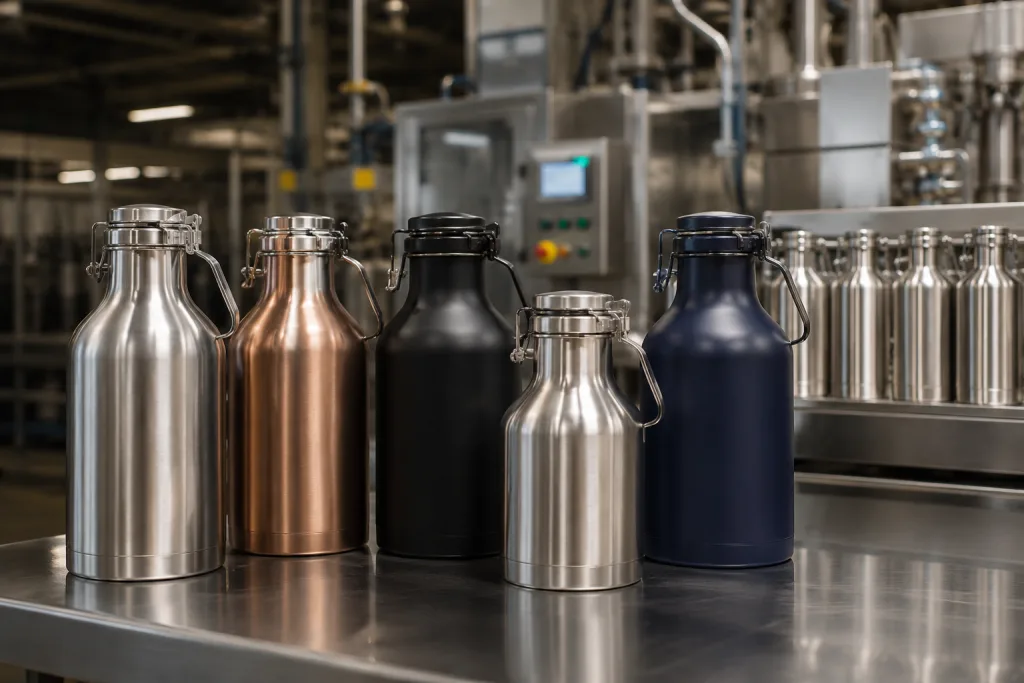
A growler bottle custom made is not a generic bottle buy. You are buying 304 stainless, vacuum hold time, decoration pass rate, carton count, and a ship date your sales team can put on the PO without getting burned. We see quotes that look close on page one split by 18% after lid changes, laser logo vs. silk print, third-party test requests, and retail box inserts. On our line, even a 2 mm taller lid can change carton fit and push freight up. This is the wrong question to ask: “Why is this factory cheaper?” Ask what is missing.
For B2B buyers in Europe and North America, the hard part is not finding a canteen manufacturer in China. It is lining up offers from a canteen factory, canteen suppliers, and canteen vendors on the same spec sheet so the math works. In Zhejiang, China, a practical factory gives the numbers early: MOQ from 500 to 3,000 units, sample lead time of 7 to 12 days, and mass production of 25 to 45 days depending on body style and decoration complexity. QC pulled the sample last month on one order because the buyer flagged a logo position drift of 1.5 mm, and that detail mattered more than the headline unit price.
What you are really paying for
Request a growler bottle custom made quote and you are not buying just the bottle body. Most buyers compare capacity and finish first. Then the price shifts after sampling because the lid, logo method, carton spec, and test request were never fixed on the PO. We run quotes item by item: body, lid, decoration, packaging, testing, and shipping terms. If a supplier sends one bundled number, this is the wrong question to ask—ask for the cost split.
For a common 64 oz double-wall 18/8 stainless steel growler with copper-coated vacuum insulation, a realistic FOB China price range is:
- 500 units: USD 6.30-8.60 each
- 1,000 units: USD 5.40-7.40 each
- 3,000 units: USD 4.80-6.60 each
- 5,000 units: USD 4.50-6.10 each
Those numbers usually mean an existing mold, powder coating or single-color spray finish, one logo position, standard export carton, and a basic screw cap or flip handle lid. Change one line and the math moves fast. A swing-top lid can add 7 to 12 days on sourcing if the hinge sample fails torque check at 1.8 N·m. A bamboo cap insert, textured powder, gift box, or multi-pass print will push the quote up the same way, and we have seen buyers miss that over a one-word PO typo.
A practical canteen manufacturer or custom drinkware factory should confirm wall structure early. Buyers ask for vacuum insulation. That is not enough. Body gauge affects dent resistance, hand feel, and freight weight. A common setup is 0.5 mm outer wall and 0.4 mm inner wall. Heavier builds such as 0.6/0.5 mm improve feel and durability but can add USD 0.25-0.55 per unit depending on size. QC pulled the sample more than once because a thin outer wall looked acceptable on paper but oil-canned after a 60 cm drop test.
You do not control cost by negotiating the last 3%. You control cost by freezing specifications before sampling.
This applies whether you are sourcing a custom growler, a customizable growler, or broader customizable drinkware from China. The best savings usually come from simpler decoration and simpler packaging. The steel price argument usually goes nowhere. We ship plenty of repeat orders where the buyer flagged a USD 0.08 logo change but missed a USD 0.42 gift box upgrade.
MOQ changes the whole project
MOQ is not just a factory rule. It sets the process route on the line. Buyers new to a canteen factory ask us why one supplier quotes 500 units and another quotes 3,000 for what looks like the same growler. Usually it comes down to three shop-floor facts: whether the mold is already running, whether the decoration setup needs a new screen or jig, and whether purchasing can batch the 304 stainless, lids, and cartons into one run.
For existing growler bodies already in production at a canteen manufacturer in China, the usual MOQ tiers look like this:
- 500 units: stock color or limited finish options, one size, standard lid
- 1,000 units: better color freedom, mixed carton marking, more print methods
- 3,000 units: custom Pantone coating, multiple SKUs, stronger pricing leverage
- 5,000+ units: better value for retail box, insert cards, barcodes, and line audits
If you want a fully customized growler shape, not just a logo on an existing bottle, MOQ normally starts around 3,000 units per size. New body tooling for stainless drinkware in Zhejiang, China commonly falls in the USD 3,500-9,000 range for the bottle body, with separate costs if the cap or handle is also unique. Sample tooling may add another USD 300-800 for trial pieces. We have seen buyers push for 1,000 on a new shape, but the math doesn't work once you include CNC sampling, welding fixtures, and the first leak test run.
This matters if your wider program also includes custom canteen, custom canteen gift sets, or a family line for a canteen distributor. If the growler and canteen share one black powder coat, we can run them in the same coating batch and cut purchasing time to 12 days vs 18 days on separate orders. We ship projects like this every season. A lot of canteen distributors and distributor drinkware buyers bundle 2 to 4 stainless SKUs into one production window so the raw material coil, coating powder, and packaging order all hit MOQ together.
Ask your canteen vendors one direct question: Is this MOQ based on production reality or just your sales policy? This is the right question. A real answer should mention mold availability, coating line batch size, and packaging setup time; on our side, carton printing alone can mean a 2-hour changeover if the PO barcode or shipping mark was typed wrong. If the answer is vague, your lead time will be vague too.
The biggest cost drivers after steel
Raw stainless steel gets most of the attention. Fair enough. But on a growler bottle custom made program, steel is often not what blows up margin. We’ve seen the bigger swings come from lids, print, and packaging after the bottle body is settled. On the line, a 0.5 mm change in accessory spec can move cost faster than buyers expect.
Lid construction
A basic PP screw cap with silicone seal may add only USD 0.28-0.45. Move to a stainless outer cap, carry handle, or leak-resistant chug assembly, and the cap set usually lands at USD 0.65-1.20. Swing-top growler closures look strong on shelf for craft beverage positioning, but they cost more and need tighter leak testing. QC pulled one batch last month because 4 of 80 samples failed the vacuum leak check at -0.04 MPa. If the buyer wants swing-top, ask for the pass standard first. That is the right question.
Decoration method
- Silkscreen: lowest cost for simple logos, often USD 0.08-0.18 per color per position
- Laser engraving: clean and durable, usually USD 0.12-0.30
- Heat transfer or full-wrap printing: better for graphics, often USD 0.35-0.90
- Embossed or debossed effects: higher setup cost, better on larger runs
For canteen promotional orders, print complexity pushes up rejection rates during inspection. That is why smart buyers ask for decoration yield, not just unit price. If a factory expects 3% print loss on a simple one-color logo and 8% on a metallic full wrap, that changes both price and schedule. We run AQL pulls after decoration, and this is where jobs go sideways: the buyer flagged a gold logo shift of 1.2 mm, but the PO artwork had no tolerance marked.
Packaging
Standard white box packaging is efficient. A custom mailer, color gift box, molded pulp insert, or PDQ display changes the math fast. Retail-ready packaging can add USD 0.40-1.50 per set. It can also increase carton volume by 20%-45%, which then raises freight. We’ve shipped programs where the bottle cost stayed flat, but the master carton jumped from 6 pcs to 4 pcs because the gift box was 18 mm wider.
This is where experienced canteen manufacturers, canteen suppliers, and canteen vendors separate themselves from traders who just forward quotes. A competent canteen factory in China will tell you if your box size kills pallet efficiency or creates high outer carton drop risk. We’ve seen buyers chase USD 0.03 off the bottle, then lose more than that on freight and damage claims because the carton failed a 76 cm drop test. For large distributor growler and distributor canteen programs, that factory advice matters more than squeezing a few cents from the bottle itself.
A realistic timeline from inquiry to shipment
Lead time has to be broken into stages, not sold as one neat number. If a canteen maker quotes 35 days, ask what is inside that figure: sampling, artwork approval, drop test, carton confirmation. Usually, those items sit outside the quote.
For an existing mold customized drinkware job, this is the kind of schedule we run:
- Day 1-3: quote revision, artwork check, spec sheet sign-off
- Day 4-7: pre-production sample arranged
- Day 7-12: sample finished and sent by courier
- Day 13-18: buyer review and approval
- Day 19-25: material booking, coating slot, packaging print file approval
- Day 26-45: mass production, assembly, aging, inspection, packing
- Day 46-50: final payment, vessel booking, port handover under FOB China
If you are building a customizable canteen or customizable growler with a new mold, add 15-30 days for tooling and trial samples. If the retail pack uses offset printed boxes, add 5-8 days for packaging unless your canteen supplier keeps plain cartons in stock and labels them later. We had a buyer flag a PO typo once — “5000 pcs” became “500 pcs” — and the line sat idle until the revision came back.
At BottleForge-scale production in Zhejiang, one stainless vacuum line can handle tens of thousands of units per month, but your order still waits for shared gear like coating booths, laser stations, and carton printing slots. A 300,000-unit monthly drinkware plant can still quote 35 days on one order and 45 days on the next; the math does not care about headline capacity. QC pulled the sample on a 2 mm seam gap before packing, and that saved us a rework loop.
Ask for the milestone list in writing: sample date, deposit date, in-line inspection date, final inspection date, and ETA port date. Serious canteen distributors and distributor drinkware buyers track these dates closely, because one late artwork file can burn 7 days fast. Keep the questions tight.
How testing and compliance affect timing
For Europe and North America, compliance is often the part that holds the shipment, not the unit price. We have seen a growler project lose 12 days because the buyer asked for declarations after sample approval. A stainless customized canteen or growler program usually needs material declarations, migration-related support files, and buyer RSL checks. On our side, QC pulls the sample and matches the BOM to the 304 stainless contact parts before we release anything to the lab.
Common requests are REACH screening for EU markets, LFGB for food-contact positioning in Europe, and FDA alignment for the US. If the item is for children, some buyers ask for CPSIA or accessory checks on straws, seals, or paint. Packaging can create its own delay; we had one PO where the buyer flagged an ink claim on the color box, and the carton approval stopped the line for 3 working days.
Testing lead times usually look like this:
- Internal leak and vacuum retention checks: 1-3 days
- Third-party lab screening: 5-7 working days
- Full compliance package with retest risk: 7-14 working days
Inspection needs to be set early. This is the wrong question to ask at the end. Many B2B buyers use AQL 2.5/4.0 as a baseline: 2.5 for major defects and 4.0 for minor defects. For growlers, major defects usually mean leakage, weak vacuum, wrong color, wrong logo, sharp edges over a 0.3 mm burr, or bad thread fit on the cap. Minor defects are more like slight print offset or cosmetic marks within the approved limit. We run a thread gauge check on the neck finish because we have seen this go sideways in final inspection.
If your canteen vendor or canteen manufacturer also holds BSCI, ISO 9001, or similar system documents, that makes vendor onboarding easier, but it does not replace product testing. Buyers mix these two topics all the time, and the math does not work. Factory audits check the system; compliance checks the item you ship. Good canteen manufacturers in China prepare both document tracks at the same time, and that can mean 7 days instead of 14 if the lab booking is done before mass production starts.
How buyers keep margins safe
If you buy for a brand, retail chain, or canteen distributor network, margin usually disappears in rework, air freight, or spec drift, not on the quoted FOB line. We have seen a USD 0.28 saving on unit price turn into USD 3,200 in relabeling after QC pulled the sample and found the logo 6 mm off-center. The safe move is plain: freeze the spec sheet and cost every variable before deposit. Fancy sourcing talk does not fix a bad PO.
For a typical growler bottle custom made order, lock these points before sample approval:
- Capacity tolerance, such as 32 oz, 40 oz, or 64 oz, with a written fill-volume range
- Steel grade, usually 18/8 or SUS304 for food-contact parts, and which parts actually use it
- Wall thickness, for example 0.5/0.4 mm, checked by micrometer on the line
- Finish code and Pantone reference, not “matte black” written loosely on the PO
- Logo method, size, and position count, down to 1-side or 2-side print
- Lid material stack and seal color, including whether the gasket is silicone or TPR
- Packaging structure, barcode placement, and carton drop requirement, with carton board grade confirmed
- Inspection standard, such as AQL 2.5/4.0, plus who signs off the golden sample
For Amazon or other e-commerce programs, add carton weight limit, FNSKU labeling, and master carton dimensions at the start. We ship programs where 1 master carton must stay under 15 kg, and that number changes insert design fast. This matters more when the same supplier also runs a custom canteen, canteen custom, or other customizable drinkware SKUs on the same line, because carton size creep usually starts there. The buyer flagged this exact issue for us once after a 64 oz growler packout copied a bottle set carton by mistake.
A practical buying benchmark is simple: if the supplier cannot explain why unit cost moves by USD 0.40, they probably do not control production variance either. This is the wrong question to dodge. Good Zhejiang teams will break it down for you—steel weight, lid tooling share, print pass, carton spec, even the extra 12 seconds of vacuum hold time. That is what you want from a long-term canteen supplier, canteen manufacturers partner, or distributor growler source: not a fast quote, but a shipment that lands matching the approved sample.
Get your growler costed before you commit
Send your target size, lid style, logo method, packaging idea, and quantity. We will reply with a practical MOQ, FOB price range, and lead-time plan from Zhejiang, China.
Frequently asked questions
What is the normal MOQ for a growler bottle custom made order?
For an existing stainless growler mold, MOQ usually starts at 500 units per size and colorway, though many factories prefer 1,000 units for cleaner pricing and production scheduling. If you want a fully custom body shape, MOQ is more often 3,000 units per size, plus tooling. For mixed programs that include a custom canteen or other customized drinkware, some China suppliers can combine steel purchasing and coating batches to keep the effective MOQ workable. Always confirm whether the MOQ is based on the bottle only, or also on logo setup, packaging print, and lid assembly. A 500-unit MOQ with a custom gift box may still require 1,000 boxes to be cost-efficient.
How much should I budget per unit for a custom growler?
A good starting budget for a double-wall stainless custom growler is USD 4.80-7.90 FOB China for 1,000-3,000 units, depending on size, finish, lid, and packaging. Entry-level builds with standard screw caps and simple silkscreen sit near the lower end. Premium builds with textured powder coating, laser mark plus print, swing-top lid, and color retail box can move above USD 8.00. If you are buying through a canteen manufacturer or canteen supplier in Zhejiang, ask for separated pricing on bottle, lid, decoration, packaging, and testing. That lets you see where value is going. Tooling for a new shape is usually extra, often around USD 3,500-9,000 for the bottle body.
How long does production usually take after sample approval?
For an existing mold order, mass production commonly takes 25-45 days after deposit, approved sample, and confirmed packaging artwork. Simple stock-color projects can finish in around 25-30 days. Orders with custom Pantone coating, multiple logo locations, or printed retail boxes usually run 35-45 days. Add 7-12 days for pre-production samples before that. If the project needs a new mold, plan on another 15-30 days for tooling and trial samples. In China, production timing also depends on shared processes like coating lines and carton printing. A supplier with strong capacity may still need extra days if your project lands during a peak export window or before major holidays.
What usually causes delays on customized drinkware orders?
The most common delays are late artwork approval, packaging changes after sampling, and missing compliance documents. A logo change that looks small can restart print film preparation and sample confirmation, costing 3-7 days. Custom boxes often create another bottleneck because print files, die lines, and barcode positions must all be signed off before bulk packaging can start. Testing can also slow things down if seals, coatings, or inks need retesting. For distributor growler or distributor drinkware programs, booking pressure near peak shipping season can add several more days. The safest method is to approve bottle spec, logo, packaging, and carton markings together, then hold changes unless they are truly necessary.
How do I compare quotes from canteen manufacturers and canteen vendors fairly?
Ask every supplier to quote on the same structure: FOB China price, MOQ, steel grade, wall thickness, lid type, decoration method, packaging type, sample cost, tooling cost, and lead time. Also ask whether testing, spare parts, and inspection support are included. A serious canteen factory or canteen manufacturer should be able to state if the body is SUS304, whether the wall is 0.5/0.4 mm or heavier, and what AQL standard they work to. If one quote is 12% lower but leaves out retail packaging or uses thinner steel, it is not actually cheaper. Buyers in Europe and North America save time when they compare landed specifications, not just headline unit price.