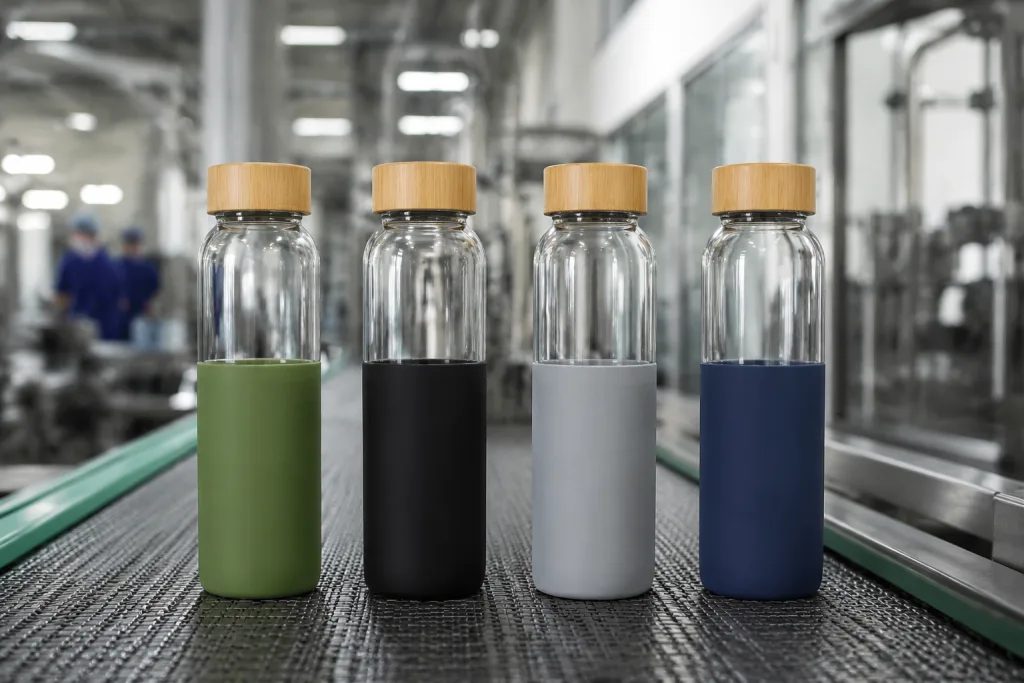
Key Takeaways
- For a 550ml borosilicate glass bottle bulk order, practical MOQ is usually 1,000 to 3,000 pcs per design, with custom color parts often starting at 3,000 pcs
- Typical FOB China pricing for a single-wall borosilicate bottle with one-color logo is about USD 1.85 to 3.60 at 3,000 pcs, depending on lid, sleeve, and packaging
- Mass production usually needs 30 to 45 days after sample approval, while pre-production samples take 7 to 12 days and mold changes add 15 to 20 days
- Put AQL 2.5 major and 4.0 minor, carton drop standard, and logo adhesion requirements directly on the PO, not only in email
Glass looks good on shelf, and the sustainability pitch sells. But promo drinkware punishes loose specs fast: the first bulk order lands with cracked bodies, leaking lids, or logo print rubbing off after 200 rub tests. A glass water bottle promotional project is not hard to source. Vague RFQs are the problem. Leave out glass grade, sleeve material, drop test, or carton spec, and the factory will fill the gap on the line—usually with the cheaper option. We have seen this go sideways after QC pulled the sample and found a 1.2 mm wall where the approved piece was thicker.
This hits both sides: a wellness brand building a retail line and a sustainable retailer booking seasonal volume. In Zhejiang, China, we regularly see buyers lose 4 to 8 weeks after approving a nice-looking sample that was never locked to a production standard. One buyer even signed off a PO with the color code typed wrong, and the line ran 3,000 sleeves before anyone caught it. The fix is simple. Break sourcing into purchase decisions, and write each one into the PO with clear line items, from bottle body and lid fit to carton pack-out. Pretty samples are not the standard. That is the wrong question to ask.
Start with a useful RFQ
If you ask three borosilicate glass bottle suppliers for “a nice eco bottle with logo,” you will get three prices for three different products. We see this every week. One supplier quotes soda-lime glass, one assumes a bamboo lid with no handle, and one buries a gift box cost inside the unit price. Then the buyer asks why the spread is 18%. This is the wrong question to ask. For glass water bottle promotional sourcing, the RFQ needs to lock the core spec before any quote means much.
Your RFQ should state bottle capacity, glass type, wall thickness, decoration method, accessory materials, target market, compliance needs, and packaging standard. On our line, the common opening brief for wellness brands is 500ml to 600ml high-borosilicate, single-wall, with a silicone sleeve or a PP carry lid. High borosilicate is usually the better call if you want heat resistance and a cleaner premium hand feel. A common body wall thickness is 2.3mm to 2.8mm; once you drop below that, transit breakage climbs fast. QC pulled samples last month at 2.1mm and the drop test failure rate jumped. If you need a custom glass water bottle for gym retail or gift-with-purchase, say clearly whether it is for cold-fill only or for hot beverage use up to 95°C.
Put these line items into the RFQ
- Product: 550ml custom borosilicate glass bottle, clear, single wall
- Glass spec: high borosilicate, body thickness 2.5mm ±0.2mm
- Lid: 304 stainless steel outer + PP inner thread, food-contact silicone gasket
- Decoration: 1-color silkscreen, 1 position, Pantone reference required
- Packaging: individual kraft box, 24 pcs/export carton, dividers required
- Compliance: REACH, LFGB where relevant, California Proposition 65 screening if selling in North America
- Commercial term: FOB Ningbo or Shanghai, Zhejiang, China
A serious borosilicate glass bottle manufacturer in China should quote this cleanly in 2 to 3 working days. If they cannot, pay attention. We ship enough of these programs to know where quote delays come from: missing gasket spec, no Pantone number, or a PO note that says “same as last order” when there was no last order. At BottleForge Industrial, our normal capacity for glass and mixed-material drinkware programs is up to 300,000 units/month across active lines, but the math doesn't work unless the RFQ is tight enough for production scheduling.
Choose the bottle construction early
The biggest cost and quality swings start with construction, not the logo. Buyers ask about print size first, then ignore the body, lid, and sleeve set. That is the wrong question to ask. A borosilicate glass bottle custom program should be built around actual use, drop risk, and shipping method. On our line, a 0.8 mm wall change or a loose thread fit will move complaint rates faster than any artwork revision.
For promotional use, most projects fall into three constructions. First, a basic single-wall bottle with a simple screw lid. This is the lowest-cost route for bulk glass water bottle campaigns, usually USD 1.85 to 2.40 FOB at 3,000 pcs for standard sizes. We ship a lot of these in 500ml and 550ml. Second, a sleeve-protected bottle with silicone wrap or boot. It cuts minor knock damage and gives better grip, but it needs sleeve color tooling and raises unit cost by about USD 0.25 to 0.60. Third, a double-glass tea infuser style bottle. It looks premium. The math doesn't work for mass promo. A 620ml infuser bottle can weigh 180 to 260 g more than a single-wall version, and we have seen this go sideways in parcel networks where QC pulled the sample and found chip damage after one carton drop test.
For sustainable retailers, the practical sweet spot is often a 500ml or 600ml customizable glass water bottle with borosilicate body, food-grade silicone sleeve, and a leak-tested PP-threaded lid with a stainless outer cap. This build holds up better in mixed retail and e-commerce orders. We usually run a vacuum leak test on the lid set and check sleeve fit at +/- 1 mm. Bamboo lids look good in photos, but natural material variation brings color mismatch, and humid storage can cause swelling or hairline cracks if the material control is weak. If you want bamboo, specify moisture control and top-surface tolerance. One buyer flagged a 0.7 mm lid height variation last season, and they were right to do it.
What you are buying is not “a bottle.” You are buying a failure rate. Good sourcing is mostly about reducing the reasons the bottle fails before your customer touches it.
For your PO draft, write line items by component. Example: bottle body clear high-borosilicate; lid black; sleeve Pantone 7488C; logo white silkscreen; individual box kraft. This blocks the common supplier move of swapping one part while keeping the headline price. We have seen a PO typo on sleeve color turn into 3,000 pcs in the wrong shade. It also makes quality inspection easier because the checker can match each component against the approved standard with a physical sample, carton mark, and packing spec sheet.
Sample against production reality
A nice sample is not the goal. A sample that matches bulk production is. We see buyers approve a hand-built engineering sample, then flag the first mass-production lot because the print sits 2mm higher or the sleeve feels tighter. For a customized glass water bottle project, plan at least two steps: a stock sample or digital mockup first, then a pre-production sample built with the actual glass, actual decoration process, and actual packaging.
Lead time for stock samples is usually 2 to 5 days. A proper pre-production sample is more like 7 to 12 days. If your borosilicate glass bottle customized program needs a new mold, add 15 to 20 days for tooling and the first trial run. New sleeve molds, cap top inserts, or embossing dies also take time. This is normal in China. We run trial pieces on the line, QC pulled the sample, and sometimes the first mold correction is 0.3mm on the neck finish. Arguing later does not change the clock.
What to approve on the sample PO
- Dimensional tolerance: height, diameter, mouth finish, net weight
- Leakage: inverted 2 hours, no seepage
- Logo standard: color tolerance, location, rub test, dishwasher disclaimer if hand-wash only
- Packaging: barcode position, carton mark, inner divider type
- Drop expectation: carton drop test from 76cm or 1m depending on pack style
For wellness brands selling online, ask us to courier one packaged sample exactly the way mass production will ship. This is the right test. A bottle that looks fine on a table can still break in a fulfillment network after vibration, relabeling, and outer-carton compression. If you plan FNSKU relabeling for Amazon, put label size and placement on the sample approval sheet; we had one PO with a 50 x 30mm label spec, but the buyer later asked for 60 x 40mm and the panel area was already blocked by the logo. If you need a borosilicate glass bottle customizable gift set, test insert fit after vibration, not just on the table. We’ve seen this go sideways.
The sample approval should end with a signed spec sheet. Not a chat screenshot. Not “looks good.” In Zhejiang export manufacturing, that sheet is what we ship against. This is the wrong place to stay casual. If bulk arrives and the buyer flagged a carton mark or cap color, the signed sheet is the first document both sides pull.
Build the purchase order properly
The PO is where buyers control risk—or give away margin. We’ve seen disputes start from one simple gap: the commercial PO shows quantity and price, but the technical PO is blank. On a glass water bottle promotional order, the PO should read like a short contract between you and the borosilicate glass bottle factory, down to lid style and print position in mm.
Start with the basics: item code, description, quantity, unit price, trade term, destination port, payment term, and ship window. Then write the parts new buyers usually miss. If your order is 3,000 pcs, split the quantity by color and artwork version. If there are two lids and three sleeve colors, list each SKU on its own line. We run into this on the line all the time. If the supplier rolls everything into one line, it gets messy later, and QC pulled the sample won’t help much if the PO never separated black lids from bamboo lids.
Typical payment terms for custom glass programs from China are 30% deposit, 70% against copy documents or pre-shipment inspection release. Long-term accounts sometimes get better terms. For a first order, pushing too hard on payment is the wrong question to ask. We’ve seen this go sideways. A factory that loses margin will look for it somewhere else—thinner silicone sleeve, lighter carton, slower rework on logo smear. Better to pay a workable price and lock the spec tighter.
PO line items worth adding
- MOQ: 1,000 pcs per size for standard bottle; 3,000 pcs per custom sleeve color mix
- Inspection: AQL 2.5 major, 4.0 minor, random sampling before shipment
- Defect definitions: crack, chip, bubbling, logo smear, color mismatch, lid cross-threading, odor
- Carton spec: 5-ply export carton, burst strength target, carton weight limit under 15kg
- Testing: leak test 100%, thermal shock test by agreed method, migration report by request
- Spare policy: extra 1% plain units or accessories for breakage replacement
Most borosilicate glass bottle distributors and importers also ask for photo confirmation during packing. That makes sense. We ship those photos after carton drop test checks and barcode scan checks at packing. If your supplier in Zhejiang, China ships 3,000 pcs with the wrong barcode, FOB savings mean nothing. The buyer flagged this on one PO last season because a single EAN digit was wrong, and relabeling in Europe or North America cost more than the ocean freight difference.
Control bulk quality before shipment
Glass is easy to inspect if the defect standard is written clearly. If not, the line gets messy fast. Before bulk starts, ask the borosilicate glass bottle supplier for a production schedule with three checkpoints: material prep, first-off approval, and finished goods inspection. On a 3,000 to 10,000 pc order, you do not need to sit in the factory every day. You do need evidence. We usually ask for date-stamped photos, a first-off signoff sheet, and one short line video from the annealing area.
For a bulk borosilicate glass bottle order, the key checks are plain: body clarity, wall consistency, mouth finish smoothness, thread fit, gasket seating, logo adhesion, sleeve fit, and pack-out accuracy. QC pulled the sample and checked mouth chips by fingertip first, then under a lamp, because a 0.5 mm edge flaw will cut someone even if the bottle looks clean. Bubbles in glass are not automatic defects unless they exceed your agreed size or affect strength or appearance in the main viewing area. Write that limit down in mm. This is the wrong question to skip. We have seen buyers reject cosmetic variation later, then find out the PO never defined bubble size, seed count, or where the viewing area starts.
The final inspection should include count verification, drop testing of the export carton, and leakage testing on sampled finished units. AQL 2.5 is common, but only if the sample size and defect class are agreed before QC starts. For logo durability, a simple alcohol rub test can be agreed if the print process is silkscreen; for dishwasher-safe claims, you need a more formal test and a supplier willing to stand behind it. Most promotional orders should avoid dishwasher-safe claims unless you have verified data. The buyer flagged this once after seeing “dishwasher safe” typed on a draft color box, and the math did not work because no cycle test had been run.
Lead time for mass production is usually 30 to 45 days after sample approval and deposit. In October and before CNY, we see 30 days turn into 38 days fast. If your program targets holiday retail, back up your ship date by at least 2 weeks. China factory schedules tighten quickly around major holidays, and glass plus mixed-material assembly can bottleneck at packaging rather than forming. On one run, the forming side was on time, but the line lost 3 days waiting for custom EPE inserts cut to the wrong cavity size.
A capable borosilicate glass bottle manufacturer or borosilicate glass bottle distributors network should also tell you where the real breakage risk sits. Usually it is not the sea freight; it is inner packing, pallet stacking, and last-mile parcel handling. We ship plenty of glass, and most claims come from loose dividers, overhang on pallets, or cartons stacked past the limit by 2 layers. Ask for palletization details and carton stacking limits before shipment is booked. Get the pallet size, cartons per layer, total layers, and whether the top load test was done at 5 kg or 8 kg per filled carton.
Landed cost and long-term supply
If you are comparing borosilicate glass bottle wholesale options, do not stop at FOB. This is the wrong question to ask. Glass looks cheap on a quote sheet, then the extra cost shows up in the drop test, the export carton, the duty line, and the breakage reserve. For North America and Europe, your landed cost model should include unit cost, sample charges, mold cost if any, export carton upgrade, inspection fee, sea freight, destination charges, duty, and a realistic breakage reserve. We usually spec a 5-ply master carton and run a 1A drop test before shipment. For retail programs, adding a 1.5% to 3% breakage reserve into the margin model is more honest than writing in zero and arguing about claims later.
Here is a practical range. A 550ml borosilicate glass bottle promotional order at 3,000 pcs with one-color print and standard kraft box often lands FOB China around USD 2.10 to 3.20. Add custom silicone sleeve, premium lid, or gift box and you can move to USD 3.40 to 4.80 fast. New molds can add USD 800 to 2,500 depending on complexity. On the line, a sleeve that is 0.5 mm too tight will slow packing and push scrap up, so the math changes fast. Those are not bad prices; they are the real cost of making a promotional bottle that does not come back as a claim.
If the first order goes well, the next move is not always a lower price. Most of the time, it is standardizing components across SKUs. Use one body size, one thread finish, and two lid colors across the range. We have seen this cut repeat lead time by 5 to 10 days because the factory can hold semi-finished parts instead of starting from zero. A buyer once pushed back on using the same lid on two designs, but spare-part planning got easier right away. It also helps if you work through a borosilicate glass bottle distributor or distributor glass water bottle channel in your market, because replacements stay manageable.
The buyers who do best with China supply are not the ones pressing for the last USD 0.03. They are the ones who make the second and third order easier than the first: same carton footprint, same barcode position, same inspection rule, same gasket spec. QC pulled the sample on one repeat PO last month and found the barcode had shifted 12 mm from the approved artwork because the buyer changed a carton vendor without updating the file. Small changes like that create delays. Lock the basics early, and a custom glass water bottle program turns into a stable product line.
Send your bottle RFQ with real specs
Share capacity, glass type, lid, logo, packaging, and target quantity. We will quote practical MOQ, FOB pricing, sample timing, and quality checkpoints.
Frequently asked questions
What MOQ should I expect for a custom glass water bottle order?
For a standard 500ml to 600ml high-borosilicate model, MOQ is usually 1,000 pcs per item if you use existing molds and standard lid colors. If you want a custom silicone sleeve color, bamboo lid engraving, or gift box insert, practical MOQ often moves to 2,000 to 3,000 pcs. A fully new bottle mold can require 3,000 to 5,000 pcs to make the project viable. Ask your supplier to separate MOQ by component on the quote. In China, some factories quote a low bottle MOQ but hide a higher MOQ for sleeves or printed boxes. For promotional buying, the honest question is not only “what is the MOQ” but “what MOQ gives a stable unit cost and color consistency.”
Is borosilicate really better than soda-lime for promotional bottles?
Usually yes, especially for wellness brands positioning the product as premium or heat-resistant. High borosilicate handles thermal change better and generally gives a cleaner, lighter feel than comparable soda-lime construction. That said, borosilicate is not unbreakable. For single-wall bottles, a 2.3mm to 2.8mm body is a common working range. If your bottle is mainly for low-cost event giveaways, soda-lime can reduce cost, but the quality perception is lower and thermal shock performance is worse. If your RFQ says only “glass,” some suppliers in China will quote the cheaper option. If you need borosilicate glass bottle promotional quality, write “high borosilicate” on both the RFQ and PO.
How long does a bulk order take from sample to shipment?
If you choose a stock design with standard parts, stock sample timing is often 2 to 5 days and a pre-production sample is about 7 to 12 days. After sample approval and deposit, mass production usually takes 30 to 45 days. Add 15 to 20 days if a new mold is required. Peak season, holiday shutdowns, or custom packaging can extend that. From Zhejiang, China, sea freight then depends on destination and routing, so build a buffer of at least 2 weeks if you have a retail launch date. The main mistake buyers make is approving a visual sample without approving packaging and logo standards, which then resets the clock later.
What tests or compliance documents should I ask for?
For Europe, REACH and LFGB are common discussion points depending on materials and your market channel. For North America, many buyers also request California Proposition 65 screening. If the bottle is for children, additional requirements may apply, including relevant ASTM considerations depending on the product setup. Beyond chemical compliance, ask for practical performance checks: 100% leak test, carton drop test, and agreed logo adhesion test. If the bottle uses stainless components, confirm 304 grade where claimed. If it uses silicone sleeves or gaskets, specify food-contact grade. Keep the request tied to the exact SKU, because a generic report from another bottle or another year does not protect you much.
How do I reduce breakage during shipping and fulfillment?
Start with packaging, not with thicker glass alone. Use inner dividers, a 5-ply export carton, and keep carton weight under about 15kg for easier handling. For e-commerce or parcel distribution, ask for a packaged drop test from 76cm to 1m based on your route risk. A silicone sleeve or boot can help with minor impacts, but it does not replace proper packaging. Also check pallet stacking and whether cartons overhang the pallet. For first orders, ask for 1% extra plain units or spare accessories in the shipment. Most breakage claims come from poor inner protection, mixed carton counts, or fulfillment handling after arrival, not from ocean transit itself.