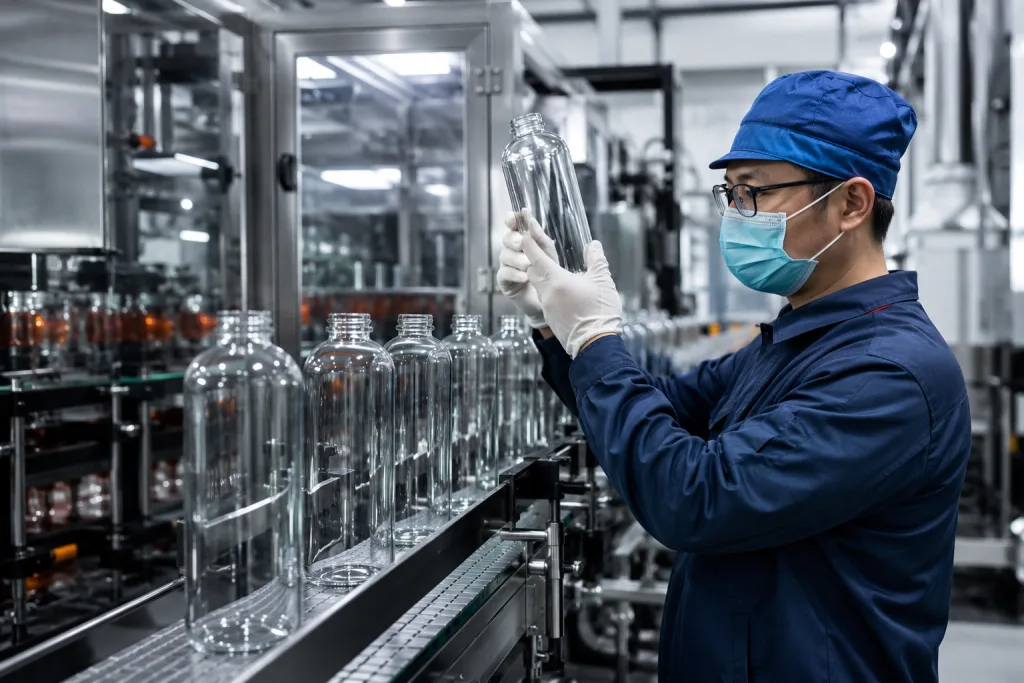
Key Takeaways
- For a custom glass water bottle, practical MOQ usually starts at 1,000-3,000 pcs per SKU; fully custom mold projects often start at 5,000-10,000 pcs
- High borosilicate glass usually costs 12-25% more than soda-lime, but it handles thermal shock better and fits premium wellness positioning
- Standard production lead time for repeat orders is often 30-45 days; new mold development typically adds 20-30 days
- Use AQL 2.5/4.0 with drop, leak, dishwasher, and logo adhesion tests before shipment to control defect risk
You are not buying a bottle. You are buying a breakage rate, a lead time, a print limit, and a landed cost that still leaves margin after duty and freight. That is why choosing a glass water bottle manufacturer needs a spec sheet and process check, not a catalog flip. For wellness brands and sustainable retailers, the wrong pick shows up 60 days later: chipped bottles at carton corners, silicone sleeves slipping at 3 mm wall variation, logo rub-off after a dishwasher test, or a 5,000 pcs MOQ that freezes cash. We’ve seen this go sideways.
Most buyers sourcing from Zhejiang ask the same questions after the sample stage, when a mold change or decal revision starts to cost real money. Should you use high borosilicate or soda-lime? What breakage rate is realistic in bulk glass water bottle shipments? How low can MOQ go for a custom glass water bottle? This is the right time to ask, but the wrong question is “What is your best price?” Ask for numbers. We run drop tests, carton compression checks, and AQL pull plans on the line. A practical supplier in China should answer with data, not slogans.
Start with four buying decisions
If you are evaluating a glass water bottle manufacturer, make four buying decisions first. Ask these first. We see POs stall for 2 weeks when the spec sheet skips one of them.
- Material: high borosilicate or soda-lime glass
- Format: stock bottle with decoration, or fully custom mold
- Channel fit: retail shelf, e-commerce, corporate gifting, or studio resale
- Risk tolerance: lowest FOB price, or lower defect and return rates
For wellness brands, high borosilicate usually wins. The story is cleaner, and the glass handles heat better. If you plan to market tea infusion, hot lemon water, or temperature-contrast use, a borosilicate glass bottle manufacturer is the safer path. On the line, we check wall thickness at 2.8-3.2 mm for this type because buyers will ask about thermal shock. If your program is simple room-temperature hydration and budget is tight, soda-lime still works. Just budget for stronger packaging and real breakage numbers. This is where buyers get optimistic, and we have seen that go sideways.
Your second decision is whether you need a custom borosilicate glass bottle or a proven stock shape. Stock bottles with custom logo, sleeve color, lid finish, and packaging are usually the fastest route. MOQ can be 1,000 pcs per design, sometimes 500 pcs for plain stock with simple one-color printing. We run these orders faster because the mold is already stable and QC has a known master sample. A true borosilicate glass bottle customized with a new silhouette, base profile, or neck finish can push MOQ to 5,000-10,000 pcs and add USD 1,500-4,000 in mold cost. The buyer often asks for “full custom” at 2,000 pcs; the math does not work.
Third, decide how the bottle will be sold. E-commerce needs thicker cartons, more transit testing, and often individual shippers. For one U.S. project, we moved from a 5-layer outer carton to a heavier spec after a drop-test failure at 76 cm. Retail shelf programs care more about visual consistency, exact Pantone sleeves, and barcode placement. QC pulled the sample once because the barcode sat 4 mm too low on the back panel. Promotional buyers asking for a borosilicate glass bottle promotional run usually want lower MOQ and faster decoration, not a proprietary mold.
Last, be honest about your risk tolerance. The cheapest borosilicate glass bottle supplier may quote USD 0.18 lower per unit but create 3-5% more rework or replacement exposure. We ship enough replacement parts to know where this goes. That saving disappears quickly in North America or Europe once returns, customer service time, and damaged stock are counted. This is the wrong question to ask: “Who is cheapest today?” Better question: who can hold the same spec lot after lot, with fewer cracks, cleaner print, and packing that survives the route.
Choose the right glass specification
The first technical call is the glass itself. A capable borosilicate glass bottle factory should spell out the trade-off in plain terms, with a drawing and actual tolerances, not sales talk.
High borosilicate glass
This is the standard premium choice for a customizable glass water bottle. It handles thermal shock better, keeps good clarity, and feels lighter in hand if the structure is done right. On the line, for 500-650 ml bottles, we usually run 2.2-2.8 mm wall thickness. Thicker is not always better. At 3.0 mm and above, unit weight climbs fast, carton weight follows, and freight from China moves the wrong way. The math doesn't work if you expect thick glass to fix every breakage claim.
Soda-lime glass
This option is usually cheaper and common in food containers, but it is less forgiving with temperature change. We have seen buyers ask for boiling-water use on a soda-lime body, and QC pulled the sample after a hot-cold shock test because that risk was obvious. For a premium sustainability line, soda-lime often reads as a cost-down move unless the brand is built around entry pricing.
For most wellness brands, the safer baseline is a borosilicate glass bottle custom project with a high borosilicate body, PP or stainless lid parts, and a food-grade silicone sleeve. Ask for these details up front. This saves time.
- Glass composition and grade
- Body weight tolerance, usually plus or minus 3-5%
- Wall thickness range by bottle zone
- Neck finish dimensions and cap thread standard
- Temperature use guidance, such as -10°C to 100°C
If a borosilicate glass bottle vendor cannot send a drawing with weight, dimensions, and tolerance, you are still talking at trader level, not factory engineering. We have seen POs with a neck size typo of 58 mm instead of 38 mm, and that kind of miss goes sideways fast.
A good sample looks nice. A good specification survives scale.
Also check how the bottle will be used: bamboo lids, stainless lids, tea infusers, or protective sleeves. Each accessory changes fit, leak performance, and compliance. At BottleForge Industrial in Zhejiang, China, we treat the bottle body, cap system, sleeve, and packaging as one assembly. The buyer flagged leaks on one project, and the issue was not the glass body; it was a 0.4 mm mismatch between the neck finish and the inner seal.
Stock platform or new mold
This is where budget discipline matters. We hear this every week: a new buyer wants a fully customized glass water bottle, but a stock platform gets the launch done faster and with less cash tied up. This is the wrong question to ask at the start. Ask what must be custom, not what could be custom.
A stock platform means the bottle shape already exists on the factory side. You change the logo, sleeve, cap color, strap, label, gift box, and on some models the base embossing. For a bulk borosilicate glass bottle order, this is usually the fastest, lowest-risk route. We run samples off an existing mold, so there is no new tooling delay. You skip mold fees, cut development time to about 7-12 days instead of 20-30 days, and buy against a shape the line has already packed, drop-tested, and loaded into export cartons dozens of times. Last month QC pulled a sample because the sleeve opening was 1.5 mm tight; fixing that on a stock item took one day, not two weeks.
A new mold makes sense if your brand needs a proprietary silhouette, a grip that actually fits the hand, or a neck finish built for a unique accessory system. Go in with real numbers. In Zhejiang and other China manufacturing clusters, mold development for a new bottle often takes 20-30 days for tooling and first sampling, plus another 7-14 days if revisions are needed. MOQ for mass production usually starts at 5,000 pcs, and many borosilicate glass bottle manufacturers will prefer 10,000 pcs to stabilize unit economics. We have seen this go sideways when the buyer approved the drawing, then changed the cap thread after first sample. That usually means a second mold correction and another bill.
Typical FOB pricing ranges vary by complexity, but as a rough planning range:
- 500-600 ml stock high borosilicate bottle with basic lid: USD 1.20-1.90
- With silicone sleeve and one-color logo: USD 1.55-2.40
- With infuser, premium gift box, and retail-ready pack: USD 2.20-3.80
- Fully custom mold premium program: often 15-30% above stock equivalent at lower volumes
If you are talking to several borosilicate glass bottle suppliers, compare like for like. A lower quote often leaves something out. We see missing sleeve tooling, logo plate cost, export carton upgrade, or drop-test packaging all the time. One PO we received even said “gift ox” instead of “gift box,” and the buyer still expected the insert tray. Ask each borosilicate glass bottle wholesale source to break out bottle body, cap assembly, decoration, packaging, and testing as separate lines. Then you can see where the quote is competitive and where the math doesn’t work.
Decoration, branding, and compliance details
A custom glass water bottle can miss the market even if the bottle body passes inspection. We’ve seen a clean 304 cap, straight wall, and good leak result, then the logo rubs off after 20 dishwasher cycles. Decoration drives shelf look, repeat orders, and compliance paperwork.
For logos on glass, the usual choices are silkscreen, heat transfer, decal, and laser on coated parts. On our line, silkscreen is the standard pick for volume orders above 3,000 pcs because the unit cost stays under control and the print looks sharp if mesh count, ink viscosity, and curing temperature are locked. QC pulled the sample last month because white ink coverage was thin at the shoulder radius. That happens. For premium wellness brands, frosted finish with a single-color mark often sells better than a bottle covered in graphics; the buyer flagged the busy artwork, and they were right. If you need a customizable borosilicate glass bottle with color sleeve, focus first on silicone hardness, Pantone drift, and sleeve fit at +/-1 mm. Extra print effects are usually the wrong question to ask.
Ask your borosilicate glass bottle supplier for market-specific compliance, not generic test talk. For Europe, REACH and food-contact documents need to match the actual bill of materials. For North America, you may need LFGB or FDA-related material declarations based on the lid, sleeve, straw, or coating, and ASTM transit performance matters for gift sets shipped in color boxes. If the item is for children, the spec changes fast. Small parts, sharp edge risk, and decoration choices need another review. We’ve seen this go sideways over a 6 mm removable bumper. On outer packaging, retail buyers usually ask for barcode, country of origin, warning text, and pallet label consistency; one PO even came in with the barcode font typo, and we had to stop carton print before the line ran.
A serious factory or borosilicate glass bottle distributors network should also confirm:
- Logo adhesion test method
- Dishwasher recommendation, usually hand wash for decorated items
- Leak test standard, such as vacuum or inverted hold time
- Sleeve odor control and silicone grade
- Individual pack dimensions and carton gross weight
For Amazon or DTC channels, ask for FNSKU labeling support, barcode placement photos, and transit packaging validation. We ship pallet orders and parcel orders differently. A good distributor glass water bottle partner can hold stock, but the factory still has to build packaging for drop impact, corner crush, and carrier abuse, not just container loading. The math doesn’t work if you use a standard export carton with no extra insert and expect low breakage in small-parcel delivery. That is why e-commerce-ready custom packaging from China costs more than a plain master carton—often one extra drop test round, thicker E-flute or corrugated insert, and 80 to 150 g more material per set.
Audit the factory beyond the sample
Plenty of buyers mistake a good-looking pre-production sample for actual manufacturing control. Different thing. A reliable borosilicate glass bottle manufacturer should show you process control on the line, not polished photos and one hand-picked sample.
Start with capacity and who owns the key steps. Does the supplier make the glass body in-house, or mostly assemble bought parts? For a borosilicate glass bottle distributor, that is not automatically a problem, but you need clean visibility. If one company buys the glass body, another supplies the silicone sleeve, and a third handles printing, lead time can slip from 12 days to 18 days on one missing part, and quality ownership gets blurry. We’ve seen this go sideways over a 0.5 mm logo shift because each vendor blamed the next one.
Ask direct questions:
- Monthly output for your bottle category, such as 300,000-500,000 units
- Normal MOQ by SKU and by color
- Sample lead time, usually 7-12 days for stock customization
- Mass production lead time, usually 30-45 days
- BSCI, ISO 9001, or social compliance status
- AQL standard used for final inspection
For glassware, I recommend at least AQL 2.5 for major defects and 4.0 for minor defects unless your market accepts more cosmetic variation. This is the right place to get specific. Define major defects in writing: cracks, chips on drinking rim, leak issues, unstable base, sharp seam, missing accessory, wrong logo. Minor defects should also be measured, not described loosely. We run rim checks with a caliper and base stability checks on a flat steel plate; QC pulled the sample last month for a sharp seam that a sales photo would never show.
If possible, review packaging drop test data and defect photos from previous runs. A practical borosilicate glass bottle vendors conversation should cover what fails in real production and how the factory stops the same issue on the next run. At BottleForge Industrial in Zhejiang, our team would rather reject a decoration method early than promise an effect that will rub off after 50 dishwasher cycles. The buyer flagged that pushback once as “too conservative,” then came back after the first reorder and agreed the math didn’t work on a weaker print.
Build the landed cost model
The quote you approve should match the way you sell. For a bulk glass water bottle program, FOB price by itself is incomplete. Build the landed cost model before you freeze the design; on our line, a 1.5 mm change in carton board or an extra EPE insert shows up fast in the final number.
Include these cost lines:
- FOB unit price
- Mold or tooling cost amortized per unit
- Packaging upgrade cost for retail or e-commerce
- Inspection cost, often USD 250-400 per shipment
- Duties, freight, and destination handling
- Expected breakage allowance in transit and warehouse handling
- Replacement and customer service cost for DTC orders
Example from the floor. A bulk borosilicate glass bottle at FOB USD 1.68 looks cheaper than one at USD 1.82. Then QC pulled the sample, and the cheaper bottle needed a thicker pulp tray, packed 24 pcs per carton instead of 30, and showed a 2% higher breakage claim rate after drop-test review. The math doesn’t work. Your landed cost ends up worse, especially on fragile glass moving from China to Europe or North America.
Payment terms change real cost too. New orders from a borosilicate glass bottle factory are often 30% deposit and 70% balance before shipment. Established accounts usually get better terms after 2 or 3 repeat POs and stable claim history. Do not give up inspection rights just to shave the deposit. We’ve seen this go sideways after a buyer flagged logo print offset at final inspection.
When you compare borosilicate glass bottle distributors with direct factory sourcing, look at order size and replenishment speed, not just unit price. A distributor may offer lower MOQs like 500 pcs and local stock. A factory usually gives better control on decoration, lid fit, and packaging spec, plus lower ex-works or FOB cost once volume builds. If your forecast is below 3,000 pcs per SKU every few months, a local distributor is a rational choice. If you are building a brand line with repeat demand, we ship direct from China and the structure is better over time.
The buyers who perform best do not chase the cheapest bottle. They lock the spec, packaging method, inspection standard, and reorder timing before the first production PO. Even a small PO typo like 600 ml vs 650 ml can stall the line for a day.
Get a practical quote for your glass bottle project
Send your target size, lid style, MOQ, and sales channel. We will recommend the right stock platform or custom path with lead time and FOB pricing.
Frequently asked questions
What MOQ should I expect from a glass water bottle manufacturer for custom orders?
For a stock bottle with custom logo and standard packaging, MOQ is commonly 1,000-3,000 pcs per SKU. Some factories in China will accept 500 pcs for a simple test run, but unit cost rises sharply. If you need a custom silicone sleeve color, bamboo lid engraving, or gift box, the practical MOQ usually moves closer to 2,000-3,000 pcs. For a fully custom mold, expect 5,000-10,000 pcs plus tooling cost, often around USD 1,500-4,000 depending on shape complexity. If a supplier offers a very low MOQ on a fully customized borosilicate glass bottle, check whether they are actually using a stock body and only changing decoration.
Is high borosilicate really worth the extra cost for wellness brands?
Usually yes. High borosilicate glass often costs about 12-25% more than soda-lime at the same bottle size, but it gives you better thermal shock resistance and a stronger premium story. That matters if your customers use hot water, tea infusers, or temperature contrast cleaning. It also fits sustainable retail better because shoppers expect a cleaner, more durable material spec when paying premium pricing. For a 550 ml bottle, the difference may only be USD 0.15-0.35 FOB, which is small compared with the cost of returns or a weaker brand position. If your retail price is above USD 18, borosilicate is usually the better decision.
How do I control breakage risk when importing bulk glass water bottles from China?
Start with packaging design, not just thicker glass. Use partitioned inner protection, correct carton drop performance, and carton gross weight below about 12-14 kg for safer handling. Ask for transit testing and packing photos before production finishes. For quality control, use leak testing, visual inspection, and AQL 2.5/4.0 final inspection. Define acceptable bubble size, seam tolerance, and rim chip standards in writing. For DTC or Amazon, retail gift boxes alone are not enough; you usually need an additional shipper or stronger insert system. Many breakage issues come from poor pack-out, not poor glass. A factory in Zhejiang with regular export experience should already have tested carton configurations.
What certifications and documents should I request from a borosilicate glass bottle supplier?
Ask for food-contact declarations for all components that touch liquid, including glass body, lid liner, silicone sleeve, and infuser parts. For Europe, REACH-related compliance and material safety documentation are standard checkpoints. For broader factory evaluation, ask for BSCI or similar social compliance reports and ISO 9001 if available. If packaging will go into major retail or e-commerce channels, request carton specs, barcode controls, and any transit test records. For each PO, you should also receive a detailed specification sheet with dimensions, weight, material callouts, packaging details, and approved artwork. Without that file, quality disputes become hard to settle.
Should I buy through a borosilicate glass bottle distributor or direct from the factory?
It depends on volume and how much customization you need. A distributor borosilicate glass bottle source is useful if your volume is low, you need local stock, or you want simpler payment and logistics. You will usually pay more per unit, but MOQ may be far lower. Direct factory sourcing from China makes more sense when you have repeat demand, need custom packaging or decoration, and can order at least 1,000-3,000 pcs per SKU consistently. For fully custom development, factory-direct is usually the only practical route. If you compare both, calculate total landed cost, lead time, and flexibility, not just the bottle price.