Key Takeaways
- For most distributor programs, 3.0-3.5 mm borosilicate with a silicone sleeve cuts transit breakage by 20-35% versus thin-wall unsleeved designs
- Typical MOQ for a custom glass water bottle is 1,000-3,000 pcs per SKU, with 25-35 day lead time after sample approval in Zhejiang, China
- Single-color silkscreen usually starts around USD 0.10-0.18 per unit, while laser-marked caps and full gift-box packs can add USD 0.35-0.90
- Use AQL 2.5/4.0, REACH and LFGB checks, and 1A carton drop validation before you commit to borosilicate glass bottle bulk orders
If you distribute glass water bottles to wellness brands or sustainable retail chains, you know the problem is not finding a bottle. The problem is getting one that survives freight, passes compliance, takes decoration cleanly, and still leaves margin after duty, packaging, and a 2% to 5% breakage allowance. We hear the same pushback from buyers every month: “The sample looked good, but will the line hold on a 20,000-piece order?” A pretty sample is easy. Bulk repeatability is the hard part.
Most buyers sourcing a bulk glass water bottle program from China start with shape and price. Then the trouble shows up: carton drop failures at 76 cm, logo print limits on curved surfaces, or refill lead time stretching to 18 days instead of 12. In Zhejiang, we run into this every season, and QC pulled more than one sample this year for neck finish variance over 0.5 mm. The better way is a straight comparison of glass type, wall thickness, cap system, decoration method, carton spec, MOQ, and lead time. That is how you pick a borosilicate glass bottle supplier that fits your sales channel, not just your first PO. The first PO is the wrong question to ask.
Start with the right bottle architecture
Glass water bottle distributors often line up three samples and ask which bottle is best. Wrong question. The better question is which bottle architecture fits your sales channel and claim set. A wellness brand selling studio merch at USD 28 retail does not need the same build as a replenishment SKU headed for mass retail, where the buyer will flag 12 g of extra weight on freight.
For most programs, you are comparing four common builds:
- Single-wall soda-lime glass: lowest cost, usually USD 0.65-1.05 FOB China at 1,000-3,000 pcs, but weaker thermal shock performance and higher break risk.
- Single-wall high borosilicate: a standard custom borosilicate glass bottle option, usually USD 1.05-1.85 FOB depending on size, cap, sleeve, and packout.
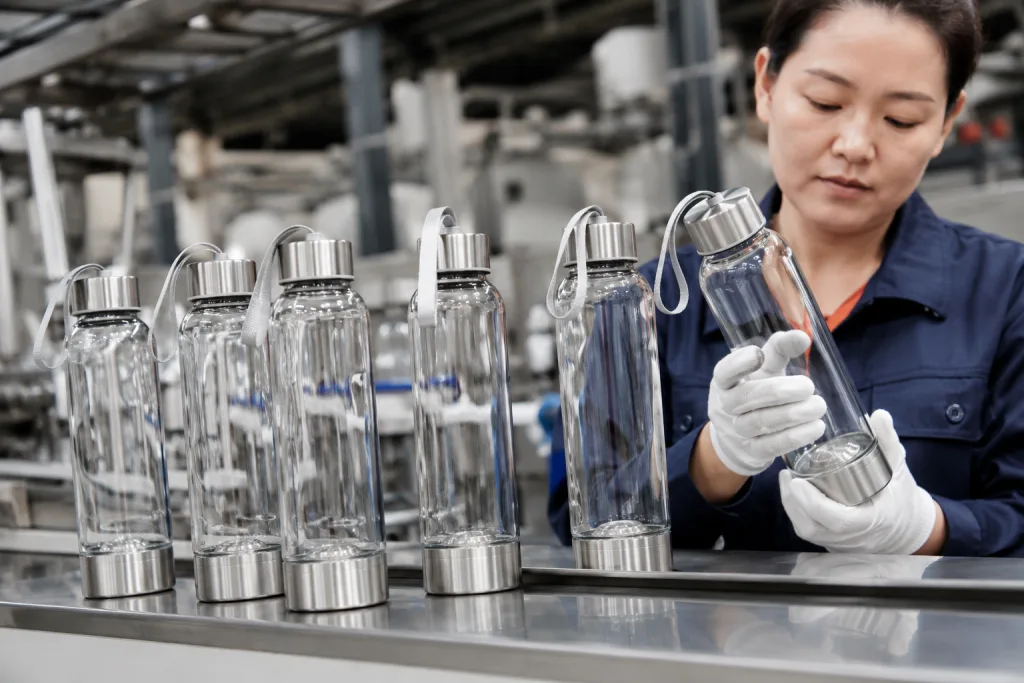
- Borosilicate with silicone sleeve: better grip, stronger shelf story, often the safest bet for sustainable retailers.
- Double-wall glass: better insulation appearance, but heavier, more fragile at the rim, and usually less attractive for distributor glass water bottle projects that need efficient freight.
High borosilicate is usually the practical middle ground. It handles wider temperature swings, shows cleaner clarity, and gives the premium claim some backing on shelf. If you buy from a borosilicate glass bottle manufacturer in Zhejiang with stable furnace control, wall thickness variation is usually tighter; on our line, QC pulled the sample and checks body thickness at three points, and the spread matters. Uneven thickness is where we see trouble go sideways: more failures during capping, more edge contact in packing, more transit claims.
At BottleForge Industrial, our glass bottle line is built around distributor needs: repeatable decoration registration, mixed-pack options, and monthly output around 180,000 units across standard glass bottle models. We run this volume without forcing small and mid-size buyers into MOQs that do not fit the sell-through math. Last month one PO came in with the cap finish typed wrong by 1 mm, and that alone would have delayed sampling; this is the kind of detail that separates a smooth repeat order from a messy one.
You do not need the most expensive bottle. You need the bottle that keeps complaint rate below 1.5% after warehousing, parcel handling, and retail shelf life.
Head-to-head spec table that matters
If you're checking a borosilicate glass bottle factory, ask for a real spec sheet, not a polished sales deck. This table is what buyers on our side of the line actually use before we quote MOQ, mold risk, and packout.
Typical sourcing comparison
- Material: soda-lime vs high borosilicate. Borosilicate costs more, but it handles thermal shock better and gives you a stronger premium story. We’ve seen buyers push for soda-lime, then flag breakage after a hot-water fill test.
- Capacity: 350 ml, 500 ml, 650 ml, and 750 ml are the working size bands. In wellness and yoga retail, 500-650 ml usually moves fastest. On one 40HQ plan, 550 ml beat 750 ml by 18% because shelf fit was easier.
- Wall thickness: 2.2-2.5 mm is economy grade; 3.0-3.5 mm is the safer range for a bulk borosilicate glass bottle program; above 4.0 mm adds weight fast. QC pulled the sample last month and the 4.2 mm bottle was 68 g heavier than the 3.2 mm version.
- Mouth diameter: 32-38 mm is easier for cleaning and ice fill. Narrower openings cut splash, but brush access gets worse. We check this with a standard cleaning brush on the bench, not by guesswork.
- Cap system: PP screw cap, stainless cap with PP inner, bamboo-look cap, or leakproof carry-loop lid. Ask for torque standard and gasket material. This matters. A cap that looks good in photos can still fail at 0.25 MPa leak testing.
- Sleeve: no sleeve, half sleeve, full sleeve. Full silicone sleeve usually adds USD 0.22-0.40 depending on mold and thickness. Common sleeve thickness is 2.0-2.5 mm; below 1.8 mm, the grip feel gets cheap fast.
- Decoration: one-color silkscreen, multi-color print, heat-transfer decal, laser on cap, or gift-box branding. Ask what passes after 100 rub cycles. The buyer flagged logo scratching on a matte print once, and the claim cost more than the decoration upgrade.
- Packout: egg-crate export carton, white box, color box, PDQ tray, or mailer-tested inner box. Don’t skip this point. We’ve seen a good bottle fail because the drop test on the inner box was only 60 cm.
For borosilicate glass bottle customizable programs, the sweet spot for 7 out of 10 distributors we quote is 550 ml, 3.2 mm wall, stainless-look screw cap with food-grade PP liner, and a 2.0-2.5 mm silicone sleeve. It is not the cheapest line on the sheet. The math still works better on landed value because claims, breakage, and repacking usually drop.
Ask every borosilicate glass bottle supplier to quote the same structure with the same incoterm. FOB Ningbo or Shanghai is usually the cleanest comparison for buyers in Europe and North America. If one borosilicate glass bottle vendor quotes ex-works and another quotes FOB, the comparison is already off. Also ask for unit weight. A 500 ml glass bottle can range from 280 g to 430 g. That gap changes freight and hand feel right away. We ship both ranges, and buyers notice the difference within 10 seconds of picking up the sample.
Use-case fit by channel and margin
Not every custom glass water bottle fits every sales channel. We see distributors miss this point, then ship a good-looking bottle into the wrong route and get returns 45 days later.
Wellness studios and premium gift shops: Stick to a custom borosilicate glass bottle in the 500-650 ml range, with a full or half sleeve and a matte-finish cap. This channel buys on hand feel and shelf impression. Buyers check logo edges, cap coating, and whether the bottle feels safe in hand after 10 minutes of use. On our line, QC pulled the sample twice last spring because a 0.3 mm logo shift was obvious on a low-color print. A borosilicate glass bottle promotional program for studio memberships or retreat kits usually sells better with restrained branding and a gift-ready white box. If the artwork is loud, premium shops push back fast.
Sustainable retailers: Put refillability, material transparency, and compliance paperwork first. A customizable glass water bottle with REACH-friendly decoration inks, LFGB or FDA contact compliance, and recycled-paper packaging sells better than an overbuilt box with extra inserts. The eco story needs proof, not adjectives. We ship packaging composition sheets down to paper weight in gsm because eco-focused accounts ask for it, and they ask early. One buyer even flagged a PO typo where “recycled paper” became “recyclable paper.” Small wording issue, big trust issue. Here, the box design is the wrong question to ask if the paperwork is weak.
Corporate programs and events: If timing is tight, use stock molds and customize the decoration. Do not open a new mold unless the volume supports it. New mold development can add 15-25 days plus mold charges from roughly USD 600 to USD 1,800 depending on complexity. For a 2,000-piece event order, the math doesn't work. We run these jobs against event dates all the time, and a delayed approval on a pantone cap can already cost 3 days. Adding mold work on top of that is how projects go sideways.
E-commerce and Amazon FBA: Be careful. Glass and parcel networks are not friends. You need stronger inner packaging, barcode placement control, and mailers that pass drop test requirements, not just clean-looking cartons. A borosilicate glass bottle customized for e-commerce should have tighter pack specs than one going on pallets to stores. We usually add thicker dividers, lock barcode position within a few mm, and check carton crush after sealing because the buyer flagged scuffing on the first parcel run. This is where nice packaging fails if the line packs for retail instead of parcel handling.
The practical test is simple: ask what the end customer pays for most—appearance, temperature tolerance, sustainability story, or lowest ticket price. Rank that first. Then match the bottle spec to the channel. We’ve seen this go sideways when distributors try to make one SKU cover 4 channels with one box and one insert. The wrong choice usually shows up as returns and account complaints, not at order confirmation.
Customization without expensive surprises
A borosilicate glass bottle custom project gets expensive fast if you customize the wrong part. This is the wrong question to ask: “Do we need a new bottle shape?” In 7 out of 10 distributor projects we quote, the better answer is no. You usually need tighter decoration control and better packout, not a fresh mold. On the line, the first thing we check is print position with a steel jig, not bottle shape.
For most distributor orders, these are the common customization cost bands:
- Silkscreen logo: USD 0.10-0.18 per color per unit, depending on print area and quantity.
- Heat-transfer decal: USD 0.18-0.35 per unit, better for gradients and multicolor graphics.
- Embossed silicone sleeve: mold/setup charges often USD 120-300, then USD 0.25-0.45 per sleeve.
- Custom color box: USD 0.28-0.65 depending on board grade and finish.
- New bottle mold: roughly USD 600-1,800 for simpler bodies, higher for unusual necks or integrated details.
If you are buying borosilicate glass bottle wholesale for multiple retailers, a stock bottle with custom decoration is usually the better margin play. We run this model all the time because MOQ stays manageable, often 1,000 pcs per colorway, and reorders stay cleaner. A fully customized borosilicate glass bottle shape often pushes MOQ to 5,000 pcs or more. Then the math doesn't work if one retailer’s forecast slips. We’ve seen this go sideways over a 2 mm neck change that looked nice on a rendering but slowed capping and left old stock sitting in the warehouse.
Ask your borosilicate glass bottle manufacturers one practical question: where does decoration fail first? Good suppliers should answer straight. On glass, the weak spots are usually dishwasher abrasion and print registration on curved walls; QC pulled the sample more than once for a 1.5 mm logo shift. Between production lots, color drift also shows up fast. On bamboo-look caps, buyers usually flag tone variation first. On silicone sleeves, the common complaints are lint pickup and Pantone drift.
If you need a borosilicate glass bottle customized for promotional campaigns, prioritize speed. Use existing molds, one-color print, and standard export cartons. We ship these faster because there are fewer approval points, and 12 days vs 18 days matters for a campaign. If you need a customizable borosilicate glass bottle for a premium evergreen collection, spend the money on sleeve tooling and stronger packout. Not on fancy glass geometry. A drop-test failure in a corrugated divider is more expensive than a plain bottle body.
Quality control points buyers should not skip
This is where first-time buyers get polite promises instead of measurable control. We see it often. If you are sourcing from borosilicate glass bottle suppliers in China, write the inspection points into the PO before deposit payment, not after the sample is approved. We had one PO last quarter with the lid color typed as “mat black” instead of “matte black,” and the line followed the wrong note.
Start with these standards:
- AQL: General Inspection Level II, Major 2.5, Minor 4.0 is a workable baseline for distributor orders. QC pulled the sample by carton count, not by guesswork.
- Leak test: 100% basic leak check after capping, especially for carry-loop lids. On our line, that usually means an inverted hold check after capping, carton by carton.
- Drop and transit: packed-carton drop test aligned to your channel. For parcel-heavy programs, ask for 1A style transport validation or equivalent internal protocol. The wrong carton spec is a common miss; a 5-layer box and a 62 ECT box are not the same thing.
- Compliance: REACH for EU market expectations, LFGB where required, FDA food-contact relevance for the US, and BPA-free declaration for polymer components. Ask for the test report scope, not just the certificate name.
- Factory systems: ISO-oriented documentation helps, but what you really need is traceable incoming material and in-line inspection records. If the factory cannot trace the gasket lot back to receiving, that is a problem.
For glass, visual defects need tighter definition than most vendors give you. This is the wrong question to ask: “Is your quality good?” Ask your borosilicate glass bottle vendor to write limits for bubbles, stones, seam lines, rim chips, scratch length, logo position tolerance, and sleeve fit, with actual numbers in mm where possible. We run this by a master sample and an inspection sheet at the line. “Within factory standard” means nothing unless that standard is written down.
A reliable borosilicate glass bottle manufacturer should also confirm cap torque range, gasket material, and whether bamboo or wood-look parts are cosmetic sleeves over PP or actual natural material components. That point gets skipped. It affects moisture stability and claim risk, and we have seen this go sideways in Zhejiang: the bottle body passed inspection, but cap swelling drove most of the customer complaints. One buyer flagged a lid that grew almost 1.5 mm after humid storage, and the math didn't work for retail returns.
If your order is headed to North America retail, request barcode scan verification and carton marking review. A handheld scanner check takes minutes. If it is going to Europe, check labeling language and disposal marks early, before mass packing starts. We ship orders that were fine on product quality but got stuck for outer-carton mark errors, and warehouse rework on 3,000 units is expensive.
China sourcing math: MOQ, lead time, and landed cost
You cannot pick a borosilicate glass bottle distributor on unit price alone. Landed cost decides if the SKU makes money. We’ve seen a PO win by USD 0.06 and lose it back on breakage before the first container was sold through.
For a standard 500-600 ml borosilicate glass bottle bulk order from Zhejiang and nearby production areas, the working numbers usually look like this. On the line, we still check bottle mouth tolerance with a digital caliper before final packing because 0.5 mm drift is enough to start cap-fit complaints.
- MOQ: 1,000 pcs for stock model with simple logo; 2,000-3,000 pcs for custom sleeve or color box; 5,000+ pcs for new mold programs.
- Sample time: 5-7 days for stock sample with logo mockup; 7-12 days for pre-production sample.
- Mass production: 25-35 days after sample approval and deposit for standard runs.
- FOB unit price: around USD 1.05-1.85 for common high-borosilicate setups, excluding unusual accessories.
- Breakage reserve: budget 1-3% depending on pack method and route.
Here is the part buyers miss: packaging and freight. Moving from a plain egg-crate carton to a retail box plus export master may add USD 0.35-0.70 per unit. On paper, that hurts. In claims, it often saves you. QC pulled the sample on one run last year and found corner crush on a 32 ECT outer carton; the buyer had pushed for cheaper packing, then flagged breakage after delivery. If the upgrade cuts returns by 2%, the math usually works in your favor. Glass is unforgiving once parcels start taking drops.
When you compare borosilicate glass bottle vendors, ask for carton dimensions, gross weight, units per carton, and pallet loading. Ask for the actual numbers, not “optimized packing.” A 10% gain in carton efficiency changes freight fast on a 40HQ shipment. We ship mixed loads for distributors all the time, and this matters. One carton at 58 x 38 x 42 cm versus a loose pack at 61 x 41 x 45 cm adds up across the container. Also confirm whether the factory can consolidate mixed SKUs in one shipment. For distributors covering 4 or 5 wellness accounts, that flexibility is usually worth more than saving the last USD 0.03.
Our advice from Zhejiang is simple: buy the second-cheapest compliant option, not the cheapest. This is the wrong question to ask if you only focus on FOB. The lowest quote often hides weak caps, thin walls, or underbuilt packaging. We’ve seen this go sideways. One inspection found a silicone ring swapped to a lower grade without notice; the PO still looked clean, but the leak rate told the real story. You usually pay later in claims, not on the quote sheet.
Get a workable glass bottle quote, not guesswork
Send your target size, channel, decoration, and packaging needs. We will quote the right bottle structure, MOQ, and lead time for your market.
Frequently asked questions
What MOQ should glass water bottle distributors expect for custom orders?
For a stock-shape custom glass water bottle with one-color logo, a realistic MOQ is 1,000 pcs per SKU from many China factories. If you add a custom silicone sleeve, printed color box, or multiple cap colors, MOQ often moves to 2,000-3,000 pcs. A fully new mold usually starts closer to 5,000 pcs and can require mold fees from about USD 600 to USD 1,800. If a borosilicate glass bottle supplier offers very low MOQ, check whether they are using mixed leftover materials, accepting loose print tolerances, or charging a higher unit price to compensate. For distributors, the best balance is usually a stock mold with custom decoration and standard export packaging.
Is borosilicate always better than soda-lime for wholesale glass bottles?
Not always, but usually yes for premium retail and wellness channels. High borosilicate handles temperature changes better and supports a cleaner premium story, which matters if you sell to sustainable retailers or spa and fitness brands. It also tends to perform better in repeated use. The trade-off is cost: borosilicate can run roughly USD 0.25-0.70 more per unit than a comparable soda-lime bottle, depending on size and wall thickness. If your program is price-led, short-term promotional, or not intended for hot-fill perception, soda-lime may still work. For most borosilicate glass bottle wholesale distributor programs in Europe and North America, 3.0-3.5 mm high borosilicate is the safer commercial choice.
How do I reduce breakage on bulk glass water bottle shipments?
Start with structure, not just packaging. A 3.0-3.5 mm wall bottle with a silicone sleeve is usually more stable than a thin-wall unsleeved design. Then control the packout: individual bagging, partitioned inner protection, stronger master cartons, and carton gross weight below about 14 kg help a lot. For parcel channels, ask your borosilicate glass bottle manufacturer for a mailer-tested pack and drop test records. Also budget a 1-3% breakage reserve depending on route and handling intensity. Cheap color boxes without export support often create more claims than they save. If you sell through e-commerce, invest the extra USD 0.35-0.70 per unit in packaging before you spend money on premium decoration.
What compliance documents should a borosilicate glass bottle supplier provide?
For Europe, you should ask about REACH-related chemical compliance for inks, coatings, sleeves, and polymer parts, and LFGB relevance if your channel requests it. For North America, FDA food-contact alignment for relevant materials is common, along with BPA-free declarations for caps, seals, and sleeves. You should also request test records for leak performance and, where applicable, packaging material information if your customer has sustainability reporting requirements. BSCI or similar social compliance can matter for retail chains, but product compliance is separate from factory ethics audits. A serious borosilicate glass bottle factory in China should be able to identify which documents apply to the bottle body, cap liner, sleeve, and decoration, not just send one generic certificate.
How long does a borosilicate glass bottle customized project usually take?
For a standard stock model with custom logo, plan 5-7 days for samples and 25-35 days for production after sample approval and deposit. A project with custom sleeve color, printed box, and mixed accessories may take 30-40 days. If you need a new bottle mold, add roughly 15-25 days for tooling and confirmation before mass production. Lead time also depends on whether your supplier controls printing, sleeve production, and packaging in-house or through local partners. In Zhejiang, China, shorter lead times are possible during quiet periods, but it is safer to plan with margin, especially before summer promotions or Q4 gift demand. Rush production usually increases defect risk, especially on decorated glass.