Key Takeaways
- For custom stainless thermos, a workable MOQ is often 1,000-3,000 pcs per SKU, with 35-50 day lead time after sample approval
- 18/8 stainless steel, vacuum copper coating, and AQL 2.5/4.0 are more useful buying points than generic “premium quality” claims
- For promotional thermos orders, logo method changes cost by about USD 0.12-0.80 per unit depending on silkscreen, laser, or wrap print
- A factory in Zhejiang, China producing 300,000 units/month should still provide lot traceability, REACH testing, and drop-test records on request
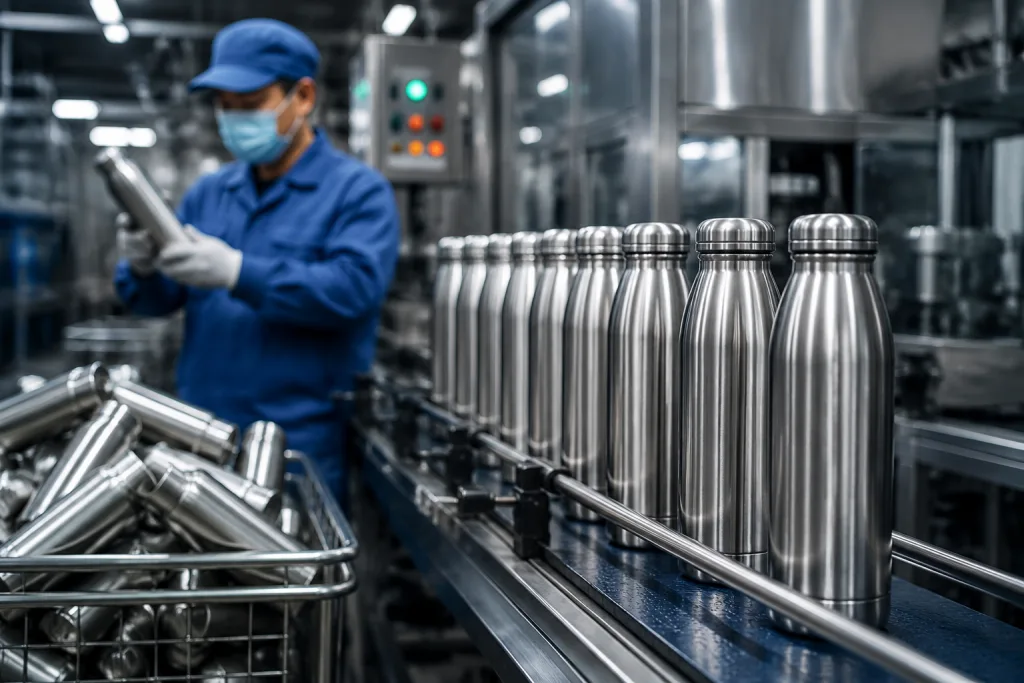
Some buyers start with a glass vacuum flask supplier and then hit the same wall: half the order book shifts to stainless steel. That happens all the time. Outdoor retailers ask for impact resistance and steady heat retention after a 1.2 m drop test. Promotional brands care more about clean logo space, 35-day lead time instead of 50, and landed cost that still works after carton count is fixed. The hard part is not finding a factory in China. The hard part is sorting a real thermos manufacturer from a trading layer that cannot answer basic questions on steel grade, vacuum yield, or AQL.
At BottleForge Industrial in Zhejiang, China, we run into this every week. One buyer flagged a PO last month with “stainess steel” typed on the spec sheet, and the bigger problem was they were comparing glass-lined vacuum flasks, stainless thermos programs, and mixed SKU rollouts as if the risks were the same. They are not. If you are sourcing bulk thermos or a customized thermos line, the checklist is practical: material choice, insulation performance, compliance file, decoration method, MOQ, and failure rate from the line. Miss one item, QC pulls the sample late, and your launch date slips.
Start with the right supplier type
Search for a glass vacuum flask supplier and you usually get 3 company types: direct thermos factories, trading companies, and mixed suppliers that assemble some parts but outsource key steps like vacuuming or powder coating. None is wrong by itself. Mismatch is the problem. If your project needs new tooling, exact Pantone matching, and a retail box that passes drop-test review, ask who runs the line and who owns the mold. We have seen buyers lose 12 days just waiting for a trader to relay a 0.3 mm lid-gap issue back to the actual factory.
Ask direct questions early. A real thermos manufacturer should answer fast, and with shop-floor detail, not sales copy:
- What steel grade do you use: 18/8, 18/0, or 316 for selected models?
- Do you produce vacuum bodies in-house or buy semi-finished shells?
- What is your monthly output capacity and current load?
- What is your normal MOQ for logo change, color change, and packaging change?
- Can you provide REACH, LFGB, or FDA-related material reports from recent lots?
For outdoor retail, stainless is usually the safer call than a glass-lined body because one breakage claim can eat the profit on a carton. This is the wrong question to ask as style alone. Ask about claims rate. A glass vacuum flask still fits classic gift channels, but for distributor thermos programs, camping retail, and promotional thermos campaigns, stainless usually ships with fewer return headaches. QC pulled one fall-test sample last month with a dented base, and it still held vacuum; the same drop with glass lining would have been a write-off.
At our Zhejiang operation, typical MOQ starts at 1,000 pcs for an existing stainless thermos model with one-color print, while new color box development may need 2,000 pcs. Lead time is usually 35 to 45 days after deposit and pre-production sample signoff. We run vacuum testing on the line before packing, and the buyer often flags the same point: who owns the tooling if the order moves next season? If a supplier thermos quote comes in lower but they cannot explain tooling ownership, spare parts, or production routing, the math does not work. Treat that as risk cost, not savings.
Glass-lined or stainless for your market?
Buyers leave this decision too late all the time. A glass vacuum flask supplier might throw out a sharp price on a classic pump pot or home-use flask, but outdoor retail and promo programs should judge the item by how it gets used on the shelf and after shipment, not by what the last PO looked like. We have seen one buyer flag a cracked insert after a 76 cm drop test on a courier sample, and that is usually where the cheap quote stops looking cheap.
Where glass-lined still makes sense
- Traditional household channels
- Low-acid beverages where taste neutrality matters
- Gift sets where the product stays mostly indoors
Where stainless is usually better
- Camping, commuting, hiking, school use, and travel retail
- Distributor thermos or distributors thermos programs where rough handling claims show up fast
- E-commerce orders, where parcel drop damage and carton compression both matter
- Promotional campaigns that need custom colors, logo durability, and repeat orders from 1,000 pcs up
From a procurement angle, stainless gives you fewer bad surprises. We run a standard double-wall vacuum bottle in 18/8 stainless with 0.4 mm inner wall and 0.5 mm outer wall, and it stands up to daily handling far better than a glass-lined insert on the line and in transit. Heat retention can still hit 12 hours hot and 24 hours cold, depending on volume and lid structure. For a 500 ml bottle, FOB China pricing for a stock-shape stainless custom thermos often lands around USD 2.80 to 4.80 at 3,000 pcs, while more complex lids or powder-coat finishes push it higher. This is the wrong question to ask if the only target is unit price; the math does not work once returns and replacement freight start stacking up.
You are not choosing between old and new materials. You are choosing the return rate you can live with.
If you need a customizable thermos line for outdoor stores, stainless is the easier call. If your project started with a search for thermos supplier options around glass vacuum products, widen the brief and check who actually runs both structures well. In Zhejiang, plenty of thermos suppliers will quote both, but QC pulled enough mixed-structure samples for us to say this plainly: not every factory that sells both can make both to the same standard.
Questions to ask before sample approval
Sample approval is where a lot of custom thermos jobs slip. Buyers check logo placement and miss the parts that decide whether the bulk thermos shipment matches the sample. Run a checklist. Get each point in writing.
- Capacity tolerance: State the allowed range, such as 500 ml plus or minus 3%.
- Weight tolerance: Useful for marketplace listings and carton planning, usually plus or minus 5 g to 10 g.
- Heat retention test: Ask for actual data, for example 95 degrees C fill, measured at 6 hours and 12 hours under lab condition.
- Leak test: 100% air-pressure or inverted hold test before packing.
- Coating adhesion: Cross-hatch and tape test for powder coat or paint.
- Odor check: Check silicone seals and straw parts before packing; QC pulled the sample on this one before once, and the buyer flagged it fast.
- Drop test: Define carton drop standard, commonly 76 cm for packed goods.
If you are buying thermos custom programs for promotional use, ask which logo method the line will actually run: silkscreen, heat transfer, laser engraving, UV print, or water decal. Each one changes price and wear life. One-color silkscreen may add USD 0.12 to 0.25 per unit at volume. Laser engraving can add USD 0.18 to 0.40. Full-wrap decoration may add USD 0.50 to 0.80. The math does not work if the buyer wants premium decoration at entry-level cost.
A true thermos factory or thermos manufacturer should issue a pre-production sample that reflects the mass production process, not an art-room mockup. If the sample uses a hand-applied finish the line cannot repeat, the approval is weak. For any customized thermos order above 5,000 pcs, ask for a sealed golden sample and a signed specification sheet with photos, dimensions, and packaging details. We ship better when the PO calls out the exact carton size, too.
MOQ, pricing, and tooling reality
Most buyers ask MOQ first. Fewer ask which part sets it. That is the right question. A thermos bulk order can carry one MOQ for the bottle body, another for lid color, and a third for the printed gift box. If cash is tight, split the order logic instead of treating it as one number.
For a stainless manufacturer thermos project in China, these are the numbers we usually see on the line:
- Existing bottle shape, stock lid, one-color logo: 1,000 pcs
- Custom color body and matching lid parts: 2,000 to 3,000 pcs
- New mold for cap or handle: tooling from USD 2,000 to 8,000 depending on complexity
- Retail gift box with foam insert: often 2,000 pcs MOQ
- Master carton customization and barcode labels: usually low cost, low MOQ add-on
Outdoor retailers often want mixed cartons or mixed colors. Some thermos vendors take 3 colors in one order if total quantity reaches 3,000 pcs and each color stays above 1,000 pcs. The buyer flagged it once when a factory pushed for 300 pcs across ten colors; that math does not work. Small splits slow the line and raise defect risk.
Do not chase the lowest factory thermos quote without checking what is left out. We have seen this go sideways on logo plate charges, replacement seal cost, third-party inspection fees, carton upgrades for Amazon FBA, and export packaging for lids shipped separately. A quote from thermos manufacturers should state FOB Ningbo or FOB Shanghai, sample charges, tooling ownership, and payment terms such as 30% deposit and 70% before shipment. QC pulled the sample and found a PO typo on the carton count once; that saved a headache.
At BottleForge Industrial in Zhejiang, China, our monthly output on drinkware is around 300,000 units across standard lines, but we still limit new customized thermos launches during peak season. We run that way on purpose. A caliper on the packing table and a 1.5 mm lid tolerance matter more than a fast promise. You want a supplier who says no before production chaos starts.
Compliance, inspection, and packaging checkpoints
Outdoor retail and promo buying is not just about basic quality anymore. Buyers now ask for market-entry files, retailer onboarding records, and social audit documents before the first container moves. If a thermos supplier says “no problem” to 6 requests in one call but sends no REACH report, no audit, and no test copy within 24 hours, treat that as a no. We’ve seen this go sideways after deposit.
For Europe and North America, stainless thermos projects usually touch some mix of these checkpoints:
- REACH: Most often tied to coatings, plastics, silicone parts, and printed or powder-coated surfaces; the buyer flagged lid gaskets more than bottle bodies on 3 recent programs
- LFGB or FDA-related food-contact testing: Based on target market request; QC pulled the sample from the same production lot, not from a hand-made preproduction piece
- BSCI or Sedex: Needed where retailer programs require social compliance; audit validity dates matter, and expired reports get kicked back fast
- ISO 9001: Useful for process control, but it does not replace product inspection; this is the wrong question to ask if the line still has scratch complaints
- AQL inspection: Often Major 2.5, Minor 4.0, Critical 0; we run this against sealing, finish, logo position, and carton marks before booking balance payment
- ASTM/CP65 awareness: Relevant where decorated items or accessories raise chemical concerns; this comes up more on painted gift sets and strap accessories
For promotional thermos shipments, packaging mistakes usually cost more than product defects. A barcode 12 mm off the required panel can stop receiving. An inner pack packed 24 pcs instead of 20 pcs can trigger manual relabeling fees at the warehouse. If you ship to FBA or 3PL warehouses, lock down carton weight cap, FNSKU label position, suffocation warning, drop test level, and pallet standard before the first PO print. One buyer even sent a PO with the carton mark typo “THREMOS,” and the warehouse still rejected the batch.
A capable suppliers thermos team should send a packaging layout for approval before mass print. No guesswork. Ask for:
- Unit box dieline and artwork proof
- Master carton dimensions and gross weight
- Barcode scan verification photo
- Transit pack photos after drop test
If your order is over USD 10,000, paying USD 250 to 400 for a third-party pre-shipment inspection is cheap insurance. On one 1,200-carton run, the inspector caught mixed lid colors in 7 cartons and a gross weight over spec by 1.8 kg. Even if you buy from a thermos factory you trust in Zhejiang or elsewhere in China, an outside check keeps the line sharp and the math works.
Branding choices that fit the channel
Custom branding is where a customizable thermos turns into margin or trouble. Outdoor retailers usually want a quiet look and a logo that survives knocks. Promo buyers want the logo bigger and the ship date locked. Different channel, different spec. We run that split all the time.
For brushed stainless or powder-coated bodies, the usual options are:
- Silkscreen: Low cost, clean on simple logos, works best on flatter print areas
- Laser engraving: Durable and premium, especially on matte powder coat
- Heat transfer or water decal: Better for multicolor artwork, but it needs abrasion testing
- Embossed badge or metal plate: Higher cost, works for gift and distributor thermos lines
If you run thermos promotional campaigns, ask how the logo holds up after dishwasher cycles, ice abrasion, and hand lotion contact. We have seen buyers approve artwork at sample stage and skip wear testing. QC pulled the sample after 24 hours in the wash test, and the print edge started to lift. That is not a small miss.
For outdoor channels, keep it practical. Dark matte colors, narrow laser marks, and standard lid parts are easier to replenish. For event giveaways, bright Pantone matching and a low unit cost usually matter more than cosmetic life. One body can serve both channels if you change the decoration method. The wrong question is “which finish is best”; the right one is “what does the buyer need after 90 days?”
Buyers also ask whether customized thermos packaging should be retail-ready in China or finished locally. If the order is under 2,000 pcs and the campaign date is still moving, plain units plus local sleeves or labels cut risk. Above that, direct packed product from thermos distributors or thermos manufacturers in China usually saves money and handling time. We’ve seen a PO typo on carton marks add a full day at the port, so the packaging line matters more than people think.
A short sourcing checklist you can use
When you compare a glass vacuum flask supplier with stainless thermos suppliers, skip the brochure talk. We run one decision sheet and score every thermos candidate on the same line items. That keeps the buyer from cherry-picking the easy answers.
- Can they make sample and mass production on the same line, with the same molds and polishing method?
- Do they state 18/8 stainless, wall thickness, and surface finish in writing?
- Is MOQ workable for a first run: 1,000, 2,000, or 3,000 pcs?
- Can they commit to 35-50 day production, not hand-wave it?
- Do they accept AQL inspection and share past defect data?
- Can they handle custom thermos packaging, carton marks, and FNSKU if needed?
- Do they provide REACH or food-contact test reports for similar models?
- Have they shipped to Europe or North America in the last 12 months?
- Will they confirm spare gasket supply and replacement part availability?
- Are they clear about which parts are outsourced?
If a thermos distributor or thermos vendor fits your buying model, that can still work. The factory side still needs to be visible for technical questions and QC. We have seen this go sideways when the buyer only talks to trading staff and the real coating line is never shown. For outdoor retailers, a stainless thermos manufacturer with export cartons and stable coating results is the safer call. For promo brands, speed, logo placement, and carton compliance often beat fine material debates.
The best supplier is not the one saying yes to everything. That is the wrong question to ask. It is the one in China, ideally in a drinkware cluster like Zhejiang, that gives measurable answers, workable MOQ, and fewer surprises after deposit. We ship a lot of thermos orders this way, and the math works: fewer claims, fewer reworks, better launch timing.
Get clear answers on your thermos sourcing project
Send your target quantity, decoration method, and market. We will review MOQ, compliance, and lead time for a practical stainless thermos proposal.
Frequently asked questions
Can a glass vacuum flask supplier also handle custom stainless thermos orders well?
Sometimes yes, but you should verify whether they actually produce stainless vacuum bodies or just source them. Ask for steel grade, wall thickness, vacuum testing method, and monthly capacity. A credible supplier should quote something like 18/8 stainless, 0.4 mm inner wall, 0.5 mm outer wall, and a 35-45 day lead time. If they only discuss colors and logo, they are probably acting as a trading layer. For first orders above 2,000 pcs, request recent inspection reports, packaging photos, and at least one compliance document such as REACH-related testing for materials or coatings. If they cannot provide those within a few days, keep looking.
What MOQ should I expect for a customized thermos program?
For an existing stainless thermos shape with one-color print, 1,000 pcs per SKU is a normal starting MOQ in China. If you want custom body color, matching lid parts, and a printed retail box, expect 2,000 to 3,000 pcs. New tooling for a cap, handle, or unique base can push the project into a separate mold cost range of roughly USD 2,000 to 8,000. Be careful with mixed-color requests. Many thermos manufacturers will accept 3 colors if total order volume is at least 3,000 pcs and each color is 1,000 pcs. Lower splits are possible, but unit cost usually rises and consistency can drop.
What tests matter most for outdoor retail stainless thermos?
Start with the practical ones: leak test, heat retention, coating adhesion, odor check, and packaged drop test. For a 500 ml bottle, ask the factory to document hot retention from a 95 degrees C fill at 6 and 12 hours. Require 100% leak testing before packing. For painted or powder-coated bodies, a cross-hatch adhesion test is standard. If the product will go through e-commerce parcels, ask for a packed drop test at 76 cm. On compliance, REACH is common for Europe, while food-contact documentation for plastics, silicone, and coated parts may also be requested. For final shipment quality control, AQL 2.5 major and 4.0 minor is a practical baseline.
How much should I budget for logo decoration on promotional thermos?
For simple one-color silkscreen, budget roughly USD 0.12 to 0.25 per unit at decent volume, often 3,000 pcs or more. Laser engraving usually runs around USD 0.18 to 0.40 depending on logo size and position. Multicolor wrap or transfer decoration can range from USD 0.50 to 0.80, sometimes higher if the artwork needs extra setup or protective coating. The cheaper method is not always the better one. Event giveaways may accept lower abrasion resistance, but outdoor retailers usually prefer laser or well-tested screen print on powder coat. Ask for a decoration durability test, not just an artwork proof, before you approve mass production.
How do I reduce risk on my first thermos bulk order from China?
Keep the first order simple. Use an existing mold, one or two standard colors, and proven packaging. Stay in the 1,000 to 3,000 pcs range if possible, and insist on a golden sample plus written specification sheet. Choose FOB terms with clear payment conditions such as 30% deposit and 70% before shipment. Before production, confirm carton dimensions, barcode placement, and inspection standard. A third-party pre-shipment inspection usually costs around USD 250 to 400 and is worth it on almost any order above USD 10,000. Finally, ask the factory in China for replacement gasket policy and spare part availability, because small service issues can become large account problems later.