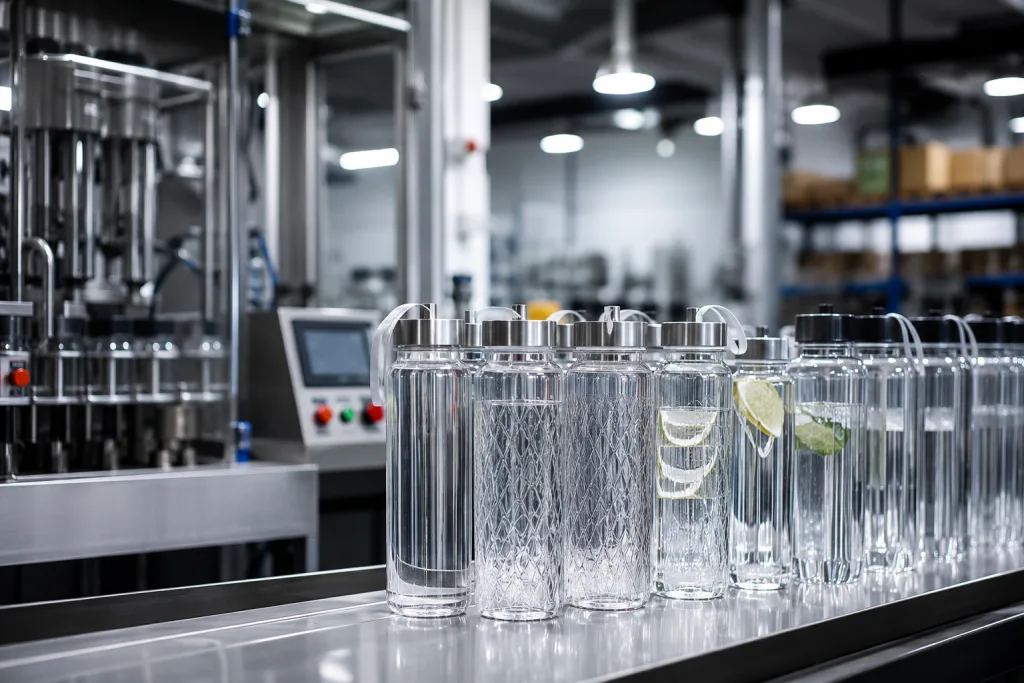
Key Takeaways
- A workable opening MOQ is often 3,000-5,000 pcs per model, with 20-35 days production after sample approval
- For 500-600 ml bottles, FOB China pricing commonly runs USD 1.85-3.90 for Tritan and USD 2.20-4.80 for borosilicate glass depending on lid and print
- Use AQL 2.5/4.0, 1.2 m drop testing, leak tests, and carton compression checks before balance payment
- If you need EU and North America compliance, confirm REACH, LFGB or FDA contact testing, and packaging labeling before mass production
You are not buying a generic bottle. You are trying to secure a glass tritan bottle custom program that survives sampling, compliance review, transit testing, and an actual sales launch. In one SKU family, you are balancing two materials with different failure points: borosilicate glass for premium shelf feel, and Tritan for lower breakage risk in transit. This is where 6 out of 10 quotes fall apart. A supplier sends a fast unit price, but leaves out wall thickness, lid fit, drop-test standard, or even carton spec, and the margin disappears later.
A practical buyer starts with order flow, not the catalog photo. At our Zhejiang factory, we see the same mess on the line: artwork comes after sampling, the gift box is marked only as “custom color,” and QC gets discussed after the 30% deposit. Last month QC pulled the sample and found a 1.5 mm logo shift against the approved drawing; the buyer had already booked launch photos. That sequence is backwards. If you want stable landed cost, fewer claims, and a product your distributor drinkware channel can reorder, lock the specification first. This is the right place to be strict.
Start with the buying brief
Start with the job in front of you. You are the procurement manager for a wellness brand in Germany or a canteen distributor in Canada. Sales needs a 550 ml bottle line for retail and corporate gifting. Marketing wants a clean premium look. Operations wants fewer breakage claims than last year’s glass program. You send an RFQ to 3 canteen manufacturers in Zhejiang. Two reply with a one-line price. One comes back asking about neck finish, drop-test packout, and whether the logo sits at 60 mm or 80 mm from the base. Keep talking to that supplier. The line detail tells you they know what they are quoting.
Your brief should fit on one page and answer the commercial basics:
- Material route: borosilicate glass body, Tritan body, or a shared lid system for both.
- Capacity: 450 ml, 550 ml, 700 ml are the most efficient common molds.
- Wall thickness: 2.2-2.8 mm for borosilicate glass; Tritan bottle body usually specified by weight and neck finish rather than wall only.
- Lid construction: PP inner, stainless accent, silicone seal, carry loop, tea infuser, straw, or flip spout.
- Decoration: 1-color silkscreen, heat transfer, UV print, laser on cap, or paper insert.
- Target price: state the FOB target, not just "best price".
- Compliance market: EU, UK, US, Canada.
- Packaging: egg-crate divider, single gift box, PDQ tray, or Amazon-ready labeling.
Skip those points and each vendor will quote a different bottle, lid, and pack method. Then the comparison is useless. We have seen buyers compare 480 g glass against 620 g glass and think the cheaper quote is a win; the math doesn’t work. On custom drinkware, a clear RFQ usually saves 3-5% in mistake cost later. QC pulled one sample last month where the PO said 550 ml but the artwork wrap file was sized for a shorter 500 ml body. That kind of miss costs more than another USD 0.06 on unit price.
Choose glass, Tritan, or both
For this order, assume one product family in two versions: a 550 ml borosilicate bottle for specialty retail and a 600 ml Tritan version for gym, school, and canteen promo business. We see this split often. One lid platform cuts tooling cost and spare-part headaches, but the wrong question to ask is “can one cap fit both?” The real question is whether the same thread finish and gasket compression work on both bodies without leaks. On the line, we check this early with a torque tester and a 24-hour inverted leak test, because a cap that “fits” is not always a cap that ships safely.
Glass and Tritan solve different problems.
When borosilicate glass makes sense
- Stronger shelf appeal and clean taste neutrality. Buyers in specialty retail often ask for this after comparing it side by side with plastic under store lighting.
- Good fit for tea infuser or fruit infuser positioning. A common setup is a 304 stainless filter with a 0.5 mm perforation pattern.
- Body cost is usually higher, and transit breakage is real. In one drop-test review, QC pulled the sample after carton corner damage showed up first on the glass version.
When Tritan makes sense
- Fewer breakage claims in e-commerce and school channels. That matters fast when you ship 5,000 pcs into parcel delivery instead of pallet retail.
- Better match for sports and high-frequency use. Kids drop bottles; office buyers say they do not, but we have seen this go sideways.
- Easier to run as a customizable canteen program with more lid colors, since matching PP lids across 6 to 8 Pantone requests is more straightforward on this line.
A realistic FOB China range for a 550-600 ml bottle with standard screw lid and one-color print is:
- Tritan: USD 1.85-3.90
- Borosilicate glass with sleeve: USD 2.20-4.80
This range shifts with decoration, lid build, and packaging spec. Add a stainless tea filter and gift box, and you may add USD 0.45-1.10. Add full-wrap print, and reject rate can rise if artwork coverage is aggressive. We have had buyers send artwork with a seam crossing the logo by 3 mm, then flag the print line later, so prepress matters more than most quote sheets show.
If your buyer brief says only "custom canteen, 500 ml, logo," you will receive a cheap quote for a bottle that is not the one your market expects.
If you also plan a custom growler or customizable growler line later, ask the canteen manufacturer to keep finish style and color palette consistent across SKUs. Distributors care about family appearance because reorders are easier when products look related. We ship these programs faster when the cap profile, carry loop color, and print position stay aligned from bottle to bottle, even if the carton mark has a typo on the first PO.
Lock the specification before sampling
The supplier sends the drawing, and this is the point where buyers rush. Stop there. Lock the spec before you sign off any sample. On glass tritan bottle custom jobs, we see delays start from one missing line on the sheet—mouth diameter listed, thread finish missing, or a PO typo that says 500 ml while the drawing shows 550 ml. At BottleForge Industrial, our factory capacity is 600,000 units per month across mixed drinkware lines, but that speed means nothing if document control is loose.
Your spec sheet needs measurable points, not general comments. QC pulled the sample once because the logo was centered by eye, but the approved file called for a 42 mm print width and 18 mm offset from the seam.
- Body dimensions: overall height, bottom diameter, mouth diameter, thread finish.
- Net weight tolerance: for example 285 g plus or minus 10 g for Tritan, 420 g plus or minus 15 g for glass.
- Seal standard: no leakage after upside-down test for 30 minutes and no bubbles in vacuum test if applicable.
- Temperature use note: whether suitable for cold drinks only or for warm water to a stated limit.
- Logo location: print size in mm, Pantone reference, adhesion requirement.
- Packaging details: box board grade, barcode position, drop requirement, inner partition style.
For a canteen customized project, pre-production samples must cover the failure points, not just the look. This is the wrong question to ask: “Does it look good?” Ask if the cap torque is in range, if the base sits flat, if the partition board holds after a 1.2 m drop test.
- 1 unprinted fit sample
- 1 decorated sample
- 1 packaging drop-test sample
Sampling usually takes 7-12 days if no new mold is needed. If you need a new cap tool or custom silicone carry loop color, allow 15-25 days. A new mold can cost anywhere from USD 1,500 to 6,000 depending on complexity. Ask whether the tool is dedicated or shared. We’ve seen this go sideways when a buyer assumed the mold was exclusive, then found the same lid profile on another customer’s order. Serious canteen suppliers answer that clearly.
If your channel is Amazon or marketplace heavy, approve carton dimensions and FNSKU placement now. Do not leave it for mass production. We ship cartons by CBM, and the math doesn't work once the outer box runs oversize by even 8 mm on one panel. Fixing it after production usually means repacking in China, fresh labels on the line, and 12 days lost instead of 3.
Price the order like an operator
Once the sample is close, price the full program, not just the bottle. New buyers in China often stare at the FOB unit price and miss the carton, test fee, and breakage reserve. Then the “cheap” quote loses. On our line, QC pulled a glass sample with a 1.8 mm wall variation, and that alone changed the breakage allowance on the packing plan.
Take a sample calculation for 5,000 pcs of a 550 ml glass bottle and 5,000 pcs of a 600 ml Tritan bottle under one PO:
- Glass bottle FOB: USD 2.95 each
- Tritan bottle FOB: USD 2.30 each
- Gift box surcharge: USD 0.28 each
- Silkscreen one color: included
- Drop-test mailer upgrade for e-commerce portion: USD 0.22 each on 2,000 pcs
- Third-party lab test: USD 350-900 per configuration
Match the quote to the sales channel. That is the operator view. A canteen vendor selling into retail may keep the gift box because better shelf presentation covers the extra USD 0.28. A distributor canteen promotion program often strips that out and runs a white box plus barcode sticker, saving USD 0.18-0.35 per unit. For corporate customization with individual names, the buyer flagged this before: “Why is printing suddenly slower?” Because variable data adds setup time on the screen-print table and raises reject risk if one PO has 300 names with two spelling formats.
Payment terms for first orders from China are still commonly 30% deposit and 70% before shipment. If the order is above USD 30,000 and the factory has a stable export record, ask for balance after inspection approval but before loading. That is a fair ask. Lead time is usually 20-35 days after deposit, artwork approval, and sample confirmation. In peak season, especially from August to November in Zhejiang, add 7-10 days buffer. We’ve seen this go sideways over one small PO typo—cap color written as smoke gray on the artwork and dark gray on the purchase order.
Ask for a simple costed BOM or at least a line-item quote. If a supplier gives one total only, this is the wrong question to accept. Good canteen manufacturers will split body, lid, decoration, and packaging. Then you can cut cost fast if the target misses by USD 0.20-0.40. We run these revisions every week, and a clean line-item sheet saves a day on back-and-forth with purchasing.
Build QC into the timeline
Quality control is not a last-step inspection. It starts before raw material release, before the line runs. For this buyer scenario, set 3 checkpoints: pre-production, inline, and pre-shipment. If your canteen supplier only talks about final inspection, you are late already. We’ve seen this go sideways when the first issue showed up only at packing, after 6,000 pcs were made.
A basic QC plan for custom drinkware should include:
- Incoming material check: resin grade for Tritan, borosilicate body appearance, silicone seal hardness, color masterbatch match.
- Inline controls: thread fit, leak test, print adhesion, body weight, and cosmetic defects.
- Pre-shipment inspection: AQL 2.5 for major defects and 4.0 for minor is common for promotional and retail programs.
Write defect definitions down on paper before sampling starts. This is the wrong question to ask after production. For example, QC pulled the sample and the buyer flagged “bad logo,” but without a written limit, nobody agrees whether 1 mm is pass or fail.
- Critical: leakage, cracked glass, sharp edge, wrong barcode, missing compliance mark.
- Major: obvious logo shift over 2 mm, cap cross-threading, unstable base, missing seal.
- Minor: slight print pinhole, faint mold line, carton rub mark if product is unaffected.
Testing should match the product type. For glass, ask for transit-focused packaging verification, not just a clean bench sample. For Tritan, check stress whitening, lid fit, and odor; we usually compare against the sealed golden sample at the line. Typical tests include 1.2 m drop test in shipper carton, 24-hour upside-down leak test, dishwasher statement verification if claimed, and carton compression where relevant. If the project includes a customized growler or customized canteen line with metal parts, add corrosion and coating checks. A salt spray request sounds smart, but if the coating spec is not defined first, the math doesn’t work.
Do not pay the 70% balance from factory photos alone. Ask for inspection data: sample size, defect counts, pass/fail by AQL level, and photos of actual lot markings. We ship with lot codes on cartons and keep retained samples for traceability, usually 2 pcs per lot. A professional canteen factory in China will have that record ready, not buried in a chat screenshot.
Compliance and packaging are not optional
Buyer problems usually show up after production, not because the bottle failed, but because the documents and packaging were handled late. We see this after packing week. For Europe and North America, you need the right set of material declarations, migration testing where applicable, and retail labeling before the line starts. If you sell to children, schools, or large chains, expect a harder review. One school-project PO even came in with the age grade typed wrong, and the buyer flagged it before shipment.
At minimum, discuss these points with your canteen manufacturer:
- Food-contact compliance: REACH SVHC screening for relevant parts, LFGB or FDA food-contact testing depending on destination, and any California-focused chemical disclosure review if needed.
- Factory systems: ISO-style quality controls, social audit such as BSCI if your brand requires it, and product traceability by lot.
- Packaging law: barcode, country of origin, suffocation warning where applicable, and recycling marks that match destination rules.
A common mistake is adding a bamboo lid insert or decorative paint after sampling. We’ve seen this go sideways. A new coating or natural insert changes the test path, and it can push approval from 12 days to 18 days if the lab needs extra migration work. If you want a sustainable claim, ask for the exact material statement, resin grade, and coating spec, not a sales phrase. For customizable drinkware sold into retail, claims like "BPA free" or "dishwasher safe" need supplier data behind them. This is the wrong question to ask: "Can you print the claim?" Ask what test report supports it. QC pulled one sample last month where the lid insert adhesive was missing from the declaration.
Packaging needs to match the sales channel. A canteen promotional program shipped in master cartons to one warehouse can run with simpler inner packing than a DTC launch. Parcel shipment is different. The outer carton, insert fit, and corner protection decide whether your glass SKU still makes money after claims. On our line, a 3 mm EPE sleeve plus a fitted pulp tray usually costs USD 0.12-0.25 more for glass, and that small add-on saves far more in breakage, resend freight, and customer service tickets. The math doesn't work if you underpack glass.
From PO to repeat order
Once inspection passes, shipment release is phase two. Not the finish line. Ask your canteen supplier for the final packing list, carton marks, production lot record, and the retained approval sample number taped on the sample bag. If your distributor growler or distributor drinkware network later reports a leak complaint, you need batch traceability fast: one lot, one cap cavity, or one packaging revision. We’ve seen this go sideways over a 0.3 mm liner change that never made it onto the PO.
For first orders, control the SKU count. One body, two lid colors, one print method is enough for most launch runs. Buyers push for six colors, three box styles, and separate labels for 4 regions on day one; the line slows down, pick-pack errors jump, and lead time slips from 12 days to 18 days. The buyer flagged it as a sales need. We flagged it as a warehouse problem waiting to happen. A cleaner first PO gives you better data on the second order, and this is the right question to ask.
After arrival, review the order with hard numbers:
- Actual delivered quantity versus ordered quantity
- Transit damage percentage
- Warehouse receiving defect rate
- Sell-through by channel
- Customer return reasons
If defects are under 1%, packaging damage is under control, and reorder demand is visible, expand the line. Add a custom growler, a customizable growler gift set, or a customized drinkware family built around the same branding language and cap fit. QC pulled the sample and matched the logo position against the golden sample before we approved the extension SKU. Good canteen vendors in Zhejiang, China matter because they can scale a product family without shifting the quality baseline every time. That consistency saves money.
The best long-term relationship is not with the cheapest canteen supplier. It’s with the one that tells you early that your logo lines are too fine for the curved surface, that the drop test will fail at 1.2 m, or that your MOQ should be 5,000 instead of 1,000 because setup loss and scrap kill the math. We run into this on screen print jobs all the time. The math doesn’t work at low volume, and saying so early is what turns a first glass tritan bottle custom order into a repeatable product line.
Send your bottle brief and get a workable quote
Share capacity, material, logo, packaging, and target market. We will review MOQ, lead time, compliance, and QC points before you place the PO.
Frequently asked questions
What is a realistic MOQ for a glass tritan bottle custom order?
For standard existing molds, a realistic MOQ is usually 3,000 pcs per model and colorway, though some canteen manufacturers in China will accept 2,000 pcs if decoration is simple and packaging is standard. If you mix glass and Tritan under one lid platform, expect 3,000-5,000 pcs per version to keep pricing stable. For fully custom colors, printed gift boxes, or unique accessories, 5,000 pcs is more practical because setup loss and carton minimums add cost fast. If a canteen supplier offers 500 pcs on a custom program, check what is actually custom. Often it means stock body, stock box, and only a simple logo print.
How long does production take after sample approval?
For an order using existing molds, production usually takes 20-35 days after deposit, artwork approval, and sealed sample confirmation. In peak export periods from Zhejiang, China, add 7-10 days buffer. Sampling itself is normally 7-12 days for a stock structure with custom print, or 15-25 days if you need a new component color or tooling adjustment. If compliance testing is required before mass production, allow another 5-10 working days depending on the lab and market. A serious canteen factory should give you a milestone plan: sample, packaging confirmation, production start, inline QC, inspection, and loading window.
Which is better for my program, borosilicate glass or Tritan?
It depends on channel and claim risk. Borosilicate glass gives a more premium look and cleaner taste perception, so it works well for retail, tea, and gift programs. Tritan usually performs better in sports, school, corporate, and e-commerce because breakage is much lower. Cost can also favor Tritan by USD 0.30-1.00 per unit depending on lid and packaging. If you are a distributor drinkware buyer serving different channels, a two-version family often works best: glass for premium shelves, Tritan for volume. Keep the branding and lid language aligned so the line looks intentional rather than mixed together.
What QC standard should I put in the PO?
Put the inspection method and defect definitions directly in the PO and approval sheet. For most custom drinkware programs, use AQL 2.5 for major defects and 4.0 for minor defects, with no acceptance for critical defects like leakage, cracks, sharp edges, or wrong labels. Require 100% leak testing at factory for screw-cap bottles, plus carton drop testing at 1.2 m for packaged samples. For glass, define acceptable cosmetic tolerance clearly, including bubbles, mold marks, and logo alignment. Also request retained samples and lot traceability. If your canteen vendor resists written standards, that is a warning sign.
How can I reduce breakage and claim rates on glass bottles?
Start with packaging, not with customer service after the fact. Use a borosilicate wall thickness around 2.2-2.8 mm depending on shape, then specify protective inner packing: partition, pulp tray, or foam support matched to the shipper carton. For parcel delivery, upgrade the mailer and test the packed product with at least 1.2 m drops on edges, faces, and corners. A silicone sleeve can help reduce cosmetic damage but it is not a substitute for proper packaging. In many cases, spending an extra USD 0.12-0.25 per unit on packaging in China cuts claim rates far more than trying to save a few cents upfront.