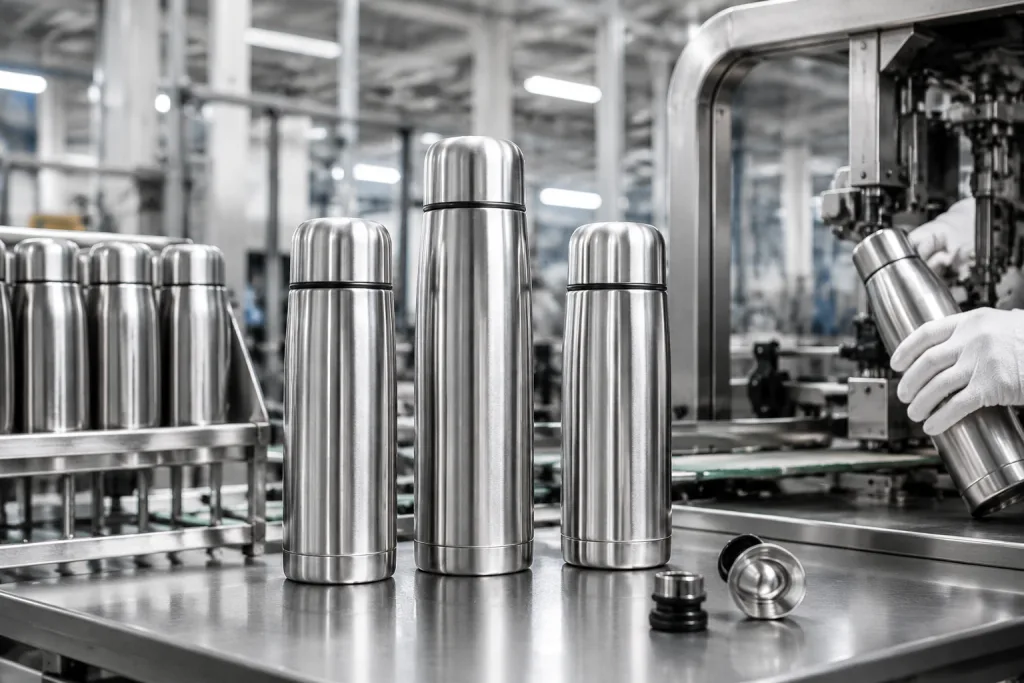
Key Takeaways
- Vacuum loss is the costliest failure; require 6-12 hour heat retention data and 100% vacuum inspection on every order over 3,000 pcs.
- For a standard 500 ml custom thermos, practical MOQ is usually 1,000-3,000 pcs per color, with FOB China pricing around USD 2.80-6.50 depending on steel grade and lid.
- Most lid leakage comes from tolerance stack-up, not just bad silicone; specify food-grade silicone hardness at 50-60 Shore A and 24-hour inverted leak tests.
- Logo and coating claims drop sharply when you define coating thickness, adhesion, and abrasion criteria before tooling, not after samples.
Some buyers start with a glass thermos supplier and switch to stainless after the first damaged shipment. We see it on the line every season. The reasons are plain: breakage claims, carton crush in transit, and logos on glass units scratching off faster than buyers expect. The mistake comes next. The material changes, but the spec sheet stays loose. Then the first bulk order lands with heat loss after 6 hours, leaking lids at a 45° tilt test, body dents from a 76 cm drop, or print that fails after one trade show because no one fixed the ink adhesion standard.
If you source custom thermos programs for distributor channels, retail chains, or corporate gifting, think like a quality engineer. Not just a merchandiser. In Zhejiang, we ship these programs every season, and the repeat failures are boringly consistent: lid thread mismatch, vacuum performance gaps, paint adhesion misses, and POs with no gasket hardness listed. QC pulled the sample last month on one order because the buyer flagged a loose stopper fit over 0.6 mm. A good thermos supplier should call this out early. This is the wrong question to ask: “What’s your best price?” Ask which numbers get locked before production, which tests run before mass goods, and where stainless orders usually go sideways.
Where stainless orders actually fail
Outdoor retailers and promo brands ask a glass thermos supplier for a stainless option when they need better drop performance. Fair ask. Stainless fixes breakage, then brings its own factory problems on the line. We see this every season. The usual mistake is pricing a thermos manufacturer quote like a plain commodity buy. It is not. A 500 ml bottle is not the same bottle once you change neck diameter, inner wall thickness by 0.05 mm, or lid structure.
Most field claims trace back to six points: vacuum loss, lid leakage, thread mismatch, dented body construction, coating adhesion, and compliance misses. QC pulled the sample more than once for thread start angle drift after capping torque went over spec. If your thermos supplier talks only about capacity, pantone color, and logo position, you are buying blind. The right conversation covers steel grade, wall thickness, neck forming, weld condition, vacuum test method, coating system, and inspection level. This is the wrong question to ask: “Why is your 500 ml price $0.28 higher?” Ask what is inside that $0.28.
At BottleForge Industrial in Hangzhou, Zhejiang, a typical stainless line can run 300,000 units per month, but volume means nothing if the spec sheet is loose. We run MOQ at 1,000 pcs for stock shapes and 3,000 pcs for new tooling or complex lids. Lead time is usually 25-35 days after sample approval. On the floor, the vacuum station and torque tester decide whether the shipment is stable, not the sales promise. If a thermos factory offers heavy customization in 7-10 days, ask what they skipped. We've seen this go sideways after a buyer approved a sample with no neck gauge check.
What buyers should lock early:
- Body material: 18/8 stainless, often called SUS304, for inner and outer where food contact matters
- Wall thickness: usually 0.35-0.50 mm outer, 0.30-0.45 mm inner for mainstream models
- Vacuum target: heat retention and cold retention with stated test conditions
- Leakage standard: inverted time, temperature, and pass rate
- Inspection plan: AQL 2.5 major, 4.0 minor is a common starting point
A reliable thermos vendor does not just send a clean pre-production sample. They tell you what fail rate they see at final inspection, what QC gauge they use, and which defects the buyer flagged on the last PO.
Vacuum loss starts at the weld
If you remember one failure mode, pick this one. A stainless thermos holds temperature because the double-wall cavity is evacuated and sealed tight. Once the vacuum starts leaking, the bottle still looks normal on day one. Then your customer refills coffee once, or takes it on a 6-hour hike with cold water, and the complaint lands. Returns start there. On our line, QC pulled the sample more than once where the shell looked clean but the retention test missed spec by 8 degrees C.
Most vacuum loss starts at the weld, dirt left in the cavity, or a weak pinch-off after evacuation. We have seen buyers get a low quote because the supplier cut inner-wall thickness by 0.1 mm or shortened the vacuum hold time by 12 seconds. The saving is usually USD 0.15-0.30 per unit. The trade-off is not small. Heat retention can drop by 15-30%. This is the wrong place to save cost.
What to specify
- Material: SUS304 for both walls on mainstream products; SUS316 only when chloride resistance is required
- Heat retention target: for a 500 ml bottle, 95 degrees C filled water should remain above 60 degrees C after 6 hours
- Cold retention target: below 10 degrees C after 6 hours under stated room conditions
- Test condition: ambient 20-25 degrees C, preheated vessel, capped for full duration
- Vacuum inspection: 100% line check using dedicated vacuum detection, not random tapping by hand
For custom thermos programs, ask if the supplier runs copper plating on the inner wall to cut radiant heat loss. Not every promotional thermos needs that layer. Premium outdoor retail usually does. Ask how the vacuum point is hidden on the base, and how the base cap is fixed: snap fit, glue, or ultrasonic weld. We have seen this go sideways. One buyer flagged base covers falling off after a 76 cm carton drop test, and the loose cap exposed a bad seal underneath.
If you source from China, ask for retention data from mass production, not only the development sample. In Zhejiang plants, the sample room often runs slower—say 12 days lead time for samples versus 18 days for pilot bulk—and senior operators handle the setup. Bulk is different. The line runs faster, newer staff step in, and small process drift shows up. We ship against production data, because a golden sample that passes once means little if the 3,000 pcs order misses the same target.
Leaks come from tolerances, not luck
Buyers often blame the silicone ring first. Sometimes they’re right. But on the line, most lid leaks come from tolerance stack-up across three parts: the neck thread, the lid thread, and gasket compression. A customizable thermos with several lid options looks good in a catalog, but interchangeable lids are where leak claims start if the thread pitch or seal height drifts by 0.2 mm.
On a distributor thermos or thermos distributor order, buyers often want 4 lid colors on the same body SKU. That sounds simple until those lids are molded in separate runs on different tools. If process control is loose, shrink rate changes and the fit moves. We’ve seen one lot pass a 10-minute inverted test, then the next lot drip in a backpack because QC pulled the sample from cavity 6 and found the lid sitting high.
Numbers that matter:
- Silicone hardness: 50-60 Shore A is a practical band for many leak-proof lids
- Compression set: require food-grade silicone suitable for repeated hot-fill use
- Thread engagement: define turns to lock and torque window for closing
- Leak test: 100% inverted test for 5-10 minutes on line, plus 24-hour random sample validation
- Drop test: filled bottle, typically 3-5 drops from 80-100 cm depending on retail requirement
Ask your thermos supplier whether the lid uses PP, Tritan, stainless, or a mixed assembly with a push-button mechanism. This is the right question. The wrong one is only asking for the cheapest lid. Simple screw lids have fewer failure points than flip lids, and the math doesn’t work on feature-heavy lids if the target price is tight. For promotional thermos projects, a plain screw cap usually ships with fewer claims.
If you need a customized thermos for outdoor use, specify leak testing after thermal cycling. Hot fill the bottle, close it, cool it, then invert it again. Short test. Necessary test. Some lids seal at room temperature but relax after expansion and contraction, especially on mixed-material assemblies. A serious thermos manufacturer should show test records with batch dates and torque readings, not guesses.
Dents and deformation are designed in
Buyers switch from glass for one reason: fewer breakage claims. Then the first container lands and dents show up because the steel spec was too light. We’ve seen this on the line. A clean-looking sample made with thin-wall stainless passes a showroom check, then pallet pressure, container vibration, and a 76 cm drop at the warehouse show the real weakness fast.
For a manufacturer thermos project, body strength comes from wall thickness, diameter, base geometry, and the neck transition radius. A wide 750 ml bottle with a big flat panel dents faster than a slimmer 500 ml body, even at the same nominal thickness, because the sidewall has less support. QC pulled this sample last year: same 0.4 mm claim on paper, different dent performance after vacuum. That is why stock molds from experienced thermos manufacturers usually hold up better than a new shape drawn for appearance first. Frankly, “Can you make it look slimmer?” is often the wrong question to ask.
Practical specification ranges:
- Outer wall: 0.40-0.50 mm for mainstream retail quality
- Inner wall: 0.30-0.40 mm depending on capacity and weight target
- Base design: reinforced or stepped base reduces deformation during vacuum process and transport
- Carton drop standard: 5-layer export carton, usually 1A or similar internal packing logic depending on unit weight
If you are buying thermos custom shapes, ask for a packed drop test, not just a unit drop test. We ship both tests for some accounts because the freight chain is where bad packaging gets exposed. A bottle might pass end-user handling and still arrive dented if the pulp tray crushes by 8 mm or the divider board is too soft. One buyer in Canada flagged this after relabeling through a 3PL: bottle was fine out of the factory, outer carton failed on the second warehouse move. For North America, this matters more when units are relabeled and redistributed through 3PL warehouses. For Europe, tighter carton dimensions save freight, but we’ve seen this go sideways when pallet stacking height is pushed without a compression check.
A factory thermos quote that is USD 0.20 cheaper often means thinner steel. The math doesn’t work any other way. Ask for actual micrometer readings from cut samples, not “about 0.4 mm” on a sales sheet. We usually measure three points on the body with a digital micrometer after cutting, and if the PO says 0.40 mm, 0.36 mm is already a red flag. If your channel is premium outdoor retail, that vagueness costs more than it saves.
Coating and logos fail after shipping
Brand owners buy performance. End users judge the finish in 3 seconds. On custom thermos orders, the fastest dispute is cosmetic: color mismatch against the approved chip, scratches from carton rub, fish-eyes in powder coat, weak laser contrast, or silkscreen logos that fade after 20 rubs. A customized thermos for a promo campaign usually gets rougher handling than retail stock because we ship it through events, offices, and courier hubs, not one clean shelf display.
Powder coating lasts better than standard spray paint only if pretreatment is done right on the line. Oil residue, weak curing, or bad masking at the thread start can wreck both looks and fit; we check masking width in mm before batch run. For thermos customized projects with gradients or metallic finishes, scrap rate is higher, sometimes 8% instead of 3% on a single-color matte cup. If a supplier promises a complex finish with the same defect level as plain black matte, this is the wrong question to ask. Ask for the real yield and rework plan.
What to define before approval
- Color tolerance: approved against a master sample under specified light source
- Adhesion: cross-hatch adhesion test with clear pass standard
- Abrasion: rub test cycles for logo and body finish
- Dishwasher claim: only make it if tested; many powder-coated units are hand-wash recommended
- Logo method: laser engraving, silkscreen, heat transfer, or pad print depending on use case
For thermos promotional programs, screen print may be fine at USD 0.05-0.15 per color position, but for long-life outdoor retail, engraving or high-grade transfer usually holds up better. The buyer flagged this more than once after a trade-show shipment because logo wear showed up before the bottle failed. If your distributors thermos network sells to corporate clients, expect late artwork edits and PO typos on logo size or Pantone callout. Build that into timing. New screens, jigs, and approval photos add 2-4 days, and if QC pulled the sample for mismatch, the line stops.
A good glass thermos supplier moving into stainless needs to be straight about decoration capacity. Some factories make the vessel in-house but send coating to a subcontractor 18 km away. That setup is not the problem by itself. No traceability is the problem. Ask where coating is done, who signs off QC, what AQL applies to visual defects, and whether failed decorated stock can be stripped or reworked without hurting vacuum integrity. We have seen this go sideways when re-bake temperature was too high and the cap fit changed by 0.3 mm.
Compliance gaps show up too late
Compliance is where 7 out of 10 thermos suppliers still get exposed the moment you ask for the exact test-report scope. We hear “food safe” all the time, then QC pulled the sample file and the report only covered the 304 stainless inner wall, not the straw, lid gasket, or paint ring. Europe and North America usually need more than that. Stainless drinkware should be checked against the right food-contact requirements, and the accessory materials often cause the claim to fail, not the steel body.
If you buy from China, ask for REACH information for Europe, LFGB if that matches your market positioning, and California Proposition 65 attention points for the US channel. For children’s SKUs, ASTM and CPSIA matter more once the design includes straws, bite valves, or easy-open caps for lower age grading. We’ve seen this go sideways. A promotional buyer once told us, “It’s only a gift item,” but regulators do not care what was printed on the box, and neither does Amazon compliance.
- Factory audit: BSCI or equivalent social compliance may be required by larger retail groups
- Quality system: ISO 9001 is common and useful, though not a guarantee of good product by itself
- Incoming checks: steel grade verification, plastic resin identification, silicone approval
- Final inspection: AQL sampling with defined critical, major, and minor defects
For a thermos manufacturer relationship, also ask how mixed-material lids are controlled on the line. This is the right question. A stainless body may pass migration testing, while the UV paint on a lid insert or the glue under a decorative badge becomes the actual risk point. We had one 8,000-piece order where the buyer flagged a late badge change after mold polishing, and that single cosmetic upgrade forced a new material declaration before shipment.
If your order is for Amazon or retail fulfillment, lock barcode and packaging requirements at the same time as compliance. FNSKU labels, suffocation warnings, carton markings, and country-of-origin declarations look small on paper. They are not small at pack-out. We ship cases where a 3 mm barcode height difference or one PO typo in the carton mark stops warehouse receiving, and the relabel bill comes after production is finished. A disciplined thermos factory in Zhejiang should fold these points into the pack-out SOP and carton drop test plan before mass production starts.
How to write a spec suppliers can execute
A smooth order starts with a clean spec. A bad one usually starts with a vague RFQ, not the factory. If you are briefing a glass thermos supplier that is shifting into stainless, or a Zhejiang team already running vacuum bottles, write the document so nobody has to guess. On our line, if one detail is blank, purchasing will often default to the lowest acceptable option. That is where projects go sideways.
For a custom thermos RFQ, keep the core sheet to one page and put test standards and artwork rules in separate attachments. You do not need full engineering drawings for every repeat order. You do need measurable points: 500 ml brimful or usable capacity, 0.5 mm wall thickness or 0.4 mm, logo position 35 mm from the base, carton gross weight under 12 kg. QC pulled the sample on one job because the PO said “mat painting” instead of “matte painting,” and three people read it three different ways. This is the wrong question to ask: not “is the spec detailed?” Ask “can production and QC check it with a caliper and a scale?”
Your minimum RFQ checklist:
- Capacity, target net weight, and dimensional limits
- Steel grade for inner and outer walls
- Wall thickness range with tolerance if critical
- Lid structure and material list
- Leak standard and retention standard
- Coating finish, pantone reference, and logo size/location
- Packaging style, barcode, insert, and carton limit
- AQL plan, pre-shipment inspection, and claim window
For mainstream bulk thermos orders, expect FOB China pricing around USD 2.80-4.20 for simple 500 ml double-wall bottles, and USD 4.80-6.50 for more complex lids or premium coatings, assuming 3,000-10,000 pcs. New mold costs for lids can range from USD 2,000 to over USD 8,000 depending on mechanism. Sample lead time is often 7-12 days for stock models and 15-25 days for customized thermos tooling. We ship these ranges every month, but the math does not work if your target price assumes a custom lid, rubber paint, and a 1,000 pcs MOQ.
If a thermos supplier pushes back on this level of detail, take that seriously. A solid thermos partner usually wants a tighter spec because it protects both sides at mass production and at claim stage. We have seen buyers flag a 2 mm logo shift, a different spout PP grade, or a carton drop issue after shipment; all three started from loose paperwork. You are not being difficult. You are making sure the bottle that ships from China matches the approved sample, not the cheaper cousin carrying your logo.
Send your thermos spec before you place it
We review your stainless program for leak, vacuum, coating, and compliance risks, then quote practical MOQ, FOB pricing, and lead time from Zhejiang, China.
Frequently asked questions
Can a glass thermos supplier reliably produce stainless thermos orders?
Yes, but only if they control stainless production or manage a proven partner factory closely. Ask whether they own the vacuum line, polishing, and final assembly, or if they are trading the order. For a reliable 500 ml custom thermos program, you should see clear data on heat retention, leak testing, and AQL results from recent mass production. Request material declarations for SUS304, silicone, and plastics, plus photos or video of vacuum testing and coating lines. If MOQ is 1,000 pcs but the supplier cannot explain wall thickness or retention conditions, they are probably better at selling than producing. In China, a capable factory thermos partner should give sample lead time around 7-12 days and bulk lead time around 25-35 days with real process checkpoints.
What MOQ should I expect for bulk thermos with custom logo or color?
For stock stainless shapes, MOQ is commonly 1,000 pcs per model and around 500-1,000 pcs per color if the factory is flexible. For a fully customized thermos with a new lid or new body tooling, MOQ usually moves to 3,000-5,000 pcs, sometimes higher. Silkscreen logo programs are easier at lower volume than laser plus custom powder color plus gift box. If you need distributor thermos inventory across several logo versions, ask whether the factory can hold undecorated stock and apply logos later. That can reduce risk. In Zhejiang, we often advise buyers to separate body color from artwork so one 3,000-piece body run can support multiple end clients without forcing every logo version into a full MOQ.
What tests matter most for outdoor retail stainless thermos?
Start with the three that drive most claims: heat retention, leakage, and coating durability. For a 500 ml thermos, set a hot retention target such as above 60 degrees C after 6 hours from a 95 degrees C fill under controlled ambient conditions. Require 100% short leak testing on line and random 24-hour inverted testing. For finish, ask for cross-hatch adhesion and rub or abrasion testing with a defined pass standard. Then add drop testing, packed carton drop testing, and dishwasher testing only if you plan to claim dishwasher safe. If your thermos supplier cannot state the exact method, sample size, and pass criteria, the test is not really part of their quality system.
How do I reduce complaint rates on promotional thermos orders?
Keep the design simple and the specification strict. The lowest complaint rates usually come from plain screw-lid bottles with matte powder coating, laser logo, and standard export packaging. Flip lids, glossy finishes, metallic inks, and multi-part decorative assemblies look good in sales decks but create more return points. For promotional thermos orders below 5,000 pcs, pick a proven stock mold instead of chasing a new shape. Lock silicone hardness, leak-test method, and artwork approval before deposit. Also define carton markings, barcode placement, and spare parts policy. A practical target for a mature thermos manufacturer is under 1.0% major defect rate at final inspection with AQL 2.5, but only when the spec is realistic and the decoration is not overcomplicated.
What price range is normal for a customized stainless thermos from China?
For a standard 500 ml double-wall stainless bottle from China, simple logo-only projects often land around USD 2.80-4.20 FOB. If you add premium powder coating, copper-plated insulation, a more complex lid, custom gift box, or lower-volume color splits, pricing often moves to USD 4.80-6.50 FOB. New mold charges for a lid can start around USD 2,000 and rise above USD 8,000 for push-button mechanisms. Freight, duty, and testing are separate. Be careful with quotes far below market. A very cheap thermos supplier may be cutting steel thickness, skipping 100% leak checks, or using lower-grade accessories. That usually becomes visible only after the goods reach your warehouse.