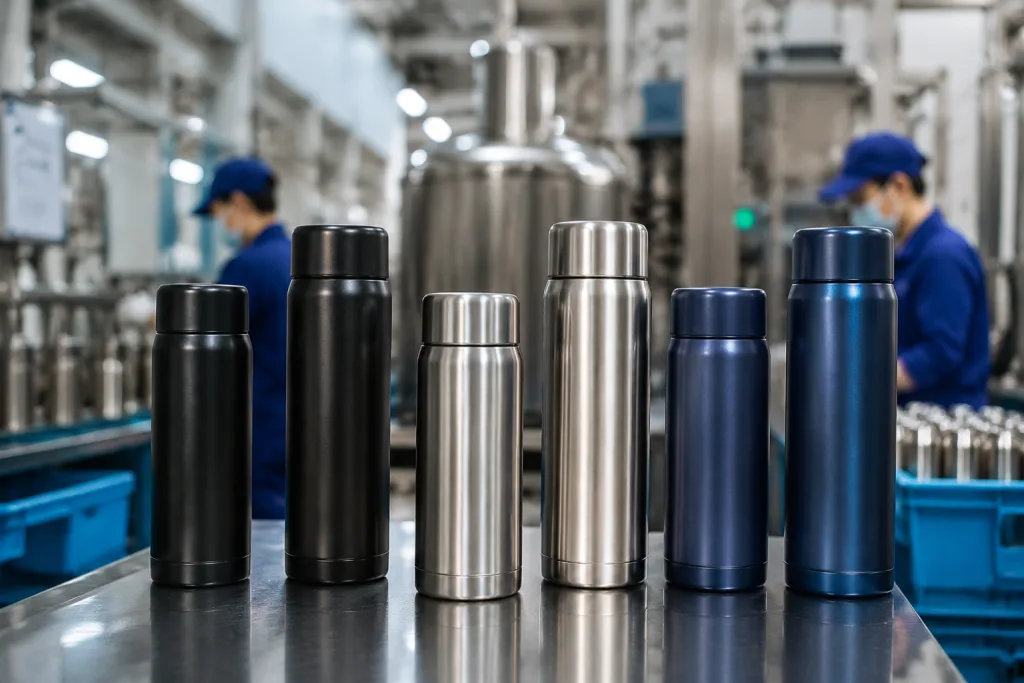
Key Takeaways
- Standard glass-lined thermos usually starts around USD 3.20-5.80 FOB China at 1,000-3,000 units, while full stainless vacuum models often run USD 4.80-8.50
- Typical MOQ is 1,000 pcs for stock-color bulk thermos, 3,000 pcs for custom color, and 5,000 pcs when you need new lid tooling or exclusive molds
- Mass production lead time is commonly 25-40 days after sample approval and 30% deposit, plus 3-7 days for logo setup and pre-production sampling
- Decoration can shift cost by USD 0.08-0.90 per unit depending on silkscreen, laser engraving, wrap printing, or individual name personalization
If you sell outdoor gear or run promo programs, you have heard this one: why is one thermos quoted at USD 3.80 and another at USD 8.90 when the bottle shape looks almost identical on the screen? In glass thermos flask wholesale, the price gap usually comes from buyers mixing up two builds: a stainless outer shell with a glass liner, and a full stainless vacuum bottle. They are different products. They do not pass the same 1.0 m drop test, and they do not run through the line at the same speed.
At BottleForge Industrial in Zhejiang, China, we quote both styles every week for outdoor retailers and promotional brands. Our factory output is about 450,000 units per month, with MOQ starting at 1,000 pieces for standard models and 3,000 to 5,000 for deeper custom work. We run these quotes side by side, and the buyer often flags the wrong question first: unit price before structure. That is backwards. If you want a custom thermos order to land on time, cost and lead time need to be broken down before artwork starts, not after a PO typo or cap-size mismatch slows sampling by 3 days.
What you are really buying
Buyers searching glass thermos flask wholesale usually mean 1 of 2 products. First: the classic build with a stainless steel outer shell, glass vacuum liner, plastic stopper, and cup cap. Second: a stainless vacuum bottle with a similar shape on the shelf. On the line, these are not the same item. The tooling, drop risk, and complaint rate all change.
A glass-lined unit is usually cheaper at entry level, holds heat well, and fits office gifts, tea sets, and light outdoor use. The weak point is the liner. We have seen a 0.8 mm neck impact chip the inner glass during rough courier handling, even with foam packing. A stainless vacuum bottle costs more, but for outdoor retail it is the safer call. Hiking, camping, fishing, jobsite sales—this is where glass claims start to hurt.
This is why buyers asking for a customized thermos often begin with a glass version, then switch to a stainless factory thermos after they review returns or breakage claims. One buyer flagged the math after seeing USD 0.60 FOB savings disappear in after-sales cost. In Europe and North America, return rates matter more than that small unit saving. We ship both, but we have seen this go sideways.
- Glass-lined thermos: lower entry cost, solid heat retention, fragile in transit and end use, common in household and gift channels.
- Stainless vacuum thermos: better impact resistance, more room for custom lid sets, colors, and logo methods, a better fit for outdoor retail and distributor programs.
- Hybrid sourcing reality: some promotional brands quote both versions on the same PO and let the customer choose by budget. We have even seen a style code typo mix the two.
From Zhejiang, China, we usually tell buyers to split the project into "gift channel" and "outdoor channel" instead of forcing one bottle to cover both. This is the right way to quote it. QC pulled samples on both structures for one 3,000 pcs program, and the risk profile was obvious. The photos may match, but the product does not.
Cost drivers that move your quote
The fastest way to control your quote is to know which part moves the price. Capacity matters, yes. Structure, finish, decoration, and packaging move it more. A 500 ml supplier thermos in stock silver is a simple run on the line. The same size with custom Pantone matte powder coat, copper plating for 12- to 24-hour thermal performance, laser logo, and a gift tube usually adds USD 1.20 to 2.00 per unit. We quote this off the BOM, not guesswork, and the buyer often flags color first while the packaging cost ends up bigger.
Main cost components
- Body material and wall: 18/8 stainless steel is standard for a quality manufacturer thermos. Common outer wall thickness is 0.4 mm to 0.5 mm; inner wall 0.3 mm to 0.4 mm. A digital micrometer checks this on incoming material. Thicker steel gives better dent resistance, though the math does not always work if your target is low freight and a sharp retail price.
- Glass liner grade: better glass liner consistency cuts breakage in filling and packing, but scrap on glass is higher than stainless. Last month QC pulled the sample and found 6 cracked liners in a 200-piece prepack lot after a drop check.
- Lid construction: a simple screw cap with PP stopper costs less than a leakproof multi-part lid with silicone rings and a push-button mechanism. More parts mean more assembly time, more leak-test points, and more buyer complaints if one ring is out by 0.3 mm.
- Finish: spray paint is often USD 0.12-0.25; powder coating USD 0.25-0.55; special metallic or rubber finish can go higher. Powder coat usually needs a cleaner surface and tighter cure control in the oven, or the buyer will flag orange peel on the sample.
- Decoration: one-color silkscreen may add USD 0.08-0.18; laser engraving USD 0.12-0.30; full-wrap heat transfer or digital print USD 0.35-0.90. This part gets argued too much. The wrong question to ask is only logo price; print position, registration tolerance, and artwork revision count also hit cost.
- Packaging: plain white box can stay under USD 0.20, while a printed mailer or gift tube may add USD 0.45-1.20. We have seen this go sideways over small details: 5-ply mailer instead of 3-ply, EVA insert added late, or one PO typo that changed 24 pcs/ctn to 12 pcs/ctn and doubled carton count.
For promotional thermos orders, the packaging line often adds more cost than the logo itself. Buyers underestimate this constantly.
If you need compliance for the EU or North America, add testing and audit cost into your sourcing plan from day one. REACH, LFGB, FDA-contact compliance, and ASTM-related checks are not optional when the program is large. AQL inspection, usually 2.5 major / 4.0 minor, is also normal for a thermos vendor exporting from China. We ship plenty of orders where the lab fee is small next to the order value, but skipping it can stop the whole shipment at final inspection.
MOQ tiers and realistic FOB prices
MOQ is where first-time buyers burn 2 or 3 weeks. A factory says yes to 300 pcs, then hides the damage inside setup scrap, half-empty master cartons, and hand packing on the line. The result is simple: below 3,000 pcs, your unit price often jumps fast. We see this every month, and this is the wrong question to ask—don’t ask whether the factory can make 300 pcs; ask what 300 pcs does to your FOB.
For a standard 350-500 ml glass-lined item, a practical thermos bulk MOQ is 1,000 pcs per model. That level usually fits carton packing and inner allocation without odd rework. For a stainless vacuum customizable thermos, 1,000 pcs still works if the body, lid, and color stay on existing tooling; we run this type with stock neck dimensions and standard silicone rings. Once you ask for a new lid part, a non-standard body curve, or exclusive mold rights, MOQ usually moves to 5,000 pcs or more. If the lid needs a new injection mold, the math doesn’t work at 1,000 pcs.
Typical FOB China reference ranges
- Glass-lined flask, stock color, 500 ml, white box: 1,000 pcs at USD 4.60-5.80; 3,000 pcs at USD 3.80-4.90; 10,000 pcs at USD 3.20-4.20.
- Stainless vacuum thermos, 500 ml, stock powder coat: 1,000 pcs at USD 5.60-7.20; 3,000 pcs at USD 4.90-6.10; 10,000 pcs at USD 4.30-5.40.
- Promotional grade bottle with simple silkscreen: add roughly USD 0.10-0.20 per unit.
- Retail gift pack with color box and insert: add roughly USD 0.50-1.10 per unit.
For distributor thermos programs, buyers often split one PO into 2 or 3 colorways and keep the same body and lid. That usually holds the price if each color lands at 500 to 1,000 pcs and the powder line is scheduled together. Split it into 5 colors at 200 pcs each, and the buyer flagged the quote for good reason: paint setup, label checks, and carton sorting start eating margin.
A serious thermos manufacturer in Zhejiang or elsewhere in China should tell you in one call whether your MOQ fits your customization list. If not, ask for a phased plan: standard bottle first, exclusive lid in the next run. We’ve seen this go sideways when a customer pushed both at once, then changed the logo position by 8 mm after sample approval. The phased route usually saves money and 20 to 30 days.
Where lead time actually goes
Lead time is almost never just "production days." On our side, the clock starts with artwork, pre-production sample, steel and lid booking, inline inspection, assembly, packing, and vessel booking. If a supplier quotes 15 days for a fully thermos customized order, read that as assembly time on the line under clean conditions. We've seen buyers treat that number as door-to-port timing, and this is where projects slip.
For most bulk thermos orders, the working timeline looks like this:
- Quotation and specification lock: 2-5 days.
- Artwork check and logo file adjustment: 1-3 days.
- Pre-production sample: 5-10 days for existing models; 15-25 days if new tooling is involved.
- Mass production: 25-40 days after sample approval and deposit.
- Inspection and export document prep: 2-5 days.
- Port delivery in Zhejiang or nearby port areas: 1-3 days.
Peak season changes the schedule fast. Orders placed from August to November for holiday promotions or Q1 retail launches should be planned against the longer number, not the shortest one on the quote. The bottleneck is usually paint or printing, not final assembly; on a busy week, the coating line is backed up 12 days while body welding is only 3 days. QC pulled the sample on one September run and the color was right, but the silk screen queue still pushed shipment out by 6 days.
If your item includes custom retail packaging, Amazon FNSKU labeling, barcode stickers, or mixed carton pack-outs for multiple SKUs, add another 3 to 7 days. The packing team has to sort by warehouse, scan labels, and check carton marks one by one, especially on 4-SKU mixed loads. We ship these every season, and the buyer usually flags outer-carton text or pallet labels at the last minute. For thermos distributors and promotional buyers sending stock to two or three warehouses, this extra time is normal.
A realistic planning rule: if the project matters, book against the 35- to 45-day scenario, not the 25-day best case.
At BottleForge Industrial, we normally quote 7-10 days for approved sample dispatch and 30-35 days for repeat orders without structural changes. New custom programs run longer because steel tube, coating slots, printing plates, and gift box suppliers all sit on one shared calendar. A 0.5 mm lid fit issue or a typo on a PO can cost 2 days by itself. The wrong question is "what is your fastest lead time?" Ask what is already booked, what process is outsourced, and where the line is likely to stall.
Custom options worth paying for
Not every custom feature pays back. In outdoor retail, buyers usually get better sell-through from durability upgrades than from heavy decoration. We’ve seen the buyer flagged a fancy printed finish, then come back 60 days later with slip complaints from store staff. Promotional brands work differently. Visual impact often matters more than adding 4 hours of heat retention.
For a thermos custom project, put the budget where your sales channel will notice it on shelf or in use:
- Outdoor retail: leakproof lid with a 30-minute inverted test, anti-slip powder coat, 18/8 stainless, copper-coated vacuum insulation, wider mouth for brush cleaning, reinforced base pad. This is what survives the line and the return desk.
- Promotional thermos: Pantone body color, a clean logo area with no seam interference, individual gift box, name personalization, low-MOQ decoration options. We run a lot of 500-piece logo programs here.
- Distributor programs: stable replenishment SKU, consistent carton dimensions, barcode labeling, spare parts continuity. A 5 mm carton size change sounds small until the warehouse racking says no.
A customizable thermos also has to run cleanly in production. A deep embossed logo on a curved body may look strong in a rendering, but it can push tooling cost to USD 2,000-5,000 and add 15-20 days to the schedule. The math often doesn’t work. We’ve seen this go sideways after mold trial when the draft angle was too tight and QC pulled the sample for body deformation. For most buyers, laser engraving or silkscreen gets 90% of the visual effect at a much lower cost.
If you are comparing glass and stainless for a branded campaign, ask your thermos supplier two direct questions: what is the historical breakage rate, and what claim rate did similar customers see? Ask for shipment data, not sales talk. Last year one buyer asked only about unit price, then the PO even had a color-code typo and nobody checked the drop-risk assumptions. A fragile gift item can work at the right price. A field-use bottle for an outdoor chain usually does not.
Good manufacturers thermos programs are boring where they should be: repeatable lid fit, stable coating, packaging that survives export. That is the base job. Fancy extras come after that. In Zhejiang, China, the export factories that stay in business are usually the ones that say no to risky cosmetic ideas once production yield starts falling below 92%.
How to compare suppliers without guesswork
When you compare thermos suppliers, do not start with unit price alone. Start with the quote structure. A USD 0.70 gap means nothing if one manufacturer thermos offer skips steel grade, wall thickness, testing scope, or packaging detail. Then you are pricing two different bottles. We check this first on the line spec sheet, and wall thickness gaps of 0.1 mm already change weight and heat retention.
Ask every supplier for the same checklist
- Material spec: 18/8 or 18/10 stainless, PP or Tritan parts, silicone grade.
- Capacity and tolerance: for example 500 ml plus or minus 3%.
- Thermal result: 6, 12, or 24 hours, and test method.
- Net weight and gross weight.
- MOQ by color and by logo version.
- Packaging spec: units per carton, carton size, gross carton weight.
- Testing support: REACH, LFGB, FDA, CA Prop 65 if relevant.
- Inspection standard: AQL level and who pays for rework if it fails.
For a thermos factory, response quality tells you a lot. If they answer technical questions clearly within 24-48 hours, with the same numbers showing on the drawing, quote, and carton spec, they usually know their process. If they keep changing numbers, expect claims later. QC pulled one sample last month where the PO said 500 ml but the draft sticker showed 530 ml. Small typo, big problem.
Check factory capability beyond the sales sheet. Ask if they run in-house powder coating, vacuum testing, logo printing, and final inspection. This is the wrong question to ask: “Are you a factory?” Ask which steps stay inside the plant. If every step is outsourced, lead time control gets weaker and defect tracing gets messy. We have seen buyers save USD 0.15 upfront, then lose 12 days vs 18 days promised because the printing subcontractor missed the slot and the buyer flagged the Pantone mismatch.
For larger suppliers thermos programs, request production photos, BSCI or audit records if needed, and a sample approval sheet with seal points. Ask for photos of the vacuum test station, not just the showroom. We ship more smoothly when the supplier marks approval points on lid fit, logo position, and carton drop test result. Serious sourcing works better when the supplier treats your order like an engineering job, not just a trading quote.
Get a clear thermos quote before you commit
Send your target quantity, capacity, logo method, and packaging spec. We will reply with realistic MOQ, FOB pricing, and lead time options from our Zhejiang factory.
Frequently asked questions
What MOQ should I expect for glass thermos flask wholesale with my logo?
For existing models, 1,000 pcs is a realistic starting MOQ from a China factory if you want a simple logo and standard packaging. If you need a custom body color, expect 1,000 pcs per color or about 3,000 pcs total to keep pricing efficient. If the project includes a new lid, base, or exclusive mold, MOQ usually moves to 5,000 pcs and tooling can add USD 2,000 to 6,000 depending on complexity. For promotional thermos projects, some suppliers accept 500 pcs, but the FOB price rises fast because setup and carton costs are spread over fewer units. If you are new, start with an existing bottle and customize the finish, logo, and box first.
How long does a customized thermos order usually take from approval to shipment?
For an existing model, count 5 to 10 days for a pre-production sample and 25 to 40 days for mass production after sample approval and deposit. Add 2 to 5 days for inspection and export document preparation. If you are buying from Zhejiang, China and shipping FOB Ningbo or Shanghai, factory-to-port movement is usually another 1 to 3 days. New tooling changes the timeline more than buyers expect: sample development can take 15 to 25 days before production even starts. If your order includes custom gift boxes, Amazon labels, or mixed SKU carton packing, add 3 to 7 extra days. Repeat orders without structural changes are often 30 to 35 days total in production.
Is a glass-lined thermos or a stainless vacuum thermos better for outdoor retail?
For outdoor retail, stainless vacuum usually wins. A glass-lined flask can hold temperature well and may cost USD 0.80 to 1.50 less at mid-level volumes, but it is more vulnerable to breakage during transport and customer use. That makes it a weaker fit for hiking, camping, jobsite, and travel channels. Stainless vacuum models cost more upfront, often USD 4.80 to 8.50 FOB at common order sizes, but they handle impact better and usually produce lower claims. If your channel is gift, hospitality, or office use, glass-lined units can still work well. Ask your thermos supplier for drop-test feedback, complaint history, and packaging recommendations before deciding.
Which decoration method is best for promotional thermos orders?
For most promotional thermos orders, one-color silkscreen is still the most cost-efficient choice. It usually adds about USD 0.08 to 0.18 per unit and works well when the logo area is clean and high contrast. Laser engraving costs a bit more, often USD 0.12 to 0.30, but it gives a more premium look on stainless surfaces and avoids ink wear. Full-wrap transfer or digital print can reach USD 0.35 to 0.90 per unit, so it only makes sense when the artwork drives the sale. If you need individual names, plan for extra handling time and a decoration surcharge. For high-volume bulk thermos, keep the print process simple unless retail packaging justifies the added spend.
How should I compare quotes from thermos manufacturers and suppliers?
Use a line-by-line comparison sheet. Ask every thermos manufacturer to quote the same capacity, steel grade, wall thickness, finish, lid structure, logo method, packaging, MOQ, and inspection standard. A quote without these details is not reliable, even if it looks cheaper. Check whether the price is EXW, FOB, or delivered, and whether testing, sample cost, barcode labels, and spare parts are included. For quality control, confirm AQL levels such as 2.5 major and 4.0 minor, plus leak testing and vacuum retention checks. Also look at lead time honesty. A supplier who says 28 to 35 days with clear assumptions is often safer than one promising 18 days with no process detail.