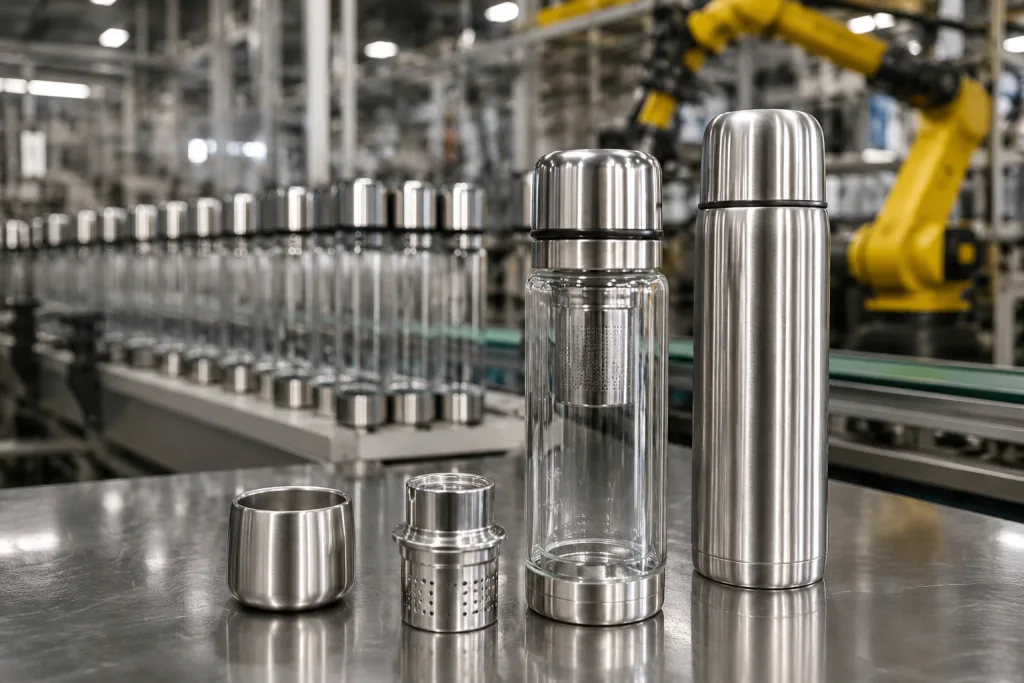
Key Takeaways
- For glass thermos flask custom orders, ask for a drop and leak test plan before mass production; one cracked liner in 100 can erase margin fast.
- A realistic MOQ for custom color and logo is often 1,000-3,000 pcs, with 35-55 day lead time from Zhejiang, China depending on tooling and decoration.
- Heat retention claims should be tied to a written test method, such as 95°C fill water measured after 6, 12, and 24 hours at 20°C ambient.
- Use AQL 2.5 for major defects and AQL 4.0 for minor defects, plus 100% vacuum and leak inspection on every unit.
You may start with a simple brief: a glass thermos flask custom program for retail or a promotional campaign. Then samples land on the table and the trouble starts. The glass liner cracks in transit after a 1.2 m drop test. Lids leak after a week on the line. Logos print 2 mm off-center, or heat retention misses your claim by 4 hours. On paper, a thermos looks easy. In production, it is not.
At BottleForge Industrial in Zhejiang, China, we build both stainless and glass-lined vacuum drinkware, and we see the same mistake on about 7 out of 10 new projects: buyers look at shape and price first, then find out the expensive part is failure control. QC pulled the sample on one order because the PO artwork file had the logo shifted left by 3 mm, and the buyer only caught it after approval. If you buy bulk thermos or a customized thermos for outdoor retail, you need to spec failure points before tooling, not after 5,000 units are packed. This is the wrong question to ask: “What is your best price?” Ask what fails first.
The liner fails before the sale
The first thing that fails in a glass thermos flask custom project is usually not the logo or paint. It is the liner. A glass-lined vacuum flask looks premium and keeps taste neutral, but the weak point is plain: the inner liner cracks during assembly, on a 600 km truck run inside China, after ocean shipment, at Amazon prep, or on the first retail drop. We have seen buyers spend 2 weeks on Pantone approval and leave the liner spec at “standard glass.” That is the wrong question to ask.
Ask your thermos manufacturer for four points in writing. First, define the liner material and wall consistency, not just “glass liner.” Second, define the shock-protection structure between liner and outer body: silicone ring with 2 mm compression, foam seat, or PP support parts. Third, define the packed drop test standard. Fourth, define the pass rate you expect in pilot production. QC pulled the sample on one order last winter because the PP seat had flash burrs, and that small defect was enough to chip the liner mouth during assembly.
- Recommended packed drop test: 1 corner, 3 edges, 6 faces from 76 cm for mail-order packs; 60 cm may be enough for retail master cartons.
- Recommended sample size: at least 10 packed units per SKU.
- Critical defect: any broken liner, vacuum loss, or chipped mouth.
If your supplier thermos quote is much lower than others, check where they cut cost. In 3 out of 5 low-price comparisons we see, the saving comes from thinner outer shell steel, less cushioning around the liner, or a weak gift box that collapses under stack load. The line may pass factory inspection and still fail after container unloading. That still counts as a failed project. In our Zhejiang plant, we treat liner seating parts as functional components, not filler plastic. Saving USD 0.08 per unit sounds good on paper. The math doesn't work once breakage claims start.
For outdoor retailers, the risk goes up fast because the product gets handled harder and stacked rougher. If you are a thermos distributor, or one of the thermos distributors serving hardware, camping, or winter channels, ask for transit simulation at pilot stage. We ship enough of these to know where it goes sideways. One buyer flagged a 3% damage rate after store replenishment, and the root cause was a loose liner seat, not the carton print or the master mark typo on the PO. It is cheaper to reject a pilot than explain broken stock to your customer.
Vacuum loss hides until claims arrive
The second failure mode is vacuum loss. This one gets expensive fast. The flask looks fine at incoming inspection, passes carton check, and still fails in actual use. We’ve seen a custom thermos hold heat for 4 to 6 hours instead of 12 to 24 because the vacuum was weak. Your customer won’t catch that at receiving. They find it at 7 a.m. on a cold jobsite, after the claims start.
You need a written retention standard, not sales wording like “long-lasting insulation.” For a glass thermos flask custom order, write the test method on the PO in plain terms: fill with 95°C water, close for 12 hours at 20°C ambient, then record final temperature. For cold retention, use 4°C water or an ice-water mix under the same ambient condition. We use a calibrated probe and log the reading by SKU. If your supplier quotes one method and your QC team checks another, the math doesn’t work.
What to put on the PO
- Initial fill temperature: 95±1°C
- Ambient test room: 20±2°C
- Fill volume: 95% of nominal capacity
- Measurement points: 6h, 12h, 24h
- Minimum acceptable result for each size
Also ask how the factory verifies vacuum. A serious thermos factory runs 100% vacuum inspection on the line, usually by temperature-change method, vacuum detector, or hold-time screening depending on construction. QC pulled the sample is not enough if the rest of the lot never saw screening. We’ve seen one 5,000-piece promo batch come back weeks after an event because buyers only tested appearance at receipt and missed insulation drift.
You are not buying a bottle shape. You are buying a thermal performance window, and that has to be measurable.
At BottleForge Industrial, our monthly output across vacuum drinkware is 300,000 units, and the lesson from the floor is simple: lock the performance claim early. Fewer disputes later. On one PO, the buyer flagged “keep hot 24h” but gave no test condition, and the line had to stop until both sides agreed on ambient and fill volume. This applies whether you need a customizable thermos for gifting, a manufacturer thermos line for retail, or a distributor thermos program with private label packaging from China.
Leak paths start at the lid
Most buyers look at the glass body and think that is where the engineering sits. On the line, the lid causes more complaints. In a glass thermos flask custom project, leaks usually start at the thread match, uneven silicone gasket compression, or a loose stopper assembly. If you add a cup-cap structure, you add one more sealing face, and QC pulled the sample on one run last year because the cap lip was off by 0.3 mm.
Do not sign off on a lid because it looks clean in photos. That is the wrong question to ask. You need a defined leak protocol before mass production. At minimum, we run static inversion testing and hot-water leak testing. For travel use, ask for side-lay testing. We have seen lids pass upright inversion for 30 minutes, then leak flat on the bench because the vent hole or pour valve could not hold pressure shift after filling.
- Basic leak test: fill with 85-95°C water, invert for 5 minutes, no visible leakage.
- Extended test: side-lay for 2 hours, no seepage at thread, vent, or stopper.
- Torque control: define closing torque range so sealing is repeatable.
If you are buying thermos customized products for North America, check how people actually use them. Some consumers over-tighten. Some barely close the lid. A seal that works only in a narrow torque window will come back as a complaint. We usually ask for a closing torque range in N·m and confirm it with a torque meter, not by hand feel. Your thermos vendor should show gasket hardness, material grade, and dimensional tolerance. Food-contact silicone should align with applicable REACH and LFGB or FDA-type requirements depending on your market.
For promotional brands, the common trap is picking a push-button lid because the client likes the look, then watching defect rates climb from 0.8% to 3.5%. The math doesn't work. Simple threaded stopper systems usually ship cleaner. One buyer flagged this after 20,000 pcs because the spring in the button lid shifted during drop test and caused seepage. If you need a thermos promotional item at scale, simple engineering is usually more profitable than clever engineering. That holds whether you buy from manufacturers thermos sources in Zhejiang or from suppliers thermos traders consolidating product from different China workshops.
Decoration fails after a few washes
Buyers ask for a custom thermos. What they usually need is decoration that still looks clean after 30 washes and normal daily handling. On a glass thermos flask custom order, we see five repeat failures on the line: logo offset beyond the approved position, color drift from the Pantone target, weak adhesion on painted steel shells, print scuffing from nested packing, and laser marks going light on curved sections where the fixture does not hold the body tight enough.
Pick the decoration for the actual selling channel, not for the sample shelf. That is the wrong question to ask. For a promo thermos with a 3-month campaign life, silk screen is fine if the artwork is simple and the budget is tight; we run this on single-color logos every week. For outdoor retail, powder coating plus laser engraving or baked transfer holds up better in field use. If your customized thermos has a glossy painted shell, ask for adhesion and abrasion data, not just a nice pre-production sample. QC pulled the sample once on a black shell order and found edge lift after 20 rubs with the alcohol cloth.
Useful controls
- Cross-hatch adhesion test on painted surface
- Dishwasher warning if product is hand-wash only
- Logo position tolerance, for example ±1.5 mm
- Pantone match tolerance agreed from approved sample
- Carton packing that prevents cup-cap and body rubbing
About 8 out of 10 factories can make the sample look right because senior operators handle it one piece at a time. Mass production is where it goes sideways. Ask for first article photos from the actual line, not only from the sampling room. We also suggest one photo with a ruler on the logo and one under the same light box used for color approval. If you are a thermos supplier to chains or a thermos distributor serving catalog clients, this is where claims start stacking up. A logo that scratches off after 10 days will not trigger a safety case, but the buyer flagged it on the next PO and repeat orders stopped.
At our China facility, standard MOQ for custom color with one logo position is typically 1,000 pcs per SKU, while new mold changes push MOQ to 3,000 pcs or more. So lock the finish, print method, and packaging at the same time. Change one halfway through, and the other two often move with it. We have seen a buyer switch from PE bag to nested packing to save freight, then the body print started rubbing at carton drop test stage. The math does not work.
Specs drift when capacity gets vague
A common failure point is spec drift. The buyer asks for “500 ml,” Supplier A quotes brimful, Supplier B quotes usable fill, and Supplier C pulls an old mold that was 480 ml on our bench test. Then the gift box, label copy, and compliance file carry three different numbers. Sounds small. It is not. We’ve seen a buyer flag this the minute two lots sit side by side under the same shelf card.
For glass thermos flask custom development, freeze capacity, dimensions, and weight on the engineering drawing and the sales confirmation. Write down whether capacity is brimful or nominal. List body diameter, overall height, mouth diameter, empty weight, and tolerance in mm and g. If accessories are included, define them on the same page: tea filter mesh size, cup-cap, strap length, stopper type, spare gasket. On the line, QC pulled a sample last month because the PO said “black strap,” but the approved drawing had no strap hole at all. This is the wrong question to leave loose.
- Capacity tolerance: typically ±3% depending on construction
- Weight tolerance: often ±5-10 g for stable production
- Dimension tolerance: set realistic ranges for steel shell and plastic parts
This drives thermos bulk programs because the pack line, shelf tray, and carton quantity are built from those numbers. A 3 mm increase in body diameter can force a new insert card; we’ve had that happen on a 10,000 pcs run. For Amazon and other e-commerce channels, dimensional weight changes freight cost and the FNSKU carton plan. For distributor thermos deals, one master artwork often covers 4 colors across 3 POs, so one wrong capacity callout spreads fast.
If your thermos manufacturer cannot issue a controlled spec sheet with revision history, expect a mess later. A serious manufacturer thermos supplier in Zhejiang, China should give you pre-production sample approval, golden sample retention, and revision control. We ship repeat orders 6 to 12 months apart all the time, and this is where projects go sideways. One old rev on the factory floor, one 2 mm lid change, and the math doesn’t work anymore.
Compliance paperwork arrives too late
The product may work fine and still be unsellable if the paperwork shows up late or comes with gaps. We see this a lot on first China orders. A glass thermos flask custom project often mixes a stainless steel shell, glass liner, PP or ABS parts, silicone gaskets, paint, ink, gift-box board, and barcode labels. Every item adds one more compliance check. On our side, QC pulled a pre-production sample once and found the silicone grade on the BOM did not match the gasket sample in the bin. Small miss. Big delay.
For Europe, buyers usually ask for REACH declarations and food-contact statements that match the parts touching the drink. For North America, they often want FDA-style food-contact support, plus ASTM or CPSIA review if the item is for children. If the flask sits in a kids line, the requirement list changes fast, and this is the wrong question to ask at the end of sampling. We also get social audit requests like BSCI on retail programs, sometimes after price approval, which is where the math doesn't work. Last quarter, one buyer flagged a gift box claim for “BPA free” while the PO only covered the bottle set, not the full pack-out.
Do not wait until cargo booking. Ask your thermos supplier at quotation stage which documents are on file and which need fresh lab work. If testing is needed, allow 7 to 15 working days depending on scope. Some reports move in 7 days; migration testing with more material points can take 15. For first orders, tie payment milestones to document timing where practical. We run this check before sample approval, not after the cartons are taped.
- Request bill of materials at project start
- Confirm market destination: EU, UK, US, Canada
- List all required reports before sample approval
- Check packaging claims match actual test support
Compliance delay gets expensive because it hits after production money is already out and the line has started. A 40-day lead time can easily become 55 days if a declaration is missing or a label claim is overstated. We’ve seen this go sideways over one carton mark typo and one missing ink report. On supplier thermos projects tied to promotion dates, that slip can kill the campaign. The right manufacturers thermos partner will tell you early if a claim is risky, even if it trims the sales pitch. Honest factories in Zhejiang do that because missing a launch window costs more than one uncomfortable call.
Pre-shipment inspection is not enough
Too many buyers put all the weight on one pre-shipment inspection. PSI matters, but it will not correct a shaky line. For glass thermos flask custom orders, we run control at pre-production, in-line, and final inspection. Miss the first two, and you start seeing the pattern after 80% of the goods are already packed. By then, the math doesn't work.
A workable QC plan starts with a signed golden sample and an approved spec sheet taped at the line. Then we check in-line: liner seating depth, vacuum retention screening, lid fit torque, and decoration position against the approved artwork. QC pulled the sample last month because the logo sat 3 mm low on one private-label run. Final inspection should use AQL with clear defect categories. We usually suggest AQL 2.5 for major defects and AQL 4.0 for minor defects, while critical defects such as broken glass, leak, or vacuum failure should be zero acceptance.
Minimum control points
- 100% visual check for cracks and mouth chips
- 100% leak test
- 100% vacuum screening
- Random heat retention verification per lot
- Carton drop verification for each packaging style
If you are a thermos distributors buyer or a thermos vendor supplying multiple private labels, lot traceability matters just as much. Ask for date code or batch coding on carton and product where possible. We have seen complaint cases where one PO typo mixed 2 lots into the same warehouse stack. You want to isolate 2,000 units, not question 20,000.
Lead time discipline sits inside quality control. In our Hangzhou, Zhejiang operation, standard lead time for repeat vacuum bottle orders is around 35 to 45 days after deposit and artwork approval. First orders with new tooling or new packaging usually need 45 to 55 days. If a supplier promises 20 days for a complex thermos custom job, the buyer should push back. This is the wrong question to ask. Ask what they will skip. We have seen this go sideways when validation was cut and cartons went straight from assembly to loading.
Set the failure modes early, and a glass thermos flask custom project stays under control. Leave them until final inspection, and you are not buying a custom thermos program. You are buying surprises. That part is simple.
Need a thermos spec review before ordering?
Send your target price, capacity, market, and artwork. We will flag likely failure points, realistic MOQ, and lead time before you commit tooling or production.
Frequently asked questions
Is glass thermos flask custom better than stainless for outdoor retail?
It depends on the use case. Glass-lined flasks usually give a cleaner taste profile for tea and coffee, and many buyers like the classic premium feel. For outdoor retail, though, impact risk is higher than with all-stainless construction. If your channel includes camping, worksite, ski, or commuter use, stainless is normally safer. If you still want glass thermos flask custom products, improve shock protection, specify a stronger outer shell, and require packed drop testing. A realistic target is 0 critical defects at final inspection and less than 1% transit damage on first shipment. For gift and office programs, glass-lined designs can work very well. For rough-use channels, stainless usually gives fewer returns.
What MOQ should I expect for a customized thermos order from China?
For a standard shape with custom color, logo, and carton, MOQ is often 1,000 pcs per SKU. If you want a new cap color, custom mold parts, or a unique body shape, MOQ commonly moves to 2,000-3,000 pcs. For mixed colors under one style, some thermos suppliers in China allow split quantities if total volume reaches 3,000 pcs. Printed gift boxes and inserts can also drive MOQ because packaging vendors work in larger runs. If you need a promotional thermos project under 1,000 pcs, expect fewer options and a higher unit cost. For planning, assume 35-45 days for repeat orders and 45-55 days for first orders with packaging development.
How do I verify heat retention claims before placing a bulk thermos order?
Ask for the test method first, then the result. The useful standard for buyers is simple: 95°C fill water, 20°C room temperature, 95% fill volume, and checkpoints at 6, 12, and 24 hours. The supplier should state minimum acceptable temperatures for each checkpoint, not just one marketing claim. Also ask how many samples were tested and whether the same construction will be used in mass production. One sample in the showroom means very little. For mass production control, require 100% vacuum screening plus random retention tests per lot. If you sell through North America or Europe, keep the approved sample and written results on file so future repeat orders use the same benchmark.
Which decoration method is best for a custom thermos that will be used daily?
For daily-use drinkware, durability matters more than initial gloss. On most stainless outer shells, powder coating with laser engraving is a safe choice because the mark does not peel and the finish handles abrasion better than basic screen printing. If you need multi-color branding, baked transfer can work well, but ask for adhesion and scratch testing. A low-cost silk screen option is fine for short-term promotional use, but it is not the best option for hard outdoor use. You should also define logo position tolerance, usually around ±1.5 mm, and make sure inner packing prevents rubbing. A decoration method that saves USD 0.12 per unit can cost much more if the complaint rate rises above 2%.
What QC terms should I put into the PO for thermos customized production?
Keep it practical and measurable. Include product drawing revision, nominal capacity, material list, finish code, logo artwork reference, packaging spec, and required test methods. For QC, specify 100% leak testing and 100% vacuum screening. Use AQL 2.5 for major defects and AQL 4.0 for minor defects, with zero acceptance for critical defects such as broken glass, vacuum loss, sharp edges, or leakage. Add packed drop test requirements if the item ships in gift boxes or e-commerce cartons. If you need compliance documents, list them by market at PO stage, not after production. Finally, retain a signed golden sample. Without that, every repeat order turns into a discussion about what was previously approved.