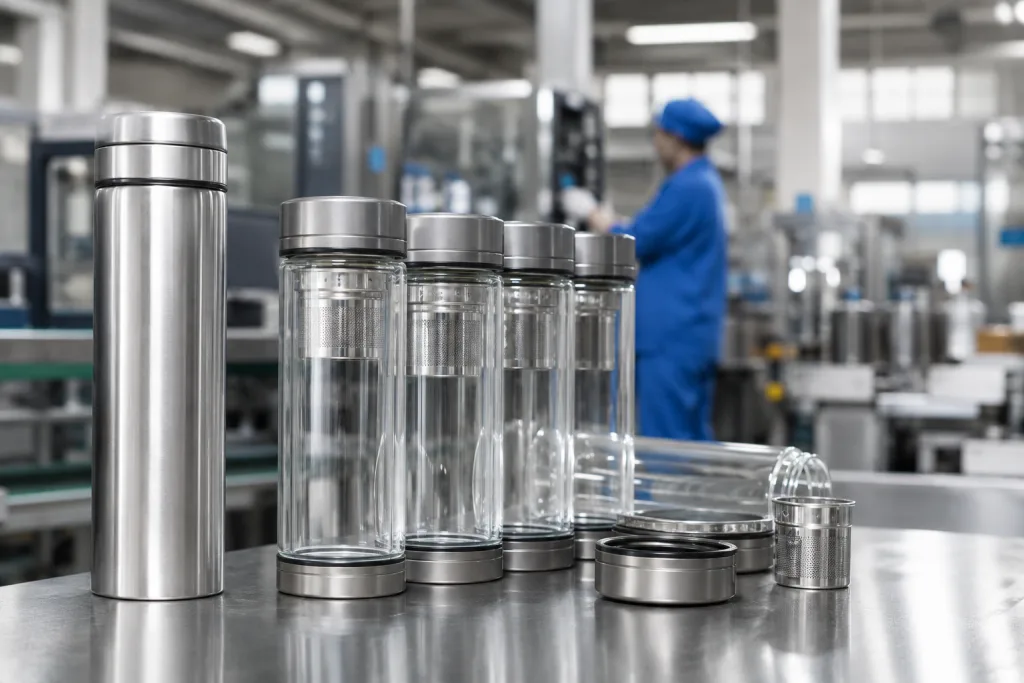
Key Takeaways
- Double-wall 18/8 stainless usually survives a 1.0 m carton drop better than glass-lined units and starts around MOQ 1,000 pcs per color
- Glass thermos bottle wholesale fits tea, office, and gifting better, but breakage risk can add 2% to 5% over long-haul distribution
- Typical lead time from Zhejiang, China is 25-35 days for repeat stainless orders and 35-45 days for customized thermos projects
- For promotional thermos programs under USD 6.50 FOB, simple powder coat plus 1-color silkscreen is usually the most practical spec
You searched for glass thermos bottle wholesale, but orders usually stall on a tougher question: should your next line be glass-lined, double-wall stainless, or a mixed range? We’ve seen this go sideways. For outdoor retail and promo programs, the wrong material shows up fast in returns, freight cost, and weak reorders. Last month one buyer flagged a 1.2 kg glass-lined sample as too fragile after a single carton drop from 76 cm.
From Zhejiang, China, we see this every season on the line. A buyer asks for a custom thermos with a premium feel, then QC pulled the sample and the real issues were drop-test target, leak rate, and logo method, not the catalog photo. This is the wrong question to ask first. If you are comparing bulk thermos offers from thermos suppliers, start with the numbers: vacuum performance, wall thickness, MOQ, carton drop results, and compliance documents. We ship plenty of nice-looking bottles; the math doesn’t work if the lid leaks at 0.03 MPa or the screen print scratches in the tape test.
Start with the actual sales channel
Buyers compare a glass thermos bottle wholesale quote with a stainless quote like both items belong on the same shelf. They don’t. Channel comes first. For outdoor retail, stainless wins in most cases because users jam the bottle into backpacks, car cup holders, and mixed cartons on the line. For gifting, office wellness, tea accessories, or premium promo programs, glass has a case because the drink is visible and the photos sell faster on listing pages.
Blunt answer: a thermos factory can build a glass-lined vacuum bottle that looks clean and premium, but shipping decides what reaches the customer. For Europe and North America, freight usually runs 8,000 to 11,000 km from China, then the goods still go through parcel sorting, warehouse stacking, and last-mile delivery. Stainless takes that beating better. Glass needs thicker inner protection, lower drop targets, and tighter carton design; last month QC pulled the sample after a 76 cm drop test cracked the liner at the shoulder. We’ve seen this go sideways.
If you are an outdoor retailer, your shortlist should lean to double-wall 18/8 stainless with a silicone or PP leakproof stopper, 500 ml to 750 ml capacity, and a body weight below 420 g where possible. That spec ships cleaner. If you are a promotional buyer, a customizable thermos for events usually needs easy branding, lower FOB cost, and stable lead time. The math points to stainless again unless the brief clearly asks for a tea-viewing or wellness angle; one buyer flagged a glass option after seeing the insert pack-out jump from 18 days to 24 days.
You are not buying a material. You are buying a return rate, a freight profile, and a use-case fit.
At BottleForge Industrial in Zhejiang, we usually tell buyers to build the range around stainless first, then add one glass thermos bottle wholesale SKU only if the sales channel can carry the packaging burden. This is the right question to ask. On our side, that often means a 12 mm EPE insert, a stricter master carton drop standard, and a higher MOQ before we run the line.
Head-to-head spec table buyers actually use
Review quotes from thermos manufacturers or thermos suppliers in one table. Do not compare one by one. Every supplier thermos offer looks fine on its own until QC pulls the sample set and you line up net weight, wall thickness, and drop-test notes side by side.
Core comparison
- Body material: Glass-lined vacuum bottle vs 18/8 stainless steel double-wall vacuum
- Common capacity: 350 ml, 500 ml, 750 ml for both; stainless extends more easily to 1,000 ml
- Typical net weight: Glass 420-650 g; stainless 280-480 g depending on wall thickness
- Wall spec: Stainless outer wall often 0.4 mm, inner wall 0.4 mm; premium models 0.5/0.4 mm
- Heat retention: Glass 8-12 hours hot; stainless 12-24 hours hot depending on copper coating and stopper design
- Cold retention: Glass 10-18 hours; stainless 18-24 hours
- Drop tolerance: Glass needs stronger inserts and still carries higher break risk; stainless usually passes 1.0 m master carton drop more reliably
- Logo methods: Glass usually decal or screen on outer shell; stainless supports silkscreen, laser engraving, UV print, embossing on selected parts
- FOB price guide: Glass often USD 3.80-7.20; stainless USD 2.90-8.50 depending on size and finish
- MOQ: 1,000-3,000 pcs for standard colors; 3,000-5,000 pcs for new molds or complex accessories
That spread matters. A buyer asking for thermos bulk is usually balancing 3 hard points: target retail, complaint risk, and shelf look. This is the wrong question to ask if you only ask for the lowest FOB. A factory thermos quote under USD 4.00 FOB may look good on the PO, but if the stopper leaks at 60 kPa internal pressure or the powder coat chips after carton vibration, the math doesn't work.
For most outdoor and distributor thermos programs, stainless gives a wider production window. We run lid-fit checks with a go/no-go gauge, test to AQL 2.5 for major defects, and keep packed weight inside retailer carton limits more easily. Glass still has a place, mostly in premium tea channels, but we've seen this go sideways when the buyer flagged breakage claims and still wanted the same 1.0 m drop standard as stainless.
Use-case fit: where each one wins
If you need one rule, use this: stainless wins on movement, glass wins on shelf look. That is why 7 out of 10 thermos distributors we quote in Europe keep stainless as the volume SKU and reserve glass for gift sets or office lines. On our line, the 500ml stainless sample usually clears the 1.2m drop test with less trouble; glass needs more protection before we ship.
- Outdoor retail: Stainless is the safer call. Better impact resistance, lower carry weight, stronger vacuum retention, fewer after-sales claims. We’ve seen buyers flag chipped glass after one carton corner hit in transit.
- Corporate gifting: Both can work, but the brief matters. If the client wants a premium desk bottle for tea, a clean silhouette, and visible infuser parts, glass thermos bottle wholesale fits. If the program is for daily commuting and repeat logo exposure, go stainless. A 0.3mm laser mark on stainless holds up better than silk print on a glossy outer shell.
- Promotional campaigns: Stainless usually wins because a thermos promotional SKU has to please the widest group and pack fast. The math doesn’t work if breakage risk forces thicker EPE inserts on a 10,000-piece run.
- Distributor programs: If you are a distributor thermos buyer watching stock risk, stainless is easier to reorder by color and capacity. We run 350ml, 500ml, and 750ml bodies off shared tooling more often; glass programs usually lock you into a narrower spec.
- Tea and wellness: Glass, or a glass-window concept, sells better on visual appeal, especially with an infuser. QC pulled one sample last month because the tea basket sat 2mm off-center, and the buyer noticed it at once.
For a customized thermos built for trail, camping, cycling, or commuting, stainless gives you more freedom on accessories without turning the product fragile. You can add a carry loop, anti-slip base, tea filter, or dual-use cup lid and still keep the main body solid. We ship a lot of these with silicone boots in 70 Shore A hardness. Glass is less forgiving. Every accessory change needs a closer check on center of gravity, outer shell stiffness, and internal shock protection.
The buyers who regret it most are not the ones who paid 6% more for better stainless. They are the ones who picked a fragile concept for a channel that treats drinkware like hardware. We’ve seen this go sideways. One showroom sample looked great, then the bulk order came back with cracked inner bottles after rough parcel handling. If your end users are hard on products, this is the wrong question to ask. Don’t let the display sample decide the program. Let the use case decide.
Customization changes the real landed cost
Buyers ask for a custom thermos quote and compare only unit price. This is the wrong question to ask. Cost usually moves in scrap, packing minutes, extra QC points, and lead time. On our line, a stock-body program with one logo position runs clean; once you add lid tooling, EVA foam in a gift box, and artwork on 3 positions, the reject rate jumps and the schedule changes. A simple thermos custom order can ship on schedule. A heavy custom build should not be priced like a standard repeat PO.
For stainless, the lowest-risk branding stack is simple: stock body shape, standard powder coat, one-position silkscreen or laser, and standard brown export carton. We run these orders every month, and the line usually holds under 30-day production after sample approval. Add Pantone color matching, a retail box, barcode labels, and a tea filter, and the timing often shifts to 35-45 days. One reason is small but real: QC pulled the sample last month because the tea filter thread was 0.4 mm tight, and that alone cost 2 days.
For glass thermos bottle wholesale, packaging design matters more than graphics. We have seen buyers cut decoration cost by USD 0.08, then add USD 0.20 in inner protection or freight weight and lose the saving. The math doesn't work. Glass breaks for simple reasons. A thicker corrugated divider, a 10 mm EPE sleeve, or a tighter drop-test target will change landed cost faster than a prettier print file.
- Basic stainless custom: MOQ 1,000 pcs, tooling USD 0, lead time 25-35 days
- Custom color plus logo: MOQ 1,000-2,000 pcs, sample 7-10 days, production 30-40 days
- New lid or base mold: Tooling often USD 2,000-6,000, depending on structure
- Gift box with insert: Adds packing labor and carton volume; check CBM before approving
At our Zhejiang facility, output on stainless vacuum drinkware can reach 300,000 units per month across mixed models, but not every customizable thermos project fits that pace. We ship volume, but custom work slows fast if the buyer flags FNSKU labels late, retailer packing rules arrive after sampling, or mixed-color assortments are added after PO release. Last quarter one PO even had the carton mark typoed, so 4,800 labels had to be reprinted before loading. Tell the thermos vendor early. Those details decide if your launch stays on time.
Quality checkpoints that prevent expensive surprises
A good quote from a thermos manufacturer is not enough. You need a quality plan before deposit. This is where experienced buyers separate a reliable bulk thermos supplier from a trading-only operation that does not run the line and cannot control what happens after PO approval.
For stainless vacuum bottles, ask for the inspection list in writing. Do this before you pay the 30% deposit. At minimum, include vacuum retention test, leak test, coating adhesion, odor check, thread engagement, and carton drop test. On our floor, QC pulled the sample after the aging rack and checked lid threading with a go/no-go gauge because cross-threading at 0.3 mm off will come back as a leak claim. For material, 18/8 stainless should be backed by material confirmation if you need it. For food-contact parts, ask about REACH for the EU market and relevant LFGB or FDA-style migration controls depending on your program. If the item is for children, additional ASTM and CPSIA considerations may apply. Buyers ask for the cheapest unit price first; this is the wrong question to ask if the return risk sits with you.
- AQL target: Commonly AQL 2.5 major / 4.0 minor for finished drinkware
- Leak test: 100% line test recommended for all vacuum bottles
- Vacuum test: Sample-based retention verification per batch
- Coating: Check scratch and adhesion after cure
- Drop test: Master carton 1.0 m on edge, corner, and face for export packing review
For glass thermos bottle wholesale, add breakage-focused controls: fit of inner supports, stopper alignment, shell-to-liner stability, and stronger packaging validation. We have seen a flask pass bench inspection, then arrive with 6% breakage after ocean transit because the EPS insert was 2 mm loose at the shoulder. That is where claims start. The buyer flagged it once on a PO where the stopper spec was typed as 65 mm instead of 63 mm, and the whole fit changed.
China has strong drinkware capability, but standards vary by factory. In Zhejiang, you will find serious vacuum bottle plants and small workshops that quote low and sort quality out later. We have seen this go sideways. Ask who handles in-line QC, whether the site has ISO-based process control, and whether social compliance such as BSCI matters for your retailer account. Ask for numbers: defect rate, leak-test coverage, daily output on the line, and how many inspectors are on final random check. A real manufacturers thermos partner should answer fast and with data, not soft promises.
How to choose the right sourcing model
Buyers should not source this the same way. An outdoor retailer building a private-label line should start with sell-through, reorder cycle, and shelf price. A promo buyer should start with the in-hand date, logo position, and whether the artwork has 2 colors or 4. We see this on the line all the time. Both may ask for a thermos customized product, but the sourcing model is different from day one.
For distributor business, standardization wins. Pick two body sizes, not five. Keep thread specs and accessory fit tight; on one 500ml program we hold lid-match tolerance within 0.3 mm so replacement caps do not come back as claims. A thermos distributor program gets stronger when repeat colors, spare parts, and carton packing stay under control. Stainless fits this better than glass. The reason is simple: we can hold forming and vacuum performance more consistently across larger runs, and QC pulled fewer damage samples on stainless than glass on the last mixed-material order.
If your first order is small, do not force a fragile concept into a low-MOQ launch. This is the wrong question to ask. Buyers often ask whether glass can match stainless pricing at 500 pcs; the math doesn't work once you add inner dividers, drop-test packaging, and extra master carton weight. In China, 500 pcs is common for stock-color stainless trial orders, while full OEM usually starts around 1,000 pcs with custom mold details or special surface finish. For glass thermos bottle wholesale, we have seen unit cost jump fast after adding EPE foam and thicker corrugated inserts.
Use this practical filter:
- If your target retail price is under USD 24.99 and the channel includes outdoor or travel, choose stainless.
- If your order is for event gifting under 60 days, choose a stock stainless body with logo print.
- If your concept depends on visible tea infusion or premium desk aesthetics, consider glass with stricter packaging specs.
- If you need long-term distributor thermos volume, choose a stainless platform that can support multiple finishes and 1,000+ pc reorders.
The best sourcing choice is usually not the most creative one. It is the one you can repeat without drama: stable quality, lead time you can book against, and a claims rate your margin can absorb. We ship a lot of these out of Zhejiang, and most serious thermos factory programs still run their core volume on stainless vacuum bottles. Glass has its place, but only when the product story covers the added breakage risk and packing cost.
Get a spec-based thermos quote that makes sense
Send your target price, capacity, logo method, and channel. We will recommend stainless or glass, quote MOQ clearly, and flag any packaging or compliance risks early.
Frequently asked questions
Should I source glass thermos bottle wholesale for outdoor retail?
Usually no, unless the product is clearly positioned for office, tea, or low-movement use. Outdoor retail puts drinkware through more drops, vibration, and rough storage. A glass-lined thermos may look premium, but breakage risk is materially higher in parcel and wholesale handling. For most outdoor programs, double-wall 18/8 stainless with a 0.4 mm/0.4 mm wall structure and leak-tested stopper is the safer choice. MOQ typically starts at 1,000 pcs per color for custom stainless, with FOB pricing often from USD 2.90 to USD 6.50 depending on size and finish. If you still want glass, budget for stronger inserts, higher carton weight, and an expected damage exposure that can run 2% to 5% higher than stainless.
What MOQ is realistic for a custom thermos order from China?
For a standard stainless vacuum bottle using an existing mold, 1,000 pcs per color is a realistic MOQ from many Zhejiang factories. Some stock-color trials can go to 500 pcs, but that usually limits decoration and accessory options. If you need a customized thermos with Pantone coating, retail box, tea filter, or mixed accessories, expect 1,000 to 2,000 pcs. If you want a new lid or body mold, the MOQ often moves to 3,000 pcs or more, plus tooling that can range from USD 2,000 to USD 6,000. Glass thermos bottle wholesale projects can require similar unit MOQs, but packaging complexity makes small runs less economical. Always ask whether MOQ is per SKU, per color, or per order.
How long does production take for bulk thermos orders?
For repeat stainless orders with approved artwork and standard packaging, 25 to 35 days is common after deposit and sample signoff. For first-time thermos custom projects, 30 to 45 days is more realistic because color chips, pre-production samples, and packaging checks take time. Sample lead time is usually 7 to 10 days for logo and color work. If you need new tooling, add 15 to 25 days before mass production. Glass thermos bottle wholesale often sits at the longer end because protective packaging validation is more critical. During peak season, especially before Q4, add 7 to 10 days buffer. If your thermos supplier promises 15 days for a fully customized program, ask exactly what steps are being skipped.
Which tests matter most before I approve a thermos supplier?
For stainless vacuum bottles, focus on leak testing, heat retention, coating adhesion, odor, threading, and carton drop performance. A practical benchmark is 100% leak testing on the line plus sample-based vacuum retention checks by batch. For finished goods inspection, many buyers use AQL 2.5 for major defects and 4.0 for minor defects. If you sell into the EU, ask about REACH compliance for food-contact components. For retailer accounts, BSCI or similar social compliance may also matter. For glass thermos bottle wholesale, add packaging validation and breakage-focused tests because the bottle may pass appearance inspection yet fail in transit. Ask the factory for actual reports, not just a generic statement that quality is controlled.
Is stainless or glass better for promotional thermos programs?
Stainless is usually better for promotional thermos business because it balances cost, durability, and branding flexibility. A 500 ml stainless model with powder coat and one-color silkscreen can often land in the USD 3.20 to USD 5.80 FOB range at 1,000 to 3,000 pcs, depending on lid style and packaging. It also supports laser engraving, which many corporate buyers prefer for a permanent logo. Glass can look more premium in photos and gift sets, but it needs better inner protection and carries higher damage risk. If your campaign timeline is tight or the end users are broad, choose stainless. If the brief is premium tea, desk use, or wellness gifting, glass thermos bottle wholesale can still work with tighter packaging control.