Key Takeaways
- For custom stainless thermos, 18/8 stainless with 0.4-0.5 mm inner and outer walls is the practical baseline at MOQ 1,000 pcs per SKU.
- A reliable vacuum bottle should keep hot liquids above 60°C for 12 hours in a 500 ml format, with leak rate controlled at 0% in inline testing.
- Decoration choice changes defect risk: laser engraving has lower fallout than multicolor silk screen when you scale from 1,000 to 10,000 units.
- Ask for AQL 2.5/4.0 inspection, REACH and LFGB material compliance, and a 25-35 day production window before paying the balance.
Buyers often start by searching “glass thermos bottle factory,” then find out the real decision is glass-lined or stainless vacuum. Normal shift. We see it on the line every month. Outdoor chains and promo brands use the retail term first, but the PO is decided by hard specs: 304 vs 316 stainless, vacuum rate, lid torque, coating rub test results, and whether the factory can keep color delta under control across 5,000 pieces. Last month a buyer flagged a 0.8 N·m lid torque gap on pre-production samples, and that changed the whole approval.
If you are sourcing in Zhejiang, China, skip the marketing copy. You need a spec sheet you can check line by line and turn into a clean RFQ. This is the right place to be strict. At BottleForge Industrial in Hangzhou, Zhejiang, our stainless thermos capacity is 450,000 units/month, standard MOQ is 1,000 pcs per SKU, and mass production usually runs 25 to 35 days after sample approval. QC pulled the sample, checked mouth diameter with a digital caliper, and matched coating against the signed panel before we released the line.
Start with the actual vessel type
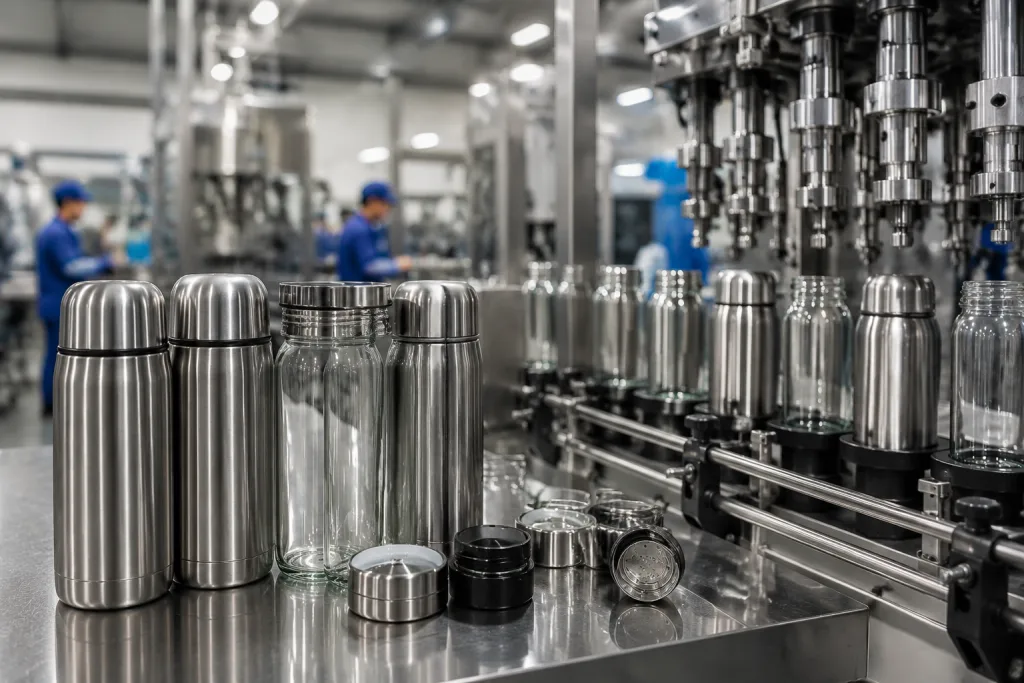
Buyers searching for a glass thermos bottle factory usually mean one of two builds. First is a true glass-lined thermos: a glass vacuum liner sitting inside a protective outer shell. Second is a stainless vacuum bottle that the market still calls a thermos. On our line, these are different products from tooling onward; a 304 stainless body might run with a 0.4 mm outer wall, while the glass version needs extra packing clearance. For outdoor retail, gym, commuter, and promotional thermos programs, stainless wins most orders because it survives drops, stacks tighter in cartons, and takes more decoration methods.
The buyer impact is straightforward. If you sell through outdoor retail, glass liners usually mean more breakage claims and more pallet damage; we have seen buyers push back after a single 1.2 m drop test failure. For gifting campaigns or office promo, glass can work, but the carton spec has to be stronger and the abuse tolerance lower. Last month QC pulled the sample on a glass item because the divider board compressed too easily in transit simulation. A stainless factory thermos is the safer commercial choice, and this is the right question to ask early.
- Glass-lined format: known for classic heat-retention reputation, weaker in drop resistance, limited in practical shape options because the inner glass geometry is less forgiving.
- Stainless vacuum format: better fit for modern retail programs, supports powder coating and laser marking, and holds up through repeated warehouse and courier handling.
- Outdoor use: stainless is the default. We only see glass move when the brand wants a traditional glass-interior story and accepts the packing cost.
If your brief says custom thermos but your distributor network expects rugged performance, write the RFQ around stainless. Then ask the supplier a direct question: are they a real thermos manufacturer or only a trading source? In Zhejiang, China, you will find 20 sellers using the same broad product name for different constructions. The math doesn't work if you stay vague. Push the discussion to construction, wall thickness, finish, and test data; we have even seen a PO say "glass thermos" while the approved sample was stainless, which turns into a mess at pre-production.
Material grade is not a small detail
On a spec sheet, stainless grade looks like one line. On the line, it decides taste transfer, rust risk, unit cost, and how many complaints hit after shipment. For most bulk thermos orders, ask for food-contact 18/8 stainless steel, SUS304, on both inner and outer walls. For coffee, tea, water, and daily retail use, 304 is enough. If the bottle will hold electrolyte drinks, acidic contents, or go into marine retail channels, ask whether SUS316 on the inner wall pays back the added cost. We check this with a handheld XRF gun at incoming material. This is not a small detail.
Typical price movement from 304 to 316 inner wall is around USD 0.18 to 0.45 per unit depending on size and commodity pricing. That hits fast if you are buying thermos bulk for a promotion at 3,000 to 20,000 pieces. One buyer pushed for 316 on a 500ml promo bottle at 10,000 pcs, then cut the budget by USD 0.20 per unit; the math doesn't work.
What to ask for
- Inner wall: SUS304 minimum, SUS316 optional for higher corrosion resistance
- Outer wall: SUS304 is standard
- Lid food-contact parts: virgin PP or Tritan, plus silicone gasket
- Coating: BPA-free powder coat or spray paint with adhesion test data
Do not accept vague wording like "food grade metal." Ask for material certificates. For Europe, ask about REACH and LFGB readiness. For North America, depending on the product category, ask the thermos supplier for FDA-contact declarations and California Proposition 65 screening on coatings and decorations. QC pulled the sample once because a PO said "304 inside" but the lid resin line was blank. That kind of miss turns into a claim later.
A stainless bottle that looks identical in a photo can differ by 15% to 25% in complaint risk based on steel grade, lid resin, and gasket quality alone.
If you are dealing with multiple thermos suppliers or manufacturers thermos quotes, compare the bill of materials line by line. The cheapest quote often hides 0.35mm steel instead of 0.4mm, recycled plastic in the lid, or a lower-grade gasket that starts leaking after repeated dishwashing. We've seen this go sideways after the third wash cycle test, and the buyer flagged it only after goods landed.
Wall thickness, weight, and dent resistance
Buyers new to customized thermos projects usually start with capacity: 350 ml, 500 ml, 750 ml, 1,000 ml. That is normal. Still, wall thickness tells you faster how the bottle will feel in hand and how it will hold up in freight. On our line, a practical range for a stainless vacuum bottle is 0.4 mm to 0.5 mm for both inner and outer walls, checked with a micrometer after deep drawing. Lighter promo builds sometimes drop to 0.35 mm. Heavy-duty outdoor builds often stay at 0.5 mm outer with a reinforced base ring. If you only ask for capacity, you are asking the wrong question.
The buyer impact is direct:
- 0.35 mm outer wall: lower unit cost, lower shipment weight, higher dent risk. We have seen QC pulled the sample and found a sidewall ding after a 76 cm drop onto the carton corner.
- 0.4 mm outer wall: the balanced commercial standard for a lot of distributor thermos programs, especially when the MOQ is 3,000 to 5,000 pcs per color.
- 0.5 mm outer wall: stronger hand feel, better dent resistance, slightly higher FOB and freight cost. The buyer flagged this before on a 40HQ load because the gross weight moved up faster than expected.
For a 500 ml bottle, moving from 0.4/0.4 mm to 0.5/0.5 mm can add roughly 35 to 60 grams depending on shape. Small number. Big freight effect. At 10,000 units, that adds about 350 to 600 kg to the shipment, and the math doesn't work if your target is a low-price giveaway. Air freight gets hit first. Sea freight feels it too once carton count and gross weight are locked. It also changes shelf feel. Outdoor retailers usually ask for the sturdier hand feel, while promo buyers push us to hold a campaign target under budget, sometimes down to the last $0.08 per unit.
Ask your thermos factory for actual bottle weight tolerance, not just nominal weight on the spec sheet. A decent control range is within plus or minus 3% for mass production, and we run random checks on the digital scale every 30 minutes. If the variance is wider, the issue is often unstable raw material thickness or forming control, not bad luck. For customizable thermos projects with special handles, bumpers, or wide-mouth tooling, ask if the added parts create wobble, lid alignment issues, or extra carton cube. We have seen this go sideways after sampling: one PO even had the lid code typed wrong, and the handle version added 12 mm to carton width. A good manufacturer thermos team raises these tradeoffs before sampling, not after the PO is paid.
Vacuum performance and leak testing
This is the point where 7 out of 10 sourcing talks get fuzzy. Buyers say they want a bottle that "keeps drinks hot for a long time." That is the wrong question to ask. A usable spec needs the test method, start temperature, ambient temperature, fill rate, and the exact check point. For a 500 ml stainless bottle, a sensible commercial benchmark is 95°C water at fill, 20°C ambient, 6 hours above 70°C, 12 hours above 60°C. Cold retention can be set at under 10°C after 12 hours depending on ice ratio and room temperature. On our line, QC writes the start temp and test time on the tray card, or the whole report becomes useless.
Vacuum quality comes from process control, not brochure words. Ask the thermos manufacturer how they test and what they record per shift. Good factories in China run 100% vacuum inspection during production, usually by temperature differential or vacuum-related line checks, then random retention validation by batch. We have seen this go sideways when a factory only checks finished cartons and skips in-line vacuum screening.
Leak-proof points that matter
- Lid thread engagement depth, usually checked against the neck finish so the cap does not cross-thread after 2 or 3 cycles
- Silicone gasket hardness and seating; QC pulled the sample once because the gasket sat 0.8 mm proud and leaked on inversion
- Torque range during cap closing, measured with a torque meter instead of hand feel
- Stopper design for push-button or screw-lid models, since these two structures fail in different ways
If you are buying for e-commerce or FBA, leaks hurt more than slight paint issues because returns are expensive and reviews stay there. We ship enough Amazon orders to know this. Tell your thermos vendor to test every unit for leakage before packing. For standard screw-cap bottles, it is reasonable to require 0 leakage under inverted test for 30 minutes and random drop tests in inner packaging. Buyers sometimes push back on 100% leak testing to save a little labor cost, but the math doesn't work.
On QC terms, AQL 2.5 for major defects and 4.0 for minor defects is common for drinkware. Write the defect list clearly. Leaks, failed vacuum, sharp edges, and logo misspells should be listed as major defects. We once saw a PO where "THERMOS" was typed wrong in the approval file, and the buyer flagged it only after 3,000 pcs were packed. If you work with thermos distributors or larger chain retailers, they may impose their own protocol. If they do not, you should still write one. A proper supplier thermos partner will accept that because clear standards cut disputes at shipment stage.
Decoration drives both branding and fallout
Most buyers treat decoration as a marketing pick. On the factory side, it is also a yield-risk call. On a thermos custom project, the usual options are powder coating, spray painting, silk screen printing, heat transfer, water transfer, digital print, and laser engraving. Each method shifts scrap rate, color control, and piece cost. On our line, QC pulled 6 bottles from a 500-pc pilot last month because a fine white logo filled in after curing; the artwork looked clean on screen, then failed on steel.
For outdoor retail, powder coat plus laser engraving is usually the safe bet. Powder coat gives grip and better scratch resistance, and we check film thickness at 60 to 80 μm with a coating gauge. Laser engraving stays put. It avoids the ink adhesion claims we see when curing temperature drifts. For promotional thermos orders, silk screen is common because the setup cost is lower at 1 or 2 colors, but Pantone matching and abrasion resistance need tight control. Buyers ask for the lowest print cost, but this is often the wrong question to ask.
- Laser engraving: low defect risk, premium look, best for 1-color permanent branding.
- Silk screen: lower tooling cost, good for simple logos; if the line width drops below 0.2 mm, fallout goes up fast.
- Heat transfer: full-wrap graphics possible, higher setup complexity; one roller pressure setting off-spec and the seam will show.
- Powder coat: better durability than standard spray paint, usually higher unit cost by USD 0.12 to 0.35.
If your order is a customized thermos line for distributors, ask for coating adhesion results, dishwasher warning language, and packed sample approval in the exact decoration method. Ask for a cross-hatch tape test record, not a verbal yes. You should also lock Delta E under an agreed range for large runs. We usually see buyers set ΔE ≤ 1.0 for dark solid colors and accept a little more on textured finishes. A bottle can pass leak test and still miss the shelf standard if black shifts to charcoal between lots. We have seen this go sideways over one PO typo that changed matte black to rubber black.
At BottleForge Industrial in Zhejiang, standard logo MOQ usually starts at 1,000 pcs per design, while some laser-marked programs can be consolidated by color. That matters for distributors thermos business when you need 4 logos on one body style without sitting on dead stock. We run mixed-logo plans this way. Decoration is where a capable thermos supplier cuts cost by stopping artwork that sells well in a mockup but drives an 8% reject rate on the line.
Packing spec affects landed cost
You can lose margin on a good bottle with bad packaging. We see this on the line all the time. The spec sheet needs to lock unit packing, inner carton, outer carton, barcode position, and drop-test standard before sampling. A plain white box is still the lowest-cost choice for a lot of bulk thermos orders, usually at MOQ 3,000 pcs. A color gift box looks better on shelf, but it adds carton cube and often fails the first drop test if the insert wall is under 8 mm. For outdoor retail, mailer strength matters almost as much as shelf look. Omnichannel orders get tossed around.
Typical options look like this:
- Egg-crate carton only: lowest cost, good for plain B2B shipments or replenishment stock where the buyer only cares about arrival rate and pallet density.
- White box with barcode: the standard setup for a lot of thermos distributor programs; easy to run, easy for QC to scan, and usually the best balance on cost.
- Color box with EVA or pulp insert: better presentation, higher tooling and packing cost, and more setup on the folding line. We’ve seen this go sideways when the buyer approved artwork but forgot the insert fit for the silicone carry loop.
If you sell into Amazon FBA, write FNSKU labeling, carton weight limits, suffocation warnings for any polybag, and master carton size targets into the PO. Don’t leave it verbal. A carton above 15 kg might pass for one channel and get rejected by another warehouse. QC pulled the sample last month on a PO because the outer label showed 24 pcs/ctn, but the actual packout was 20 pcs. Ask your suppliers thermos candidate for packed dimensions and units per carton before you approve final packaging. After production starts is too late. This is the wrong question to ask at the end.
Lead time tracks packaging complexity. A standard bottle with carton packing usually runs in 25 days after deposit and approved pre-production sample. Add a custom mold, special lid, and full-color gift box, and you are looking at 35 to 45 days. We run into the same bottleneck every autumn: coating slots fill first, then box printing. If you source from Zhejiang, China, book earlier than your sales team thinks. September to November gets tight across a lot of thermos manufacturers, and 12 days vs 18 days on box printing can break the ship date.
For trade terms, compare FOB Ningbo and FOB Shanghai line by line, and ask whether testing, barcode application, and palletization are included. The math doesn’t work if you only compare unit price. We ship quotes that look USD 0.20 cheaper, then the buyer flags missing label labor, extra drop-test packaging, or third-party inspection, and the landed cost ends up higher.
Compliance, audit, and sample control
The last lines on the spec sheet protect you after the container ships. If you buy for Europe or North America, do not stop at a clean-looking sample. Ask the custom thermos supplier for the paperwork behind the item: material compliance, audit status if your customer asks for it, and the QC plan for mass production. We’ve seen this go sideways when a buyer approved a nice bench sample, then found the carton mark on the PO was wrong by 1 letter and the factory had no signed production standard.
A practical checklist should cover REACH, LFGB where applicable for EU food-contact expectations, and test reports for migration or heavy metals based on the material set. For kids’ items, ASTM-related questions show up even on a stainless bottle project. If your customer asks about factory audits, BSCI or an equivalent social audit matters. ISO 9001 is fine, but this is the wrong question to ask if all the factory shows you is a certificate on the lobby wall. Ask for process records, CAPA logs, and in-line inspection sheets. QC pulled the sample last month on a 0.8 mm body wall issue that the certificate would never catch.
Sample control is where first-time buyers get burned. Fast. The approved sample should be frozen as the production reference sample. That means signed-off color, logo position in mm, packaging method, and performance target. If you have a thermos customizable project with interchangeable lids or accessories, list each approved combination one by one. Otherwise the line team will improvise, and the buyer flagged exactly that on a 3-lid set when the straw lid was packed with the wrong gasket.
- Request a pre-production sample after artwork approval
- Confirm golden sample storage at factory and buyer side
- Set AQL standard and major defect definitions in writing
- Book a pre-shipment inspection if order value justifies it
For first orders, buyers in China often start with 1,000 to 3,000 pcs per SKU and one or two colorways. That is sensible. We run trial orders like this all the time. You get market feedback without tying up cash in 5,000 extra units that sit in a warehouse. A disciplined supplier thermos relationship is not built by chasing the lowest FOB on day one; the math doesn’t work if the first run needs rework. Get the first production run right, lock the sample, check AQL 2.5 if that is your standard, then scale with fewer surprises.
Send your thermos spec sheet for a factory review
We will check material grade, decoration, MOQ, and packaging line by line, then quote a practical stainless solution from Hangzhou, Zhejiang.
Frequently asked questions
If I searched for a glass thermos bottle factory, should I still buy stainless?
Usually yes, if your end market is outdoor retail, commuting, fitness, or broad promotional distribution. Glass-lined vacuum bottles can perform well thermally, but they are more fragile in transit and in daily use. A stainless vacuum bottle with SUS304 inner and outer walls is the standard commercial choice for most B2B programs. If you need higher corrosion resistance, upgrade the inner wall to SUS316 for about USD 0.18 to 0.45 extra per unit depending on size. For first orders in China, many buyers start with 500 ml or 750 ml stainless models at 1,000 pcs per SKU, then test sell-through before expanding.
What MOQ is realistic for a custom thermos order?
For an existing stainless bottle mold with one logo and standard carton packing, 1,000 pcs per SKU is a realistic MOQ. Some simple laser-logo programs can be more flexible if body color is shared, while full custom colors, special lids, or gift boxes often push MOQ to 2,000 to 3,000 pcs. If you want a completely new mold, tooling cost and MOQ rise sharply and are usually not efficient below 5,000 pcs. In Zhejiang, China, MOQ is often tied more to decoration and packaging setup than to bottle forming alone. Ask for MOQ by bottle body, lid, coating color, and logo method separately.
How do I compare quotes from different thermos suppliers fairly?
Build a comparison sheet with the same inputs for every quote: capacity, SUS304 or SUS316, wall thickness, bottle weight, coating type, logo process, packaging, test standard, and trade term. A quote for a 500 ml bottle at USD 2.45 FOB can be worse than a USD 2.62 quote if the cheaper version uses 0.35 mm steel, spray paint instead of powder coat, or a lower-grade lid gasket. Also check whether the price includes barcode labeling, leak testing, and export carton standard. Put lead time beside the price. A 25-day reliable run can be more valuable than a 20-day promise that slips to 35.
What tests should I require before mass production ships?
At minimum, require vacuum retention verification, 100% leak testing, appearance inspection, barcode check if needed, and packaging drop validation. For compliance, ask for material reports covering REACH and LFGB readiness for EU-oriented programs, plus any food-contact declarations your market requires. For QC acceptance, AQL 2.5 for major defects and 4.0 for minor defects is a common baseline. Major defects should include leakage, failed vacuum, sharp burrs, major dents, wrong logo, and wrong color. If the order is above about USD 10,000 to 15,000, a third-party pre-shipment inspection is usually money well spent.
What lead time should I plan for a customized thermos project?
For an existing mold with standard decoration, plan about 7 to 10 days for samples and 25 to 35 days for mass production after deposit and final sample approval. If the project includes a new lid, custom color box, multiple decoration passes, or special testing, 35 to 45 days is more realistic. Peak season in China can extend scheduling, especially from September through November. Do not forget shipping time after ex-factory completion. If you need retail launch certainty, ask the factory for a backward plan including sample approval date, packaging approval date, production start, inspection window, and estimated vessel cutoff.