Key Takeaways
- For custom glass thermal bottles, practical MOQ usually starts at 1,000-3,000 units per SKU, with sample time of 7-12 days and mass production in 30-45 days.
- A borosilicate glass inner with 304 stainless outer and silicone base can cut transit breakage below 1.0% when paired with a 5-layer export carton.
- Expect FOB China pricing around USD 2.80-6.50 per unit at 3,000 pieces depending on capacity, lid type, decoration, and packaging.
- Use AQL 2.5 for major defects and verify REACH, LFGB or FDA contact compliance before approving customized drinkware for your market.
You are buying more than a bottle. You are buying a claim set: heat retention hours, food-contact safety, breakage rate, logo adhesion after 500 dishwasher cycles, carton drop performance, and whether the factory in China can repeat the same result on the next PO. This is where projects slip. We’ve seen a clean pre-production sample turn into a bulk shipment 12 days late, or a sharp unit price get wiped out by 3.8% defects, relabeling, and chargebacks from a distributor network. On the line, QC pulled the sample and the vacuum reading was fine, but the outer carton failed a 76 cm drop test.
For a glass thermal bottle supplier, the real questions are straightforward: what is the structure, what fails first, what gets tested, and what is your landed cost per usable unit in Europe or North America. This is the right question; FOB price alone is the wrong question to ask. In Zhejiang, China, you can find 40+ canteen manufacturers and canteen suppliers within a short sourcing radius, but only a handful run custom drinkware programs with disciplined QC, clean paperwork, and lead times they can actually hold. We run into the same buyer pushback all the time: “sample looks good, why is mass production different?” Usually the answer sits in a missed tolerance, like a 0.5 mm silicone ring shift, not in the sales quote.
Start with the bottle structure
Ask for the structure first, then the decoration. “Glass thermal” covers different builds, and the quote swings fast if the supplier is guessing. Some bottles are double-wall borosilicate with an air gap. Some use a stainless outer shell with a glass liner. Some are single-wall glass with a sleeve, which is not thermal in any serious sense. We’ve seen 3 quotes on the same RFQ land 18% apart because one factory priced exposed double-wall glass and another priced a steel-shell build. Lock the structure before the line starts costing anything.
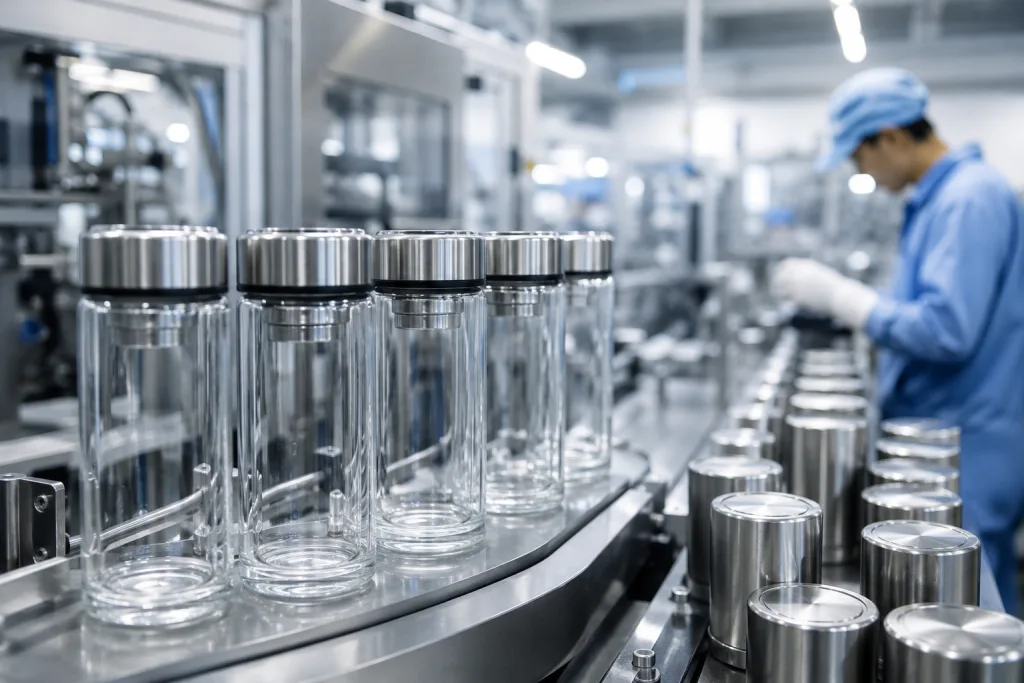
For B2B, the safer commercial build is usually a borosilicate glass inner with a stainless outer body, commonly 0.4-0.5 mm 304 stainless. This is the spec we run most often for repeat programs. It takes knocks better than exposed double-wall glass and cuts return risk for your canteen distributor or distributor drinkware channel. Typical capacities are 350 ml, 500 ml, and 750 ml. Weight often lands between 420 g and 780 g depending on body size and lid assembly. On our floor, QC pulled a 500 ml sample last month at 612 g with infuser and boot, which is normal for this structure.
- Inner material: high borosilicate glass, often 3.0-3.5 mm
- Outer shell: SUS304, 0.4-0.5 mm
- Lid: PP or stainless with food-grade silicone seal
- Base protection: silicone boot or TPR ring for drop resistance
If you sell canteen custom or custom canteen programs into gifting, office, wellness, or tea categories, ask for a tea infuser option and a leakproof screw lid with at least 1.5 turns of thread engagement. Count the turns on the sample. This detail gets missed. If you are buying for retail, request a retention test at 95 degrees C fill start and measure at 6 and 12 hours. A glass-lined thermal bottle will usually test below premium vacuum stainless, and this is the wrong spec to oversell on packaging. We’ve seen this go sideways when a buyer flagged “12H HOT” after the lab report showed a bigger drop than expected.
A buyer mistake we see often in Zhejiang is approving a sample because it looks premium, while ignoring wall thickness, lid resin grade, and whether replacement parts can be supplied on repeat orders. Last quarter, one PO even had the lid resin typed as “PE” instead of “PP,” and that kind of small error creates big claims later.
What questions should you ask first
A good RFQ for a glass thermal bottle supplier is short and specific. Most quote delays start with one loose line—"customized drinkware"—and no commercial basics behind it. Then by round three, the buyer flagged that the master carton misses Amazon FBA limits, or QC pulled the sample and found the logo scratching after 500 handling cycles on the rub test fixture.
Use this supplier checklist before asking for final pricing
- What exact structure are you quoting: double-wall glass, glass liner with steel outer, or single-wall glass?
- What are the net weight, capacity tolerance, and dimensions?
- What is the MOQ by color and by logo process?
- What is the sample fee, sample lead time, and refund policy after PO?
- What compliance reports can you provide: REACH, LFGB, FDA, Prop 65, ASTM if relevant?
- What QC standard do you run: AQL 2.5/4.0 or buyer-specified?
- What is the breakage allowance policy for sea shipment?
- Can you support FNSKU labeling, barcode application, and drop-test packaging?
For most China projects, MOQ for a standard mold is 1,000 units per color. If you are building a fully customized canteen or customized growler with a new lid, base, or EVA gift box insert, the number usually moves to 3,000-5,000 units. We see buyers ask about total factory capacity first. This is the wrong question to ask. BottleForge Industrial in Zhejiang typically plans 500,000 units/month across drinkware lines, but one custom glass thermal bottle SKU is usually limited by decoration queue, hand-pack speed, and carton setup on the line, not by metal forming capacity alone.
If you buy from canteen vendors, canteen factory partners, or canteen suppliers across several categories, ask one direct question: do you make the bottle in-house or assemble from bought-in parts? An assembler can be solid. We ship with assemblers every month. You still need a clear answer on who owns the glass production, lid molding, and final leak test at 0.03 MPa. We have seen this go sideways when the PO says "matte black lid" but the subcontractor reads "bright black" and production loses 6 days fixing the finish source. That is where the real schedule risk sits.
MOQ, pricing, and landed cost reality
Cost needs to be checked in three layers: ex-factory or FOB unit price, packaging and compliance adders, and failure cost after arrival. We’ve seen buyers save USD 0.16 on the quote, then lose it fast on relabeling, breakage, and claim handling after QC pulled the sample from the return lot.
For a standard 500 ml glass thermal bottle with one-color silk screen logo and plain white box, a normal FOB Ningbo or Shanghai range from Zhejiang, China is roughly USD 2.80-4.20 at 3,000 units. Add laser engraving, color box, infuser, silicone boot, or gift packaging and you can move to USD 4.50-6.50. On our line, a silicone boot alone adds one packing step and usually 6-8 seconds per unit. A customized growler or customizable growler with higher volume and reinforced handle can run higher still because glass thickness and carton strength both increase. If the bottle body moves from 3.2 mm to 4.0 mm glass, the math changes fast.
- MOQ: 1,000 units for simple logo on existing mold
- MOQ with custom color box: often 2,000 units
- New mold deposit: commonly USD 1,500-6,000 depending on lid or body complexity
- Pre-production sample: USD 80-250 for existing mold with print
Do not miss the hidden lines in your costing sheet. This is the wrong question to ask if you only focus on unit price. Last month a buyer flagged a PO typo on barcode placement, and that single correction added half a day before packing started.
- Drop-test packaging upgrade: USD 0.12-0.35 per unit
- Third-party lab test: USD 250-800 per SKU or material set
- Barcode or FNSKU labeling: USD 0.03-0.08 per unit
- Spare lids or seals: 1-2% extra stock recommended
If you are a canteen distributor, distributor growler account, or canteen promotional buyer selling into campaigns, your margin is usually protected more by consistency than by saving USD 0.18 on the factory quote. We run into this all the time. One supplier quotes with a 5-layer export carton, another uses a lighter carton that fails edge crush at stacking height. Ask every canteen vendor for the same packaging spec and the same QC level. Otherwise you are not comparing like for like.
How to judge quality before bulk
Samples can mislead you. We’ve seen factories hand-pick glass, hand-tighten lids, and send the set by courier with a 10 mm foam pack that never appears in bulk. Then the line starts, operators run at normal speed, and the real defect rate shows up. Your approval stage should copy production risk, not showroom conditions. This is the right place to be picky.
For glass thermal bottles, the defect map is predictable:
- Glass bubble, wave, or thickness inconsistency
- Misaligned outer shell or loose inner liner
- Lid leakage after torque variation
- Logo scratch or poor adhesion
- Odor from seal material
- High breakage in transit due to weak insert design
Set a written QC protocol. A practical standard for bulk inspection is AQL 2.5 for major defects and 4.0 for minor defects. Require 100% leak testing in production, ideally by vacuum or inverted hot-water method depending on structure. Ask for torque range on the lid, such as 8-12 kgf.cm, to cut random leakage from uneven tightening. QC pulled the sample once at 7 kgf.cm and it passed; bulk at 11 kgf.cm started weeping after 2 hours. That gap matters.
For Europe, ask for REACH and, where relevant, LFGB documentation for food-contact components. For North America, ask for FDA food-contact declarations and Prop 65 screening where the program requires it. If the bottle is for children, ASTM and CPSIA questions become more relevant even if the body itself is not a toy. Buyers sometimes ask for only the final report; that’s the wrong question to ask. Ask which parts were tested: silicone ring, coating, decal ink, straw, and glue.
A reliable canteen manufacturer or canteen factory should also share packaging test data. At minimum, ask for carton gross weight, carton dimensions, and drop-test method. For sea freight, a 5-layer export carton with shaped EPE or pulp inserts is safer than a simple divider set. If your acceptable breakage rate on arrival is under 1.0%, insist on validated packaging, not just "export standard" language on a quote sheet. We ship enough of these to say it plainly: the math doesn’t work if a 12.5 kg carton has loose fit and no corner protection.
Whether you buy customizable canteen, canteen customized gift sets, or customized canteen retail SKUs, keep a golden sample signed against a spec sheet with photos. Add lid torque, logo position in mm, carton mark, and even the PO typo if one got approved. That document stops the usual argument later, where the buyer flagged it and the factory says, “sample approved.”
Customization that sells, not complicates
Not every decoration should go on the bottle. We see buyers stack on 4 or 5 processes just to move away from a catalog look, then the line slows down and QC pulled the sample for logo shift, dust nibs, or color mismatch. Each extra process adds lead time, rework, and one more approval loop. The math doesn't work.
For custom drinkware and customizable drinkware, these options usually sell well without making production messy:
- Silk screen on stainless outer shell for bold colors and lower cost
- Laser engraving for durable corporate branding
- Powder coating on outer shell for grip and perceived value
- Color silicone boot for impact protection and SKU differentiation
- Tea infuser or filter basket for office and wellness channels
For a canteen promotional run or a short event program, keep it tight: 1-2 print colors, stock body colors, standard carton. We usually ship in 25-35 days after approval if the artwork is clean and the PO does not have the usual Pantone typo. If you add canteen customizable gift boxes, multilingual inserts, and exact Pantone coating, plan on 35-45 days in normal season. Before Q4 peak, we've seen this go sideways.
Be careful with full-wrap graphics on glass-contact structures. They look good in renderings, but reject rates go up fast because alignment is tighter and scratch resistance is harder to hold after packing tests. On the line, even a 1.5 mm logo drift gets flagged. For distributor canteen and canteen distributors managing lots of small accounts, simple branding is easier to replenish and less likely to trigger complaints.
If you want a custom growler or customized growler version for beverage, kombucha, cold brew, or tea concentrate lines, ask a direct question: is the lid for pressure-free liquid storage only? This is the right question. Most glass thermal bottles are not built for carbonation, and buyer teams still mix this up with insulated beer growlers. Get the supplier to confirm it in writing, especially if your sales team is preparing retail copy, so nobody markets the wrong use case.
Lead time, compliance, and supplier fit
The best supplier is not the one saying yes to every request. It is the one that points out risk before PO release. In Zhejiang, the better export factories will tell you straight if a new lid mold needs 25 days, if logo approval must be locked before 4 p.m. on Friday, or if the drop test is done in-house and the LFGB check goes to a third-party lab. We see this on the line all the time. A sample looks fine until QC checks thread fit with a go/no-go gauge and finds the cap torque drifting.
For a typical program, use this planning logic:
- Existing mold sample: 3-7 days without logo, 7-12 days with logo
- New mold development: 20-35 days depending on lid and fit tests
- Bulk production: 30-45 days after deposit and artwork approval
- Peak season buffer: add 7-15 days before major holidays or Q4
These dates are workable if approvals move fast. If your Pantone file comes in one day late, shipping slips one week fast during peak season. We have seen a buyer flag a carton mark typo on the PO, then hold print approval for 3 days over one missing hyphen. That is enough to miss a vessel cut-off. Ask early about BSCI, ISO 9001, or social compliance audits if your customer needs them. Those papers do not make a good bottle, but procurement teams in Europe and North America often will not clear a vendor without them. Confirm Incoterms at the start too. This is the wrong question to leave for later. A lot of first-time buyers ask only for FOB, then switch to DDP after production starts, or realize the warehouse needs 1100 x 1100 mm pallets and corner boards.
Supplier fit comes down to order shape, not just price. Some canteen factories want repeat volume and will not move a 1,000-piece test run ahead of a 30,000-piece reorder. Others are set up for flexible private label work with lower MOQ, mixed carton packs, and frequent artwork changes. We run both types across this region. Be honest about your forecast. If your annual demand is 12,000 pieces over four releases, say so. If the first drop is 3,000 pieces and the second is only possible after sell-through, say that too. The math does not work if the factory books 2 tons of glass tube and custom color boxes based on inflated numbers.
Ask one simple question: who owns the problem if the shipment arrives with 2.5% breakage? The answer tells you more than any brochure. A supplier worth keeping will spell out claim timing, required evidence, and compensation method before the PO is signed. We usually ask for outer-carton photos, breakage count by carton, and warehouse receipt within 7 days, because claims go sideways when nobody defined the window. QC pulled the sample, packing passed drop test, and the buyer still got damage because the pallet wrap was too loose. That is why this point matters.
Send your glass thermal bottle RFQ with real specs
Share target quantity, capacity, logo method, market, and packaging needs. We will quote practical MOQ, FOB pricing, and lead time from Zhejiang, China.
Frequently asked questions
What is a realistic MOQ for a custom glass thermal bottle order?
For an existing bottle mold, a realistic MOQ is usually 1,000 units per SKU for one logo process and one body color. If you need a custom color box, silicone boot, or mixed accessories, many factories in China will push MOQ to 2,000-3,000 units because packaging materials and setup loss increase. A fully new custom canteen or customized drinkware project with a new lid or body mold may require 3,000-5,000 units plus a mold charge of about USD 1,500-6,000. If a supplier quotes 300 pieces for a fully customized program, check carefully whether they are offering true production customization or only stock decoration on a standard item.
How do I verify that a glass thermal bottle is safe for Europe or North America?
Ask for material declarations and current test reports, not just a verbal promise. For Europe, REACH is the starting point, and many buyers also request LFGB for food-contact confidence. For North America, FDA food-contact declarations are common, and some retailers ask for Prop 65 screening. If the bottle includes PP, silicone, paint, or printed decoration, those components should be covered too. For children’s programs, you may need additional ASTM or CPSIA review depending on the sales channel. Budget roughly USD 250-800 for third-party lab work if you need buyer-specific reports. A good supplier in Zhejiang, China should tell you exactly which reports are existing and which must be run for your SKU.
What breakage rate is acceptable for bulk sea shipments?
For glass-containing drinkware, you should not treat breakage as unavoidable. With a well-designed 5-layer export carton, shaped EPE or pulp inserts, and proper pallet handling, many buyers target arrival breakage below 1.0%. If packaging is weak, rates can jump to 2-5%, which wipes out any unit-price savings fast. Ask the supplier to state carton dimensions, gross weight, insert type, and drop-test method. Also clarify the claim window after goods arrive. We usually advise buyers to request photo and quantity evidence within 7-15 days of receipt. If your channel is e-commerce or Amazon FBA, upgrade the pack spec early because parcel handling is harsher than palletized wholesale distribution.
Is a glass thermal bottle good enough for heat retention compared with stainless vacuum bottles?
It depends on the structure and your market claim. A glass-lined thermal bottle can perform well for tea, coffee, and office use, but it usually should not be marketed as equal to a high-performance stainless vacuum flask unless your test data proves it. Ask the supplier to run a retention test starting at about 95 degrees C and record temperature at 6 and 12 hours. For many commercial models, the real-world result is acceptable for daily beverage use but below top-tier vacuum stainless performance. Be conservative in artwork and packaging claims. If your customer wants maximum retention for outdoor or winter use, a stainless vacuum model may be safer. If they want cleaner taste perception and premium presentation, glass can be the better fit.
What should I include in my PO to avoid disputes with the supplier?
Your PO should include more than price and quantity. List full dimensions, capacity tolerance, materials, wall thickness if specified, color references, logo size and location, packaging method, carton marks, inspection standard, and required compliance documents. Add the accepted AQL level, leak-test requirement, and any drop-test or transit packaging requirement. State lead time from deposit and final artwork approval, not just a vague shipment month. If you need FNSKU labels, pallet rules, or barcode placement, write those in the PO and packing spec. Also define the claim process for breakage or defects, including evidence type and reporting deadline. A clean PO saves weeks of argument later, especially when multiple canteen suppliers or canteen distributors are involved in one program.