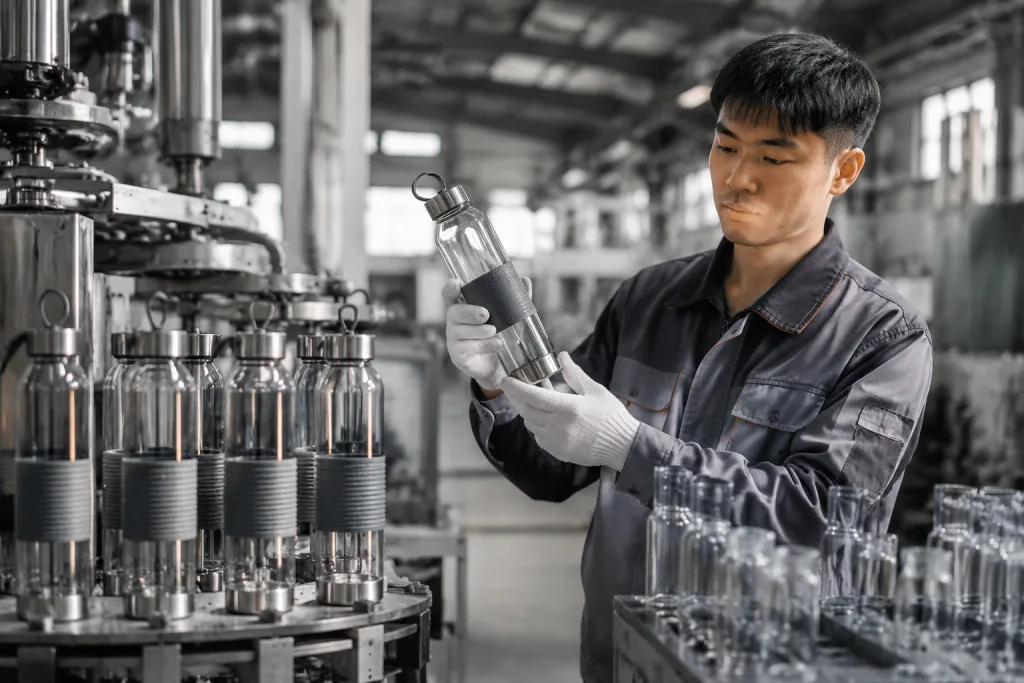
Key Takeaways
- For glass sport bottles, MOQ usually starts at 1,000-3,000 units per SKU, with 30-45 days production after sample approval
- A practical commercial spec is 550ml borosilicate glass, 2.8-3.2mm wall thickness, and a leak test at 0.03 MPa
- Use AQL 2.5 for major defects and AQL 4.0 for minor defects to control chips, logo shift, and carton issues
- FOB Ningbo or Shanghai from Zhejiang, China is often USD 1.85-3.60 per unit depending on sleeve, lid, and packaging
You are not buying a bottle. You are buying a production result: correct glass weight, lid torque that stays in spec, logo placement within 1.5 mm, retail-safe packaging, and a shipment that lands before your promotion date is dead. This is where first-time buyers get burned with a glass sport bottle manufacturer. The sample passed. Mass production showed chips on the rim, silicone sleeves sliding after a 48-hour fit test, barcode print errors, or cartons failing a 1.2 m drop test.
At BottleForge Industrial in Hangzhou, Zhejiang, China, we see this on the line when a buyer jumps straight to decoration and skips the build sheet. QC pulled the sample; it looked good, but the PO had no torque range and no carton spec. A smart custom drinkware order starts with the use case, then moves to specification, compliance, pre-production approval, AQL inspection, and shipping terms. Follow that order, and China sourcing gets more predictable. Skip it, and we've seen this go sideways fast.
Start with the actual sales scenario
You’re a European drinkware distributor selling into a fitness chain. The brief is simple on paper: 8,000 units of a 550ml glass sport bottle, two colors, 4,000 black sleeve and 4,000 sage sleeve, one logo, in store inside 75 days. We’ve run projects like this where the buyer also wants the same design language to carry into a custom canteen line later, then into a customizable growler program for another channel. That cross-over matters early. Sleeve Pantone, cap thread, and carton size all start to affect the next SKU, not just this one.
This is where you judge the glass sport bottle manufacturer, before anyone spends a week on clean renderings and revised mockups. Pretty PDFs do not ship goods. Ask the factory five direct questions first:
- What is your real MOQ per SKU and per color?
- What is your monthly output for glass assemblies, not just decorated units?
- Do you produce in Zhejiang, China, or outsource key steps like sleeves and packaging?
- What compliance files can you provide for EU and North America?
- What defect standards do you use during in-line and final inspection?
A proper factory reply sounds like production control, not a brochure. For example: MOQ 2,000 units per color, 150,000 units/month capacity, 7-10 days for pre-production sample, 35 days mass production, BSCI audit available, REACH and LFGB support on materials, and AQL 2.5/4.0 final inspection. That is workable. If the sales rep adds that sleeve hardness is checked on a Shore tester and QC pulled the sample from line trial, even better. You can cost it. You can build a schedule. You can also catch weak spots fast, like a factory quoting 35 days but outsourcing the silicone sleeve and losing 6 days in transit between workshops.
If you are also a canteen distributor, or one of several canteen distributors building a wider hydration range, think in platform terms from day one. One lid family shared across a glass bottle, a stainless custom canteen, and an infuser body cuts tooling spend and reduces spare-part mistakes at the warehouse. We’ve seen buyers flag a 2mm thread mismatch only after pilot sample assembly, and by then the line is already booked. A capable canteen factory or canteen manufacturer should tell you exactly where standardization saves money and where it adds risk. This is the wrong question to ask: “Can one lid fit everything?” The better question is: “Which bottle neck finish can share the same lid without hurting torque or leak results?” Too many canteen vendors promise one lid fits all, then production starts and torque drifts, leakage shows up in inverted testing, and the math doesn’t work.
Write the specification before pricing
Most price mistakes start with a loose RFQ. A reference photo is not enough. If you ask 4 factories for a custom drinkware quote from one image, you will get 4 numbers built on different assumptions, so the comparison is useless. We see this every month. One buyer sent a PO with “500ml” only, and QC pulled the sample at 550ml filled to brim because the nominal volume was never written. A proper build sheet for a glass sport bottle should include the basics below.
- Capacity: 550ml filled to brim, 500ml nominal if needed for retail claim
- Material: high borosilicate glass, food-contact grade silicone sleeve, PP or stainless lid insert as applicable
- Wall thickness: 2.8-3.2mm for daily sport use; heavier glass improves hand feel but also pushes breakage rate and freight per carton
- Neck finish: exact thread size and pitch, usually based on an existing tooling family
- Dimensions: body diameter, overall height, mouth opening, carton packout
- Weight tolerance: for example 420g plus or minus 15g per unit
- Decoration: 1-color silkscreen, 2-color print, decal, or laser on cap component
- Packaging: egg-crate divider, white box, color box, PDQ, master carton burst strength
For a practical FOB target from China, a plain 550ml borosilicate bottle with silicone sleeve and carry loop may land around USD 1.85-2.40 FOB Ningbo at 3,000-5,000 units. Add custom color sleeve, printed logo, and retail gift box, and you may be at USD 2.65-3.60. This is the wrong question to ask if the spec is still open, because price swings fast on small details. We have seen sleeve hardness move cost after the first sample, and a cap with 3 parts instead of 2 adds assembly time on the line. Carton spec matters too; changing from a basic 5-layer carton to a stronger export carton changes both unit cost and drop-test confidence.
If your wider range also includes canteen custom projects, a custom growler, or a customized canteen for outdoor retail, use the same spec format across categories. It saves time. We run quotes faster when the RFQ already shows target market, test requirements, shipping terms, MOQ, and whether the buyer needs retail pack or bulk pack. One outdoor buyer flagged “EU food contact” on the bottle but forgot to state it on the growler lid, which sent the sampling round in the wrong direction for 6 days. Good canteen suppliers and canteen supplier teams want clean RFQs up front. That cuts the usual back-and-forth with canteen manufacturers, canteen vendor contacts, and distributor growler buyers who are trying to compare offers that were never built on the same spec.
Approve samples like a quality engineer
Sample approval is where you keep margin or pay for rework. For glass bottles, ask for three sample stages. One sample is not enough, and we’ve seen this go sideways on the line.
Stage 1: existing-tool reference sample
This sample checks the bottle itself: body shape, hand feel, and base stability. Leave decoration for later. Put it on a granite table and see if it rocks. Check the mouth rim for level seating. Hold the body under a 6500K light box and look for uneven wall thickness, seed bubbles, or a heavy heel at the base. QC pulled a sample last month with a 1.8mm wall swing from shoulder to base, and the buyer flagged it right away.
Stage 2: pre-production sample with your materials
Use your exact sleeve color, your cap option, and the print process you plan to run. Measure key dimensions with a digital caliper, weigh the bottle, and match logo position to the approved artwork file. Typical logo position tolerance is plus or minus 1.5mm for screen printing. Sleeve fit should stay snug without twisting by hand after 10 turns. Also check cap torque. If the cap opens too loose, the math doesn’t work on complaint risk.
Stage 3: packaging sample
This is where custom drinkware programs often fail. The bottle passes, then the color box scuffs, the barcode prints soft at 300 dpi, or the insert drops paper dust onto the glass. For Amazon or club-channel programs, get carton size, carton weight, FNSKU placement, and drop-test confirmation before production starts. We ship packaging samples with the bottle inside for a reason. A clean bottle in a weak box still comes back as a claim.
A sample is approved only when the bottle, decoration, and packaging are approved together. Partial approval creates arguments later.
For buyers managing a customizable canteen or customizable drinkware line, ask the factory to freeze the sample with a signed golden sample record: photos, dimensions, Pantone references, logo size, and packaging notes. Put the date on it, add the PO number, and keep one sealed sample at the factory. The same discipline applies if you source from multiple canteen suppliers or a canteen manufacturer and need consistency across China production. Without that frozen reference, a canteen customized reorder 6 months later can drift 2mm in print position or shift half a shade in sleeve color, and then both sides start arguing over memory instead of sample record.
Lock compliance and test points early
A reliable glass sport bottle manufacturer should raise compliance before you ask. For Europe and North America, the material set usually touches REACH, LFGB or relevant food-contact declarations, and where applicable California Proposition 65 screening for components. If the bottle is aimed at children, ASTM and CPSIA move to the front, especially for coatings, prints, and small-part risk. On our side, QC pulls the BOM first and checks every cap, sleeve, and print layer against the PO before the line starts.
Glass itself is straightforward compared with coated metals, but the bottle is more than glass. The silicone sleeve, paint, decal ink, adhesive labels, carry strap, and plastic cap inserts all count. Ask for a component matrix listing each material and its declaration status, down to the cap insert and the 2 mm silicone O-ring. This avoids a common sourcing problem in China: the assembler assumes the cap vendor paperwork covers all versions, then your custom Pantone sleeve or logo ink changed the chemistry package. We have seen this go sideways after sampling, not before shipment, and that is the wrong stage to find it.
Your test plan should include practical factory checks, not just lab reports:
- 100% visual inspection for chips, cracks, bubbles affecting appearance, and contamination; on the line we usually inspect under 6000K light because small rim chips get missed under warm light
- Leak test on assembled bottle, often inverted for 30 minutes and sampled under light pressure; if the buyer flagged past leaking, we run a higher sample rate instead of the standard spot check
- Thermal shock check according to agreed internal method; for borosilicate, define the temperature range clearly, such as 20°C to 95°C, or the test result means nothing
- Handle or loop pull test, for example 10kg static load for 1 minute if a carry feature is sold as functional; if the strap supplier changed webbing thickness by 0.3 mm, retest it
- Carton drop test based on actual packout, typically 1A style from 76cm for standard retail shipments; use the real master carton, not an empty sample box, or the math does not work
If you are also sourcing a customized growler or custom canteen from the same canteen factory, keep test plans product-specific. Buyers sometimes copy stainless standards onto glass, or glass standards onto stainless, and that creates avoidable confusion. Last year one PO even carried a typo that called a glass bottle “304 stainless,” and the supplier still approved it — that tells you enough. A serious canteen supplier in Zhejiang will tell you what applies and what does not. That honesty is worth more than a low quote from canteen vendors who say yes to everything.
Run production with inspection gates
After deposit and artwork sign-off, the factory should not go quiet for 30 days. That is how orders drift. We run four inspection gates on a custom glass bottle order at BottleForge Industrial in Zhejiang, and each gate has a record the buyer can check.
1. Incoming material check
Check glass bodies, sleeves, lids, and boxes against the approved BOM before the line starts. Silicone color needs to be checked under standard light, not by warehouse eyesight near the loading door. Cartons need the right flute and burst spec. Last month QC pulled the sample and found a sleeve lot changed from 50 Shore A to 60 Shore A; assembly had not started yet, so we stopped it in time.
2. First article during production
Review assembled units from the first run, usually within the first hour. Check logo centering with a positioning jig, sleeve alignment, cap fit, and bottle verticality on a flat plate. Fixing this at 200 units is cheap. Fixing it after 8,000 packed pieces is not. We have seen buyers focus on price here, but this is the wrong question to ask.
3. In-line inspection
Set the defect list first, with clear definitions and photo examples. Major defects might include leaking, cracked glass, wrong logo, sharp rim, or missing barcode. Minor defects might include small print fuzz, light sleeve flash at 0.5 mm, or carton scuff. AQL 2.5 for major and 4.0 for minor is a normal starting point for B2B drinkware. If the buyer flagged “logo issue” on a PO without a limit sample, the math doesn’t work and arguments start on packing day.
4. Final random inspection
Before balance payment, inspect packed goods by ANSI/ASQ Z1.4 or an equivalent sampling plan. Verify count, assortment, barcode scan, net and gross weights, and shipment marks. We also check outer carton drop condition and confirm the shipping mark spelling matches the booking file; one typo in a consignee line can hold a shipment longer than a scratch on a carton.
If you are a canteen distributor expanding into custom drinkware, ask for photo and video records from each gate. We ship these records by stage, not as one file dump at the end. This helps when coordinating with canteen distributors, distributor canteen accounts, or a distributor growler program across several SKUs. Strong canteen manufacturers and canteen manufacturer teams do not resist this request; they already run the order by data, sample retention, and line records.
Plan freight, timing, and reorder logic
The last mistake is to treat shipping like office paperwork. For glass, freight changes landed cost and breakage fast. On a 550ml bottle, single-unit inner boxes with divider-loaded master cartons often push gross weight past 12 kg, and that is where warehouse handling gets rough. We have seen QC pull a transit sample after a drop test and find corner crush starting from the outer, not the bottle. Ask for outer carton dimensions, gross weight, and pallet pattern before you sign off packaging. This is the right question to ask early.
A typical timeline for an 8,000-unit order from Zhejiang, China looks like this:
- Day 1-3: quotation alignment and artwork brief
- Day 4-10: sample revision and approval
- Day 11-15: packaging confirmation and deposit
- Day 16-45: mass production
- Day 46-50: final inspection and balance payment
- Day 51 onward: vessel booking and export paperwork
If the goods ship FOB Ningbo or Shanghai, sea freight to North America may take 20-35 days port to port, while Europe may be 25-40 days depending on route and season. Then add 5-10 days for customs, trucking, and warehouse receiving. During peak season, we have had buyers book on Friday and miss the vessel cutoff by 24 hours because the SI had a PO typo. That costs time. If your launch date is fixed, approve samples at least 90 days before shelf date. We prefer 110 days, because we have seen this go sideways.
Reorder planning matters. A professional glass sport bottle manufacturer should tell you which parts are standard and which are custom. Standard neck tooling and common cap families cut repeat lead time to 25-35 days. Fully custom color boxes or non-stock silicone colors usually add 7 days, sometimes more if the Pantone match fails on the first dip sample. On the line, the buyer often flags silicone shade difference first, not the bottle. The same logic applies if you are building a broader canteen customizable range, running a canteen promotional project, or moving from one-off customized drinkware into a stable annual program with multiple canteen vendors. The cheapest first PO is not the target. We want PO No. 3 to be boring, predictable, and easy to ship.
Send your bottle spec, get a workable factory plan
Share your target quantity, market, artwork, and deadline. We will review MOQ, compliance, packaging, and lead time before you place a risky PO.
Frequently asked questions
What MOQ should I expect from a glass sport bottle manufacturer?
For a standard 500-550ml borosilicate bottle using existing tooling, MOQ is usually 1,000-3,000 units per SKU and 500-1,000 units per color. If you need a custom lid mold, unusual sleeve texture, or premium gift box, the workable MOQ often moves to 3,000-5,000 units. In Zhejiang, China, many factories will quote a lower trial MOQ, but then add setup charges of USD 80-250 per color or a carton surcharge. Ask whether MOQ applies by bottle color, sleeve color, logo version, or packaging version. Those are not the same thing, and they change your inventory plan.
How do I compare glass bottle quotes from different China suppliers?
Put every supplier on the same RFQ sheet. Specify capacity, wall thickness, glass type, lid material, sleeve material, decoration method, packaging style, Incoterm, and target quantity. A quote of USD 1.95 FOB can be more expensive than USD 2.20 if the lighter bottle uses 2.5mm glass, weaker cartons, or a lower-grade silicone sleeve. Ask for unit weight, carton size, pieces per carton, and lead time in days. Also ask whether testing, replacement overage, and inspection cooperation are included. Good canteen suppliers and drinkware factories will answer with a BOM-style breakdown instead of a one-line number.
What quality defects are most common on custom glass sport bottles?
The top issues are chipped rims, small body cracks, unstable bases, sleeve fit inconsistency, print misalignment, and weak export cartons. On mass production, a realistic defect control plan is AQL 2.5 for major defects and AQL 4.0 for minor defects. Define major defects clearly: leaking, crack, wrong artwork, sharp mouth edge, broken carry loop, or barcode failure. Minor defects can include tiny print fuzz, slight color variation, or carton rub marks. Ask the factory to sort 100% for chips and cracks before packing. On glass, that single rule reduces the most expensive claims.
Can one supplier handle glass bottles and other custom canteen products?
Yes, but only if you check what is truly made in-house and what is managed through audited partner factories. Many B2B buyers want one canteen manufacturer or canteen factory to cover glass bottle, stainless custom canteen, and even customized growler projects. That can work well when the supplier controls artwork, QC, packaging, and export documentation across all lines. The risk is uneven specialization. Ask which products use the same QC team, what the monthly capacity is for each category, and whether compliance files are product-specific. A good lead supplier will tell you where their strength is and where partner production is used.
What lead time should I build in for a branded glass bottle order?
For an existing shape with custom sleeve color and logo, allow 7-10 days for samples and 30-45 days for production after approval. Add 5 days if you need a new color box or a second sample round. If a new mold is involved, tooling can add 20-30 days before sample approval. From FOB shipment in China, sea transit is often 20-35 days to North America and 25-40 days to Europe, plus customs and inland delivery. For a fixed launch, work backward at least 90 days from warehouse arrival. If the order is seasonal, 110 days is safer.