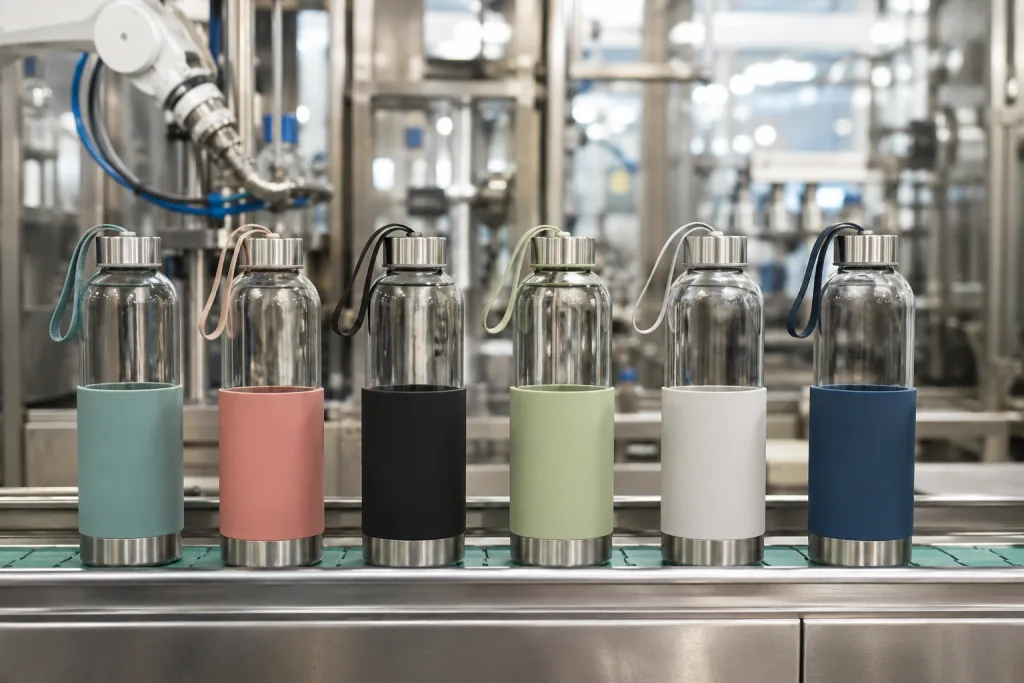
Key Takeaways
- A workable MOQ for glass sport bottle custom is often 1,000-3,000 pcs per SKU, with 25-35 day production after sample approval
- For 550-650ml borosilicate bottles, FOB China pricing commonly moves from USD 1.85 to USD 3.60 depending on sleeve, lid, and print process
- Your RFQ should lock 10 core specs: capacity, glass type, wall thickness, lid material, logo method, packaging, test standard, AQL, Incoterm, and target date
- Pre-production samples usually take 7-12 days; mass production samples for packaging confirmation add another 3-5 days but prevent expensive carton mistakes
You can buy a glass bottle from almost any catalog. Easy part. The hard part is building a glass sport bottle custom program that survives a 1.2 m drop test, clears compliance, matches the decoration file you approved, and still lands at a price your sales team can sell. We’ve seen the trouble start before sampling even opens: vague RFQs, PO lines with no carton spec, and buyers assuming the lid thread, insert color, or test standard is “standard.” It usually is not.
If you are a procurement manager, brand owner, or distributor drinkware buyer in Europe or North America, you need a process that runs quietly. No drama. At BottleForge Industrial in Zhejiang, China, we run custom drinkware jobs from first drawing to final carton inspection, and QC pulled enough bad pre-production samples over the years to prove one point: “cheapest unit price” is the wrong question to ask. Clean orders ship with fewer surprises because the specs are written tight, the MOQ is realistic, and each line item leaves little room for the line to guess.
Start with an RFQ that can be quoted
Most buyers ask for a quote before the supplier has enough to price. A canteen manufacturer or canteen supplier in China cannot give a reliable number from one line like “need custom glass bottle with logo.” That gets you a placeholder, not a decision-grade quote. We see this every week. On our side, the sales team usually checks bottle weight, cap structure, and packing count before we even ask the line for a cost sheet. If you want real pricing and a lead time you can use, write the RFQ like a purchase brief.
For glass sport bottle custom, send these details in the first email:
- Capacity: 500ml, 550ml, 600ml, 750ml
- Glass type: high borosilicate or soda-lime
- Wall thickness: for example 2.8mm or 3.2mm
- Bottle structure: single wall, silicone sleeve, tea infuser, carry loop
- Lid material: PP, Tritan, bamboo cap, stainless steel cap with PP inner
- Decoration: 1-color silkscreen, heat transfer, decal, laser on cap, sleeve deboss
- Packaging: egg-crate bulk, white box, color box, PDQ, mailer
- Compliance target: REACH, LFGB, Prop 65, ASTM where applicable
- Order quantity: by SKU and total
- Trade term: FOB Ningbo, EXW Zhejiang, or DDP if you need landed cost
Add the target retail channel. This is not a small detail. A canteen distributor serving promo clients buys differently from a canteen vendor supplying specialty retail, and the quote logic changes with it. If you sell into e-commerce, say Amazon FBA, barcode position, drop test standard, and master carton weight limit up front; we often cap cartons at 15 kg because the buyer flagged handling claims before. If you are a canteen factory sourcing for another brand, say that too. Approval flow is usually slower, and tolerance calls get tighter once their QC team joins the thread.
A good RFQ also states what you do not want. Example: no bamboo due to mold risk in humid warehouses, no direct print on the curved shoulder area, no individual polybag, no lid squeak, no metallic ink. This is the right place to be picky. We have seen projects go sideways because the PO said “black lid” and the buyer meant matte black outside with a food-contact PP inner, while the sample room built gloss black. QC pulled the sample, but that was 6 days later. In Zhejiang, China, experienced canteen manufacturers read this level of detail as a buyer who knows the job, and those RFQs usually get answered faster with fewer back-and-forth edits.
PO line items to define at RFQ stage
- Item name and target capacity
- Target FOB price range, if you have one
- Estimated annual volume, not just trial order
- Required certifications and test reports
- Requested sample deadline and bulk ETA
Pick the bottle architecture before the artwork
Buyers often start with logo position before they lock the bottle structure. That is the wrong order. On glass, structure decides breakage rate, packing method, decoration yield, and how the carton holds up in transit. On one 550ml run, QC pulled the sample and found the artwork was fine, but the shoulder radius forced a wider divider and cut master carton quantity. For a customized drinkware project, pick the body and closure first, then place the artwork around that.
For sports and daily hydration, high borosilicate is usually the safer default than soda-lime. It handles wider temperature swings and gives a stronger shelf impression. A common 550ml borosilicate body with 3.0mm wall thickness and a PP carry lid is a solid baseline, and we run this spec on the line week after week. Add a silicone sleeve and your freight cube rises, assembly labor rises, and pack-out slows because workers have to seat the sleeve cleanly over the base ring. Claims from transit breakage usually drop. The math matters if you are a canteen distributor or distributor canteen buyer shipping mixed orders to 12 end customers instead of one warehouse.
You are not buying a pretty bottle. You are buying a failure rate, a freight profile, and a repeat-order margin.
Lid choice is where new buyers lose margin fast. Bamboo photographs well, but we have seen this go sideways when the moisture content is not controlled and the insert fit shifts after storage. One buyer flagged shade variation on 2,000 caps after a humid-week arrival, even though the sealing test passed. A stainless outer cap with food-contact PP inner and silicone seal is more predictable on repeat orders. For leak resistance, write the test method into the PO: filled with water, inverted 30 minutes, no visible leakage. If the shipment will move through parcel channels, add a vibration test on top of that.
If your project overlaps with a custom canteen or customizable canteen line, think about part commonality early. Shared caps across glass, stainless, and Tritan programs cut spare-part inventory and make future POs cleaner. We have seen buyers save one full carton SKU just by keeping the same 43mm thread family across two bottle bodies. Some canteen suppliers and canteen vendors can build that cross-platform setup. Many cannot, and the buyer only finds out after the sample stage.
PO line items to lock before sampling
- Body material and wall thickness tolerance
- Lid construction and gasket material
- Bottle mouth finish and thread spec
- Assembled unit weight target
- Leak standard and basic drop/transport expectation
At BottleForge Industrial, our factory in Zhejiang runs around 600,000 units per month across categories, but glass projects still live or die on structure simplicity. A straight-wall 600ml body prints faster, packs faster, and usually ships in a cleaner divider layout than a contour bottle with sleeve, strap, and gift box. On the packing bench, that difference is obvious in labor minutes per carton. Technical choice comes first. Artwork follows.
Build the quote from actual cost drivers
If a canteen vendor sends a one-line price, treat it as the opening bid, not the quote. On glass sport bottle custom, the main cost drivers are the bottle body, lid build, print method, packing spec, and reject rate on the line; bottle size alone does not tell you much. We see this every week. A 600ml bottle with a sleeve and carry loop can land higher than a plain 750ml bottle because QC pulled the sample for sleeve fit and print alignment, not because of the extra glass.
As a rough FOB China guide for 1,000-3,000 pcs per SKU:
- 550ml borosilicate bottle, PP lid, 1-color print, white box: USD 1.85-2.40
- 600ml borosilicate bottle, silicone sleeve, carry loop lid, 1-color print: USD 2.40-3.10
- 750ml borosilicate bottle, bamboo-style lid, color box, 2-position print: USD 2.90-3.60
Tooling on standard bottles is usually light, but custom sleeve molds, special cap tooling, or exact-fit gift box inserts add setup charges fast. Ask direct questions: are screen charges billed per color per design, does carton artwork revision need a new plate, and are barcode labels in the unit price or billed at USD 0.03-0.05 each? Buyers miss this point. Last month one PO even had the barcode size typed wrong at 38mm instead of 83mm, and the buyer flagged it only after the packing layout was done.
For larger orders, ask the supplier to break the price into cost buckets. This is the right question. A usable quote should show bottle, cap, decoration, packaging, and add-on parts such as tea infuser or strap. Then you can cut cost without damaging the product spec. We run this exercise with buyers all the time: switch from a rigid color box to a 350gsm kraft box and you may save USD 0.18-0.35 per unit; change a two-color wrap print to a single-color spot logo and save another USD 0.06-0.12. On a 5,000-piece order, the math works.
If you are comparing canteen manufacturers or canteen distributors acting as sourcing agents, compare the same Incoterm line by line. FOB Ningbo is normal for Zhejiang exporters. EXW often looks lower on paper, then local trucking, export docs, terminal handling, and booking coordination get pushed back onto the buyer. We ship this route every month. If you need delivered pricing to Europe or North America, ask for DDP as a separate line and still keep the FOB breakdown so you can see where the cost sits.
PO line items to confirm in the quotation
- Unit price by SKU and by quantity break
- Sample charge and refund terms
- Tooling or artwork setup fees
- Carton dimensions, gross weight, and units/carton
- Payment term, usually 30% deposit and 70% before shipment
Approve samples like a production buyer
A sample is not a photo prop. It is the cheapest place to find trouble, when the fix costs tens of dollars instead of thousands on the line. Most customized canteen and customizable drinkware projects need two sample rounds at minimum: a blank construction sample first, then a decorated pre-production sample. We still see buyers try to skip the blank sample on a 5,000 pcs PO. The math doesn't work.
Typical timing in China is 3-5 days for stock blank samples, 7-12 days for logo samples, and another 3-5 days if packaging is customized. If your deadline is tight, ask what we can run in parallel. We often move the bottle body sample and carton mockup together, while final print approval waits for PMS confirmation. Last month a buyer flagged an 18-day target; by splitting the work, we shipped approvals in 12 days instead of 18.
When the sample arrives, inspect it like your QC team would. Not like marketing.
- Measure capacity and check overflow capacity with a graduated cylinder, not a kitchen cup
- Confirm body straightness and base stability on a flat plate; QC usually checks wobble within 1 mm
- Check seam, bubbles, scratches, and foreign specks under white light at 600-800 lux
- Test lid torque, leakage, and carry loop strength; we run a simple inverted leak test for 30 minutes
- Check logo position with a ruler, not by eye; 2 mm drift is enough for the buyer to reject it
- Review print adhesion and curing with a tape test after full drying
- Open and close the carton, inner fit, and divider quality; one weak divider can crack 24 bottles in transit
For glass, define acceptable cosmetic standards by zone. Minor pinpoint bubbles may be fine on the lower body, but not in the logo area. If you leave this vague, your supplier and your receiving team will judge the same defect two different ways. Use marked photos with circles, arrows, and notes like “reject if bubble >1.5 mm in Zone A.” We prefer that. QC pulled a sample last season because the buyer approved “clean appearance” on the PO, which says nothing.
If the order is for a custom growler or customizable growler line extension, do not copy beer-growler assumptions onto sports bottles. We’ve seen this go sideways. Neck finish, filling habits, and daily use are different, so the risk points change fast. A distributor once reused a growler insert for a 550 ml sport bottle, and the neck clearance was off by 6 mm. The same applies if a distributor growler program shares packaging rules with drinkware but not with sports hydration.
PO line items to add after sample approval
- Approved sample reference number or date code
- PMS color callout and print placement drawing
- Signed packaging artwork PDF version
- Defined cosmetic acceptance photos
- Golden sample storage requirement at factory
Write the bulk PO so nothing is guessed
The purchase order is where fair pricing turns into costly arguments. We see this on the line all the time. If your PO says only “glass bottle with logo,” the factory has to piece together 12 email threads, 4 PDF attachments, and one marked-up photo from a sales chat. That is the wrong way to buy. Your bulk PO should stand on its own, with nothing left to memory.
For a serious glass sport bottle custom order, write the PO in full line-item form. This is the format most factories in Zhejiang can run without back-and-forth:
- Item code: GF600-BS-PPLID-SLV-BLK
- Description: 600ml high borosilicate sport bottle, 3.0mm wall, black PP carry lid, black silicone sleeve
- Decoration: 1C white silkscreen, front center, 55 x 70mm
- Packaging: 1pc/white box, 24pcs/master, divider type B
- Compliance: REACH SVHC, LFGB for food-contact parts
- Inspection: AQL 2.5 major / 4.0 minor unless otherwise agreed
- Quantity: 3,000 pcs
- Unit price: FOB Ningbo USD 2.58
- Lead time: 30 days after deposit and artwork approval
Then write the commercial terms in the same PO, not in a separate chat message that gets missed. Put in payment schedule, late-change policy, over/under shipment tolerance, carton marking, pallet requirement, booking contact, and document list. If you need FNSKU labels, Amazon outer carton labels, or bilingual warning labels for Europe, spell them out line by line. We had one buyer flag a shipment because the outer carton mark showed “Made in Chian” from a typo on the PO artwork file. Small miss. Big delay. If a canteen distributor is shipping to 3 or 4 warehouses, carton mix rules also need to be written clearly, such as “one SKU per carton” or “mixed inner packs prohibited.”
From Zhejiang, China, standard MOQ for custom glass bottles is often 1,000 pcs per color per size. Special lids or gift boxes push MOQ to 2,000-3,000 pcs fast. Ask the canteen factory to state MOQ by component, not just by finished item. This matters on repeat orders. If you reorder only the black sleeve and keep the same 600ml bottle body, the math changes, and we have seen buyers assume 1,000 pcs is enough when the silicone sleeve supplier is asking for 2,000 pcs per Pantone. That gap causes trouble.
For larger programs, attach the approved BOM to the PO. If the cap has a stainless shell, PP inner, silicone ring, and nylon strap pin, name every part. Use part names the factory actually uses on the floor, not just “cap set.” QC pulled one sample last year where the strap pin diameter was 0.3mm off because purchasing swapped a like-for-like part from another mold. The bottle still looked fine in photos. It failed in use. Experienced canteen manufacturers list each small component because substitutions in these parts cause most post-shipment complaints.
Control production, inspection, and shipment timing
After the deposit lands, stay on the order. Bulk quality comes from checkpoints on the line, not crossed fingers. For a 3,000-10,000 piece customized growler, customized drinkware, or glass sports bottle order, we usually run five gates: material confirmation, first article approval, inline inspection, final inspection, and shipment release. Miss one gate, and QC pulled the sample too late to fix the batch.
Ask for a dated production schedule, not a rough promise. Standard lead time for custom glass bottle orders from China is 25-35 days after sample approval, and we usually break it down by printing, assembly, packing, and booking. If the order has a silicone sleeve and color box, assembly is often the choke point, not the furnace output. On one 5,000-piece run, sleeve fitting added 4 days because the opening tolerance was off by 1.5 mm. Buyers ask about glass output first; this is the wrong question to ask.
Inspection needs to match the product risk. For glass, define checks for:
- Appearance defects by zone, with clear photos of what is acceptable on the body, base, and neck
- Leak test pass rate, such as 30 minutes inverted with no seepage at the lid or gasket
- Logo placement and color variance, measured against the approved sample or Pantone target
- Carton drop resistance and divider integrity, usually after a 76 cm drop test on export cartons
- Count accuracy and barcode scanability, including a live scan with the warehouse gun before sealing cartons
Put AQL in writing. AQL 2.5/4.0 is common for consumer drinkware, but critical defects should stay at zero tolerance for sharp edges, broken glass, missing gaskets, or wrong food-contact materials. If you need third-party inspection, book it before the ex-factory date, not after the truck is waiting. In Zhejiang, inspection slots get tight before CNY and September shipping peaks, and we've seen this go sideways over one missed booking email.
Before shipment, confirm if goods move in loose cartons, on pallets, or with corner board plus stretch wrap. Pallets cut handling damage on the warehouse side, but they add cube and local charges; on a 40HQ, that cost difference is not small. If you are a canteen distributor, canteen distributors, or distributor growler buyer supplying more than one channel, ask for a packing list with carton count by SKU, net weight, gross weight, and CBM per SKU. We ship this file in Excel because warehouse teams catch mistakes fast there. Last month a buyer flagged a PO typo where 24 pcs/carton was entered as 12.
Keep records from the first bulk run. Good canteen vendors and canteen suppliers get better on repeat orders when you send hard data: breakage rate on arrival, claim photos, sell-through, and carton performance. A 1.8% breakage claim with photos of the bottom-left corner tells us more than a general complaint. That is how a one-off order turns into a stable supply program instead of the same trial-and-error loop every season.
Send your glass bottle RFQ with full specs
We will review structure, MOQ, pricing, and lead time, then suggest the cleanest PO setup for your custom drinkware program from Zhejiang, China.
Frequently asked questions
What is a realistic MOQ for glass sport bottle custom orders?
For standard shapes from a canteen manufacturer in China, MOQ is usually 1,000 pcs per SKU for basic logo printing and plain white box packing. If you want custom lid colors, silicone sleeves, color gift boxes, or multiple print colors, the practical MOQ often moves to 2,000-3,000 pcs per SKU. Some components have separate MOQs, so ask by bottle, cap, sleeve, and box. A 3,000-piece order can sometimes split into 2 colors if the cap and packaging stay the same. For trial orders, blank samples are easy, but true decorated production pricing rarely makes sense below 1,000 pcs because setup, print, and packing labor spread poorly.
How long does a custom glass bottle project usually take from RFQ to shipment?
If your artwork and specs are clear, plan 2-4 days for quotation, 7-12 days for pre-production samples, and 25-35 days for bulk production after sample approval and deposit. Add 3-5 days if you need a custom color box or Amazon-specific labeling review. Third-party testing can add 5-10 working days depending on the lab and required scope such as REACH or LFGB on food-contact parts. In peak periods before Chinese holidays, build in another 7-10 days. If a supplier promises everything in 15 days for a decorated glass bottle with custom packaging, ask exactly what they are skipping.
Which compliance and quality checks matter most for Europe and North America?
For Europe, buyers commonly ask for REACH and LFGB on relevant food-contact components, especially lid and gasket materials. For North America, requirements often include FDA-related food-contact conformity by material, plus Prop 65 attention where applicable. On the factory side, ask about ISO-style quality systems, social audits such as BSCI if your brand requires them, and written AQL standards for final inspection. For glass bottles, do not stop at paperwork. Request leak testing, carton drop checks, logo adhesion review, and sharp-edge screening. A paper certificate does not prevent a cracked base or a loose cap insert. Put both compliance documents and physical test criteria on the PO.
How should I compare quotes from different canteen suppliers or canteen vendors?
First, normalize the Incoterm. Compare FOB Ningbo to FOB Ningbo, not FOB to EXW. Then match the specification line by line: glass type, wall thickness, lid material, logo method, sleeve, box type, carton count, and testing requirement. A bottle quoted at USD 2.05 may actually use thinner soda-lime glass while a USD 2.48 offer uses 3.0mm borosilicate with better packaging. Ask each canteen supplier to break out bottle, cap, print, and packaging costs. Also compare lead time, MOQ by component, sample charges, and claim handling policy. The cheapest number is often the most incomplete number, especially on customized drinkware.
What should be on my PO to reduce quality disputes on bulk glass bottle orders?
Your PO should include item code, full description, capacity, material, wall thickness, lid construction, gasket material, decoration method, artwork version, PMS reference, logo placement size, packaging spec, carton count, barcode rules, inspection standard, AQL level, compliance requirement, quantity, unit price, Incoterm, lead time, and payment terms. Add approved sample reference, photo standard for cosmetic acceptance, and over/under shipment tolerance, usually within 3% only if you allow it. If the order is for e-commerce, include carton weight limits and label positions. A detailed PO turns memory into documentation, which is exactly what protects both you and the factory in China.