Key Takeaways
- Set PP resin grade, glass thickness, and leak test method upfront; a 500 ml bottle should typically use 2.5-3.0 mm soda-lime glass
- For custom orders in Zhejiang, China, practical MOQ is often 3,000-5,000 pcs per color, with 25-35 day lead time after sample approval
- AQL 2.5/4.0 with 1.2 m drop-carton validation reduces repeat claims far more than visual inspection alone
- Decoration, cap torque, and retail packaging cause more returns than body glass defects in many wholesale drinkware programs
You usually don’t lose money because a bottle quote came in $0.12 higher. You lose it on the first run: lids leak at 15 kPa vacuum test, logos fail the rub test after 30 cycles, or glass ships in parcel cartons with a 5 mm divider that belongs on pallet freight, not courier handling. That’s the real problem in glass polypropylene bottle wholesale. The drawing looks simple. The line does not.
If you buy wholesale drinkware for Europe or North America, spec the bottle like a product engineer, not a catalog buyer. In Zhejiang, we run into the same issue across bulk drinkware, canteen wholesale programs, and growler bulk orders: the buyer flagged defects that should have been stopped before sampling. Most were avoidable if the PO locked material, tolerance, test method, and packaging up front. We’ve seen a one-word PO typo on “PP inner lid” vs “silicone seal” send a project sideways. That’s where margin is protected, and this is the wrong question to ask if you are only comparing unit price.
Where these bottles fail first
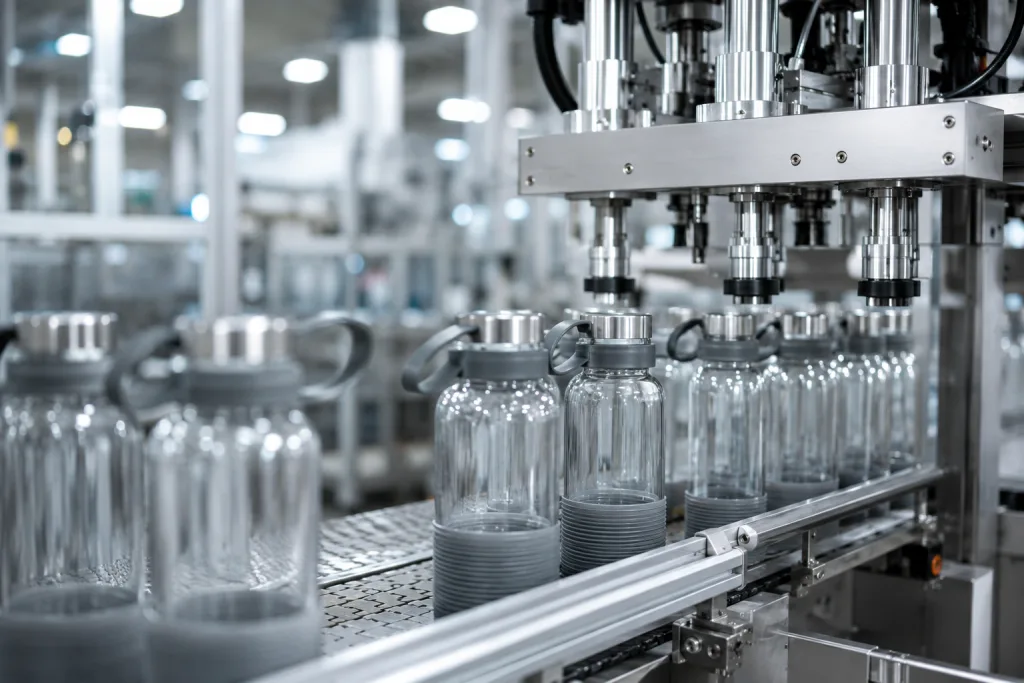
A glass body with a polypropylene part looks simple on the drawing: glass bottle, PP lid, maybe a PP sleeve, carry loop, or infuser frame. On the line, this combo is where fit problems start. Glass holds its shape after forming. PP moves with mold temperature, resin lot, and wall thickness; we see lid OD shift by 0.20 mm between cavities if the process drifts. The first failures show up at the interface.
For glass polypropylene bottle wholesale, these are the factory-side failures we see first:
- Neck finish mismatch: lid threads run tight on one cavity and loose on another. QC pulled the sample, and cavity #3 needed 15% more torque than cavity #1.
- Leak paths: silicone gasket is undersized, over-compressed, or cut with flashing. We’ve had buyers flag a slow leak after a 45-degree inversion test because the gasket parting line was not trimmed clean.
- Impact breakage: body glass is too thin for the use case, or the packaging does not protect the shoulder and base. This is where the math doesn’t work if the target is light weight and drop resistance in the same spec.
- PP warpage: lids wobble or sleeves sit unevenly after cooling. On one run, a 2.8 mm wall section cooled unevenly and the lid rocked on the neck finish.
- Decoration loss: screen print scratches off during carton vibration or dishwasher exposure. We ship vibration-tested packs, and weak ink adhesion shows up fast on dividers with rough edges.
- Odor complaints: lower-grade PP resin, color masterbatch, or gasket material leaves smell in first use. We’ve seen this go sideways with recycled-content claims that were never written clearly on the PO.
These problems are not tied to one bottle style. If you also buy bulk canteen, wholesale growler, or beer tumbler wholesale bulk items, you are still dealing with the same root causes: resin control, tolerance stack-up, transport abuse. A Zhejiang factory can run 400,000 units per month, but output does not repair a weak spec. This is the wrong question to ask: “Can you match the sample?” Ask how the line checks it instead. You need a control plan that states what matters, how we measure it, and what gets rejected at AQL 2.5 or before.
Buyers often say, “match the approved sample,” and that leaves too much open. A usable spec lists dimensions, material grades, test method, defect limits, and carton packout; we’ve even had a PO typo swap 24 pcs/ctn to 12 pcs/ctn and create breakage in transit.
Glass body defects that create claims
Body glass defects turn straight into claims: breakage in transit, safety complaints, and retailer rejects at receiving. For the usual 450-750 ml bottle, soda-lime glass is still the standard in China because the cost works and the supply base is deep. Borosilicate handles thermal shock better, but the cost can be 25-50% higher depending on shape and decoration. If the bottle does not need hot-fill or sharp temperature change, soda-lime is the practical pick. On our line, QC still checks base concentricity with a go/no-go gauge before packing because a clean-looking bottle can still fail in use.
The trouble starts with an underspecified body. Buyers ask for the best wholesale drink bottle price, then the factory cuts glass weight to hit it. We have seen a 550 ml bottle body that should be around 280-340 g come in 20-35 g lighter. That sounds minor. It is not. The shoulder and base take the hit first, especially in parcel channels where cartons get dropped on one corner and the buyer flagged it only after arrival photos came back. This is the wrong question to ask: not lowest unit price, but safe weight at the target freight route.
What to lock before sampling
- Glass type: soda-lime or borosilicate.
- Target weight: specify tolerance, for example 310 g plus or minus 8 g.
- Wall thickness: note critical points at sidewall, shoulder, and base. Typical sidewall may be 2.5-3.0 mm for a standard 500 ml bottle.
- Neck finish dimensions: ID, OD, thread pitch, and sealing land tolerance.
- Thermal shock requirement: for example 40°C change without crack if relevant.
Your QC team should check more than surface appearance. Ask for body weight by cavity, not just a mixed average, because one weak cavity in an 8-cavity mold set can drive most of the breakage. We run into this a lot. QC pulled the sample, average weight passed, but cavity No. 6 was 11 g light and kept failing at the shoulder. Set visual limits for bubbles, stones, seam lines, and chips in writing. A small seed bubble away from the sealing zone may pass. A rim chip does not pass, full stop.
For canteen bulk and drinkware bulk programs sold through e-commerce, ask for a packaged drop test, not body inspection alone. A common benchmark is one shipper dropped 10 times from 76 cm for retail transit, or ISTA-style validation if your channel requires it. For palletized B2B distribution, 1.2 m carton corner and edge drops are often enough to expose weak dividers. We have seen this go sideways when the divider paper was 200 gsm on the spec sheet but 170 gsm on the actual packout. If the supplier shows only bottle inspection and no packaging validation, claims usually show up 12 days after arrival, not on day one.
Polypropylene parts cause hidden trouble
Most claims in glass polypropylene bottle wholesale do not start with the glass body. They start at the PP parts: lid, cap insert, sleeve, handle, or infuser housing. PP makes sense here because it is food-contact friendly, light, and cheaper than Tritan or stainless assemblies. Still, the line has to hold it tight. Last month QC pulled a lid sample with sink marks around the handle boss, and the buyer flagged leakage before anyone mentioned the bottle itself.
Start with resin. Writing only “PP” on the artwork sheet is the wrong question to ask. Homo-PP and copolymer PP do not run the same in molding, and they do not feel the same in hand. Food-contact compliance for REACH, LFGB, or FDA-related declarations also depends on the exact resin and the color masterbatch lot. Ask for a material declaration, resin grade, and a migration test plan if your market needs it. We have seen importers in Germany and France ask for batch-level backing documents, while a general US private-label account often stops at the declaration sheet. That gap is real.
Then check molding stability. Warpage usually starts with uneven wall thickness. A lid top at 2.0 mm tied into a skirt at 1.1 mm cools at different rates, so the part can ovalize after ejection. We check this with a go/no-go thread gauge and cavity records, not guesswork. Once the lid goes oval, cap torque drifts by cavity. If one lid seals at 8 lbf·in and another needs 15 lbf·in, your filling line will catch it on day one, or your customer will.
Specifications buyers should add
- PP resin grade with approved substitute rules. Put the exact grade on the spec, because “equivalent PP” has caused more than one PO fight for us.
- Color tolerance against Pantone, especially for light colors that show flow marks. On white and beige lids, we usually keep a retained sample at the press for comparison.
- Critical dimensions for thread, gasket seat, and handle hinge. Call out the mm tolerance, or the math does not work later at assembly.
- Torque range, such as 9-12 lbf·in for closing and a controlled opening range. We run torque checks by cavity because average data hides bad parts.
- Odor standard: no abnormal odor after 24 hours sealed at room temperature. This sounds basic, but we have seen masterbatch cause a waxy smell after sealing.
This issue is not limited to bottles. The same resin and molding logic applies when you source wholesale canteen, alcohol flask wholesale bulk accessories, or beer growler wholesale bulk closures. If a factory cannot show cavity-level measurements and incoming resin traceability, risk goes up fast. At BottleForge Industrial, practical MOQ for custom PP colors is commonly 3,000 pieces, because below that color setup, purge loss, and first-shot adjustment on the molding machine stop making sense. That is a production limit, not a sales line.
Leaks come from interfaces, not luck
A leak is not random. In production, it almost always starts at one of four interfaces: the glass sealing land, the lid geometry, the gasket, or the applied assembly torque. Yet we still get RFQs that say only “must be leakproof.” This is the wrong question to ask. Last month one PO even had “100% no leak in any condition” typed in the remarks, with no test setup at all.
For a standard screw-cap bottle, define the sealing system by section drawing and test method. If you use a flat silicone washer, specify hardness, usually in the range of Shore A 50-60 for many consumer drinkware applications. Too soft, and it extrudes after repeated capping. Too hard, and it will not conform to the glass finish. The gasket seat matters too. We have seen a cap pass visual review, then fail on the line because the compression zone was under 1.2 mm and plastic flash near the molding gate cut the seal contact.
Testing should be simple, repeatable, and easy for both sides to copy. We usually recommend three levels:
- Inline leak check: air pressure or vacuum method during assembly if available.
- Finished goods inversion test: filled with water, inverted for 30 minutes, no visible leakage.
- Transport simulation: vibration plus inversion after torque aging for 24 hours.
If your product includes a straw lid or flip spout, raise the bar. Those closures fail more often than plain caps, and we have seen this go sideways after launch. QC pulled the sample on one school bottle program because the bite valve dripped after 600 open-close cycles. For drinkware wholesale sold into gym, school, or commuter channels, a “leak-resistant” marketing line without test criteria turns into customer service cost. Say whether it must pass in a bag, on its side, or only upright.
For growler wholesale, beer tumbler wholesale, and beer growler in bulk projects, leak specs matter even more because carbonation pressure and repeated refilling change the use case. Do not assume the same closure design from a still-water bottle can be adapted to a bulk growler. The math doesn’t work. A cap that holds on a 500 ml still bottle may fail once internal pressure builds and the liner takes a set after 12 days of refill use. If the product is for beverages beyond water, say so clearly. Alcohol flask bulk and beer growler bulk orders may require different liner compatibility and odor checks, and we usually run a 24-hour retained-smell check before approval.
Decoration and packaging fail after approval
The approved sample looks clean for a reason: someone on the line hand-checks it and packs it one by one. Bulk production is where decoration and packaging fail. On glass polypropylene bottle wholesale orders, this is the point where buyers get burned after sign-off, because the first sample passed and carton drop reality did not.
Silkscreen on glass is stable if the ink system, curing window, and adhesion test are written down before we run. We usually check cure with a cross-hatch cutter and 3M tape, not by eye. UV print can look sharper, but we’ve seen dark red and metallic silver scratch on day 3 if the process setting is off. On PP lids and sleeves, adhesion is tougher because polypropylene has low surface energy. No flame treatment, no proper primer, and the logo rubs off in transit. QC pulled a sample last month where the buyer flagged black print transfer after only 20 rubs. This is the wrong question to ask: don’t ask whether the logo looks good on the photo, ask what test it passed.
Minimum control points
- Adhesion test: cross-hatch plus tape pull, with pass criteria written into QC.
- Abrasion test: for example 50-100 dry rub cycles on print areas.
- Dishwasher statement: only claim dishwasher-safe if you have tested it. Otherwise specify hand-wash only.
- Color reference: approved master sample under D65 lighting.
Packaging creates another set of avoidable losses. A bottle shipping from Zhejiang, China to Europe or North America might go through 5 handling points before end delivery: truck, sea, warehouse pallet jack, courier sortation, final parcel van. A nice gift box does not protect much by itself. We need the carton board grade, partition layout, drop orientation, and gross weight locked before shipment. Keep export cartons below around 15 kg if workers will handle them manually. We’ve seen this go sideways when a buyer asked for a thinner box to save $0.08, then two corners collapsed in the container. Specify EPE, molded pulp, or partition board by test result, not guesswork.
This applies whether you are sourcing canteen wholesale, wholesale growler, or drinkware bulk assortments. If the program mixes SKUs in one container, carton cube efficiency matters too. We ship 20,000-unit orders where a gift box reduced by 8 mm saves real freight, not paper savings on a spreadsheet. One PO even came in with “gift ox” typed instead of “gift box,” and nobody caught the actual size line until packing review. Good packaging engineering beats aggressive unit-price negotiation most of the time; the math doesn’t work if breakage eats the savings.
The QC plan buyers should actually use
A usable QC plan is not a 40-page PDF that sits in someone’s inbox. It is a short control sheet with measurable checkpoints tied to the failures that cost you claims, delays, or a rework run. For most wholesale drinkware orders, we run four gates on the line: incoming material control, first article approval, in-process checks by cavity, and final AQL inspection. One factory-floor rule matters here: first article sign-off should happen against the sealed golden sample, not a phone photo. We have seen buyers approve from WeChat images, then reject a 0.8 mm logo shift after 12,000 pcs were packed.
A practical final inspection level is often AQL 2.5 for major defects and 4.0 for minor defects. The defect list has to match the bottle, not copy a generic template. A crack, chip at sealing area, wrong logo, failed leak test, mold contamination, or missing compliance mark is major or critical. A faint seam line or a 1 mm non-focal bubble may be minor if function is fine. Write the defect standard before production starts. This is the wrong question to ask after the cartons are taped.
Your quality checklist should include:
- Dimensions: glass body weight, neck finish, cap thread dimensions, assembled height.
- Function: leak test, cap torque, handle pull if applicable.
- Appearance: print registration, color match, contamination, scratches, sink marks.
- Packaging: barcode scan, inner pack count, carton marking, drop test verification.
- Compliance file: REACH, LFGB/FDA declaration as needed, and test reports matched to actual materials.
If you ship to Amazon or large retail, add FNSKU label position, carton label format, and master carton size limits. QC pulled samples before with the right bottle and the wrong label panel, and the buyer flagged it only after arrival. If you buy from China through FOB Ningbo or FOB Shanghai terms, confirm whether inspection happens before or after final packing. For fragile goods, inspect after final packing. Otherwise you miss the main failure mode: weak dividers, short inner pack count, or a carton that fails a drop test at 76 cm.
A factory that can produce 300,000-500,000 units per month should also be able to show basic process capability: cavity traceability, rework rules, and corrective action records. Ask to see cavity marks tied to an in-process sheet, even if it is just a simple 8-cavity check log with hourly entries. If they cannot show that, the math does not work. The low quote is usually buying you uncertainty, delayed sorting, and arguments over whose defect it was. That applies to wholesale canteen, beer tumbler in bulk, alcohol flask in bulk, and nearly every other drinkware wholesale category.
How to spec for fewer surprises
If you want fewer surprises, don’t send only artwork and capacity. Send a sourcing pack. The buyers we see move fastest in Zhejiang usually send 2 pages: one for commercial terms, one for technical control. We run quotes faster that way, and we cut the back-and-forth from 12 days to 5. On the line, missing gasket hardness or print area is where trouble starts.
Your sourcing pack should state:
- Product definition: capacity, intended beverage, target market, channel, and whether it is for parcel or pallet distribution.
- Materials: soda-lime or borosilicate glass, PP grade, silicone gasket spec, any recycled-content requirement.
- Performance: leak standard, drop/packaging test, odor requirement, temperature-use warning.
- Decoration: process, print area, color standard, adhesion requirement.
- Compliance: REACH, LFGB, ASTM or CPSIA relevance for kids items, labeling language.
- Commercials: Incoterm, MOQ, target ex-factory or FOB price, and delivery window.
Here is the practical range. A custom glass bottle with PP lid in a straightforward shape may start around USD 1.10-1.80 FOB China at 5,000 pieces, depending on size, decoration, and packaging. If you add a gift box, switch to borosilicate glass, or build a multi-part lid, the math moves up fast. We’ve seen buyers miss this on first costing. Sampling usually takes 7-12 days for existing molds and 20-30 days if new tooling is involved. Normal bulk lead time is 25-35 days after sample approval and deposit. For one recent 500ml program, QC pulled the sample because the screen print shifted 1.5 mm, and that alone cost 3 days.
If you are comparing suppliers across canteen bulk, growler wholesale, alcohol flask wholesale, or beer growler wholesale bulk lines, don’t compare unit price alone. This is the wrong question to ask. Compare landed risk. Ask which tests are included, how many cavities are in the mold, whether spare gaskets are produced, and what the claim policy is for transit breakage. We also suggest checking carton drop standard and inner partition thickness in mm, because the buyer flagged breakage on a 24-pack before and the glass was fine—the carton was too weak. Good sourcing is not about chasing a miracle quote. It is about removing the obvious failure points before your logo goes on the bottle.
Send your spec, not just a photo
We will review your glass and PP design, flag likely failure points, and quote MOQ, FOB pricing, and lead time from Zhejiang within 2 working days.
Frequently asked questions
What MOQ should I expect for glass polypropylene bottle wholesale?
For a custom color, custom logo, and standard bottle shape, a realistic MOQ is usually 3,000-5,000 pieces per SKU. If you want a new mold, plan on 5,000-10,000 pieces to spread tooling cost sensibly. Plain stock items can be lower, sometimes 1,000 pieces, but color and packaging options become limited. In Zhejiang, China, MOQ also depends on the PP part color because the molder does not want frequent line purges for tiny runs. If your range includes wholesale canteen, drinkware bulk, and a growler bulk variant, it is often smarter to standardize lid components across several bodies so you can consolidate volume and reduce MOQ pressure.
Is soda-lime glass good enough, or should I request borosilicate?
Soda-lime glass is good enough for many cold-drink programs if wall thickness and packaging are correct. It is the normal cost-driven choice for wholesale drinkware and canteen wholesale lines. Borosilicate is better if your customers will pour hot water, use infusers, or expose the bottle to faster temperature changes. Expect borosilicate to cost roughly 25-50% more depending on shape and decoration. For a 500-600 ml consumer bottle, ask the supplier for body weight, critical wall thickness, and thermal shock criteria instead of choosing only by name. If your product is a beer growler in bulk or a specialty beverage bottle, also confirm whether the closure and gasket are compatible with the actual beverage use.
How do I reduce leak complaints before shipment?
Do not rely on a general promise of 'leakproof.' Specify the closure type, gasket material, torque range, and test method. A basic standard is a 30-minute inverted water test with no visible leakage on AQL samples. Better is adding a 24-hour aging period after capping, then repeating inversion and vibration testing. Ask for silicone hardness, usually around Shore A 50-60 for many bottle seals, and confirm thread dimensions on both glass and PP cap. If the lid has a straw or flip spout, increase your sample size because those closures fail more often. This same rule applies to wholesale canteen, beer tumbler wholesale bulk accessories, and alcohol flask wholesale bulk closures.
What compliance documents should I request for Europe and North America?
At minimum, ask for a declaration of materials used in the glass body, PP parts, color masterbatch, and silicone gaskets. For Europe, buyers often request REACH-related statements and sometimes LFGB testing depending on market expectations. For North America, the exact file depends on product type and customer requirement, but food-contact declarations and component traceability are standard asks. If the item is for children, ASTM or CPSIA-related checks may become relevant. Make sure reports match the actual materials and colors used in production, not just a generic old report. A common failure in China sourcing is that the test report is valid for the clear PP cap, while your order uses a black masterbatch from a different supplier.
What lead time is normal for a custom wholesale drinkware order?
For an existing mold with new logo and color, sampling usually takes 7-12 days. Bulk production is commonly 25-35 days after final sample approval and deposit, assuming order quantity is within normal capacity. If you need a new mold, add around 20-30 days for tooling and first trials. Packaging can become the hidden delay, especially if you use gift boxes, molded pulp, or multilingual inserts for Europe and North America. In Zhejiang, China, factories often quote fast lead times based on the bottle only, not the full packed set. For wholesale growler, drinkware wholesale assortments, or alcohol flask bulk projects, always confirm whether lead time includes final packing, inspection, and booking readiness.