Key Takeaways
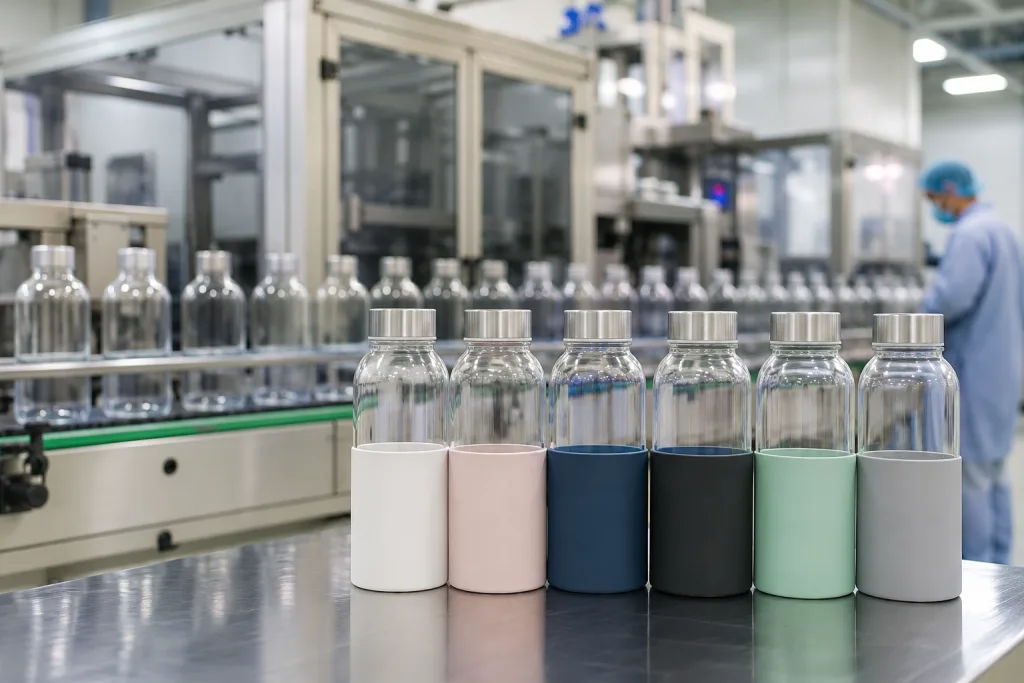
- For most custom glass + PP programs, realistic MOQ starts at 1,000-3,000 units per colorway, with sample lead time of 7-12 days and mass production in 25-40 days.
- A standard 550 ml borosilicate bottle usually uses 2.5-3.0 mm wall thickness; thinner glass lowers cost but increases breakage risk during distributor canteen shipments.
- Ask for AQL 2.5 inspection, REACH or LFGB test reports, and leak testing at 100% before packing to reduce claim rates below 1.0%.
- FOB Ningbo or Shanghai pricing for custom drinkware glass polypropylene bottles often lands around USD 1.80-4.20 depending on cap tooling, decoration, sleeve, and packaging.
You are not buying a bottle. You are buying the full stack: glass spec, decoration method, compliance paperwork, and an ex-factory ship date we are expected to hit. This gets messy fast. We see 10 China suppliers quote from similar photos, then the details split hard on glass thickness by 0.3 mm, PP grade, leak test method, and lead time—12 days on one quote, 18 on another. On the line, those gaps are not small.
For B2B buyers in Europe and North America, the job is to separate a trading quote from a program that can actually run. This is the wrong question to ask: “Who has the lowest price?” Ask who can sample fast, hold AQL discipline, and explain the build. In Zhejiang, where a big share of drinkware capacity sits, the difference shows up early. A 550 ml borosilicate bottle with a PP lid should clear REACH, LFGB, and drop testing before you place 3,000 units, and if the supplier cannot explain wall thickness, lid fit, and why QC pulled the sample after a 1.2 m drop, we have seen this go sideways.
What are you really buying?
From a glass polypropylene bottle supplier, you are not buying “a bottle.” You are buying a BOM and a process route. On the line, that usually means a borosilicate or soda-lime glass body, a PP cap or sleeve part, a silicone sealing ring, decoration, inner and outer packaging, and a test plan. We check these as separate cost points, not one lump sum. If your supplier cannot break out each part clearly, down to wall thickness in mm and packing spec, you are buying blind.
Most European and North American buyers asking for a custom canteen or customizable drinkware line want four things at the same time: a clean look, leak control, legal compliance, and a price that still works after freight and distributor margin. Those targets clash all the time. A lighter bottle may save USD 0.08-0.15 per unit ex-factory, but if transit breakage goes up 2%, the math doesn't work. We have seen buyers push for lighter glass, then QC pulled the sample after a 1.2 m carton drop because the base chipped.
- Glass options: borosilicate for thermal shock resistance; soda-lime for lower cost. Ask the body weight in grams and wall thickness, not just the glass name.
- PP options: standard polypropylene for lids, handles, or shells; food-contact grade only. We usually check cap fit with a torque tester before mass run.
- Decoration options: silk screen, heat transfer, decal, laser on coated parts, paper inlay for gift sets. The buyer flagged color shift once on a navy logo, so now we match against the signed chip under the light box.
- Packaging options: egg-crate, individual box, mailer-safe box, PDQ display, FNSKU labeling for Amazon channels. One PO even came with the FNSKU typo'd, and that small miss delayed relabeling by 3 days.
In Zhejiang, China, a capable canteen factory should explain why one structure fits your market better than another. This is the right question to ask. If you are a canteen distributor or distributor drinkware buyer, push past catalog names and marketing copy. Ask for exact capacity tolerance, neck finish dimensions, cap torque range, glass wall thickness, and carton drop standard. Good canteen manufacturers answer with numbers, not slogans. If they say “standard spec” without data, we have seen this go sideways.
A simple test: if a supplier talks about failure modes before you ask, they probably run this product often. If they only repeat “high quality,” keep looking.
How do you judge supplier fit?
The fastest way to get burned is to treat every canteen supplier or canteen vendor like the same shop. They are not. We see 3 common setups: a real factory, a trading company with fast replies but weak control on the line, and a stainless-focused plant trying to quote glass. For a glass polypropylene bottle supplier, the fit comes down to control of glass forming, cap injection, assembly, decoration, and QA. If they cannot tell you where the cap mold runs or who checks torque after assembly, this is the wrong question to skip.
Start with capacity and process visibility. A workable benchmark for a medium-size canteen manufacturer in Zhejiang is 300,000-600,000 units per month across mixed drinkware categories, with MOQ of 1,000 pieces for existing molds and 3,000-5,000 pieces for more customized canteen programs. Ask what part is made in-house and what part is overflow sent out. We have seen suppliers quote 500,000 units, then farm out silk print in peak season and lose color consistency by 0.5-1 Pantone shade. If your launch plan needs repeated POs every 45 days, ask whether monthly output is real production or outsourced overflow.
Questions worth asking early
- Do you own the glass line, the PP injection line, or both?
- What percentage of orders are export orders to the EU and North America?
- What are your normal lead times: sample 7-12 days, bulk 25-40 days, peak season 40-55 days?
- Can you provide BSCI or Sedex audit status, ISO 9001, and recent REACH or LFGB reports?
- What is your standard inspection level: AQL 2.5 or AQL 1.5 on critical issues?
If you are buying canteen promotional goods for retail, corporate gifting, or a distributor growler line, ask if they can control artwork changes across multiple SKUs without mixing parts. One sample is easy. Running 6 colorways, 3 cartons, barcode labels, and matching lids to the right bottle on the same packing line is where orders go sideways. QC pulled the sample is not enough; ask how they separate components, whether by carton mark, color card, or bin code. Last month a buyer flagged a PO typo that switched 2 barcode suffixes, and that small error would have mixed 1,200 units if the warehouse team was loose. That is where experienced China and Zhejiang exporters earn their margin.
Which specs matter before quoting?
Buyers ask for pricing too early. This is the wrong question to ask. Before you compare quotes, lock the specs that change cost, breakage risk, and packing method. A loose RFQ creates fake price competition because each canteen customizable quote is built on a different bottle. We see this on the line all the time: one PO says “550 ml clear glass bottle,” but says nothing about wall thickness, neck finish, or box style, so you end up comparing 2.5 mm glass against 3.0 mm glass as if they were the same item.
For a standard glass bottle with polypropylene cap, these are the cost drivers you should define:
- Capacity: 350 ml, 500 ml, 550 ml, 750 ml, 1,000 ml.
- Glass type and wall: borosilicate 2.5 mm, 2.8 mm, 3.0 mm; heavier glass improves hand feel and cuts breakage in transit, but freight goes up. On one drop-test run, QC pulled the sample and the 2.5 mm version failed sooner than the 3.0 mm version in the same partition.
- Cap construction: one-piece PP, PP + TPE carry loop, PP + silicone seal, inner strainer for infuser styles.
- Decoration: 1-color silk screen, full-wrap decal, spray coating plus logo, private-mold embossing.
- Packaging: bulk pack, white box, color box, gift tube, e-commerce test pack.
Here is the practical range. An existing-mold 550 ml bottle with PP lid, one-color logo, and white box may quote around USD 1.80-2.40 FOB China at 3,000 units. Add a silicone sleeve, two-color print, color box, and stricter inner partitioning, and you may move to USD 2.80-3.50. The math doesn’t work if you expect the first spec set and the second spec set to land at the same target. We ship both versions, but the pack-out is different: the sleeved bottle usually needs tighter dividers, and carton weight can jump by 1-2 kg per master carton. A customized growler or custom growler format with larger capacity and handle tooling can go higher, often USD 3.80-5.50 depending on mold amortization.
For canteen customized projects, ask the supplier to split one-time tooling from unit price. PP injection tooling for a new cap can range from roughly USD 1,500 to 6,000 depending on complexity and cavitation. New glass molds can be substantially higher. We’ve seen this go sideways when a buyer flagged the bottle price as “too high,” then we found the quote was hiding tooling inside the unit cost. A serious canteen factory will tell you if an existing finish can be modified by 0.5 mm or 1.0 mm instead of pushing a full custom mold right away.
How do you control compliance and quality?
If you sell into Europe or North America, compliance is not paperwork you file and forget. It sits inside your landed cost. A solid glass polypropylene bottle supplier should show current test reports fast and walk you through the QC flow without hand-waving. For food-contact drinkware, buyers usually ask for REACH, LFGB, or FDA-related declarations based on the market and the retailer’s policy. If the bottle is for children, ASTM and CPSIA-related testing often gets added. We’ve seen buyers lose 12 days just waiting for a corrected declaration because the PO listed the wrong lid material.
Quality control has to start before the line runs. For PP parts, ask for food-grade resin traceability by batch number and supplier lot. For glass, set visual limits for bubbles, mold seams, sharp edges, and lid fit, not just a general “good appearance” note. That wording is too soft. On our floor, QC pulled the sample and checked mouth diameter with a digital caliper in mm before assembly, then the team ran leak testing and torque control on finished bottles. If the lid torque drifts, the math doesn’t work: you save seconds on assembly and pay for claims later.
A workable checklist
- Request current test reports for the exact or similar material combination: glass, PP, silicone.
- Specify AQL 2.5 for major defects and tighter standards for critical defects such as leakage or cracked glass.
- Require 100% leak test before packing, not only random sampling.
- Confirm drop test standard for packed goods, such as 1.0 m or 1.2 m carton drop depending on channel.
- Ask for pre-production sample signoff and production sample retention.
For canteen vendors serving promotion, retail, and e-commerce at the same time, quality problems usually show up in off-center logos, lid fit variation, and breakage caused by weak partition design. We ship all three channels, and this is where buyers push back after arrival, not during sampling. A logo that sits 2 mm off may pass in a plain photo and still get rejected by a retail customer. That is why experienced canteen manufacturers in China put as much attention on packaging as on the bottle. If your distributor canteen program will be palletized and re-shipped, carton construction is not a side issue. We’ve seen this go sideways with 24-pack master cartons using thin dividers; saving a few cents there often costs more in breakage claims than the lighter box ever saved.
What lead times are realistic?
Buyers lose weeks when they plan around best-case lead times. For a glass polypropylene bottle supplier, the schedule changes fast depending on one basic point: are we running existing tooling, or are we building a custom drinkware program from scratch? If the bottle body and cap are standard parts and only the logo changes, 7-10 days for samples after artwork approval is realistic. We usually print a logo film first and QC checks position with a 0.5 mm tolerance. Production for 3,000-10,000 units usually runs 25-35 days outside peak season.
If you are developing a customizable canteen with a new cap mold, custom Pantone matching, or a new growler neck structure, add real development time. Tooling review takes 3-5 days. Mold build for PP parts takes 18-30 days. First trials need another 5-7 days, then sample confirmation. On the line, the first issue is often thread fit or cap torque, not color. Total pre-production development often lands at 35-50 days before bulk production starts. If someone skips that math, we've seen this go sideways.
Shipping shifts the launch date just as much as production. FOB Ningbo from Zhejiang, China gives you control of the forwarder, but your team still needs to book space and manage cut-off dates. Ocean transit to the US West Coast is often 18-25 days port to port; Northern Europe is often 30-40 days. Then add customs clearance, drayage, and warehouse receiving. Last month one buyer flagged a missed CY cut-off by 1 day, and the booking rolled to the next vessel. For a retail reset, work backward at least 90 days from shelf date for a repeat order and 120-150 days for a new customized canteen program.
If a supplier promises a new mold, approved sample, and 10,000-unit shipment in 20 days, you are not hearing a production plan. You are hearing a sales promise.
Ask for a milestone schedule with actual dates for artwork confirmation, color sample, pre-production sample, mass production, inspection, and ETD. This is the right question. We ship projects more smoothly when both sides lock the dates early, and QC pulled the sample before bulk starts. Strong canteen distributors and brand owners manage to milestones, not verbal assurances.
When does customization actually pay?
Not every buyer needs a fully custom bottle. If you are a canteen distributor, canteen distributors group, or canteen vendor running a seasonal promo, stock molds with custom branding are usually the faster, safer choice. You skip tooling risk, keep MOQ around 1,000-2,000 units, and ship in one production cycle. On our line, that often means sample approval on an existing mold instead of waiting 18 days for new tool corrections. For most canteen promo programs, that is enough.
Full customization starts to pay when the numbers support it. This is the wrong question to ask if the annual volume is still small. What matters is margin, function, and repeat volume, but each one needs a hard check. If your margin can carry a shape or cap another factory cannot copy in 30 days, custom is worth discussing. If your customer wants a one-hand lid, an integrated tea filter, or a dual-use sleeve, the stock option usually falls short and QC pulled the sample for fit issues before mass production even started. If your annual order is under 5,000 units, a new mold rarely pays well. At 20,000-50,000 units, the math starts working fast.
For customizable growler and customized growler projects, larger formats magnify every problem. Glass weight goes up. Handle strength gets tested harder. Cap sealing force becomes less forgiving. Transit breakage climbs if the wall thickness is too aggressive. We have seen a 350 ml concept look clean on paper, then fail after scaling to 1.9 L because the shoulder area was too thin by 0.8 mm. A sensible supplier should push back here. If the buyer flagged a decorative handle with no drop-test margin, we would say no.
That pushback has value. The best canteen supplier is not the one who says yes to every sketch; it is the one who tells you where Zhejiang production reality, China export packing, and your retail price point actually meet. We have even seen a PO typo on cap thread spec turn into a full resample, so details matter. If you want a balanced program, ask for two proposals: one using existing molds and one with targeted customization. Then compare ex-factory price against lead time, defect risk, compliance effort, and reorder flexibility.
Get a buildable quote for your next bottle program
Send your target capacity, decoration, packaging, and annual volume. We will reply with realistic MOQ, FOB pricing, compliance options, and lead time.
Frequently asked questions
What MOQ should I expect from a glass polypropylene bottle supplier?
For existing molds, most export-focused suppliers in China will quote MOQ at 1,000-3,000 units per item per color, depending on decoration and packaging. If you want a simple one-color logo on a standard 500-550 ml bottle, 1,000 pieces is often possible. For color box packaging, mixed lid colors, or exact Pantone matching, 2,000-3,000 units is more realistic. If you need a new PP cap mold or a fully customized canteen body, MOQ usually rises to 3,000-5,000 units because setup loss and tooling amortization have to be covered. Always ask whether MOQ is based on total order quantity or per SKU. That detail changes your usable inventory risk.
Is borosilicate glass worth the extra cost for custom drinkware?
Usually yes, if your market is retail, gifting, or premium promotional drinkware. Borosilicate costs more than soda-lime, but it handles thermal shock better and generally gives you fewer complaints when users add hot water or switch temperatures quickly. For many 550 ml custom drinkware bottles, the upgrade may add roughly USD 0.15-0.40 per unit depending on wall thickness and order volume. That is small compared with the cost of replacements, negative reviews, or distributor returns. If your product is strictly low-price, cold-fill only, and sold in controlled channels, soda-lime can still work. Ask your supplier for breakage data, wall thickness, and drop-test results before deciding.
What compliance documents should a canteen manufacturer provide for EU and North America?
At minimum, ask for food-contact compliance evidence for the exact materials used: glass, PP, silicone, coatings, and inks if applicable. For Europe, REACH and often LFGB-related testing are common requests. For North America, buyers often want FDA-related declarations or third-party food-contact reports. If the item is intended for children, you may need ASTM or CPSIA-related testing depending on category and customer rules. Also ask for factory audit status such as BSCI or Sedex, plus ISO 9001 if available. Good suppliers in Zhejiang usually keep recent reports on file, but check report dates, lab names, and whether the tested construction actually matches your ordered bottle.
How can I reduce breakage on glass bottle shipments?
Start with structure, not just packaging. Use borosilicate where practical, keep wall thickness around 2.5-3.0 mm for mainstream bottles, and avoid narrow stress points near the shoulder or base. Then control the pack. Individual partitions, stronger inner boxes, and proper carton burst strength matter more than decorative outer packaging. For e-commerce or Amazon programs, ask for transit-tested packaging and clear FNSKU placement. Require 100% leak testing before packing and random drop testing on packed cartons at 1.0-1.2 m. If you are shipping mixed SKUs for a canteen distributor network, insist on clear carton labeling and pallet rules. A few extra cents per unit in packaging can cut claims by more than 1%.
Should I buy from a factory directly or use a trading company?
It depends on your order complexity and your team. A direct canteen factory can give you better process visibility, faster technical answers, and sometimes lower cost, especially for repeat custom drinkware programs over 5,000 units. A good trading company can still be useful if you are buying across categories, consolidating shipments, or need stronger English communication and project coordination. The key is transparency. Ask who owns the tooling, who runs QC, and where production happens. If the supplier cannot name the production site in Zhejiang or elsewhere in China, that is a warning sign. Whether factory or trader, judge them by documentation, defect handling, milestone control, and consistent reorders.