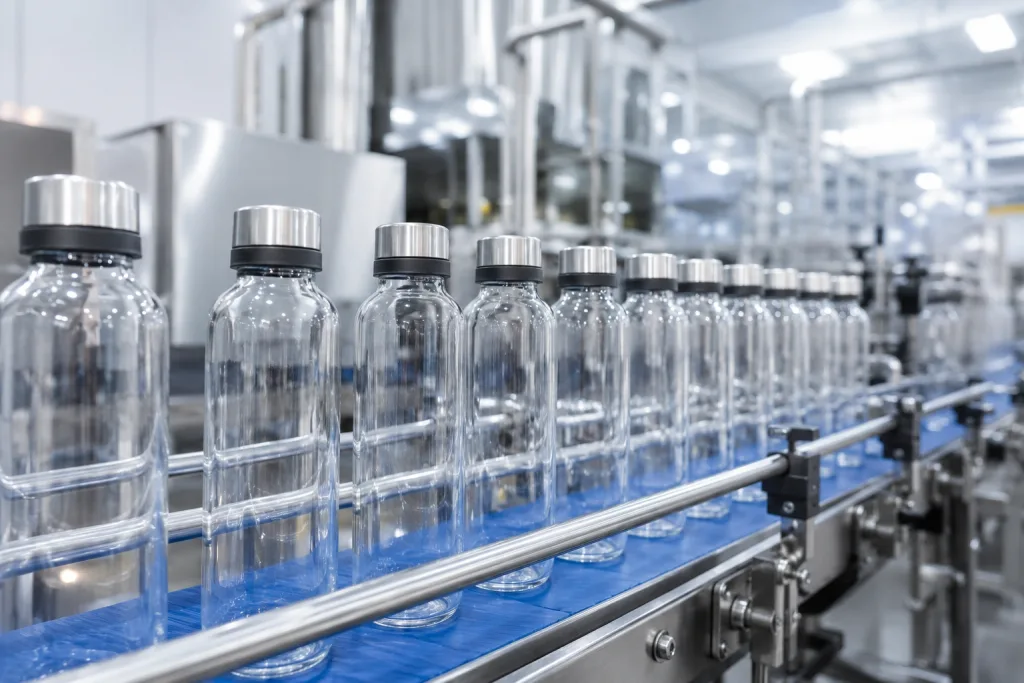
Key Takeaways
- For a 500 ml borosilicate bottle with PP lid, common FOB pricing runs USD 0.95-1.85 at 3,000-20,000 units depending on glass weight and decoration
- Typical MOQ is 3,000 units per SKU, while custom color lids or new molds often start at 5,000-10,000 units
- Mass production usually takes 25-35 days after sample approval; with mold work, testing, and peak season booking, total cycle is often 45-70 days
- Packaging, compliance, and failed assumptions on lid structure can move total landed cost by 8%-18%, more than many buyers expect
You usually do not lose money because the bottle quote looks high. You lose it in the details the quote did not spell out: mold change cost, print limits, lab test fees, carton spec, and lead time slipping from 35 days to 60. On our line, a 1.8 mm wall change or one extra silicone gasket can move cost faster than a small unit-price gap. From a glass polypropylene bottle factory, the bill is split by glass weight, PP lid structure, sealing parts, print method, and hand-packing labor. If you source for Europe or North America, compliance, pallet pattern, and transit timing matter as much as FOB price. That is where buyers get hit.
At BottleForge Industrial in Hangzhou, Zhejiang, we keep seeing the same mistake from new B2B buyers. They compare a 500 ml custom drinkware quote at USD 1.10 against USD 1.45 and skip the parts that decide the real landed cost: wall thickness, gasket grade, AQL plan, and whether the supplier in China included drop-test packaging. Last month QC pulled the sample and found the PO typo changed the carton from 24 pcs to 36 pcs, which would have failed the buyer’s drop-test target. This is the wrong question to ask if you only focus on piece price. A clean cost and lead-time breakdown gives you a better buying call.
What you are really paying for
Ask a glass polypropylene bottle factory for a quote, and the unit price only shows the top layer. The real money sits in BOM details and process choices. For a standard 500 ml glass bottle with a polypropylene lid, the glass body is the biggest cost block, typically 45%-60% of FOB value. On our line, bottle weight alone can shift the quote fast: a lighter soda-lime bottle may save USD 0.08-0.15 per unit, while a borosilicate version with cleaner clarity and better thermal shock resistance usually cuts breakage claims and gives a better hand feel. We check wall thickness at the mouth and shoulder with a caliper in mm, because this is where cost and complaint rate often meet.
The PP closure is the next big swing factor. A plain one-piece screw lid costs less than a two-part flip cap with handle, lock, and internal straw. Add a food-grade silicone gasket and the leak-test pass rate goes up, but cost rises by USD 0.03-0.08. If you want a canteen custom look with matte surface, special Pantone color, and an integrated carry loop, the closure can reach 20%-30% of bottle cost on some designs. Buyers push for a fancy lid, then ask why the bottle quote moved by 18%. The math doesn't work otherwise. We run leak tests after torque setting, and QC pulled the sample more than once because the straw seat was off by 0.5 mm.
- Glass type: soda-lime for sharper pricing, borosilicate for better heat resistance
- Glass weight: common 500 ml bottle weight is 280-420 g depending on shape and wall thickness
- Lid complexity: single-piece screw lid vs. flip top, straw lid, handle lid, or sleeve-assisted assembly
- Decoration: silk screen, heat transfer, decal, spray coating, or laser on accessory parts
- Packaging: egg-crate bulk pack, color box, PDQ display, or Amazon-ready mailer
For B2B buyers in Europe and North America, separate "factory price" from "usable program cost." This is the right question. A canteen manufacturer in Zhejiang may quote low, but if the closure design needs a higher assembly reject allowance, or the bottle needs thicker dividers for transit, landed cost moves fast. We have seen this go sideways on a PO where the buyer flagged freight damage after switching from a 7 mm divider to 5 mm to save carton cost. We usually tell buyers to budget for FOB, testing, spare parts, overrun tolerance, and carton optimization from day one. If you only compare the ex-factory number, you are missing the part that hits margin after we ship.
MOQ tiers that change the math
MOQ is not a random barrier. It comes from furnace loading, PP lid injection slots, print setup, and carton buying. On our line in Zhejiang, a stocked glass body with a standard PP lid usually starts at 3,000 units per SKU. Below that, scrap climbs and setup cost gets ugly. For stock clear glass, a black lid, one-color silk screen, and export carton packing, 3,000 units is a workable number. We run this spec with a 60-mesh screen and standard 5-layer master cartons, so the math is plain.
Once you add canteen customizable features, the MOQ moves up. A custom Pantone lid usually starts at 5,000 units because the injection machine needs a color change, and resin suppliers do not like tiny batches. If you want a customized canteen body shape or a customized growler profile with a fresh mold, 10,000 units is the more honest starting point. This is the wrong question to ask: “Can you do 2,000?” Some factories will say yes, then bury the loss in setup, higher scrap, or a tooling spread charge. We have seen buyers flag a cheap quote later when the supplier added carton wastage and mold trial fees after the PO.
Typical MOQ and FOB ranges
- 3,000 units: existing 450-550 ml bottle, stock PP lid, 1-color print, about USD 1.10-1.45 FOB Ningbo
- 5,000 units: custom lid color, 2-color print or wrap decal, about USD 1.05-1.55 FOB
- 10,000 units: better leverage on decoration and cartons, about USD 0.95-1.35 FOB for standard structures
- 10,000+ units with new mold: add tooling from USD 1,500-6,000 depending on body and closure changes
If you are a canteen distributor or distributor drinkware buyer with multiple channels, ask one direct question: can mixed colors share one MOQ under the same bottle shape. In Zhejiang, a lot of canteen vendors will allow 1 bottle shape with 3 lid colors inside a 5,000-unit run, as long as the packing spec does not change. If one color needs its own barcode sticker or inner box, the math does not work. We ship these mixed runs often, and QC pulled the sample more than once because the buyer changed a lid matte finish after approval. A serious canteen factory should tell you what part of the MOQ comes from glass production, what part comes from closure production, and what part comes from packaging purchase, instead of throwing out one vague number.
Cost drivers buyers underestimate
The obvious cost drivers are bottle size and print count. The surprises usually start with details approved too fast on the first sample sheet. Wall thickness is one. A thinner bottle can trim USD 0.05-0.12, but we’ve seen this go sideways in parcel freight. On the line, a 0.3 mm reduction looks harmless; after Amazon FBA handling, breakage eats the saving fast. Mouth finish accuracy is the next one. If the glass neck tolerance opens up to save a few cents, lid fit gets inconsistent, and straw lids are where the buyer flagged it first for leakage.
Decoration is a common cost trap. One-color silk screen is still the lowest-cost branding method for customized drinkware, and the setup is simple if the artwork sits on a straight panel. Add metallic ink, full-wrap decal, frosted spray, or tight registration, and the unit cost goes up with the reject rate. For a custom canteen order, the jump from one-color print to full-wrap decoration can be USD 0.12-0.35 per unit. QC pulled the sample last month because the logo crossed a mold seam on a curved shoulder, and the cosmetic reject rate doubled. This is the wrong question to ask: “What is the cheapest decoration?” Ask what the line can repeat for 10,000 pcs without drift.
Good sourcing is not finding the lowest quote. It is finding the lowest repeatable quote after defect rate, test risk, and pack-out reality are priced in.
Packaging adds up fast. A plain master carton with dividers may add USD 0.10-0.18. A color box with insert can add USD 0.22-0.55. An e-commerce mailer tested for drop resistance can add another USD 0.25-0.60. We ship plenty of projects where the bottle cost gets squeezed hard, then the outer pack adds 20% more than the buyer planned. Last quarter, one PO even had “mailier” typed instead of “mailer,” and the spec confusion delayed sampling by 3 days. If you sell through a canteen vendor network or distributor canteen channel, match the pack to the route: club retail, gift set, or parcel. If not, the math doesn’t work.
Compliance is another line buyers leave until late. For Europe, you may need REACH attention for decorative coatings and food-contact declarations for PP and silicone parts. For North America, buyers often ask for California Proposition 65 review, ASTM-oriented package performance checks, or retailer-specific protocols. Testing can range from USD 300 for basic contact material documentation review to USD 1,200+ for broader third-party lab work. We usually spread that over the order volume from the start, especially if MOQ is 3,000 pcs, because adding lab cost after PO approval is where margin disappears.
How long each stage actually takes
Lead-time trouble usually starts before the line even runs. The buyer asks for a fast ship date, the factory says yes, and each side is counting from a different point—one from PO release, one from deposit, one from artwork sign-off. We’ve seen this go sideways over a single typo on a PO for lid color code. A solid glass polypropylene bottle factory in China should split the job into stages. For stocked designs, we usually quote 2-4 days for price confirmation and artwork check, 5-7 days for a pre-production sample if the bottle, lid, and gasket are already on the shelf, and 25-35 days for bulk production after sample approval and deposit hit the account.
If any part is custom, say it early and put days on it. A new PP lid mold usually takes 15-25 days for tooling and first trial, and the first T1 sample often comes back with thread fit or hinge force that needs one correction. A new glass mold or a major body change needs 20-30 days. Sometimes more. Deep emboss, a tricky base radius, or a matched silicone sleeve will slow the schedule because QC pulled the sample and found wall-thickness variation over 0.8 mm. Color box work normally adds 5-8 days, including dieline check, barcode position review, and print approval. Buyers often ask if packaging can run in parallel with bottle sampling; sometimes yes, but if capacity or carton size changes, the math doesn’t work.
Working timeline you can plan around
- Existing bottle + existing lid: 30-45 days total from deposit to cargo ready
- Existing bottle + custom lid color + custom print: 35-50 days
- New closure mold or body mold: 45-70 days
- Peak season in Zhejiang and China before CNY: add 7-15 days for booking risk
Shipping runs on a separate clock. From Ningbo or Shanghai to the West Coast of North America, ocean transit is often 18-28 days port to port; East Coast is usually 28-40 days. Major Europe ports are commonly 30-40 days. Air and rail are faster, but freight jumps hard—last-minute air on a 0.45 kg glass bottle is the wrong question to ask unless the promo date is already fixed. If you run canteen distribution and have a launch date, count back from warehouse receipt, not ETD. We ship against the full critical path: production finish, booking cut-off, SI deadline, customs release, and local delivery, not just the day the cartons leave the factory.
Quality control that protects the schedule
A missed ship date usually starts in QC, not at the forwarder. On glass bottle and PP cap programs, assembly fails when neck finish drifts, the gasket sits loose by 0.3 mm, or torque range was never fixed at sample stage. Then the problem shows up during pack-out on the line, not on the first approval sample. That is how a 30-day order turns into a 42-day order.
The right move is simple: lock the checkpoints before deposit. At BottleForge Industrial, our Zhejiang line plan usually starts with incoming checks on PP resin color and silicone hardness, then in-line visual inspection for bubbles, seams, and lip chips under a light box, then leak test at assembly, then final AQL inspection. Common AQL levels are 2.5 for major defects and 4.0 for minor defects, though some retail buyers push tighter limits after QC pulled the sample and found print rub on 6 pcs out of 200. This is the wrong question to ask if the buyer only asks for the lowest price and skips the control plan.
- Leak test: 100% on assembled bottles for standard screw-cap programs
- Drop or transit simulation: based on packaging style, especially for customized canteen gift boxes
- Decoration adhesion: tape test or rub test depending on print method
- Carton verification: dimensions, gross weight, barcode placement, FNSKU if needed
If you sell through e-commerce, tell the factory at RFQ stage, not after the PO lands. Amazon-ready labels, suffocation warning rules, and carton weight limits change labor planning and ship timing; we have seen a buyer flag a 22 kg carton after mass production, and the repack cost wiped out the freight saving. For distributor growler or customizable growler projects in larger glass formats, QC should be tougher on handle pull strength, base wobble, and partition fit. The cheapest canteen manufacturer quote is rarely the fastest once rework starts. A factory with a steady inspection routine often saves 5-10 days by catching preventable corrections before final packing.
How to compare quotes from China
After you get three quotes from canteen suppliers, do not line up FOB prices and pick the lowest. That is the wrong question to ask. Build one quote sheet and force every supplier into the same columns: bottle capacity, glass material, bottle weight, lid material, gasket material, decoration method, unit packing, carton quantity, master carton size, gross weight, MOQ, sample charge, tooling cost, production lead time, and payment terms. On our line, a 30 g gap in bottle weight often explains why one price is lower. Once the format matches, the cheap quote and the high quote usually show their reason fast.
Ask blunt questions and wait for direct answers. Is the lid pure polypropylene or a PP blend with filler? Is the bottle soda-lime or borosilicate? What breakage allowance are they carrying in production—2% or 5%? Are spare lids packed at 0.5% or 1%? Is the quote based on BSCI-audited production if your compliance team requires it? Can they support ISO-documented procedures and retailer paperwork? QC pulled a sample last month where the buyer PO said PP lid, but the supplied lid had a blended resin feel and lower drop performance. A real canteen factory or canteen manufacturer will answer cleanly, not dance around it.
For buyers sourcing custom drinkware, these details matter most:
- FOB basis: Ningbo or Shanghai, and whether inland trucking is included
- Payment: common terms are 30% deposit, 70% before shipment
- Over/under shipment: usually within 3%-5% unless fixed by contract
- Spare parts: extra lids, straws, or gaskets for after-sales support
- Documentation: food-contact declarations, test reports, packing list accuracy
If you are dealing with multiple canteen vendors or canteen distributors, ask one more thing: can they repeat the same spec six months later? Repeatability beats a smooth first order. We have seen this go sideways when the first shipment used one gasket shore hardness and the repeat used another, with no ECO record on file. In Zhejiang, the stronger factories usually keep clearer engineering records, steadier sub-suppliers, and enough open capacity to protect your program. Our plant planning supports about 600,000 units per month across mixed drinkware lines. That matters in peak season, when your reorder drops and you do not want your custom growler or customizable drinkware project pushed behind a 200,000-piece promo order.
Get a real costed quote before you commit
Send your target capacity, artwork, packaging spec, and delivery window. We will break down MOQ, FOB pricing, testing, and lead time clearly from Zhejiang, China.
Frequently asked questions
What is a realistic MOQ for a glass polypropylene bottle factory?
For a standard 450-550 ml bottle using an existing glass body and existing PP lid, 3,000 units per SKU is a realistic MOQ in China. If you want a custom lid color, special gasket, or two to three print versions, 5,000 units is more common. For a new mold, especially a customized growler or custom canteen body shape, expect 10,000 units or a tooling fee to absorb setup cost. Buyers should also ask whether MOQ is per color, per print, or per combined style. That detail changes your total inventory. In Zhejiang, many factories can split one order into 2-4 colors if the total reaches the production minimum and packaging stays consistent.
How much should I budget per unit for a custom glass bottle with PP lid?
A useful budgeting range for B2B buyers is USD 0.95-1.85 FOB for a 500 ml glass bottle with a polypropylene lid, depending on structure and volume. At 3,000 units, a basic bottle with one-color silk screen may land around USD 1.10-1.45. At 10,000 units, a standard spec often drops to USD 0.95-1.35. Add USD 0.03-0.08 for silicone sealing upgrades, USD 0.12-0.35 for more complex decoration, and USD 0.22-0.55 for a printed color box. If you need retailer testing, spread another USD 300-1,200 across the order. Buyers comparing canteen supplier quotes should normalize bottle weight, lid structure, and carton spec first.
How long does production usually take after sample approval?
For existing designs, mass production usually takes 25-35 days after final sample approval and deposit. Add 5-7 days for pre-production samples if artwork and components are straightforward. If you need a new PP lid mold, expect another 15-25 days. A new glass mold can add 20-30 days depending on complexity. During peak season in China, especially before Chinese New Year, it is sensible to add 7-15 extra days for scheduling and vessel booking risk. Ocean transit from Ningbo to Europe is often 30-40 days, while North America ranges roughly 18-40 days depending on coast. Buyers should plan from warehouse receipt date backward, not from ex-factory date.
What compliance documents should I request for Europe and North America?
At minimum, ask for food-contact declarations covering the glass body, PP lid, silicone gasket, and any straw or coating. For Europe, REACH review and food-contact compliance are routine starting points. For North America, many buyers also check California Proposition 65 exposure risk and retailer-specific requirements. If your package enters parcel channels, ask about drop-test readiness or ASTM-style transit verification where applicable. It is also smart to confirm whether the factory can support BSCI audit expectations if your brand requires social compliance, and whether they run documented QC under an ISO-based system. A canteen manufacturer that hesitates on basic documentation will usually create delays later.
How do I choose between a low quote and a faster quote?
Start by asking what is different, not who is cheaper. A low quote may use lighter glass, simpler dividers, fewer leak checks, or a less stable decoration process. A faster quote may assume stock materials that do not match your approved Pantone or package. Put all suppliers on the same template: bottle weight, capacity, glass type, lid structure, gasket material, decoration, carton spec, AQL, spare parts, and lead time. Then calculate landed cost plus schedule risk. If one quote is USD 0.10 lower but causes 3% extra breakage or slips by 10 days, it is not cheaper. Experienced canteen vendors and canteen distributors usually value repeatability and claim control over the lowest opening price.