Key Takeaways
- Typical MOQ for stock glass bottles is 3,000-5,000 pcs; fully new molds usually start at 30,000 pcs
- Silk screen decoration can add USD 0.08-0.18 per unit, while decal or sleeve can add USD 0.20-0.45
- Sample to mass production usually takes 25-45 days for stock items and 45-70 days for custom mold projects
- Sea freight from Zhejiang, China to Europe or North America often saves 25-40% versus air, but adds 25-40 transit days
If this is your first buy from a glass drinkware supplier, the problem is not finding a catalog. It is figuring out why one quote comes in at USD 1.18 and another at USD 2.65 for what looks like the same bottle, tumbler, or custom growler. On the shelf, glass looks simple. On the line, it is not forgiving. Change the mold cavity by 1.5 mm, switch decoration from 1-color print to decal, raise the carton drop standard, or swap the closure, and cost and lead time move fast. We have seen one cap change add 12 days.
At BottleForge Industrial in Zhejiang, China, we see buyers lose weeks by comparing unit price only. QC pulled the sample, the buyer flagged a scratch, and then the real cost discussion started. You need the full landed picture: MOQ, mold charges, decoration yield loss, AQL inspection level, pallet pattern, and transit mode. Frankly, unit price alone is the wrong question to ask. If you are a brand owner, a canteen distributor, or a distributor drinkware buyer, those details decide whether your launch date holds and whether the margin still works after we ship.
Why glass quotes vary so much
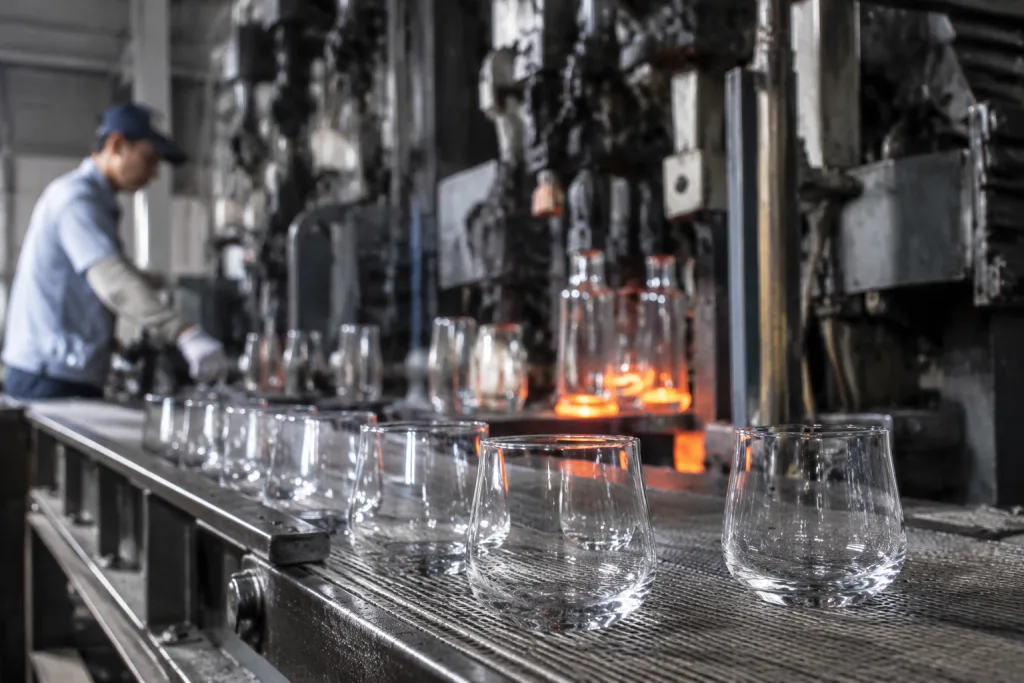
A serious glass drinkware supplier is not pricing one 550 ml bottle. We price scrap risk, yield on the line, carton strength, and how far you want the customization pushed. Two 550 ml bottles can hold the same volume and still land far apart on price because one uses a thicker wall, an 18/410 neck finish, a different cap insert, a larger print window, or a stricter drop-test pack. QC pulled samples like this last month. Same capacity, different cost.
The first cost driver is stock shape versus new mold. Stock models usually start at 3,000 to 5,000 pcs per SKU because the mold is already running and we know the yield. Ask for a custom body, base embossing, or a proprietary silhouette, and MOQ usually jumps to 20,000 to 30,000 pcs. Sometimes more. If the bottle has a deep shoulder or odd base geometry, we've seen this go sideways fast because forming speed drops and annealing gets touchy. Mold cost for glass is commonly USD 1,500 to USD 6,000 depending on cavity count and whether you need matching lid tooling.
The second driver is breakage control. This is where buyers often push back, and the math doesn't work if they want stainless-style packing on glass. Glass needs stronger inner partitions, thicker master cartons, and cleaner palletization than stainless drinkware. We run edge crush checks on the carton and watch partition fit; 2 mm too loose is enough to let bottles kiss in transit. If you ask for mailer-safe packaging for e-commerce, your carton cost can rise by USD 0.18 to USD 0.60 per set. That is normal. Not padding.
The third driver is decoration yield. A one-color silk print on a straight wall usually runs clean with low rejection. Full-wrap decal on curved glass is slower, and defects show up faster—registration drift, pinholes, color skip at the shoulder. The buyer flagged a seam line once on a retail order, and we had to sort 6% of the lot by hand. If you are planning customizable drinkware for retail chains or a canteen promotional program, expect the supplier to build in decoration loss of 2% to 8% depending on process.
- Stock bottle + stock cap: fastest launch, lowest risk, often the cleanest quote
- Stock bottle + custom logo: moderate cost increase, modest lead-time impact, usually one sample round on the print line
- Custom mold + custom closure + gift box: highest tooling spend, longest launch cycle, and the most places for approval delays
That is why a useful quote from a canteen supplier or canteen factory should separate ex-works or FOB unit price, tooling, packaging, test fees, and freight assumptions. This is the wrong question to ask: “What is your best all-in price?” Ask for the cost split instead. If a PO has a typo on pack spec or cap code, you will see the issue faster.
MOQ tiers that change your math
MOQ is where a lot of B2B buyers get caught. A glass drinkware supplier may take a trial order, but at 1,000 pcs the unit cost can sit 20% to 45% above a 5,000 pc run because setup, decoration, and carton artwork are spread too thin. We saw this on a 2.2 mm wall tumbler line last month; the buyer pushed back hard on price, and the math still didn’t work. If you are sourcing custom drinkware for promotion, hospitality, or retail, decide early whether you are testing demand or building a program you can repeat.
For stock glassware with standard caps, a realistic range is:
- 1,000-2,000 pcs: works on selected stock items, fewer decoration choices, highest unit cost
- 3,000-5,000 pcs: practical MOQ for most export orders with logo printing
- 10,000 pcs: gives better pricing for mixed decoration and color options
- 30,000+ pcs: common threshold for a customized canteen body or custom growler mold
At our Zhejiang operation, lead times stay cleaner once the order reaches 3,000 pcs per SKU; the line runs smoother, and QC pulled the sample faster on a recent 304 stainless order because the schedule was not broken into tiny batches. For buyers handling multiple markets, ask if the factory can split one run into two carton artworks or two language labels. Some canteen manufacturers can do that without raising MOQ on the glass itself, but outer cartons and inserts often have their own minimums.
If you are a canteen distributor or one of several canteen distributors under the same parent group, pool demand where you can. A 12,000 pc run with three logo versions often prices better than three separate 4,000 pc runs, and we ship those jobs with fewer handoffs on the packing table. The same applies to a distributor growler program for breweries and outdoor retail; splitting orders looks flexible, but the factory pays for every extra changeover.
Low MOQ looks good on paper until you add tooling amortization, packaging setup, and inspection cost per unit.
For Amazon FBA or DTC launches, check labeling minimums too. FNSKU labeling, barcode placement, and drop-tested cartons can erase the savings from chasing the smallest possible order; we’ve seen a PO typo on label count turn into a full reprint, and that one was on the buyer, not the factory.
Unit cost by component and process
To compare quotes cleanly, split the unit price into five buckets: glass body, closure, decoration, packaging, and compliance or quality cost. That is how an experienced canteen vendor or canteen manufacturer should break down the number. If a supplier sends one lump-sum price with no split, the buyer flagged it more than once on our side, and that is usually the wrong quote to benchmark.
Glass body
For a stock 500-750 ml soda-lime glass bottle, FOB China pricing can start around USD 0.45 to USD 0.95 depending on weight and shape. On the line, a 280 g bottle and a 420 g bottle do not price the same, even if the drawing looks close on screen. Borosilicate versions usually cost more, often USD 0.80 to USD 1.60, because the material and forming process are different. Heavier bases look premium, but the math does not work if freight jumps on a 24-piece master carton.
Closure system
A basic PP screw cap may add USD 0.06 to USD 0.15. Bamboo or acacia lids with silicone gaskets can add USD 0.18 to USD 0.45. Stainless cap assemblies and tea infusers move higher, and carry loops add another assembly step. We have seen this go sideways when a buyer asks for a clean lid look but skips leak testing; QC pulled the sample, tipped it at 45 degrees for 30 minutes, and the gasket was the weak point. If you are planning a customizable canteen or customizable growler, cap design affects leak performance and complaint rates as much as the bottle body does.
Decoration
One-color silk screen is usually the low-cost option at USD 0.08 to USD 0.18. We run it fast, but artwork setup still matters; a 0.3 mm line can fill in if the mesh count is wrong. Laser marking on coated parts can work for closures but is less common on clear glass. Decals often run USD 0.15 to USD 0.35. Powder coating is not a glass process, so do not compare that quote against metal custom drinkware as if the finish cost were equal. Frosting, spray color, and electroplated effects add cost and raise defect risk—the line sees more color variance, pinholes, and scratch marks.
Packaging
A plain export box may add USD 0.10 to USD 0.20. Color gift boxes often add USD 0.25 to USD 0.80. E-commerce protective packaging can exceed USD 1.00 per set depending on ISTA-style requirements. A lot of buyers miss this. We ship samples in drop-test packs with thicker inserts, and carton size changes by just 5 mm can push up board cost and container loading loss at the same time.
Quality and compliance
AQL inspection, REACH statement, food-contact declarations, and lab tests are not free. Budget USD 250 to USD 800 for routine third-party inspection, and higher if you need ASTM or retailer-specific protocols. One common pushback is, "Why is inspection separate if the factory already checks goods?" Fair question, but factory QC and third-party release are not the same job. Good canteen suppliers and canteen vendors state these items clearly rather than hiding them in margin.
Lead-time ranges you can actually plan around
Lead time on glass projects runs longer than most buyers expect because sample approval and packaging approval happen one after the other, not at the same time. We see this on the line every month. A buyer signs off the bottle, then the color box dieline comes back with a 2 mm barcode shift or a missed recycling mark, and the clock resets. If you are buying from China for Europe or North America, work backward from the delivery date, not from the PO date. The PO date is the wrong anchor.
For stock glass items with standard caps and one-color logo, the normal path looks like this:
- Quote and artwork review: 2-4 days
- Pre-production sample: 5-10 days
- Mass production: 20-30 days
- Inspection and booking: 3-7 days
- Sea transit: 25-40 days depending on port and season
In real scheduling, that puts you at 35 to 60 days door-to-port. Not theory. Real factory timing. If customs documents, carton marks, or retail packaging are not locked early, we have seen 12 days turn into 18 days just on approvals because the buyer flagged a PO typo and the printer would not release film.
For a fully customized drinkware project with a new bottle mold, color box, and custom closure, a realistic timeline is longer:
- Mold design and confirmation: 7-14 days
- Tooling and first mold samples: 15-25 days
- Sample revisions: 7-15 days
- Mass production: 25-35 days
- Inspection and shipment: 5-10 days
That puts you in the 60 to 90 day range before ocean transit. During peak periods in Zhejiang, China, or before major holidays, add another 7 to 15 days. We have seen this go sideways before CNY when one mold workshop was short two polishing operators and first samples slipped 6 days. If a supplier promises a complicated customized growler order in 20 days, ask which steps they are skipping. Usually it is mold validation, sample revision, or packaging proofing. The math doesn't work.
At BottleForge Industrial, our planning target for repeat stock-SKU orders is 25-35 days production, with monthly output capacity above 300,000 units across core drinkware programs. Repeat orders move faster because approved artwork, carton specs, and inspection points are already locked. QC pulled the sample once, signed the limit sample, and the line runs against the same standard on the next PO.
Where buyers lose margin after approval
The biggest margin leaks start after sample approval. We see it on the line all the time: the sample looks clean, then freight jumps, the master carton fails a 1.2 m drop, or QC pulled the sample and found the cap leaking because gasket hardness changed from 60 shore to 50 shore. This is the wrong place to chase another USD 0.03.
First, stop spec drift. Your PO needs capacity tolerance, bottle weight, wall thickness where relevant, closure torque range, logo color code, carton burst strength, and pallet standard in black and white. We still get POs with “same as sample” typed across half the page, and that is where claims start. If you are buying a custom canteen or customized canteen set with sleeve or strap, spell out the materials. “Natural bamboo lid” does not tell the factory enough; moisture range, finish, and logo method decide whether the lid stays flat or warps 2 mm after sealing.
Second, lock the inspection plan before production. For export drinkware, many buyers use AQL 2.5 for major defects and 4.0 for minor defects, but some retail programs ask for tighter limits and barcode scan checks at carton level. Define major defects line by line: leaks, cracks, sharp rims, wrong barcode, logo misalignment beyond 2 mm, or failed drop test. We ship smoother when this is written early. A canteen factory that knows B2B will not push back on clear defect criteria.
Third, check freight efficiency with actual numbers. A premium heavy-base bottle may win approval from the design team and add 10% to 18% per delivered unit once you load the container. We have seen a 520 g bottle lose out to a 430 g version with the same fill volume because the math did not work. Lighter optimized glass usually protects margin better for distributor canteen or distributor growler resale, where buyers watch freight every month and ask why one pallet is 86 kg over plan.
Fourth, review compliance early, before sampling starts. If your market needs REACH, LFGB-related documentation through your chosen lab, or specific state-level packaging claims, ask at RFQ stage. One buyer flagged this after mass production because the gift box copy said the wrong recycling claim, and 3,000 sets had to be reworked with new labels. We have seen this go sideways. Rework after mass production burns cash and lead time fast.
The cheapest quote is often the one with the most missing assumptions.
If you are dealing with multiple canteen manufacturers or canteen suppliers, send the same quote sheet to each one: FOB term, MOQ, sample days, production days, breakage allowance, inspection standard, and carton spec. Add one more line for master carton size in mm if freight matters, because it usually does. Then you are comparing suppliers on the same base, not chasing guesses after the buyer flagged a missing item.
How to brief a supplier properly
You get better pricing and a cleaner delivery plan when the RFQ is tight. “Need customized drinkware fast” gives the factory nothing to cost. We need enough detail to check mold fit, decoration risk, and carton loading before we quote. On our line, QC pulled a sample last month because the print area on a 500ml glass was 6 mm shorter than the artwork assumed.
Start with the basic specs: capacity, dimensions, target retail price, annual volume, order quantity per SKU, and destination market. Then spell out the use case. Is this a canteen custom order for corporate gifting, a canteen customizable retail line, or a customized growler for beverage refill programs? The use case changes the build. Hospitality orders often need stackability and stable foot diameter. E-commerce orders need stronger inserts and stricter drop performance. A distributor drinkware buyer often asks for multilingual packaging and lower cube per pallet. We have even seen a PO typo switch 12oz to 21oz, and that kind of mistake burns days.
- Must-have data: capacity, target weight, material type, closure style, logo method, package type, compliance market
- Commercial data: MOQ target, Incoterm, required ship date, forecast for 6-12 months
- Quality data: leak standard, AQL level, carton drop test, barcode placement
Ask the supplier to quote three scenarios: stock item with logo, stock item with upgraded packaging, and full custom mold. This is the right comparison. It usually cuts 7 days of back-and-forth because the factory can price decoration, packing, and tooling in one round. It also tells you if the canteen vendor understands cost engineering or is just forwarding catalog prices. We have seen buyers push for a full custom mold at 1000 pcs MOQ; the math doesn't work.
For factory screening, ask practical questions. Are audits such as BSCI available through partner facilities? Can they support third-party inspection before shipment? What is the normal lead time for repeat orders? Can they handle mixed containers? Ask for numbers. A reliable canteen manufacturer in Zhejiang should say 12 days vs 18 days, 1x40HQ mixed with 4 SKUs, or AQL 2.5 with pre-shipment inspection support. Generic sales claims do not help, and we have seen this go sideways when the buyer flagged “fast delivery” but nobody defined the production window.
If you need a long-term canteen supplier or canteen distributors support model, ask about spare lids, replenishment MOQs, and artwork version control. This is where weak suppliers get exposed. We ship repeat orders every month, and the trouble usually starts with small items: a lid color mismatch, a 3000 pcs replenishment MOQ that was never discussed, or old artwork still sitting at the printing station. Repeat business shows whether the line runs with discipline.
Get a real glass drinkware quote with timelines
Send your target quantity, decoration, packaging, and delivery market. We will reply with MOQ tiers, FOB pricing, and a workable production schedule.
Frequently asked questions
What MOQ should I expect from a glass drinkware supplier?
For stock glass bottles or tumblers, expect 3,000 to 5,000 pcs per SKU as the normal export MOQ with logo decoration. Some factories in China can offer 1,000 to 2,000 pcs on selected stock items, but the unit cost is usually 20% to 45% higher because setup and packaging costs are spread across fewer units. If you need a fully custom mold, most projects start around 20,000 to 30,000 pcs, with mold charges from roughly USD 1,500 to USD 6,000. If your volume is below that, ask for a stock body with custom packaging or a custom lid instead. That often gets you 80% of the branded look with much less tooling risk.
How long does a custom glass drinkware order usually take?
For a stock item with one-color printing, a practical schedule is 5 to 10 days for samples and 20 to 30 days for mass production after approval. Add 3 to 7 days for inspection and booking. If you ship FOB from Zhejiang, China, ocean transit to Europe or North America commonly adds 25 to 40 days. For a full custom project with a new mold, expect 60 to 90 days before sea transit because mold development and sample revisions take time. Peak season can add another 7 to 15 days. If you have a launch date, work backward and lock artwork, barcode, and carton details early.
What usually adds the most cost to customized drinkware?
New molding, premium closures, decoration, and e-commerce packaging are the biggest cost drivers. A stock bottle body may be under USD 1.00 FOB, but a bamboo lid, wrap decal, and gift box can push the finished cost up by USD 0.50 to USD 1.20 very quickly. Mailer-safe packaging is another major factor for DTC brands because it can add USD 0.30 to more than USD 1.00 per set depending on the drop-test standard. Heavier glass also raises freight cost. If margin is tight, ask your supplier to quote three options: basic export carton, retail gift box, and e-commerce pack. That makes the trade-off visible before you approve the sample.
Is borosilicate glass worth the extra cost for B2B buyers?
It depends on the use case. Borosilicate glass usually costs more than soda-lime glass, often by USD 0.20 to USD 0.70 per unit on common bottle sizes, but it offers better thermal shock resistance and a more premium perception. If your program includes tea infusers, hot-fill style use, or a higher-end retail position, the upgrade can make sense. For basic cold beverage programs, corporate gifting, or large distributor canteen orders, standard soda-lime glass is often the better value if the design and packaging are correct. The key is not material marketing. The key is matching the glass type to the channel, complaint risk, and target retail price.
How do I compare two supplier quotes fairly?
Use the same quote template for both suppliers and insist on line-item detail. Compare FOB term, MOQ, sample cost, mold charge, unit price by quantity break, decoration process, packaging spec, breakage allowance, inspection standard, and lead time. Ask whether the quote includes spare parts, barcode application, palletization, and third-party inspection support. Also check if the bottle weight and carton dimensions are the same, because freight can erase a lower unit price. A quote that is USD 0.07 cheaper may become more expensive after you add stronger cartons or account for lower packing density. Fair comparison means comparing the full delivered program, not just the bottle body price.