Key Takeaways
- Specify wall thickness, bottle weight tolerance, and lid torque early; a 500 ml soda-lime bottle typically needs 2.8-3.2 mm wall thickness for promo use
- Plan 30-45 days for mass production after sample approval, plus 5-7 days for logo approval and 3-5 days for drop and leak testing
- Use AQL 2.5/4.0 for final inspection and define critical defects as leaks, sharp rims, wrong barcode, and food-contact noncompliance
- For most China FOB orders, MOQ starts at 3,000 pcs per SKU for stock molds and 10,000 pcs for new molds or customized drinkware gift sets
Most problems in glass bottle promotional orders do not start at the loading dock. They start with a loose RFQ. A buyer asks for a 500 ml bottle with a bamboo lid, one-color logo, and gift box, and wants a quote the same day. We send pricing fast, the sample passes, then bulk production shows where the order was weak: logo rub-off after 50 wipe cycles, lids leaking at a 45° tilt test, cartons failing a 1.2 m drop, glass weight drifting by 18 g, and reports that cover the wrong market. We have seen buyers flag a simple PO typo on lid liner material after 20,000 pcs were already on the line. If you buy for Europe or North America, you know this already. A cheap unit price gets expensive after claims, rework, and a launch pushed from 12 days to 18 days.
At BottleForge Industrial in Hangzhou, Zhejiang, China, we see the same failures across custom drinkware, custom canteen, and customized growler projects. The fix is usually simple. Write tighter specs, set the right QC gates, and give the factory a lead time that matches the process. This is the wrong question to ask: “What is your best price?” Ask what glass thickness you are quoting, what leak standard you run, and whether QC pulled the sample against AQL or just checked appearance by eye. Our glass bottle lines run up to 600,000 units per month, and we ship large programs every week, but capacity does not fix preventable mistakes. Good paperwork does.
When the glass itself is wrong
The costliest failure is usually not the logo print. It is the bottle body. We see buyers sign off on a good-looking pre-production sample, then leave the structural numbers open. That is where trouble starts. The line switches to a lighter bottle to save a few cents or lift yield, and breakage shows up in packing, transit, or actual use. Last year QC pulled a sample where the approved look was fine, but the body weight had dropped by 28 g against the signed sample.
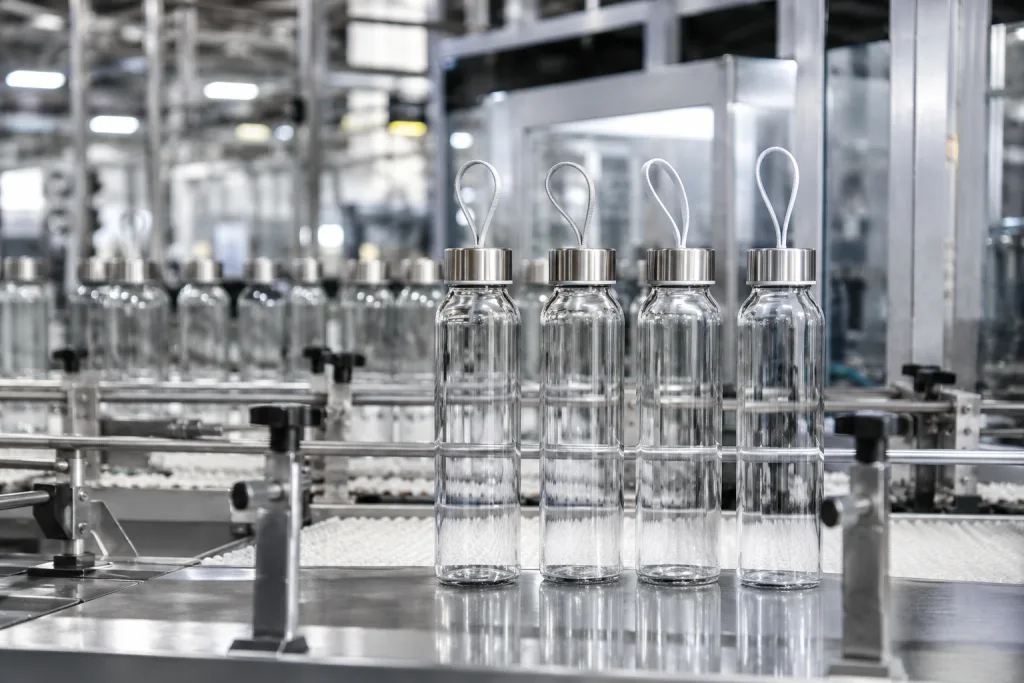
For glass bottle promotional projects, put these numbers on the PI and artwork sheet: material type, bottle weight, wall thickness range, mouth finish tolerance, height tolerance, and base flatness standard. For a common 500 ml soda-lime bottle, a practical spec is 380-450 g bottle weight and 2.8-3.2 mm wall thickness. If you want a premium-feel bottle for retail, go heavier. If you are targeting a giveaway under USD 2.20 FOB China, the factory will push weight down. Write that tradeoff into the order. Do not guess. We have seen POs with "same as sample" and no weight line at all, and the math does not work when the supplier is chasing that price.
Color inconsistency and seed bubbles cause another set of claims. A few tiny bubbles are normal in glass production. The real issue is the acceptance line. Set visible bubble limits by viewing distance, such as 30 cm under normal indoor light, instead of loose words like "perfect." If you want borosilicate instead of soda-lime, state it on the sheet. Borosilicate gives better thermal shock resistance, but it costs more and cuts down your mold choices. We have had buyers flag a bottle for "dirty glass" when the finding was actually three seed bubbles under 1 mm.
What to put in your spec sheet
- Material: soda-lime or high-borosilicate
- Capacity tolerance: usually ±5%
- Bottle weight tolerance: usually ±10 g to ±15 g
- Mouth finish: exact diameter and thread type
- Annealing requirement: confirm internal stress control
A low FOB price from Zhejiang or elsewhere in China means little if the bottle fails a 76 cm carton drop test. This is the wrong question to ask: "How cheap can you make it?" Ask what body weight and wall thickness the line will actually run.
Lids leak more than buyers expect
If your complaint history on drinkware is heavy on leakage, the bottle body may be innocent. The lid system is usually where claims start. In promotional programs, buyers often mix parts for looks: a bamboo shell over a PP inner cap, a stainless trim ring, a silicone gasket, sometimes a carry loop on top. We have seen this go sideways on the line because each extra part adds tolerance stack, and 0.3 mm drift at the insert is enough to break the seal.
For a customized drinkware order, do not approve a lid from one hand-tight sample. That is the wrong question to ask. You need the gasket material, Shore hardness if relevant, thread engagement, torque range, and leak test method written on the spec. A practical torque range for many screw caps is 8-12 kgf·cm, but it depends on thread profile and gasket compression. Too low, it leaks. Too high, users complain they cannot open it, especially on a customizable canteen or kids item. We run this check with a torque meter, and buyers still push back when opening force feels fine in the office but fails after carton compression.
Ask your canteen manufacturer or canteen supplier to run three checks before final inspection: an inverted leak test for 2 hours, a hot water leak test at 60-70°C, and vacuum or pressure simulation if the design claims a stronger seal. QC pulled the sample on one PO last month because the
Decoration fails in the real world
Logos on glass look easy until you test them on the line. Buyers ask for silkscreen, heat transfer, decal, UV print, sleeve, spray finish, or engraving, then pack 24 bottles tight in one export carton and ship across the Atlantic. QC pulled samples after a vibration test last month and found scuffing exactly where glass touched glass and where the shoulder rubbed the paper insert.
For canteen promotional and custom drinkware orders, the wrong question is “Which decoration is cheapest?” Ask what abuse the bottle will take. A wellness campaign giveaway sitting on office desks is one thing; a retail gym bottle or a custom growler line for beverage stores is another. Standard one-color silkscreen on bare glass can hold up if you lock the ink system, cure standard, and abrasion target before mass production. Frosted spray plus logo looks premium on sample photos, but we have seen this go sideways when coating adhesion drops below spec on a 1 mm cross-hatch cut.
Use measurable tests. Ask for cross-hatch adhesion on coated areas, alcohol rub resistance, dishwashing disclaimer language, and abrasion testing against corrugated or partition contact. If the bottle will be sold through Amazon FBA or mass retail, expect more carton vibration and tighter barcode rules; a label position drift of 2 mm is enough for a buyer to flag it. For promotional bottles under USD 1.80-2.50 FOB, buyers often overspec premium decoration and leave packaging protection too light. The math doesn't work.
- Silkscreen: low-cost for simple logos; cure control matters, and rubbing shows fast on shoulder contact points
- Decal: better for multi-color detail; slower, costlier, and usually adds 3-5 days to production
- UV print: fast for prototypes; we run it for approval samples, but rough handling needs actual abrasion testing
- Laser on coating or sleeve: clean effect, but the base layer must stay stable or the finish chips around the mark
If you are sourcing through a canteen vendor, canteen distributors, or a distributor drinkware channel, ask who owns the decoration QC standard. We ship claims files every year where the bottle factory blames the print house, the print house blames packing, and the PO even had a typo in the approved color code. That argument solves nothing.
Packaging is where claims are born
Glass bottle promo jobs often fail after production is done. The bottle passed visual check, the logo is clean, and then 3% to 8% lands broken because the pack spec was built for shelf look instead of container load, or for parcel pressure instead of retail display. We have seen this go sideways on the line: QC pulled the sample, shook the inner box, and the bottle neck was already touching the divider slot.
The weak spots are usually clear once you open the master carton: dividers at 1.5 mm that fold soft, single-wall gift boxes, cavities with 8-12 mm free play, and cartons with the wrong burst strength. If you buy from China on FOB terms, ask for the full packing spec: units per inner, units per master, carton size, gross weight, board grade, divider material, and pallet plan if used. For many 500 ml glass bottles, keeping the outer carton under 15 kg gross is sensible for handling. We run 5-layer corrugate for most export glass programs, then match compression strength to stack height and container load. Do not write “export standard carton.” This is the wrong question to ask, because that phrase means nothing when a claim starts.
Ask your canteen manufacturer to run carton drop tests with actual finished goods, not empty mock packs. A typical sequence is corners, edges, and faces from 76 cm for standard transit simulation. If the buyer flagged mail-order use, we tighten the pack and test again with real caps, real bottles, real inserts. Partitioned master cartons usually beat pretty single-unit gift boxes dropped straight into a shipper. The math does not work if the gift box looks good but fails on the second edge drop.
Labeling sits in the same bucket. Wrong carton marks, missing FNSKU labels, or mixed barcode versions can trigger relabeling bills in North America fast. We had one PO with a single digit wrong in the carton mark, and the warehouse stopped 1,200 units for manual sort. If you are a distributor canteen business or a distributor growler importer, carton consistency matters as much as bottle quality because warehouse damage still gets pushed back to the supplier. A capable canteen factory in Zhejiang should send dielines, carton marks, and packing photos before mass production, not after the container booking is on the board.
Compliance gaps stop shipments cold
First-time buyers often think glass is safe by default. That is only half true. The bottle body usually passes; the trouble starts with decorations, seals, lids, straws, sleeves, and coatings. If your glass bottle promotional item includes food-contact plastic, silicone, paint, or adhesive, the compliance file has to cover the full bill of materials. On our line, QC pulled a cap sample last month because the silicone ring was 1 mm thicker than the approved drawing, and that alone changed the document trail.
For Europe, buyers usually ask for REACH, and in some channels they also want LFGB-related testing based on the actual build. For North America, the file often needs FDA-related food-contact alignment, California Proposition 65 screening on decorated parts, plus retailer RSL checks. If the bottle is sold for children, ASTM or CPSIA-related items can come up depending on the accessory set and age grade. This is the wrong question to ask: “Do you have a test report?” The better question is, “Do you have a report for this exact SKU and this exact lid set?” We have seen buyers source through a random canteen vendor or one-trade-only canteen suppliers, then find out the report was for a similar PP lid from 2021, not the shipped unit. That is where shipments get stuck.
Ask for reports by component and by test date. Old paper is not enough. A report older than 2-3 years still helps for screening, but it does not replace current production control. If you switch gasket color, ink supplier, or bamboo varnish, check retest scope before the PO is released. We ship faster when this is settled early. The buyer flagged it on one order after deposit because the requested gold logo ink failed their standard, and that cost 12 days vs 18 days if we had needed a full decoration reset.
Build compliance into the schedule from day one: 5-7 days for sample confirmation, 7-10 days for new lab work if needed, and 30-45 days for production at standard MOQ. For stock designs, MOQ can start at 3,000 pcs. New mold or fully canteen customized constructions often start closer to 10,000 pcs. In Zhejiang, China, factories already shipping to EU and US accounts usually move faster because the vendor files, material declarations, and revision logs are already in place. We run into this weekly: a buyer asks for speed, but the math does not work if the sleeve supplier has no signed declaration on file.
QC plans fail when they stay generic
“We will inspect before shipment” is not a QC plan. It’s a line on paper. If you’re new to a canteen manufacturer or working through canteen distributors, set checkpoints against actual glass failures: rim chips over 0.5 mm, lean after annealing, logo scratch, lid mismatch. Good factories don’t push back on this. We run better with clear standards, and the wrong question to ask is “Will you inspect?” Ask “What fails, where, and who signs off?”
A workable flow looks like this: pre-production sample approval, in-line checks during blowing and decoration, packaging confirmation, then final random inspection under AQL 2.5/4.0 unless your account uses another level. Define critical defects clearly: leaks, sharp rim or edge, wrong artwork, wrong barcode, food-contact noncompliance, major breakage. Major defects include obvious print damage, severe tilt, or unstable standing on a flat steel table. Minor defects are small appearance issues inside your written limit, not whatever QC feels that day. QC pulled the sample and measured mouth diameter with a digital caliper; that detail matters later if the buyer flagged cap fit.
Don’t wait for final inspection alone. If curing temperature drifts on day 1, or lid torque starts running at 6 kgf·cm instead of the approved range, finding it after 12,000 pcs are packed is expensive. We’ve seen this go sideways. Ask your customizable growler, customized canteen, or customizable drinkware supplier for first-day line photos or short video. Not for sales decks. For process proof: bottle weight checks, torque checks, leak-test samples, and carton setup verification. One buyer once sent a PO with the barcode suffix typed wrong by one digit; in-line confirmation caught it before 18 master cartons were sealed.
Factory audit matters. If your volume is 20,000 pcs or more per SKU, check whether the site runs ISO-based procedures, social compliance support such as BSCI where relevant, and traceable incoming material control by lot. A serious canteen factory in China should tell you which glass plant made the body, which lid vendor supplied the closure, and which workshop handled decoration. If they can’t map that chain in 10 minutes, claim recovery gets slow fast. The math doesn’t work when 3 suppliers blame each other and nobody can trace the batch code on the outer carton.
The buyer who writes a tight defect standard usually gets fewer defects. The buyer who says “make it good” usually gets a debate.
Quote structure changes your real landed cost
A lot of sourcing mistakes start before sampling. Buyers line up quotes that are not the same job. One factory prices FOB Ningbo with standard partition pack. Another sends ex-works with no testing at all. A third adds a gift box but cuts bottle weight from 420 g to 360 g. On paper, the low price wins. After claims, it does not.
When comparing customized growler, customized drinkware, or custom canteen offers, ask for the same quote structure from each supplier. This is the right question to ask. Every offer should show Incoterm, MOQ, mold status, sample charge, logo charge, packaging type, inspection arrangement, and compliance support. For a stock 500 ml promotional glass bottle with bamboo-look lid and one-color logo, pricing may sit around USD 1.10-1.90 FOB China at 5,000 pcs depending on decoration and pack-out. Add an individual gift box and you may add USD 0.22-0.55. Add a custom sleeve, or a premium coating, and the cost moves up again. That part is normal. What is not normal is a low quote with no drop test, no leak test, and no packaging standard listed. On our line, QC pulled the sample once and found the inner carton spec missing, so the supplier had priced a thinner divider set without saying it.
If you buy through a canteen distributor, canteen vendors, or another trading layer, ask one direct question: who owns the problem if production misses the approved sample? Neither model is bad by itself. We ship with both factory-direct buyers and traders. The risk starts when accountability gets fuzzy. We have seen POs where the logo size on the artwork was 35 mm, but the trader passed 45 mm to the line. Then the buyer flagged it at inspection. You need one party responsible for the approved sample, the production standard, and the final shipment record.
The safest way to buy from Zhejiang and broader China is simple: freeze the specification before deposit, tie each cost line to a technical requirement, and leave enough time for corrections. Leave room for one more sample round if the first pre-production sample misses color or fit. Ten days saved up front can turn into 18 days lost later. We have seen this go sideways. A promotional bottle should stay promotional, not turn into a claim file.
Send your bottle spec before you place deposit
We will review your glass bottle promotional RFQ, flag likely failure points, and suggest practical specs on MOQ, packaging, testing, and lead time.
Frequently asked questions
What MOQ should you expect for promotional glass bottles from China?
For a stock mold bottle, most factories in China will quote 3,000-5,000 pcs per SKU, depending on decoration and packaging. If you need a new mold, custom lid tooling, or a gift-set structure, MOQ usually moves to 10,000 pcs or more because setup loss and mold cost must be absorbed. For mixed-color lids or multiple logo versions, ask whether MOQ applies per design, per color, or per shipment. A buyer often hears “3,000 pcs MOQ” and later learns that is for one print color on one bottle shape in one carton style. If you are working with a canteen supplier or distributor drinkware partner, get MOQ written at SKU level and artwork level before sample approval.
How long does a custom glass bottle promotional order really take?
For a standard stock bottle with simple one-color decoration, a realistic schedule is 5-7 days for pre-production sample, 30-45 days for mass production, and several more days if third-party inspection is required. New mold projects often need 20-30 extra days for tooling and sample revision. Compliance testing can add 7-10 days if you need fresh reports for lids, gaskets, or coatings. During peak season, especially before holiday promotional demand, some Zhejiang and wider China factories extend production to 45-60 days. If your order includes a custom growler or customized canteen set with a premium gift box, allow more time for packaging development. Fast promises are common; reliable promises are rarer.
Which decoration method is best for glass bottle logos?
It depends on handling conditions, not just artwork. Silkscreen is usually the most cost-efficient for clean one- or two-color logos and works well in the USD 1.10-1.90 FOB range on basic glass bottle promotional orders. Decal is better for detailed multicolor graphics but adds cost and cycle time. UV print is convenient for short-run samples but should be abrasion-tested before mass production. If you use frosted spray or painted coatings, test adhesion first because the coating can fail before the logo does. Ask your canteen manufacturer for alcohol rub, adhesion, and carton-abrasion results. Also specify whether the bottle is hand-wash only. Many logo complaints come from buyers assuming a decoration is dishwasher safe when it was never quoted that way.
What QC standard should a B2B buyer ask for on glass drinkware?
A practical starting point is final random inspection to AQL 2.5 for major defects and 4.0 for minor defects, with your own list of critical defects. For glass bottles, critical defects should include leakage, sharp rim or edge, wrong artwork, wrong barcode, food-contact noncompliance, and serious structural cracks. Add in-line controls too: bottle weight checks, lid torque checks, leak tests, and packaging verification during the first production shift. If you wait for final inspection only, defects found after full packing are costly to rework. Good canteen suppliers in Zhejiang usually accept a detailed defect chart because it removes subjectivity. If the supplier resists written defect definitions, expect arguments later.
How do you compare a canteen factory quote with a distributor quote fairly?
Normalize the quote line by line. Check whether both offers use the same Incoterm, same bottle weight, same lid materials, same decoration, same packaging, and same inspection scope. A factory quote may look lower because it excludes third-party inspection, test reports, or individual gift boxes. A distributor canteen quote may look higher but include project management, compliance coordination, and repacking support. Neither is automatically better. For a fair comparison, request FOB pricing, MOQ per SKU, sample charge, logo charge, packaging specification, test support, and lead time in writing. If one quote is 12%-18% cheaper, verify bottle weight and carton strength first. In custom drinkware sourcing, missing specs are often where the cheap price hides.