Key Takeaways
- For glass bottle custom Pantone projects, practical MOQ usually starts at 1,000-3,000 pcs per colorway, with sample approval in 7-12 days and bulk lead time of 25-40 days
- Pantone on glass is usually controlled to visual approval plus a tolerance target such as Delta E under agreed lighting, not a perfect one-number guarantee on every unit
- Decoration method changes risk: silk screen is lower cost at about USD 0.08-0.25 per color, while spray coating plus print gives better coverage but adds process steps
- Ask for AQL 2.5 inspection, REACH testing where relevant, carton drop testing, and clear artwork zones before you place deposit
You can approve a Pantone swatch on screen and still get a glass bottle that looks wrong on shelf. We see this every month. Color on glass is not just ink; it changes with substrate clarity, the coating method, oven curing temperature, print coverage, and the light at retail. On the line, even a 0.2 mm shift in print registration can make a logo look darker at the edge. If you buy custom drinkware for retail, gifting, or a canteen promotional program, small color errors turn into rework fast, and the math doesn't work once 3,000 pcs are packed.
At BottleForge Industrial in Hangzhou, Zhejiang, China, we get the same buyer questions week after week: what Pantone match is realistic, what MOQ makes sense, and where production usually fails. Last month a buyer flagged a cap-and-bottle color mismatch after approving only the artwork PDF, not the sprayed glass sample. This is the wrong question to ask if you are only chasing the lowest quote. If you are comparing a canteen manufacturer in China, a canteen supplier in Zhejiang, or several canteen vendors, you need a checklist built around factory reality—screen ink, curing racks, pull tests, carton drop risk—not brochure promises.
What buyers really mean by Pantone
When you ask for glass bottle custom Pantone, you usually mean 3 different jobs, and China factories quote each one on a different cost base. This matters on the line. A silk-screen plate, a spray booth setup, and furnace-tinted glass are not the same process.
- Printed Pantone match: the logo or graphic ink should visually match a Pantone reference on the glass surface. We normally check this after curing against the approved chip, and QC pulled the sample under D65 for one US buyer who flagged the red as too dark on a curved bottle.
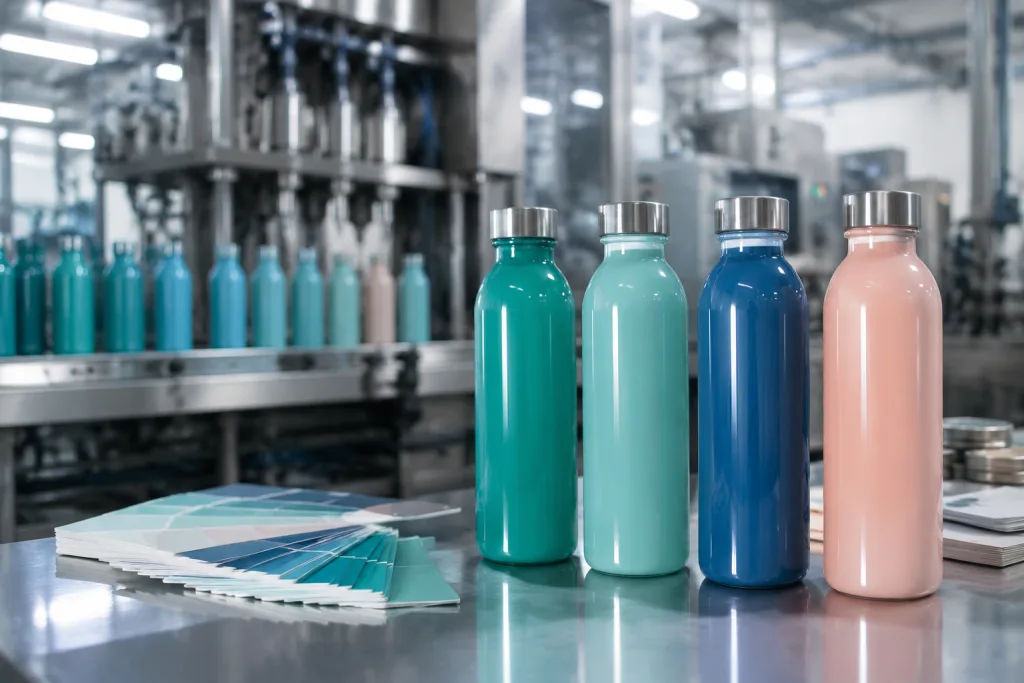
- Coated body color: the whole bottle body is sprayed or painted to approximate a Pantone shade, then cured. Film thickness matters here; if the coating is off by 8–12 μm, the color reads different before you even start printing.
- Tinted glass: the glass itself is produced in a colored tone. This gives the most stable look at scale, but the MOQ jumps and color options narrow. We’ve seen this go sideways when the PO said “Pantone green glass” with no sample and no tolerance.
Most B2B orders use clear borosilicate or soda-lime glass with external decoration. The reason is simple: easier tooling, lower MOQ, and you can add a new SKU without cutting a new bottle mold. For a normal 500 ml bottle, a Zhejiang canteen factory may offer 1,000 pcs MOQ for a one-color silk screen logo, 2,000 pcs for spray coating plus print, and 10,000 pcs or more if you want custom-colored glass from the furnace stage. We run these combinations every week. The wrong question to ask is “Which Pantone is cheapest?” Ask which process fits your volume.
The honest answer is that Pantone on glass is not the same as Pantone on coated paper. Ink opacity, bottle curvature, and background transparency change what the eye sees, and a 1-color print on clear glass will not read like the same code on a paper swatch book. If a canteen customizable project must hit a brand guide tightly, ask the canteen manufacturer to define the approval method before PI issue: Pantone code, viewing light source such as D65, finish level, and whether approval is by signed pre-production sample or lab data plus visual sign-off. We’ve had buyers approve a glossy sample, then reject mass goods because the PO typo said matte.
Good factories in Zhejiang or elsewhere in China will not promise impossible precision. They will tell you which colors stay stable, which need an underbase, and where slight batch-to-batch shift is normal. If a supplier says every bottle will match the Pantone book exactly, the math doesn't work.
The checklist before you request quotation
If you send only a logo and ask for a price, you will get a number back fast. It is often the wrong number. A proper RFQ for custom drinkware needs the cost drivers up front: bottle spec, decoration method, Pantone target, packing standard, and quantity split. We’ve seen this go sideways when a buyer asked for “same as sample” and the PO later showed double-wall instead of single-wall.
Your RFQ should include
- Bottle size and material: 350 ml, 500 ml, 750 ml; borosilicate or soda-lime; single wall or double wall.
- Decoration area: front logo only, wrap print, full-body coating, frosted finish, gradient, or metallic effect.
- Pantone reference: exact code such as PMS 186 C, and whether it applies to print or bottle coating.
- Accessory set: bamboo lid, PP lid, stainless cap, silicone sleeve, tea infuser, carry loop, or gift box.
- Compliance market: EU REACH, LFGB-related material expectations, California Proposition 65 concerns, ASTM where relevant for packaging or child-use categories.
- Packaging: white box, color box, PDQ tray, master carton drop requirement, FNSKU label if you supply Amazon.
- Order quantity and split: 3,000 pcs one SKU is not priced the same as 3,000 pcs split into 6 Pantone colors.
A canteen supplier or canteen vendor cannot quote cleanly without that detail. Same for a custom canteen, custom growler, or distributor drinkware assortment. This is the wrong question to ask: “What’s your best price?” Ask what setup is included. On the line, coating setup, screen mesh count, fixture quantity, and carton print plate all change the cost, and QC pulled one sample last month because the sleeve ID was 2 mm tighter than the approved drawing.
At our Hangzhou, Zhejiang operation, standard sample lead time is 7-12 days for decorated approval samples, and bulk production is usually 30-35 days after deposit and artwork sign-off for 3,000-10,000 pcs. That is normal. Capacity matters too. A factory running 600,000 units per month can often absorb a repeat order in 12 days versus 18 days at a smaller workshop, especially if your canteen customized program has a fixed ship window. We run into this every peak season, and the math doesn’t work if six Pantone colors share one ship date but the RFQ was priced as one SKU.
Which decoration method fits the job
For glass bottle custom Pantone work, the process choice is not decoration talk. It drives unit cost, wear performance, and the color tolerance your QC team will accept. We’ve seen buyers focus on shade first and miss the print method. That is the wrong question to ask.
Common options
- Silk screen printing: Best for simple logos and 1-3 solid colors. Typical added cost is around USD 0.08-0.25 per color per unit depending on size and order volume. We run this most often on straight-wall bottles with a fixed screen and steel jig. Good repeatability, but very light inks on clear glass usually need an underbase, or the logo looks thin under store lighting.
- Heat transfer or decal: Better for multicolor artwork and fine details. Cost often runs USD 0.12-0.35 per unit. Strong for complex branding, but positioning control must be specified. On the line, QC pulled the sample twice last season because the flower artwork shifted 2 mm off center, and the buyer flagged it right away.
- Spray coating plus print: Used when the body itself needs a Pantone-like color. Cost can add USD 0.20-0.60 per unit depending on finish, masking, and coverage. Gives a strong visual result for canteen promotional and retail collections. Good shelf impact. The tradeoff is yield loss: dust points, hanging marks, and uneven edge masking show up fast if the booth setup is loose.
- Frosted or etch effect: Useful when you want premium appearance without relying on heavy ink coverage. This works well for a softer look, and it hides minor surface reflection issues better than dense full-body print.
If your brand owner wants exact shelf consistency, ask for a pre-production sample made on the same line as mass production, not only a hand-made sample. That part matters. Hand spray often looks cleaner than automated jig production, and we’ve seen this go sideways at PO approval. For a customizable growler or customized growler with a larger curved body, wrap alignment and seam visibility need separate approval, especially once the body diameter opens up and the artwork crosses the side parting line.
Ask about adhesion and abrasion checks too. A practical factory quality routine includes tape adhesion, dishwasher resistance claim review if made, and rub testing with a cotton cloth for 50 cycles. If a canteen distributor or distributor growler buyer plans outdoor use, sleeves and coatings should also be checked for scratch marks in transit. We ship test cartons with divider packs for this reason. A coating that looks perfect on day one but scuffs inside the master carton is not a good buy, even if the ex-factory price is low.
MOQ, pricing, and where cost moves
Buyers ask this every week: why does one canteen factory quote USD 1.10 and another quote USD 1.85 for what looks like the same bottle? On paper, maybe. On the line, it usually is not. We’ve seen one RFQ call for a “500 ml bottle” but the wall thickness was 3.2 mm on one sample and 2.6 mm on the other, with different lid weights and different packing counts.
For a common 500 ml clear glass bottle with bamboo lid, you can expect broad FOB China ranges like these:
- Stock bottle, no logo: about USD 0.75-1.20 at 3,000 pcs
- One-color silk screen: about USD 0.90-1.45 at 3,000 pcs
- Spray coating plus one-color logo: about USD 1.15-1.90 at 3,000 pcs
- Color box retail pack: add roughly USD 0.18-0.45 each depending on print coverage and insert
The main cost moves are usually outside the glass body. Decoration, packaging spec, breakage allowance, and quantity split push the number around fast. If you run 6,000 pcs in one Pantone, the coating line stays efficient and waste stays lower. Split that same 6,000 pcs into 6 Pantones, and the math doesn’t work the same. We stop the line for color change, clean spray guns, confirm each drawdown, and pack by shade to avoid carton mix-up. QC pulled one job last month because two outer cartons were marked PMS 7690C, while the PO typo said 7960C.
This is why canteen suppliers and canteen manufacturers ask detailed questions early. It’s not stalling. It’s quote control. For a canteen custom or customized canteen project on a stock shape, a workable MOQ is often 1,000 pcs per SKU, but 2,000-3,000 pcs per colorway gives steadier pricing and fewer arguments later. That is the wrong question to ask if you only ask for the lowest MOQ. Ask where the price breaks are. For custom mold glass, MOQ may jump to 20,000-50,000 pcs, and tooling can run from USD 2,000 to USD 8,000 depending on bottle size and cavity plan. A 2-cavity plan and a 4-cavity plan do not quote the same.
If you are a canteen distributor, distributor canteen program manager, or one of several canteen distributors bidding the same account, pin down the quote basis first: FOB Ningbo, FOB Shanghai, or EXW Zhejiang. We ship from both Ningbo and Shanghai depending on booking, and the trucking delta from Hangzhou plus export handling can shift the landed comparison by 2% to 5%. Buyers miss this all the time, then flag the factory on price when the base term was different.
How to control quality before shipment
Glass drinkware has one hard truth: buyers spot defects fast. One scratch, one print bubble, one decal shifted 2 mm, and the claim email starts. So QC terms need to sit on the PO and PI from day one, not in a WeChat voice note. We have seen a single typo on a PO—“black lid” instead of “matte black lid”—turn into 3,000 pcs of rework.
Use a short, practical QC checklist
- AQL standard: ask for final inspection at AQL 2.5 for major defects and define critical defects as zero tolerance.
- Color approval: signed golden sample plus agreed visual standard under defined light. D65 light box is better than checking beside a factory window at 4:30 pm.
- Decoration position tolerance: for example, logo center shift within plus or minus 1.5 mm.
- Breakage checks: carton drop test, usually 1 corner, 3 edges, 6 faces based on carton size and destination. We normally confirm carton size and gross weight first; once a master carton is over 12 kg, the risk goes up fast.
- Lid fit and leak test: especially for carry-use bottles, 100% basic fit check and agreed sampling plan for leak test. QC pulled the sample, filled it, inverted it for 30 minutes, then checked the thread and silicone seat.
- Material documents: request declarations for food-contact relevant parts, bamboo, silicone, PP, or stainless components as needed.
For buyers in Europe and North America, compliance wording on the order sheet matters. If the glass bottle has an external painted coating, the factory should know when REACH-related screening is required and be ready to support third-party testing. If the SKU is meant for children, or even sits close to a kids category, the review gets stricter. This is the wrong question to ask: “The body is glass, so we’re fine, right?” Accessories are where trouble starts. We have had buyers flag the ink, the strap, and the silicone boot before they ever asked about the bottle body.
A steady canteen factory in China should be ready to send in-line photos, packing details, and master carton specs before balance payment. We ship these files before the final balance on most export orders, and the carton mark layout is usually confirmed line by line. If you run seasonal canteen customized programs, ask for defect photos from older runs, not just a clean sample photo. Factories that track print pinholes, color variation, and glass scratches by batch are easier to work with because the line already records what went wrong and where. If a supplier only says “quality no problem,” the math doesn't work.
Questions to settle before you place PO
Most disputes on custom drinkware start with one line that never made it onto the PO. Before you release the 30% deposit, settle these commercial points with your canteen supplier or canteen vendors. We’ve seen this go sideways over a 2 mm logo shift, a missing color swatch, or one typo in the ship mark.
- Who owns the artwork setup and screens? Put it in writing. Confirm whether repeat orders carry a new setup charge, especially if the logo size, mesh count, or print position changes by even 1 mm.
- What is the breakage policy? Glass has normal transit risk, so define the acceptable overage or spare percentage up front, often 1-2% for bulk export planning. QC pulled the sample on one order because inner partitions were too soft, and the buyer flagged breakage before loading.
- How are replacements handled? Set the claim method before production starts. Credit on the next order is common; air replacement for small claims is rare unless the issue is severe or the shortage blocks a launch.
- What are payment terms? Standard export terms from China are often 30% deposit, 70% before shipment or against copy B/L, depending on account history. Ask who pays bank charges too. Small point, but it causes noise.
- What is the lead-time trigger? This is the right question. Lead time should start after deposit, artwork approval, and sample sign-off, not after PO receipt. On the line, that difference is often 12 days vs 18 days.
- Can the supplier support repeatability? Ask whether the same Pantone can be repeated in 90 days or 180 days with the same coating formula and line settings. If the factory cannot show batch records or a retained sample, the math doesn’t work.
If you are comparing several canteen manufacturers or canteen vendors, don’t stop at unit price. Compare how they answer process questions and what they do when you push back. A factory that explains why PMS warm red needs an underbase on clear glass is usually safer than one that says every Pantone is easy. We run into this on gift sets and distributor growler programs all the time, and the buyer usually finds the problem only after the first pre-production sample.
At BottleForge Industrial in Zhejiang, China, we give buyers the plain version: if your target date is tight, cut one variable. Keep the stock bottle, reduce SKU splits, or stay with one proven coating finish. We ship more projects on time that way. Chasing a perfect spec on every detail at once is usually the wrong move, especially once mold availability, carton drop test results, and 5000 pcs MOQ all start pulling against the same schedule.
Get a factory-usable Pantone quote now
Send bottle size, Pantone code, decoration method, target quantity, and packaging details. We will review feasibility, MOQ, FOB pricing, and lead time clearly.
Frequently asked questions
Can you match any Pantone color exactly on a glass bottle?
Not on every process, and a factory that says yes without conditions is overselling. On clear glass, exact Pantone matching depends on ink opacity, background transparency, logo size, and curing method. For simple silk screen logos, many colors can be matched closely with visual approval, but very light tones, fluorescents, and some metallic effects are harder. For full-body coated bottles, the result is usually closer because coverage is higher, but even then approval should be based on a signed sample and agreed viewing light such as D65. For B2B orders, ask for a target tolerance, visual standard, and note whether matching applies to logo print or full bottle coating. That avoids arguments after production.
What MOQ should I expect for glass bottle custom Pantone orders?
For stock bottle shapes, 1,000 pcs can work for a basic one-color logo, but 2,000-3,000 pcs per SKU is more realistic if you want stable pricing and smoother production. If you add full-body Pantone spray coating, many factories in China will quote from 2,000 pcs per colorway because setup and cleaning time increase. If you want custom bottle mold, MOQ usually jumps to 20,000 pcs or more, sometimes 50,000 pcs depending on mold and furnace planning. Buyers often save money by using a stock bottle and customizing lid, sleeve, and print first. If you are a distributor canteen buyer testing a new account, start with 2,000-3,000 pcs rather than pushing a 500 pc special run.
How long does sampling and mass production usually take?
A normal timeline from Zhejiang or other export regions in China is 3-5 days for an undecorated stock sample, 7-12 days for a decorated approval sample, and around 25-40 days for bulk production after deposit and approved artwork. If you need a pre-production sample made on production tooling and line conditions, add a few days. Retail packaging, barcode application, and third-party lab testing can also extend the schedule. During peak months before summer promotions or Q4 gifting, you should build in an extra 7-10 days. If your launch is fixed, ask the canteen factory to break the schedule into artwork confirmation, sample sign-off, production, inspection, and booking so you can see where the real risk sits.
What tests or documents should I request from a supplier?
For most B2B glass bottle projects, request material declarations for food-contact relevant components such as silicone, PP, stainless, or bamboo parts, plus any REACH-related support needed for your market. For quality, ask for AQL 2.5 final inspection, leak test criteria, logo position tolerance, and carton drop test results. If the product is sold into children-focused channels, the compliance scope may widen and should be discussed before sampling. If you sell on Amazon, ask for packaging dimensions, carton weights, and labeling details such as FNSKU placement. Good canteen suppliers will also provide packing photos, master carton specs, and a signed golden sample reference before mass production starts.
Is glass a better choice than stainless for promotional or retail drinkware?
It depends on use case, not trend. Glass gives a clean taste profile and premium visual look, which is why many brand owners use it for office gifting, tea infusers, and wellness lines. It also shows Pantone decoration clearly when done well. But glass is heavier and has breakage risk, so freight cost and damage control matter. Stainless is stronger for outdoor, sport, and commuting use. If you are a canteen distributor, canteen vendor, or distributor drinkware buyer serving mixed channels, a balanced range often works best: glass for desk and lifestyle programs, stainless for active use. For many first orders, buyers test 2,000 pcs in glass before deciding whether to expand into a broader customizable growler or custom canteen collection.