Key Takeaways
- For glass bottle custom color, lock color standard by Pantone or approved master sample under D65 light, not phone photos; expect Delta E tolerance agreement before mass production.
- Spray-coated glass usually starts around 3,000-5,000 pcs MOQ in China, with 25-35 day lead time after sample approval and deposit.
- Define coating, print, and packing tests in writing: cross-hatch adhesion, 24-hour cure, 1.2 m drop test, and AQL 2.5 for major defects.
- If you need food-contact compliance, ask for REACH, CA Prop 65, and migration-related declarations before PO, not after shipment.
You can sign off a glass bottle custom color sample and still get bulk cargo that looks off on shelf. We see this on the line. The usual cause is not one big factory error. It is 4 small spec gaps that stack up: color checked under office light instead of D65, coating thickness left open instead of calling out 18–22 μm, logo cure temperature missed on the artwork sheet, or carton drop testing skipped. QC pulled the sample, it matched the master, but the packed goods looked darker under store lighting. If you buy custom drinkware for retail, gifting, or a canteen promotional program, those gaps turn into claims, rework, and late launches.
At factory level in Zhejiang, colored glass projects fail in predictable ways, and this is the wrong question to ask: not “Can you match this color?” but “How will you control it from sample to bulk?” We have seen POs with a one-line note that says “matte navy, same as last time,” with no Pantone reference, no gloss target, no cure window, not even a signed sample date. Then the buyer flagged it after production. If you understand the failure points, you write a tighter brief and cut preventable scrap before we run 20,000 pcs. Whether you source a custom canteen, customizable growler, or a colored glass bottle line, the rule is simple: if you do not spec the risk, the factory defaults to the fastest setting.
Color approval fails before production starts
The first failure starts before the bottles hit the spray line. We see this on the factory floor every month: the buyer signs off a glossy PDF, the canteen supplier is holding a Pantone chip, sales has a painted sample, and someone in the group chat is judging color from a phone photo. Those are not the same reference. For glass bottle custom color, set one master standard and one viewing condition. If you skip that, the bottle body, cap, silicone sleeve, and gift box will drift fast, and QC pulled one set last month where the cap looked 2 shades darker under the light box.
For most B2B projects from Zhejiang, China, we ask buyers to approve color against a physical sample under D65 lighting or a defined light box standard. This is the right question to ask first. If a project has mixed parts, ask the canteen factory or canteen manufacturer to mark which parts are color-matched and which are only color-coordinated. That line matters. Powder-coated stainless, injection-molded PP, silicone, and sprayed glass reflect light differently, even when the Pantone code on the PO is the same. We run into this with custom canteen and customized growler orders all the time, and the buyer flagged it on one 3,000-piece order because the sleeve looked warmer than the bottle under store lighting. Exact cross-material match is not realistic unless you set a visual tolerance at the start.
What to put on the spec sheet
- Color reference: Pantone code plus signed master sample
- Viewing condition: D65 or equivalent light box
- Surface finish: gloss, matte, frosted, translucent, opaque
- Tolerance: agreed visual standard or instrument method if used
- Critical pairings: bottle body to lid, sleeve, straw, or box insert
Most mass production disputes are not about bad intent. They start when a buyer approves color on one material, then expects the same look on glass, PP, and silicone after the line runs.
If you are a canteen distributor or distributor drinkware buyer handling 6 or 20 SKUs, ask for a sample retention policy. The factory should keep one sealed approved sample through production and final inspection, usually tagged with PO number, date, and line sample sign-off. Small step. It cuts arguments fast. We've seen this go sideways when the approved sample was left open on a sales desk and faded before shipment review.
Coating choice creates hidden defect risk
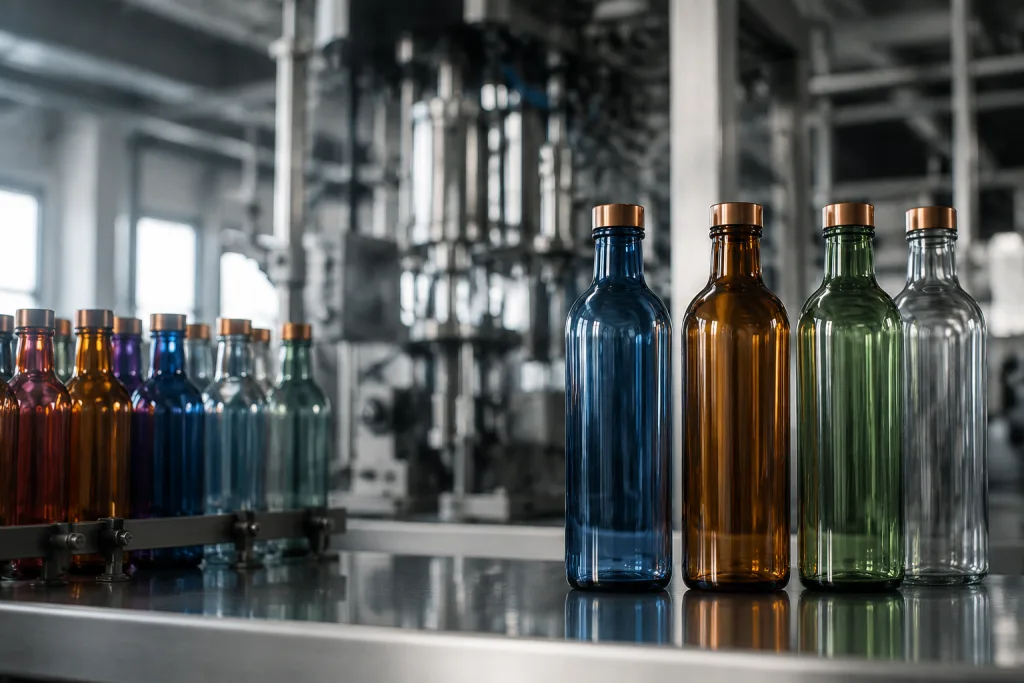
Not every colored glass bottle is built the same. Some use through-colored glass. Some use external spray coating. Some add electroplated effects, or pair frosting with print. Buyers still pick from the render first, then the buyer flagged scratch marks, odor, or weak adhesion after sample review. If this program is custom drinkware for retail or distributor growler channels, coating choice matters more than the photo. We’ve seen QC pull a sample with clean color and poor tape-pull result on the same day.
For daily-run projects, external spray coating is common because it gives flexible color options at workable MOQs. In our China supply chain, spray-coated glass often runs from 3,000 to 5,000 pcs per color, depending on bottle shape and carton pack. The line usually checks cure after baking, and if the oven window drifts even 10°C, adhesion complaints start later, not on day one. Through-colored glass is often more stable visually, but mold and raw material planning usually push MOQ higher and lead times longer. Think 12 days vs 18 days on repeat colors. Electroplated or metallic effects look premium, but the math doesn't work for every channel because defect sensitivity goes up fast; even light abrasion in packing can mark the surface. A 1 mm divider gap that looks fine on plain glass can still scuff a metallic finish in transit.
Ask the canteen manufacturers these practical questions:
- Is the color baked after spraying, and at what cure range?
- What is the typical coating thickness range in microns?
- What adhesion test is used: cross-hatch, tape pull, or both?
- Can the surface handle dishwasher cycles, or hand wash only?
- Will the coating contact food or only the exterior body?
If you need a customizable drinkware line for corporate gifting, matte sprayed finish usually photographs well, but it shows rub marks faster than semi-gloss. This is the wrong question to ask: “Which finish looks best?” Ask which finish still looks acceptable after 30 days in cartons. Frosted effects hide fingerprints, though they can soften logo edges, and we’ve measured print sharpness loss on fine text below 1.2 mm stroke width. A canteen customizable concept with a silicone boot also creates friction points where coating wears first. The line sees this near the boot edge and around the shoulder radius. A good canteen vendor will tell you where wear is expected instead of claiming every finish has the same durability.
For buyers in Europe and North America, request written compliance scope early. REACH, CA Prop 65, and packaging regulations are easier to manage before sampling than after 20,000 units are packed. We’ve seen this go sideways over one PO typo that listed “food-grade coating” when the coating was exterior-only.
Printing breaks when cure sequence is wrong
A bottle body can pass color approval and still fail after decoration if the process order is wrong. We see this on glass bottle custom color jobs with silkscreen, heat transfer, decals, UV print, or metallic logo bands. If coating, curing, and logo application are lined up badly, QC pulled the sample and found ink lifting, ghosting, pinholes, or misregistration on the same run. The bottle itself was fine. The print made it look low-grade.
For a simple one-color logo, silkscreen after full coating cure is usually the safest route and the price holds. If your artwork has gradients or text under 1.2 mm height, ask a direct question: can this process hold that detail on curved glass at production speed, not just on one sample? We run cross-hatch tape tests after cure because curved glass exposes weak adhesion fast. A canteen manufacturer focused on stainless often overpromises here; glass reacts differently during handling, flame treatment, and print setup. If you are sourcing a customized canteen range plus a glass line from one canteen factory, qualify the print process on glass only. This is the right question to ask.
Common decoration failure modes
- Ink scratches off: cure time was short or the ink system does not match the coating; we’ve seen a 20-minute bake quoted on the PO fail a tape test the same day
- Logo shifts: fixture is not stable on a curved or tapered body, often because the nest has 1 mm to 2 mm play
- White ink yellows: over-bake or weak raw material control; one batch looked clean at setup, then turned cream after oven hold
- Fine lines fill in: mesh count or artwork is wrong for the glass curve; on the line, 0.15 mm gaps usually close first
- Metallic print dulls: topcoat reaction or too much heat; the buyer flagged this most often on rose-gold bands
Write acceptance points in plain language. For example: no visible logo misalignment from 50 cm, no missing print, no color contamination, no edge lifting after tape test, and no more than 1 mm position deviation relative to artwork keyline. For B2B shipments from Zhejiang, many buyers use AQL 2.5 for major defects and 4.0 for minor defects, but the defect list does the real work. We ship against the standard that is written, not the one discussed on a call. AQL without a defect standard is weak. We’ve seen this go sideways over one PO typo on logo position.
If the project is a canteen custom bundle with matching glass bottle and custom growler packaging, approve pre-production samples assembled exactly as sold. Use the same insert, carton, and packed orientation. Flat decoration samples are not enough.
Glass quality defects show up late
Buyers who stare at color chips often miss the glass under them. That is where the late claims start. Seeds, bubbles, cords, uneven wall thickness, leaning mouths, and rocking bottoms do not disappear under coating. They just get harder to catch. We have seen QC pulled the sample from the paint line, approve the finish, then find a 1.5 mm mouth lean at final packing. The buyer flagged retail complaints 6 weeks later. Serious QC starts at the bottle, not the paint booth.
For borosilicate and soda-lime projects, ask the canteen supplier to write the material clearly on the spec and confirm the use: cold fill only, hot fill, or temperature resistant. A 550 ml borosilicate bottle may use wall thickness around 2.2-2.8 mm depending on shape. Measure it with an ultrasonic thickness gauge, not by eye. If the neck geometry drifts, the closure will not seat flat and you get leak complaints. Buyers often blame the cap or gasket first. In our experience, that is the wrong question to ask.
At incoming and in-line QC, the canteen vendor should check:
- Body and mouth dimensions against drawing
- Wall thickness consistency
- Bottom stability on flat surface
- Visual defects under defined light
- Thread or stopper fit if closure is included
If you are a canteen distributor handling private label programs, ask for a dimensional report from first article production. For high-volume orders, ask for the top 5 critical dimensions with tolerance, not a loose statement that the bottle is “standard.” We run these checks at line start, every 2 hours, and again at packing changeover on repeat orders. One common inspection finding is a PO with the finish color confirmed but no neck ID tolerance listed. That gap causes more trouble than buyers expect. This level of control matters more than a polished sample room.
Also check what “handmade” or “mouth-blown” means in the quotation. Those words get used too loosely. Some buyers accept wider variation for artisanal shapes; some reject a 2 mm height difference on arrival. We have seen this go sideways on e-commerce programs, where pack-out, divider fit, and return rate all move fast if bottle shape drifts. A customizable canteen line sold online can survive slight color shift. A leaning glass bottle usually cannot.
Packaging ruins finished bottles fastest
We see good production get damaged in the last 48 hours more than buyers expect. Colored glass takes hits during packing, palletizing, and container loading. Matte coatings scuff. Printed logos rub off on the line. Caps dent under top-load pressure, and inner partitions buckle when the carton board is too light. Buyers will spend 2 weeks on Pantone and then approve packaging with one line: “export carton.” This is the wrong question to ask.
For a standard 500-750 ml glass bottle project, ask your canteen suppliers for carton dimensions, board grade, partition style, and gross weight per carton. We usually try to keep carton weight under about 15 kg because warehouse handling is cleaner and corner crush claims drop fast. On one 750 ml order, QC pulled the sample and found the partition slot was 3 mm too wide, which let the shoulder knock against the next bottle. If the bottle has an exterior coating, each unit needs isolation by polybag, tissue, or a partition design that stops bottle-to-bottle contact. For gift box projects, do not treat the retail box as sea-shipment protection. It usually is not enough.
Minimum packaging details to confirm
- Inner protection: individual polybag, foam sleeve, or paper wrap
- Cell dividers: corrugated partitions sized to bottle shoulder and base
- Master carton: 5-ply or stronger, based on weight and drop target
- Transit test: 1.2 m drop test and carton compression check
- Pallet rule: whether palletized, stretch-wrapped, and corner-protected
If you sell through Amazon FBA or distributor canteen channels, barcode and carton marking accuracy matters as much as the bottle finish. We have shipped clean goods that still triggered warehouse penalties because the outer label was wrong. One PO even had the FNSKU typo in a single digit, and the buyer flagged it after arrival, not before loading. Put FNSKU, carton label position, and assortment map on the packing spec. Most canteen vendors in China will follow it if the document is clean and the carton mark file is final.
At BottleForge scale, projects typically run with lead times around 25-35 days after deposit and sample sign-off, with capacity over 500,000 units per month across drinkware lines. So packaging material lock-in has to happen early. We run carton print, divider die-cutting, and pallet pattern planning ahead of final loading week. Last-minute packing changes are one of the fastest ways to create delay, and we have seen this go sideways over something as small as a 10 mm taller insert.
QC plans fail because standards are vague
Buyers often ask if the canteen factory has QC. That is the wrong question to ask. Ask whether the QC plan is written tightly enough to catch the failure you care about. “100% inspection” sounds safe, but if nobody defined defects, check points, and pass/fail limits, it means little on the line. For glass bottle custom color, vague QC usually means the inspector looks for breakage only and misses the cosmetic issues your retail customer will reject. We have seen QC pulled the sample under a 6500K light box and still miss a shade shift because the PO just said “match Pantone closely.”
A workable plan should cover incoming material, first article, in-line process checks, final random inspection, and packaging audit. Put each stage on paper. Incoming glass body, spray coating thickness, logo position tolerance, carton drop check. If you use third-party inspection, align the checklist with the factory’s own controls, or the math doesn’t work. One team signs off at 1.5 mm logo offset, the other rejects above 1.0 mm. We see this go sideways on custom canteen and custom growler programs sourced from 2 workshops under one trading setup.
Use practical standards such as ISO 2859 sampling logic and an agreed AQL level. For example, you might set critical 0, major 2.5, minor 4.0. Then define what each defect means:
- Critical: glass crack, sharp edge, coating peel exposing unsafe surface, leakage
- Major: wrong color family, obvious logo defect, unstable standing, chipped rim
- Minor: small speck under 0.5 mm in non-primary visual area, slight carton scuff
For canteen distributors or distributor growler buyers serving chain stores, ask for inspection photos under controlled lighting and with visual area marked. A 360-degree bottle does not have equal visibility. The front panel where the logo sits gets harder judgment than the base ring. We usually mark Zone A, B, and C on the artwork sheet, then QC checks from 30 cm distance for Zone A and 50 cm for lower-visibility areas. Good China factories understand this once it is documented, but if you leave it vague, the buyer flagged it later and everybody argues over photos.
If the order is canteen customized for a campaign date, set one checkpoint before full production: a pre-production sample assembled from actual mass-production materials. Do not approve from a hand-made mockup only. We run this gate after coating, printing, and cap assembly with production parts, not showroom parts. One sample can save 12 days versus 18 days of rework after mass production starts. That one gate catches more problems than arguing later over finished goods.
Send your color brief before you approve samples
We will review bottle type, coating method, MOQ, and QC points so your China order is buildable before you commit tooling or packaging.
Frequently asked questions
What MOQ should you expect for glass bottle custom color?
For most spray-coated glass bottle custom color projects in China, practical MOQ starts around 3,000 to 5,000 pcs per color per shape. If you need a custom lid, special decoration, or gift box, MOQ can move to 5,000 to 10,000 pcs because packaging and print setup add cost. Simpler stock-bottle programs with one-color logo may be possible below that if the canteen supplier already has the mold and matching closure. Always ask whether MOQ is based on body color only, full SKU, or packed assortment. A low quoted MOQ sometimes excludes custom cartons, which creates confusion later.
How long does mass production usually take after sample approval?
A normal lead time is 25 to 35 days after final sample approval and deposit, assuming artwork, packaging, and compliance documents are already locked. New mold development or uncommon coating effects can push the schedule to 40 to 55 days. If you order during peak season, especially before major holidays in Zhejiang or other China manufacturing regions, book at least 1 to 2 extra weeks. Ask for a timeline broken into bottle production, coating, decoration, packing, and inspection. That helps you see where delays are likely instead of getting one vague ship date.
Can a glass bottle color match a stainless custom canteen exactly?
Usually not exactly, and a serious canteen manufacturer should tell you that early. Spray-coated glass, powder-coated stainless steel, silicone, and PP lids all reflect light differently, so the same Pantone reference will appear slightly different across materials. What you can do is create a controlled visual match under a defined light source and approve a full assembled set. For gift sets or coordinated customizable drinkware lines, ask the factory to state which parts are color-matched and what tolerance is acceptable. If exact identity is critical, reduce the number of different materials or choose finishes that hide variation better, such as satin rather than high gloss.
What compliance documents should a B2B buyer request?
At minimum, ask for material declarations and test reports relevant to your market: REACH for EU chemical compliance, CA Prop 65 screening for the US if applicable, and food-contact statements for components that touch liquid. If packaging is included, check packaging material compliance as well. For children’s items or kid-focused customized drinkware, ASTM or CPSIA-related requirements may apply depending on product design and accessories. Also ask whether the factory operates under a social compliance framework such as BSCI and whether quality systems are documented. Get the compliance scope before placing the PO; after goods are made, missing paperwork is expensive to fix.
How should you inspect a colored glass bottle order before shipment?
Use a written inspection checklist with AQL levels, defect photos, and packaging requirements. At final inspection, check color against the approved master sample under standard light, verify logo position, perform basic adhesion checks, review leak performance if the closure is included, and inspect carton markings. For glass, also confirm mouth finish, bottom stability, and visible defects such as bubbles, cords, or chips. If the project is for a canteen distributor or distributor drinkware program, inspect assortment accuracy and barcode placement too. A third-party inspection is useful, but only if the factory and inspector work from the same defect standard and approved sample.