Key Takeaways
- For new OEM programs, realistic MOQ is usually 3,000-5,000 pcs per color, while stock-based custom logo infuser bottle orders can start at 500-1,000 pcs
- Tritan bodies usually cost about USD 0.45-0.90 more than standard PET or AS, but crack resistance and odor performance are materially better
- A dependable Zhejiang factory should quote sample lead time at 7-12 days and mass production at 25-40 days after deposit and artwork approval
- For EU and North America, ask for REACH, LFGB or FDA contact compliance, AQL 2.5 inspection, and leak testing at 100% before packing
You can make a weak bottle look fine in a render. You will not hide a bad infuser basket, a leaking seal, or a cap thread that cross-binds after 300 openings on the torque tester. This is where wellness brands and hydration startups lose weeks. When you compare fruit infuser bottle manufacturers, trend colors are the wrong first question. Start with material limits, mold ownership, basket geometry, gasket performance, and whether the line can hold repeat quality at 10,000 pcs, not just the first 20 approval samples.
In Zhejiang, China, 40 factories will quote a custom infuser bottle in 24 hours. Maybe 6 can explain why Tritan usually holds up better than standard AS for citrus-heavy use, or why a 0.3 mm silicone tolerance changes leak rate at the cap seat. We ship to Europe and North America, and we have seen this go sideways: the buyer flagged stress cracks after lemon-water use, then QC pulled the sample and found the PO even had the lid color code typed wrong. If you are buying a bulk fruit infuser bottle or building a custom logo infuser bottle program for Europe or North America, you need a spec-based comparison, not sales talk.
What you should compare first
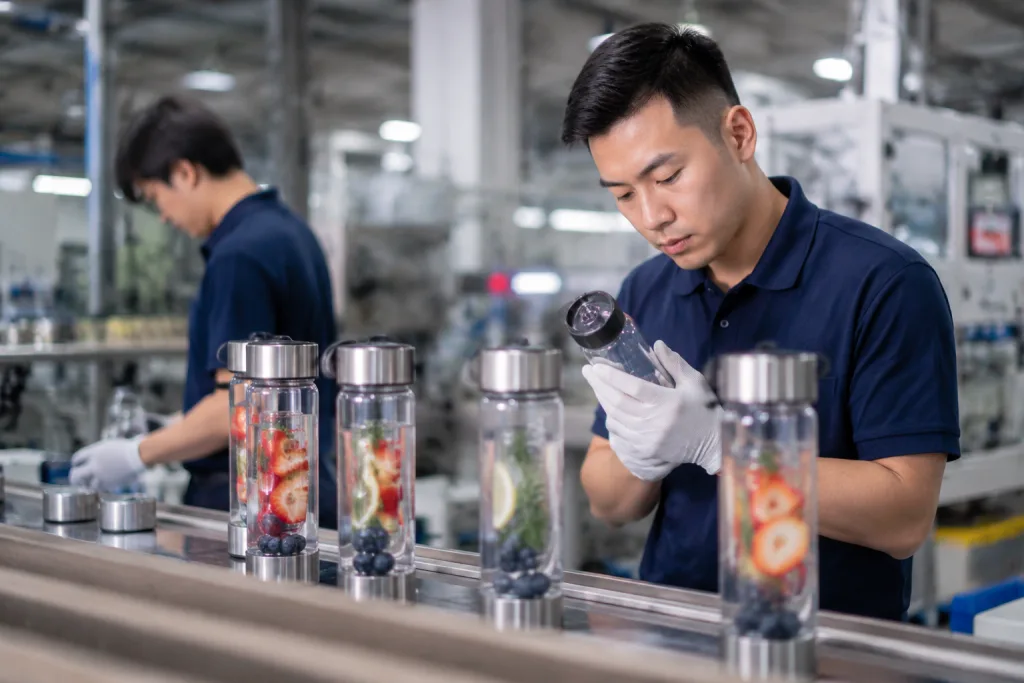
If you are screening fruit infuser bottle manufacturers, compare the parts that fail first in real use: body material, basket design, lid construction, seal stack, and print durability. A custom made infuser bottle looks simple on screen. On the line, it is a multi-part assembly with bottle body, screw cap or flip lid, fruit basket or tea strainer, carry loop, silicone gasket, and decoration. If one part is weak, the whole SKU turns into a returns problem. We have seen QC pulled the sample after a 1.2 m drop test because the lid held but the basket tabs snapped.
A practical buyer comparison looks like this:
- Body material: Tritan, PETG, PET, AS, glass, or 18/8 stainless steel outer with inner filter setup. Ask what resin grade the factory actually runs, not just the sales sheet.
- Infuser type: full-length fruit basket, short tea basket, micro-perforated stainless insert, or PP cage with 2.0-3.0 mm slots. Slot size matters; we have seen pulp clog 2.0 mm patterns on lemon-heavy designs.
- Capacity: 500 ml, 650 ml, 700 ml, and 800 ml are the most common retail sizes. The 650 ml and 700 ml sizes usually fit better in gym bag side pockets.
- Wall thickness: Plastic bottle bodies usually run 2.0-3.0 mm depending on mold and shape; thinner saves cost but reduces drop performance. This is where the math often does not work if a buyer wants lower cost with the same test standard.
- Leak control: one gasket vs double gasket, thread pitch, cap torque, and vent design. We usually check torque with a digital torque meter before shipment.
- Decoration: silk screen, heat transfer, UV print, laser marking on metal parts, or molded color matching. Ask for an abrasion test result, not just a clean hero photo.
If your target user is a gym chain, a distributor infuser bottle program should focus on impact resistance and easy cleaning. If your target is a wellness starter kit sold online, appearance and unboxing will carry more weight, but leak rate still decides whether you get repeat orders. Ask every factory in China for actual production photos, not only white-background catalog shots. Better still, ask for a sample disassembled on video so you can see wall thickness, gate marks, basket fit, and gasket seating. Last month one buyer flagged a lid after seeing flash around the hinge pin in the video; that saved 18 days versus finding it after sample delivery.
You are not buying a bottle shape. You are buying repeatability across thousands of assemblies.
Head-to-head by material and use case
Bulk infuser bottle projects should not all run on the same material. The right pick comes down to your target price, sales channel, and what users put in the bottle day after day. Citrus oil attacks parts faster than mint water does, and tea stains show up fast in a 0.8 mm-clear body. We’ve seen this go sideways when a buyer chose on unit price alone.
Spec table buyers actually use
- Tritan: Best for premium custom fruit infuser bottle and customizable infuser bottle programs. Typical FOB China price for a 700 ml model with basket is USD 2.20-3.60 at 5,000 pcs. Good clarity, better odor resistance, BPA-free positioning, stronger than AS. On our line, Tritan usually gives fewer crack complaints around the neck thread after drop test. Best fit for DTC wellness brands and specialty retail.
- PET/PETG: Better for opening price points and high-volume promotions. Typical FOB is USD 1.20-2.10 at 5,000 pcs. Lighter and cheaper, but lower heat tolerance and usually a less premium hand feel. Buyers use this for fruit infuser bottle bulk campaigns and event giveaways, especially when the carton weight limit is tight at 12 kg per master case.
- AS: Clear and low cost, often USD 1.10-1.90 FOB, but now less favored for premium launches. Fine for short-cycle promotions. Not a smart match if your brand message is long-term wellness and durability, and we still get pushback from buyers who remember older AS programs aging badly on shelf.
- Glass with infuser: Typical FOB is USD 2.40-4.20 with sleeve. Better for tea ritual positioning and office use, but breakage risk is higher. QC pulled the sample twice last year for rim chips under 1.5 mm, so the packing method matters as much as the bottle. Good fit for custom tea infuser bottle sets.
- Stainless with filter insert: Usually USD 3.80-6.80 FOB depending on vacuum construction. More often sold as a bulk tea infuser bottle than a fruit-first product because fruit visibility is lost. The math doesn’t work for some fruit-led retail concepts, even if the insulation spec looks strong on paper.
For most startups, Tritan is the safest middle path. Simple. It costs more than PET, but a lower return rate can cover that gap fast. We’ve seen 12 days of smooth sell-through turn into 18 days of complaint handling once odor retention and leaking reviews start stacking up. If your retail target is USD 19.99-29.99, a custom logo infuser bottle in Tritan usually supports margin better than a cheaper body that brings more customer complaints.
If you are pitching distributors fruit infuser bottle programs in Europe, ask one direct question: do they want dishwasher suitability claims? This is the right question early, not after sample approval. Many do. Then test print adhesion and cap deformation after repeated cycles, not just the bottle body. We run cap fit gauges and check logo wear after 20 wash cycles because the buyer flagged fading on a PO once where “dishwahser” was even misspelled on the artwork file. Zhejiang factories that know the EU market will already discuss REACH and migration testing. If a factory only talks about color options, don’t hand them a customized fruit infuser bottle for a serious launch.
Basket design changes real user satisfaction
The infuser basket is where factory-direct infuser bottle programs usually win or fail. Buyers spend most of the meeting on the bottle body, then the end user complains about weak flavor, 3-minute cleanup, or pulp floating in the drink. We have seen this go sideways. There is no universal basket. The right pick depends on what people put inside and how often they wash it.
- Full-length fruit basket: Usually 160-220 mm long. Best for lemon, cucumber, berries, and mint. Good for a custom fruit infuser bottle because the fruit sits full height and looks better on shelf. Cleaning takes longer; on one 700 ml sample, QC pulled the sample and counted 14 seeds trapped near the bottom cap after use.
- Short tea basket: Usually 60-100 mm. Better for loose leaf and tea bags. If you are building a custom tea infuser bottle or customizable tea infuser bottle line, this is often the cleaner option. Less leaf travel. Faster rinse.
- Micro-perforated stainless insert: Better particle control for tea, but higher cost. Often used in a customized tea infuser bottle sold at premium retail. We run 0.4-0.6 mm perforation on these; if the hole spec drifts, the buyer flags fines in the cup right away.
- PP slot basket: Lower cost, lighter, and common in factory tea infuser bottle projects. Works fine if slot width is controlled and the fit is tight. The slot width matters more than the resin grade in most cases, and this is the wrong question to ask if your target is leaf retention.
Ask the manufacturer 3 practical questions. First, what is the basket locking method: thread, bayonet, or snap-in? Second, what is the average open area percentage? A basket with only 18% open area may look clean on a drawing, but infusion comes out weak on the line test. Third, can the basket be removed without a tool for full cleaning? If the answer is no, expect returns and low ratings. Last month a buyer sent us a PO with "snap fix" typed instead of "screw fix," and that one wording mistake would have changed the whole basket assembly.
For wellness brands, fruit use usually leads. For corporate gifting and office channels, tea often sells faster. That is why some buyers build 2 SKUs from one bottle platform: a customizable fruit infuser bottle with a long basket and a customizable tea infuser bottle with a short stainless insert. Shared body molds cut tooling cost. A fresh bottle mold in China can cost roughly USD 3,000-8,000 depending on shape complexity, while swapping insert components is much cheaper. The math works for startups. We ship one body, two basket sets, and test two audiences without opening a second full mold.
MOQ, tooling, and true landed economics
The lowest FOB quote often turns into a more expensive landed program. Put stock customization and full OEM in separate buckets when you compare fruit infuser bottle offers. They carry different cost structures, and we’ve seen buyers mix them up on one RFQ sheet and get bad approvals from finance.
Stock model with branding: This is the fast lane for a bulk fruit infuser bottle launch. MOQ is often 500-1,000 pcs per color for a custom logo infuser bottle. Silk screen logo cost is usually USD 0.08-0.20 per color per position. Lead time can be 15-25 days after sample confirmation if inventory and components are available. On the line, this usually means we pull an existing mold, confirm logo position in mm, and run a quick adhesion check with 3M tape before mass production.
Full OEM or custom shape: Here, a custom infuser bottle is your product, not the same stock bottle other importers are buying with a new print. MOQ is commonly 3,000-5,000 pcs per color, sometimes 10,000 pcs for lower-cost plastics. Tooling for bottle body, cap, and basket set may run USD 4,500-12,000 total. Lead time after mold completion is often 30-45 days. This is the wrong place to chase the lowest MOQ, because the math doesn't work once you split resin color, mold cost, and packing setup across too few units.
At BottleForge Industrial in Zhejiang, China, typical MOQ for an OEM infuser bottle is 3,000 pcs, sample lead time is 7-12 days for pre-production mockups, and monthly capacity across drinkware lines exceeds 300,000 units. Ask every supplier for those numbers in writing. Ask what line they run, too. If a factory cannot state capacity, MOQ, and standard lead time clearly, planning gets messy fast. Last month a buyer flagged a PO typo on carton qty, and that single mistake held booking for 2 days.
For distributors infuser bottle programs, build landed cost like this:
- FOB unit price
- Decoration cost
- Packaging cost: plain white box, color box, or mailer-safe pack
- Inspection cost
- Ocean or air freight
- Duty and customs handling
- Amazon prep if needed: FNSKU, suffocation warning, carton labels
A factory direct infuser bottle at USD 1.60 FOB can easily land above USD 2.40 before warehouse receiving. That is normal. QC pulled the sample, freight moved, labels got added, and the unit cost changed. Know that at quotation stage, not after you set wholesale pricing too low.
Compliance and QC that matter in Europe
If you sell in Europe or North America, compliance is the entry ticket. Any distributor tea infuser bottle supplier worth quoting should know the documents buyers ask for before the PO is signed. Ask for food-contact test reports tied to the exact materials in your BOM—lid gasket, infuser basket, bottle body, print ink—not a recycled report from another SKU. We have seen buyers catch this on page 2, where the report listed PP but the actual basket was Tritan.
- EU market: REACH checks, LFGB where applicable, and migration testing on all food-contact parts.
- US market: FDA food-contact compliance expectations and, if the item falls into the right sales channel, a California Proposition 65 review.
- Kids-adjacent positioning: If the design reads like youth use, ask whether ASTM-related concerns touch accessories or packaging claims. This is where a straw cap or carry loop gets the buyer’s attention.
- Factory systems: ISO-style process discipline, plus BSCI or social compliance if your retail customer requires it. Some chain buyers will not move forward without the audit number on file.
Quality control needs the same level of detail. “You do QC, right?” is the wrong question to ask. For a customized infuser bottle order, we want checkpoints the line can actually run and record:
- Incoming material verification by resin batch and color standard, usually against a signed master chip or Pantone target
- Thread gauge and cap torque checks during production; on our line, QC pulled the sample every 2 hours and logged torque drift
- 100% leak testing, commonly vacuum or inverted water test
- Print adhesion testing, often tape test plus abrasion check; a rubbed logo after 20 cycles is a reject, not a discussion
- Drop testing on packed product from defined height, often 76-100 cm depending on pack format
- Final inspection to AQL 2.5 or your required plan
If you are buying a distributor fruit infuser bottle for retail chains, insist on pre-shipment photos from random carton pulls, not just the top layer from one clean carton. Ask to see the product, barcode placement, carton marks, and inner dividers. Most claims in cross-border drinkware are boring: mixed colors, missing baskets, wrong inserts, rubbed logos, cartons crushed in transit. Last year, one buyer flagged a PO typo that changed the insert language pack, and 3,000 units had to be reworked. We have seen this go sideways. A written QC checklist beats memory every time, whether the factory is in Zhejiang or elsewhere in China.
Branding options without expensive mistakes
A custom made infuser bottle should read as your brand from 2 meters away, not like a stock catalog bottle with a logo dropped on at the end. Decoration changes unit cost, scrap, and production days. On our line, the first check is simple: bottle material, surface shape, and where you sell it. That tells us what will hold up and what will fail after 200 wash cycles.
- Silk screen: Lowest cost for 1-2 colors, usually USD 0.08-0.20 per color. Good for bulk infuser bottle wholesale projects. We run this most on straight cylindrical bodies with a mesh fixture; on deep curves, QC pulled samples with logo stretch near the shoulder.
- Heat transfer: Better for multi-color graphics. Usually USD 0.18-0.45. Good for lifestyle branding, but the line needs tighter temperature and pressure control. Last year one buyer flagged edge lifting on a 0.3 mm line because the transfer dwell time drifted.
- UV print: Sharp and flexible for small runs, but test adhesion carefully if bottles face frequent washing. This is where buyers ask the wrong question. Sharp print is easy; print that stays on after repeated dishwasher or hand-wash use is the real issue, so we tape-test and rub-test before sign-off.
- Embossed or debossed mold detail: Higher upfront tooling, near-zero print wear. Good for a long-term custom fruit infuser bottle platform. If your MOQ is 10,000 pcs and you plan repeat orders, the math often works better than reprinting every run.
- Color matching: Pantone-matched lids or sleeves help a customized tea infuser bottle feel more premium even with simple logo treatment. We usually approve against a Pantone chip under D65 light, because sleeve color drift is one of the first things a buyer notices.
If you are a hydration startup, do not overbuild packaging on the first PO. Put the money into the bottle and seal system first. A plain color box with a firm insert is usually the better call than a heavy premium box that adds USD 0.35-0.80 and increases freight volume. We have seen this go sideways. One buyer spent more on a rigid box than on the infuser basket, then the box failed a drop test from 76 cm and the corners crushed before launch.
For custom logo infuser bottle orders shipped to Amazon or 3PL warehouses, lock barcode location, carton dimensions, and pack count before mass production. Small mistakes turn into chargebacks fast. We ship approval photos, carton marks, and dielines before printing, and buyers should check every line, even a simple PO typo like “24 pcs” instead of “12 pcs.” It is cheaper than reworking 5,000 boxes after arrival.
Which supplier profile fits your stage
Different buyers need different factory setups. The fruit infuser bottle manufacturers that fit a wellness startup are often the wrong fit for a distributor running a tea infuser bottle program with 3 container repeats and fixed carton specs.
If you are pre-launch: Start with a stock platform and add a custom logo infuser bottle first. Keep MOQ around 500-1,000 pcs if possible. Stay with one hero size, usually 650 ml or 700 ml. Test sell before you pay for tooling. We have seen buyers open 4 SKUs at once, then stall on reorder because the math doesn't work.
If you have repeat demand: Shift to a custom infuser bottle platform with your own cap details, basket geometry, and packaging. MOQ of 3,000-5,000 pcs is usually reasonable. This is where the product stops looking like the next factory's catalog item. On the line, even a 0.3 mm change in basket slot width affects pulp flow and cleaning feedback, so lock that drawing early.
If you sell through distributors: Put reliability ahead of novelty. Distributor infuser bottle buyers ask about lead times, carton consistency, and spare parts support before they ask about a new lid shape. They do not want running changes. Last year a buyer flagged mixed gasket hardness in one reorder, and it created more trouble than any color update ever did.
If tea is a separate category for you: Split the line. Offer a custom tea infuser bottle and a fruit-focused version. One insert usually does both jobs badly. This is the wrong question to ask: "Can one filter cover all uses?" Tea leaf cut size and fruit pulp load are different, and QC pulled samples before with fine tea dust passing through a fruit basket mesh.
The supplier profile that fits most scaling brands looks like this: clear MOQ policy, sample process in under 12 days, documented compliance support, AQL-based final inspection, and enough capacity to absorb your reorder without slipping 20 days. In Zhejiang, China, that often means a factory with export routines already in place, not a trading-style catalog operator. Ask who owns tooling maintenance, how spare gaskets are packed, and whether color masterbatch is locked by batch code. Ask what happens if your PO says matte black but the lid insert note says gloss black. Serious factories answer fast. They have the records.
If a manufacturer gives glossy claims and vague process details, keep looking. The best OEM partner for a bulk tea infuser bottle or fruit infuser bottle bulk order is rarely the loudest supplier. It is the one that can tell you the injection cycle time, the seal check method, and how they will make the same bottle again six months later.
Get a practical infuser bottle quote this week
Send your target price, volume, and channel. We will recommend the right bottle platform, MOQ, and branding method from our Zhejiang export production setup.
Frequently asked questions
What MOQ should I expect from fruit infuser bottle manufacturers?
For a stock model with your logo, MOQ often starts at 500-1,000 pcs per color. For a full custom fruit infuser bottle with new tooling, expect 3,000-5,000 pcs per color as the practical range in China. Some factories quote 10,000 pcs for lower-cost PET or AS projects, especially if they need dedicated color runs. If you want a custom basket, custom cap, and retail packaging, ask for the MOQ by component, not only by finished bottle. That matters because some suppliers can hold stock caps but require 3,000 pcs for a Pantone-matched body. For startups, a stock platform plus custom logo is usually the safer first PO.
Which material is best for a custom infuser bottle: Tritan, PET, or glass?
If your brand targets premium wellness retail, Tritan is usually the best balance. It is clearer, tougher, and more odor-resistant than standard PET or AS, and the price increase is often only USD 0.45-0.90 per bottle at 5,000 pcs. PET or PETG works for promotional or opening-price programs, especially if you need a bulk infuser bottle under a tight budget. Glass looks premium and suits tea rituals, but breakage rates and freight costs are higher. For most hydration startups selling in North America or Europe, a 650-700 ml Tritan bottle with a removable fruit basket is the most forgiving choice.
How long does a custom made infuser bottle project take?
For a stock bottle with logo printing, allow about 7-10 days for sample approval and 15-25 days for production, assuming components are available. A fully customized infuser bottle with new tooling usually takes 20-35 days for mold development, then another 7-12 days for pre-production samples, and 25-40 days for mass production after approval and deposit. If you add color box design, compliance testing, or multiple print methods, add another 5-10 days. Around Chinese holidays, especially before Lunar New Year, lead times can stretch quickly. Build your launch plan with a buffer, not the fastest quote.
What compliance documents should I request for Europe and North America?
Ask for reports tied to the actual SKU materials in your BOM: bottle body resin, basket, silicone gasket, and any coated metal parts. For Europe, buyers commonly request REACH attention and food-contact migration testing, plus LFGB where relevant. For the US, ask for FDA food-contact support and review whether Proposition 65 issues apply to inks, coatings, or accessories. Also request the factory's QC plan, leak-test method, and final inspection level such as AQL 2.5. If a supplier sends only generic statements without part-level material identification, that is not enough for a serious retail or distributor review.
Should I source factory direct infuser bottle orders or go through a trading company?
Factory direct can save cost and improve technical communication, especially when you need a custom tea infuser bottle or custom fruit infuser bottle with tooling changes. You can usually get faster answers on wall thickness, resin choice, gasket hardness, and production timing. The tradeoff is that you need a supplier with good export discipline. A capable factory should state MOQ, sample lead time, monthly capacity, inspection standard, and packing details clearly. If a trading company adds strong project management and QA, it can still be useful, but ask who actually makes the bottle and who owns tooling. Hidden layers often slow problem solving.