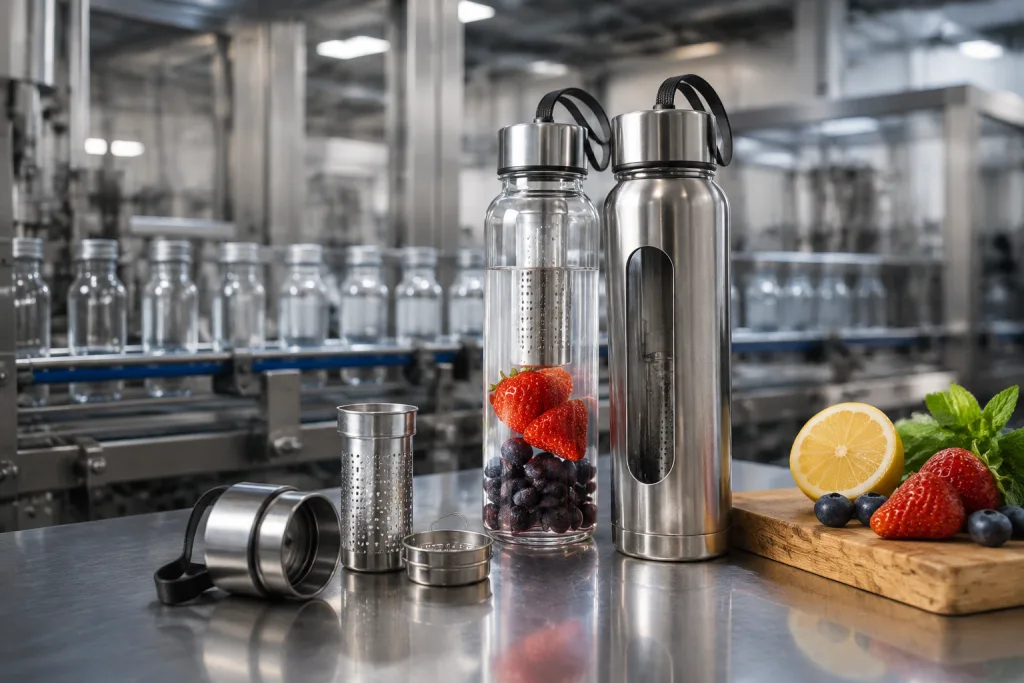
Key Takeaways
- Typical MOQ for a custom fruit infuser bottle is 1,000-3,000 pcs per color, while new mold programs usually start at 3,000-5,000 pcs
- Factory lead time in Zhejiang, China is often 7-12 days for samples and 25-40 days for mass production after deposit and artwork approval
- A standard 650ml Tritan bulk fruit infuser bottle with one-color logo often lands at FOB USD 2.80-4.20 depending on quantity and packaging
- Leak testing, AQL 2.5 inspection, and REACH/LFGB compliant materials matter more than saving USD 0.15 on a complex infuser design
A fruit infuser insert can make a basic bottle look premium, but the cost model shifts fast. A custom infuser bottle carries more parts, more leak points, and tighter decoration limits than a plain sports bottle. On our line, one extra silicone ring adds one more sealing check with a vacuum tester at 0.03 MPa. If you are building a wellness brand or hydration startup, the gap between a $2.80 unit and a $4.60 unit usually comes from material choice, lid structure, insert tooling, and packaging, not “factory mood.”
At factory level in Zhejiang, buyers often start with the wrong question: “What is your best price?” This is the wrong question to ask. The better one is: “What bottle structure hits my target margin and launch date?” We have seen this go sideways when a PO says “clear Tritan body” but the artwork file shows a frosted PET look, and then everyone loses 12 days fixing samples instead of 18 days rushing production. Once you lock volume, material, compliance, and decoration, a fruit infuser bottle custom program gets predictable. That matters if you plan distributor channels in Europe or DTC plus Amazon in North America.
What usually sets the final price
If you are sourcing a fruit infuser bottle custom program, final price usually comes from three places: bottle structure first, decoration second, carton loading third. Most buyers look at body material first. That is the wrong question to ask. On our line, the bigger cost swing usually sits in the infuser and lid set, because extra parts mean extra assembly stations and more QC checkpoints. A simple single-wall bottle with a long perforated infuser basket, PP screw lid, and carry loop is one SKU. A vacuum bottle with stainless steel tea filter, powder coating, silicone boot, and gift box is a different cost level.
As a working benchmark, a 600-700ml Eastman Tritan body with PP lid and fruit cage insert can sit around FOB USD 2.80-3.40 at 3,000 pcs, one-color print, standard polybag plus egg-crate carton. We usually quote this on a 24-pack export carton after checking cube and gross weight. Move to custom color matching, two-position print, a retail color box, and stricter cosmetic standard, and you can be at USD 3.60-4.20. We have seen buyers flag tiny print drift at 1.5 mm on this type of order, and once that standard tightens, labor goes up fast. If you want a custom tea infuser bottle in 18/8 stainless steel with double wall vacuum insulation, the same volume can move into USD 5.20-8.50 depending on lid tooling and finish.
- Material: Tritan usually costs more than standard AS or PETG, but it performs better for premium wellness positioning. In drop tests, buyers usually accept the upcharge once they compare claim rates.
- Infuser design: Long full-length baskets use more resin or steel mesh and add assembly time. A 210 mm basket sounds minor on paper; on the bench, it means another fit check and more chances for thread mismatch.
- Lid complexity: Flip lids, lock buttons, or metal caps increase tooling and defect risk. QC pulled the sample more than once for weak spring action or button scratch.
- Decoration: Silkscreen is economical; laser, UV print, water transfer, and full-wrap graphics cost more. We have seen this go sideways when the buyer wants matte coating plus full-wrap art on a curved body.
- Packaging: A color box can add USD 0.28-0.85 per unit. E-commerce drop tests may add more. The math doesn't work if the unit target is tight and the box spec jumps from standard mailer to reinforced insert pack.
If your target is a customizable fruit infuser bottle for a retail price under USD 19.99, keep the architecture clean: one body color, one print area, no soft-touch coating, and a standard insert that does not require new tooling. We ship plenty of programs like this at MOQ 3,000 pcs, and they move faster because the line setup is simpler.
MOQ tiers that actually change your cost
MOQ is not a random number from the sales team. It comes from resin buying, masterbatch color change, print setup, and how fast the line runs once assembly is stable. At BottleForge Industrial, our monthly output can reach 300,000 units across drinkware lines, but that does not mean every custom made infuser bottle starts at 300 pcs. We run different models on different tooling. If your bottle moves 2 mm on body diameter or needs a new basket fit, the MOQ changes fast.
For an existing mold with a stock-capable structure, the normal MOQ is 1,000 pcs per model and often 500 pcs per color if your logo treatment is simple. For a more customized infuser bottle with Pantone body, custom insert color, printed box, and barcode labeling, the safer commercial MOQ is 2,000-3,000 pcs. If you need a fully new body mold or lid mold, most factories in Zhejiang, China will ask for 3,000-5,000 pcs initial volume plus tooling cost. We have seen buyers push for 800 pcs with a new lid; this is the wrong question to ask, because the setup scrap alone can eat the margin before mass production starts.
What happens at each MOQ band
- 1,000 pcs: Good for market testing, but your unit cost may be 12-20% higher than 3,000 pcs. QC pulled the sample on one 1,000-pc run last month, and the carton cost per bottle was still stubborn because the print house would not break its base charge.
- 3,000 pcs: A solid balance for hydration startups. Color, insert fit, and carton loading get cleaner at this level, and the line usually runs with less stop-start waste.
- 5,000-10,000 pcs: Better pricing on custom packaging, spare parts, and decoration. At this band, we can usually buy labels and replacement straws in the same PO instead of splitting tiny lots, which is where the math often starts to work.
Your real cost target should be tied to your sales channel. Amazon FBA, distributor margin, and boutique retail each tolerate different FOB levels.
If you are a distributor infuser bottle buyer or a startup supplying regional gyms, ask the factory to quote three tiers side by side: 1,000 / 3,000 / 5,000 pcs. Do it on one sheet. We ship these comparisons all the time, and they expose the cost break right away for a bulk infuser bottle order. For plenty of buyers, moving from 1,000 to 3,000 pcs cuts landed cost enough to cover better packaging or compliance testing. One buyer even caught a PO typo on barcode quantity during this step, which saved a full reprint before mass packing.
Timeline from sketch to shipment
Lead time on a customized fruit infuser bottle order stays under control if you stay on an existing mold and stop revision loops early. We’ve seen projects slip 9 days because the buyer approved Pantone first, then logo position, then gift box dieline one by one. Run those in parallel. If your launch ties to a summer wellness campaign, count backward from the vessel booking date, not from the day the sketch looks finished. That is the wrong question to ask.
A normal schedule for an existing-model custom logo infuser bottle from China looks like this:
- Day 1-3: Confirm bottle model, volume, color, logo method, packaging spec, and target market. We usually lock this off one 3D drawing and one PO, because one typo in carton size can echo through the whole order.
- Day 3-7: Digital mockup and formal quotation approval. At this stage, buyers often flag logo size in mm after seeing the render on a 500ml body.
- Day 7-12: Pre-production sample or logo sample. QC pulled the sample and checks print position, lid fit, and infuser alignment before we release anything to the line.
- Day 12-18: Sample revision, packaging artwork approval, and deposit payment. If the color card and box artwork move together, this step lands closer to 12 days than 18 days.
- Day 25-40: Mass production after final approval. For this kind of bottle, the line usually runs body forming first, then logo, then assembly and drop test.
- Day 3-7 extra: Final inspection, carton marking, booking, and loading. AQL 2.5 is common, and we still check shipping marks by hand because one wrong PO number on the master carton causes trouble at the warehouse.
So the practical total is often 35-55 days from project kickoff to FOB shipment for an existing model. That is the real window we quote, not the sales-team fantasy number. A fully custom infuser bottle with a new mold can add 20-35 days for mold fabrication and trial sampling. Stainless steel vacuum models also take longer on the floor: powder coating needs cure time, weld points need leak checks, and vacuum retention testing can hold samples for 24 hours before release.
For a bulk tea infuser bottle or customizable tea infuser bottle, mesh basket QC is where schedules get stuck. If the filter fit is 0.3 mm too tight, assembly slows down fast; if QC finds a sharp edge on the mesh ring, we stop and rework. We’ve seen this go sideways. Experienced buyers ask for a sealed sample tested with actual tea leaves or fruit slices inside, not an empty show sample. A bottle can look fine on the table and still fail on flow rate, odor retention, or lid threading after 20 open-close cycles.
Material choices and their trade-offs
The material choice drives unit price, shelf position, test cost, and claim rate after shipment. We see it on the line. For wellness brands, Tritan is still the standard pick because it stays clear, takes drops better than cheaper resin, and supports a mid-market retail price without looking flimsy. North America buyers ask for that clean material story all the time. If you are quoting a fruit infuser bottle bulk promo program and the target price is tight, PETG or AS will still show up in the offer sheet. Check compliance first. This is the wrong place to save $0.12 if returns start 60 days later.
- Tritan body: Clear premium look, better odor resistance, common for custom fruit infuser bottle projects. Typical wall thickness 2.0-2.5mm. We usually run drop checks with a filled sample before mass production.
- Borosilicate glass body: Cleaner taste profile and stronger premium image, but breakage risk is higher and freight weight jumps fast. A 550ml glass bottle can add 0.28-0.35 kg per unit once packed.
- 18/8 stainless steel: Best choice for heat retention in a custom tea infuser bottle, usually paired with a removable steel filter. On these SKUs, QC often checks weld marks inside the filter first.
- PP or Tritan insert: PP cuts cost; Tritan keeps the whole bottle looking consistent at retail. Buyers flag this part more often than expected because the insert color can shift the full set appearance.
For Europe, ask if the supplier is ready for REACH and LFGB where the item requires it. For North America, ask what food-contact tests are already on file from recent runs, not just what the factory says it can arrange later. There is a big difference. We have seen buyers assume one report covers all colorways, then QC pulled the sample and the lid pigment was different from the tested version. If you are building a factory direct infuser bottle line for gyms, yoga studios, or health-food distribution, impact resistance matters more than the cheapest resin on the PO.
One practical point: glass infuser bottles photograph well, but the math often doesn't work once you ship through distributors, subscription boxes, or Amazon replenishment. We have seen this go sideways. A heavier carton, a 3% breakage reserve, and extra inner protection can wipe out the premium story fast. In one run, the buyer pushed for glass, then backed off after the packed drop test needed thicker EPE and added 12 days vs 18 days to the full replacement cycle after claims. For most startups, a customizable infuser bottle in Tritan is the safer first launch. Prove the SKU first. Then add stainless or glass after reorder data is real.
Decoration, packaging, and hidden extras
Buyers often price the bottle and miss the presentation cost. On a customized infuser bottle, the usable logo area is often broken by the infuser cage, silicone grip band, or body curve, and the line will reject artwork that runs into a 3-5 mm clear zone. This is where orders get delayed. A one-color silkscreen is still the lowest-cost option for a bulk fruit infuser bottle. Typical added FOB cost can be USD 0.05-0.12 per unit depending on print size and quantity. Laser marking on metal parts may be USD 0.08-0.20. Full-wrap or UV print can push higher. We have seen buyers ask for a wraparound logo on a tapered bottle, then QC pulled the sample and the seam looked off. The math doesn't work on every shape.
Packaging is where startup buyers either keep margin or burn it. We ship a lot of trial orders in 5-layer export cartons, and the wrong inner pack shows up fast in freight damage and oversize fees. Common options include:
- Polybag + partition carton: Lowest cost, suitable for many distributor orders.
- White box: Usually adds around USD 0.12-0.25.
- Retail color box: Usually adds around USD 0.28-0.85 depending on print coverage and insert structure.
- E-commerce mailer: Often adds more due to stronger corrugated spec and drop-test requirements.
If you need Amazon-ready fulfillment, confirm FNSKU, suffocation warning, carton labels, and master carton weight limits before production starts, not after the PO is on the line. We have had a buyer flag a missing suffocation warning at sample approval, and reprinting 3,000 color boxes is a bad way to spend money. If you need a distributor fruit infuser bottle program for chain retail, lock barcode position, country-of-origin marking, and carton drop resistance from day one. Ask for the carton gross weight in kg. Ask for the label size in mm. This is the right question to ask.
Do not skip spare components. Extra silicone rings, replacement infuser inserts, or alternate lids can add only USD 0.05-0.25 per set but cut down after-sales claims. On one run, we packed one spare ring per 24 pcs master carton after an inspection found the seal was easy to misplace during first use. For a factory tea infuser bottle or factory fruit infuser bottle order, these small extras are usually cheaper than sending replacements into Europe or North America. We've seen this go sideways, especially when the buyer wanted no spare parts to save 8 cents.
Quality control that protects your launch
Infuser bottles usually fail in plain, repeatable ways: cross-threaded lids, weak handle joints, loose insert fit, odor complaints, and leaks after 3 dishwasher cycles. QC belongs in the PO, not in a WeChat promise. For a customizable tea infuser bottle or fruit insert design, the part count goes up fast—body, lid, basket, gasket, handle—so the QC plan has to match what the line is actually building.
Start with a written inspection standard. Most buyers we ship to use AQL 2.5 for major defects and AQL 4.0 for minor defects on drinkware, though the right limit depends on your sales channel and margin. Call out major defects one by one: leaking, sharp edges above 0.3 mm burr, cracked body, unstable base, missing gasket, wrong logo, or failed odor test. QC pulled a sample last month because the PO said “mat black logo” and the artwork file said “gloss black.” That kind of mismatch causes claims. Cosmetic variance on a low-cost promotional bulk infuser bottle is not judged the same way as a premium wellness retail launch.
- Leak test: 100% line check or agreed sampling standard. We usually run an upside-down water hold for 30 minutes.
- Drop test: Important for packed glass bottles or e-commerce cartons. A 76 cm carton drop tells you more than a nice product photo.
- Dishwasher or heat exposure check: If you claim dishwasher safe, verify it. This is the wrong claim to print first and test later.
- Assembly fit test: Lid torque, insert lock, gasket compression. If the lid needs 1.2 kgf·cm more torque than the approved sample, buyers feel it right away.
- Material verification: Keep test reports linked to the production lot when possible. If QC can’t trace the lot, the math doesn’t work after a complaint.
Ask if the factory has handled BSCI, ISO process control, or third-party audit support before. A serious factory infuser bottle supplier in China should be used to pre-production confirmation, inline inspection, and final random inspection before balance payment. We’ve seen this go sideways when a buyer runs 6 SKUs at once and skips the pre-pro sample signoff; then the buyer flagged it only after packed goods were on the pallet. If you are one of the distributors infuser bottle buyers managing several SKUs at once, this is where claim cost and a 12-day shipment turn into 18 days.
The cheapest bottle on paper often becomes the expensive one after returns. End users in wellness care about clean flavor, easy cleaning, and no leaks in a gym bag. Build QC around those use points. Simple tests win.
Get your infuser bottle costed before you overbuy
Send your target volume, bottle size, retail channel, and artwork. We will quote MOQ, FOB price, sample timing, and realistic production lead time.
Frequently asked questions
What is the normal MOQ for a custom fruit infuser bottle order?
For an existing bottle mold, the normal starting point is 1,000 pcs per model, with 500-1,000 pcs per color depending on decoration and packaging. If you want a custom fruit infuser bottle with Pantone-matched body, custom insert color, printed retail box, and barcode labeling, 2,000-3,000 pcs is more realistic. A fully new mold program usually starts at 3,000-5,000 pcs plus tooling. For startups, the best move is often to begin with an existing structure and customize color, logo, and packaging first. That keeps development risk lower while still giving you a branded, customizable fruit infuser bottle that does not look generic.
How much does a bulk fruit infuser bottle usually cost from China?
A standard 600-700ml Tritan bulk fruit infuser bottle with PP lid, one-color logo, and basic export carton usually falls around FOB USD 2.80-4.20 depending on order quantity and packaging. At 1,000 pcs, pricing may sit near the top of that range. At 3,000-5,000 pcs, you usually get better resin, print, and carton efficiency. Stainless steel custom tea infuser bottle designs cost more, often USD 5.20-8.50 FOB. If you add a color box, spare gasket set, or e-commerce-ready carton, expect another USD 0.20-0.90 per unit depending on spec. Freight and import duty are separate from FOB cost.
How long does a custom logo infuser bottle project take?
If you use an existing mold, most custom logo infuser bottle projects need about 35-55 days from kickoff to FOB shipment. That includes 3-7 days for quotation and artwork confirmation, 7-12 days for samples, and 25-40 days for mass production after deposit and sample approval. New mold development usually adds 20-35 days, sometimes more if the lid and infuser insert both need adjustment. If your launch date is fixed, ask the factory to run sampling, packaging artwork, and compliance document review in parallel. That can save a week or more compared with a step-by-step approval process.
Which material is best for a wellness startup: Tritan, glass, or stainless steel?
For most wellness startups, Tritan is the safest first choice. It offers good clarity, decent impact resistance, and a premium look without the breakage risk of glass. Typical Tritan wall thickness for a 650ml body is around 2.0-2.5mm. Glass feels upscale and keeps flavor neutral, but breakage rates and freight cost are higher. Stainless steel is better if you want thermal performance and are leaning toward a custom tea infuser bottle, but it usually raises FOB cost by 40-100% versus a basic plastic structure. If you plan to sell through distributors or Amazon, Tritan often gives the best balance of price, durability, and retail presentation.
What quality checks should I require on a customized infuser bottle order?
At minimum, require leak testing, assembly fit checks, logo verification, and final random inspection under an agreed AQL standard such as 2.5 for major defects and 4.0 for minor defects. For a customized infuser bottle, also check the insert lock, gasket compression, and whether fruit pulp or tea leaves affect lid closing or flow. If you claim dishwasher safe, request a practical wash test. For Europe, ask about REACH or LFGB readiness where relevant; for North America, confirm food-contact suitability and current test report availability. A pre-production sample signed by both sides is important because infuser bottles have more functional parts than regular bottles.