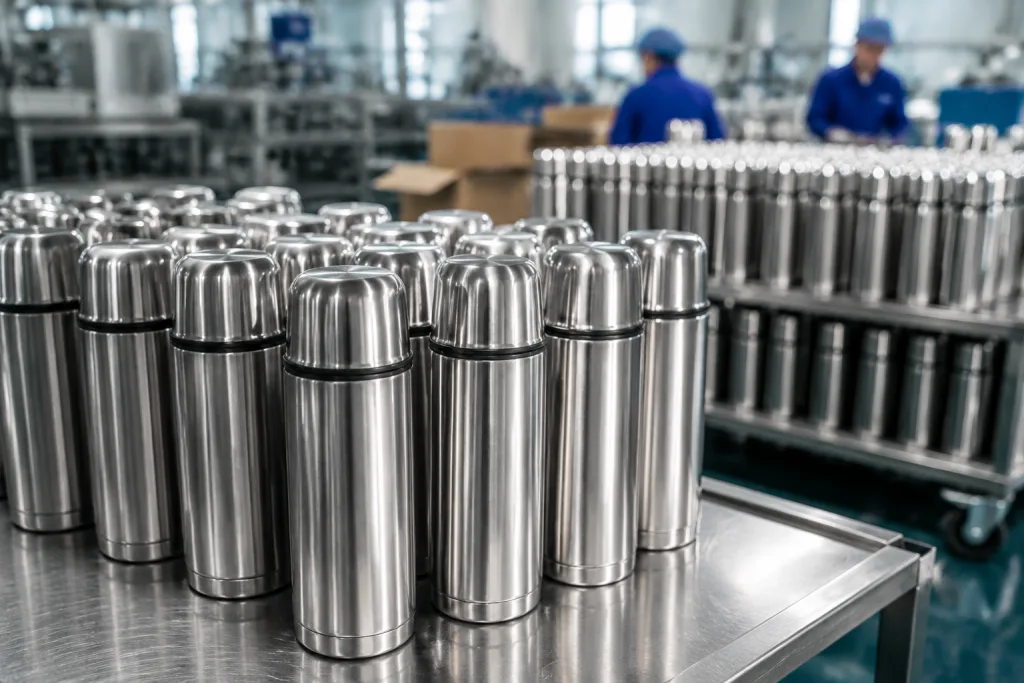
Key Takeaways
- A 500ml stainless bulk thermos usually lands at USD 3.20-6.50 FOB China depending on steel grade, lid structure, coating, and print method
- Common MOQ is 500-1,000 pcs per color, but true custom thermos molds usually start at 3,000-5,000 pcs
- Standard repeat orders ship in 25-35 days, while new customized thermos projects often need 35-55 days including sample approval
- AQL 2.5, leak testing at 100%, and REACH/LFGB/prop 65 checks should be agreed before deposit, not after production
If you need to find thermos in bulk, the hard part is not finding a factory in China. The hard part is figuring out why one quote lands at USD 2.90 and another at USD 6.80 for what looks like the same bottle on a screen. We see this on the line all the time. A 0.4 mm body, a standard spray color, and one-color silk print price out one way; a 0.5 mm body, powder coat, and laser logo move the number fast. Outdoor retailers and promotional brands usually lose time on three points buyers keep flagging: unclear MOQ, decoration limits, and lead times that change after sampling starts.
You need a quote your purchasing team can place against, not a soft number that falls apart after the PO. This is the wrong question to ask: “What is your best price?” Ask what changes at 500 vs 3,000 units, what is included in packing, and how many days each step takes from artwork approval to FOB Ningbo. In Zhejiang, China, a manufacturer thermos program is straightforward if the specification is complete. If not, the line stops for small things: a lid gasket hardness issue, a carton drop test finding, or a PO typo on logo size from 35 mm to 53 mm. We’ve seen this go sideways.
What changes the unit price
If you ask for thermos pricing, the bottle body is only part of it. For a standard 500ml double-wall vacuum flask, we usually price it in five blocks: steel, lid, finish, decoration, and packing. That is how the line here in Zhejiang works before we quote FOB, and the first cost sheet is often done from a weight check on the scale in kg, not from the photo on your inquiry.
Steel grade matters first. Most bulk thermos orders use inner 304 stainless steel and outer 201 or 304. A common build is inner 304 / outer 201 at 0.35mm to 0.40mm wall thickness. If you change both walls to 304, expect roughly USD 0.18-0.40 more per unit depending on size and current nickel prices. If you want a premium outdoor model with 18/8 food-contact steel, copper coating for heat retention, and thicker gauge, the jump can be USD 0.50-1.20. We have seen buyers ask for “heavier feel” without changing the spec; the math doesn’t work.
The lid often causes bigger variation than the body. A simple screw cap with PP and silicone parts may cost USD 0.35-0.60. A multi-part tea filter lid, carry handle lid, or one-touch push lid can raise that to USD 0.80-1.50. If your promotional thermos needs a matching cup cap, factor another USD 0.20-0.45. On our side, lid cost moves fast because of mold count, spring parts, and leak-test rejects; QC pulled the sample last month on one push lid because the button travel was off by 0.6mm.
- Powder coating: typically USD 0.18-0.35
- Spray paint or rubber finish: USD 0.15-0.40
- Silkscreen print 1 color: USD 0.05-0.10
- Laser engraving: USD 0.08-0.20
- Full wrap heat transfer or 4C print: USD 0.20-0.60
Packaging is where first-time buyers usually miss cost. A plain white box might add only USD 0.12-0.20. A retail color box with E-flute insert, barcode label, and drop-test adjustments may add USD 0.35-0.90. We ship plenty of promo orders at 1,000 pcs with the white box, but for outdoor retail the carton test and insert fit matter more. Saving USD 0.08 on bottle coating sounds smart until the buyer flagged crushed corners after a 76cm drop test.
A realistic FOB price for a 500ml custom thermos with 304 inner, 201 outer, powder coat, one-color print, and white box is usually USD 3.20-4.30 at 1,000 pcs. Add a custom lid and retail box, and you are often at USD 4.60-6.20.
MOQ tiers that actually matter
Buyers ask for thermos bulk pricing before they settle one basic point: existing mold or full custom. That is the wrong question order. These are two different buying paths. If you pick a bottle shape already running at the factory, MOQ stays workable. If you want a new silhouette, a fresh lid set, or a custom handle, MOQ climbs fast because the tooling bill and line changeover have to be covered. On the floor, even a lid swap means new fit checks with plug gauges and a new leak-test sample before we run mass production.
For existing models, common MOQ from manufacturers thermos suppliers in China is:
- 300-500 pcs: workable for unprinted stock colors, usually with limited decoration choices and standard inner box packing
- 500 pcs per model: a common starting point for custom logo orders; this is where we usually run silk screen or laser marking without wasting too much setup
- 1,000 pcs per color: more normal for custom body colors and better FOB pricing, since powder coating batches run cleaner at this level
- 3,000-5,000 pcs: often required for new lid tooling or unique bottle body changes; we have seen new cap molds alone add 25-30 days before the line is ready
The price break from 500 to 1,000 pcs is usually real. The math doesn't work if you ignore it. From 1,000 to 3,000 pcs, the savings are still there, but they are not always big unless you also standardize the packaging. A 750ml thermos custom program might quote at USD 5.40 for 500 pcs, USD 4.65 for 1,000 pcs, and USD 4.20 for 3,000 pcs. That comes from setup cost, scrap allowance, and packaging buys improving at volume. One carton print plate spread across 3,000 units hurts a lot less than the same plate spread across 500, and QC pulled the sample on one job last month because the divider board was 2 mm too thin and started rubbing the coating.
For promotional brands, color assortment is where MOQ often gets messy. A supplier thermos quote may show 1,000 pcs MOQ, then bury a 250 pcs per color minimum for powder coating and a 500 pcs per artwork minimum for heat transfer. Buyers flag this late. If your distributors thermos program needs four colorways of 250 each, ask one direct question: will the factory accept mixed colors under one PO? Some will. Some add USD 80-150 per extra color lot. We have seen this go sideways when the PO said “navy” but the artwork file was tagged “matte blue,” and the buyer flagged the mismatch only after pre-production samples.
At BottleForge Industrial in Zhejiang, our practical MOQ for existing stainless vacuum bottles is typically 500 pcs per SKU, with monthly capacity around 300,000 units across drinkware lines. Paper MOQ is not enough. It has to match the actual line: coating batch size, print setup time, and packing speed. We run stainless vacuum bottles on shared drinkware lines, so a 500 pcs order is fine if the decoration is simple, but a mixed-pack gift set with custom EPE inserts can slow packing from 18 cartons per hour to 12. That is why two quotes with the same MOQ do not always land at the same unit price.
Lead time from sample to shipment
If you need to find thermos in bulk for a seasonal launch or fixed event date, asking only for production time is the wrong question. The full schedule starts earlier: artwork check, pre-production sample approval, raw material booking, in-line QC, and carton booking. We see this on the line all the time. A China quote showing 30 days usually covers factory production only, not the 3 rounds of email on logo position or the carton mark typo the buyer flagged on the PO.
Typical timeline for an existing model
- Day 1-3: confirm specification, quote, and artwork files
- Day 4-7: digital mockup and print position approval
- Day 7-12: pre-production sample or logo sample
- Day 13-15: buyer approval and deposit
- Day 16-40: mass production, coating, printing, assembly, packing
- Day 41-45: final inspection and container loading
A realistic range is 25-35 production days after sample approval, or about 35-45 days from first confirmation to FOB shipment. For a repeat thermos supplier order with the same coating, same decoration, and same box, 20-30 days is workable outside peak season. If the order is clean and the MOQ is already standard, we ship faster. If QC pulled the sample and found a 2 mm logo shift on the silk print, the math changes fast.
Typical timeline for a new custom project
If you need a customizable thermos with a new cap, base bumper, or body profile, add tooling and validation time. New mold sampling usually takes 15-25 days, then another 7-10 days for revised samples after fit testing. A new custom thermos project often lands at 45-60 days total before shipment. From August to November, add another 7-15 days unless you lock the production slot early. We've seen this go sideways when buyers approve the first sample, then ask to change the lid thread after the mold test.
Zhejiang and the wider China drinkware belt can move fast, but only if you freeze the spec early. Every late change to Pantone color, logo size, insert card, or carton marks can restart a material booking or packing plan. We run into this with outer cartons all the time. If your thermos distributors need FNSKU labels or retailer-specific carton marks, put them on the PO before deposit, not after cartons are already ordered at 5-ply K=K spec.
Custom options that slow or speed projects
Not every custom request costs the same. Some thermos changes run through the line with no trouble. Others mean new tooling, extra validation, and scrap at first-off. If lead time matters, pick custom options that fit existing production steps instead of forcing a rebuild of the process. We’ve seen this go sideways over a 1.5mm cap detail that looked minor on the drawing.
Fast customizations: logo print changes, laser engraving, standard Pantone-like powder coat, hang tags, barcode labels, and white-box-to-color-box upgrades. If artwork is clean and approved, these usually add only 2-5 days. Most of this work sits on existing stations; for laser marks, we just swap the file and run a sample before mass production.
Medium impact customizations: all-over pattern print, soft-touch coating, electroplated trims, tea infuser assemblies, and mixed-color lid components. These can add 5-10 days because they need more trial samples and tighter color control. QC pulled the sample more than once on mixed-color lids where the buyer flagged a shade shift between PP parts from two cavities.
Slow customizations: new lid structure, custom cup cap, embossed body, new bottom shape, or a retail box that must pass tighter drop resistance. These can add 15-30 days and often need tooling cost from USD 800 to USD 6,000 depending on complexity. This is the wrong question to ask: “Can you copy this look?” Ask instead what new mold count, drop test standard, and fit tolerance are involved. A new bottom profile alone can mean fresh forming tooling and fixture changes on the weld check.
Outdoor retailers usually care more about function than novelty. For bulk thermos in camping or commuting channels, put budget into the details users touch every day: leak resistance and grip texture, then heat retention. A bottle that holds above 60°C after 12 hours will usually outsell one with a decorative base ring. The math doesn’t work if that ring adds assembly time and another failure point during a 1.0m drop test.
- Common heat retention target: 12 hours hot / 24 hours cold
- Leak test: 100% line check recommended
- Typical logo area: 35x70mm to 60x120mm depending on body shape
- Retail carton drop target: often 1.0m to 1.2m depending on channel
If you are sourcing manufacturer thermos lines for both outdoor retail and promotional thermos use, ask the factory to break the quote into body, lid, decoration, and packaging. That gives you one platform bottle with different finish levels instead of three separate SKUs. We ship this way often. Last month one PO even had the lid color typo reversed, and because the quote was split by part, we fixed it without repricing the whole model.
Quality checkpoints before you pay
The lowest quote gets expensive fast if 4% of bottles leak or the logo rubs off in the carton. A stainless vacuum flask looks easy to make. It isn’t. Most defects start in the line where buyers don’t see them: low vacuum pass rate, powder coat thickness drifting from 60μm to 85μm, silicone rings sitting loose, or lid thread tolerance shifting between batches. We’ve seen this go sideways. A serious supplier will accept inspection points written into the PO, down to leak test pressure and logo abrasion standard.
For export orders from China, a normal QC framework is:
- Incoming material check: steel grade, plastic resin, silicone hardness, paint adhesion
- In-process checks: weld seam, vacuum insulation rate, thread fit, coating color delta
- Finished goods checks: leak test, heat retention, barcode scan, carton marks, drop check
- Final inspection standard: AQL 2.5 for major defects, AQL 4.0 for minor defects is common
For Europe and North America, compliance matters as much as workmanship. We usually see 3 document gaps on first-round quotes: no REACH assumption, no LFGB or FDA food-contact declaration, and no statement on California Proposition 65 screening. For kids-oriented use, ASTM-related packaging or labeling rules can get pulled in even when the bottle is not sold as a toy. QC pulled the sample on one order because the PO said “color box with age icon,” but the buyer flagged it after artwork approval. If a thermos manufacturers quote skips testing assumptions, ask who pays for third-party lab work and how many samples are included. This is the right question to ask early.
Good factories in Zhejiang usually run 100% leak testing because the math works better than rework and claims. On our side, the line uses an air-pressure leak tester, and QC checks random pieces again after cooling because pinholes sometimes show up late. Heat-retention testing is often done by lot, not by every piece. Ask for the method: fill temperature, ambient room temperature, and measurement point at 6 or 12 hours. Be specific. Without that, one factory’s “12 hours hot” and another’s “12 hours hot” are not the same test.
If your PO value is above USD 10,000, paying USD 250-400 for a third-party final inspection is usually cheaper than arguing over a container of borderline goods.
How to compare quotes fairly
Collecting prices from thermos distributors, thermos manufacturers, and factory thermos suppliers is not enough. You need to normalize the quote sheet first. If not, you are pricing different bottles that happen to use the same photo. We usually line up at least 13 fields on one sheet: capacity, inner steel grade, outer steel grade, wall thickness, lid material, seal material, finish, print method, unit packing, carton quantity, MOQ, lead time, and trade term. On our side, the sales engineer will even mark body thickness in mm from the caliper report, because 0.4 mm vs 0.5 mm changes cost fast.
Here is where buyers get misled most often:
- Capacity mismatch: 500ml nominal capacity vs 450ml brimful can change body size and cost
- Steel mismatch: 304/201 quoted against 304/304 without being stated clearly
- Decoration mismatch: laser logo quoted against silkscreen or transfer print
- Packing mismatch: white box included by one thermos factory, master carton only by another
- Trade term mismatch: FOB Ningbo vs EXW Hangzhou vs DDP warehouse
For outdoor brands and distributor thermos programs, ask every supplier for three numbers on the same SKU: 500 pcs, 1,000 pcs, and 3,000 pcs FOB China. Then ask for two timelines: sample lead time and production lead time after approval. This is the right test. We run into traders who quote 12 days on sampling and 18 days on bulk, then the line is not even booked yet. QC pulled the sample from one source, bulk came from another, and the color drift showed up on first delivery.
A serious customizable thermos supplier should answer practical engineering questions fast: can the base fit a standard bicycle cage diameter, what is the net weight tolerance, does the cup cap use virgin PP, what is the carton gross weight at 24 pcs, and how many units fit a 40HQ. These are margin questions, not small details. Last month a buyer flagged a 74 mm base that would not sit in a common cage spec, and that problem came out before tooling, not after shipment. A bottle that saves USD 0.12 but cuts container loading by 8% is often the worse buy. The math doesn't work.
If you need to find thermos in bulk repeatedly, not just once, pick the thermos supplier that gives stable specifications and honest lead times. This is the wrong place to chase the cheapest opening number. In Zhejiang, China, the supplier who ships the same spec on the second and fifth PO usually beats the low quote that changes after artwork approval or after the buyer catches a typo on the packing PO.
Get a real thermos quote, not a placeholder
Send your capacity, lid style, logo file, packaging, and target quantity. We will reply with MOQ, FOB pricing, and lead time ranges you can actually plan around.
Frequently asked questions
What is a normal MOQ for custom stainless thermos orders?
For an existing stainless vacuum bottle, 500 pcs per SKU is a normal MOQ in China, and 1,000 pcs per color is common if you want custom coating plus logo. Some factories will accept 300 pcs for stock colors with a simple one-color print, but the unit price is usually 8-15% higher. If you need a fully customized thermos with a new lid or bottle shape, MOQ often starts at 3,000-5,000 pcs because tooling and trial runs have to be absorbed. Always ask whether MOQ means per model, per color, or per artwork, because those are not the same thing.
How much does a bulk thermos usually cost FOB China?
A practical FOB range for a 500ml double-wall stainless thermos is USD 3.20-4.30 at 1,000 pcs for a standard build: 304 inner, 201 outer, powder coat, one-color logo, white box. If you upgrade to 304 inside and outside, add a more complex lid, or use a retail gift box, the same bottle can move to USD 4.60-6.20. Entry-level stock models may come in below USD 3.00, but usually with simpler finish and packaging. Premium outdoor-style bottles with copper coating, thicker gauge, and specialty lids can exceed USD 7.00 FOB.
How long does production take for a custom thermos order?
For an existing model with standard decoration, sample approval usually takes 7-12 days, and mass production after approval takes about 25-35 days. So the total timeline is often 35-45 days from confirming artwork to FOB shipment. Repeat orders can be faster, around 20-30 days, if color, packaging, and components are unchanged. A new custom thermos project with mold work or a special lid is different: add 15-25 days for tooling samples and expect a full cycle closer to 45-60 days. During peak season from August to November, add another 7-15 days unless the slot is reserved early.
Which tests and certifications should I ask for?
For Europe and North America, start with food-contact compliance relevant to your market: REACH, LFGB, FDA declarations, and sometimes California Proposition 65 screening. On the quality side, ask for 100% leak testing, lot-based heat-retention testing, coating adhesion checks, and a final inspection standard such as AQL 2.5 for major defects. If your retail customer has a packaging drop requirement, specify 1.0m or 1.2m carton testing upfront. If the order value is above about USD 10,000, third-party pre-shipment inspection is money well spent. Also confirm whether the factory can support BSCI or ISO documentation if your sourcing policy requires it.
What details should I send to get an accurate quote fast?
Send a complete RFQ, not just a reference photo. Include capacity, target dimensions, steel grade requirement, lid style, finish, logo method, logo size, packaging type, quantity by color, and destination market. If you have retailer requirements, add barcode format, FNSKU if relevant, carton marks, and drop-test expectations. A factory can usually return a serious quote in 24-72 hours if the spec is complete. Without those details, you will get a placeholder number that changes later. The fastest path is one PDF tech pack plus vector logo files and a target order quantity at 500, 1,000, or 3,000 pcs.