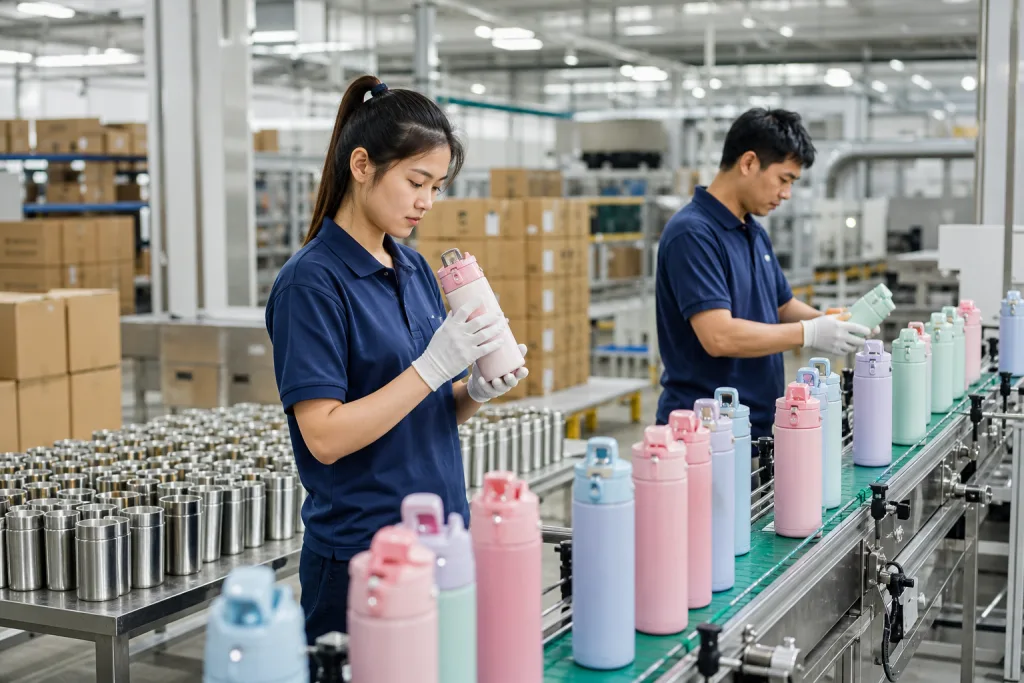
Key Takeaways
- Most kids’ thermos projects land at MOQ 1,000–3,000 pcs per color in China
- 316 or 304 stainless, 0.35–0.45 mm wall, and a PP/Tritan lid are the usual baseline
- Typical lead time is 25–35 days after sample approval, with 300,000 units/month capacity in a Zhejiang factory
- Ask for FDA food-contact support, LFGB or REACH where needed, plus 3rd-party migration tests
If you are sourcing an fda approved vacuum insulated bottle for kids, design is not the first problem. Paperwork is. Then come material claims, and whether the factory can hold the same result on line after line. A clean sample means little if the liner steel, lid seal, coating, or print starts failing after 3 months in a school bag. We have seen that go sideways. In Zhejiang, plenty of factories can make a bottle; fewer can pass brand audits, retailer QA, and school-channel packing without drama.
Do not mix up marketing copy with compliance. FDA does not “approve” most drinkware the way buyers hear it in meetings; you are checking food-contact compliance, migration test results, and factory controls. For kids, that is the part that matters. We once had a buyer flag a PO because the supplier wrote “FDA certified” on the carton; that typo alone told us the file was weak. If you buy for outdoor retailers, schools, hotels, or restaurants, tie the spec to the use case. A 0.5 mm seam gap or a loose lid torque reading will cost more than a nicer render.
What FDA compliance really means
When buyers ask for an fda approved vacuum bottle for kids, they usually want one thing: proof the cup will not give them trouble in customs or a customer complaint. The right question is food-contact compliance, not “approved” in a loose sense. On a stainless thermos order, we check the inner liner, lid plastic, gasket, coating, and printed graphics as finished parts. At the line, QC pulled the sample from a 500 ml run and sent it for migration testing; the factory should be able to show material declarations, ink safety statements, and a recent lab report from a qualified lab.
For U.S. imports, your file should include FDA food-contact support. If the bottle also goes to Europe or chain stores with tighter rules, add REACH and sometimes LFGB. For kids, we ask for a no-phtalates statement on lid parts and check the mouthpiece shape against choke-point risk. The lid decides a lot. We’ve seen this go sideways with a beautiful 304 stainless body and a cap that failed at 18 mm clearance, so the math does not work if you ignore the closure.
Checklist:
- Request FDA food-contact documentation for all contact parts, not just steel.
- Ask for full product migration tests on the finished bottle and lid.
- Confirm ink, paint, silicone, and PP grades in writing.
- Keep the term “FDA approved” out of legal copy unless your counsel signs off.
Pick the right steel and wall
The logo is the last thing we check. Steel grade, wall build, and vacuum pull decide whether a kids’ thermos survives school bags and lunch drops. For an fda approved vacuum flask for kids, 304 stainless is the standard call; 316 only makes sense when the buyer wants a higher shelf price or plans salty soup service. We run both grades on the line. A clean 304 liner, proper passivation, and a tight weld bead are enough for most retail programs. If the bottle will hold soup or salted drinks every day, 316 gives extra corrosion margin, but the math usually adds 8%–15% to the unit cost, and one buyer last season pushed back hard on that line item.
Wall thickness is where weak samples expose themselves. A solid kids’ bottle normally sits at 0.35–0.45 mm for the inner and outer shell, with enough stiffness to take daily knocks. Go thinner and the dent rate climbs after a few carton drops; go thicker and the finished weight starts working against the child user. Double-wall vacuum construction should hit a real thermal target, not a brochure number. For school use, 6–12 hours hot retention is a workable range if the lid seals cleanly and the preheat step is done. QC pulled the sample for a vacuum leak check at 1.5 kPa, and that test tells you more than any sales pitch. Ask for batch traceability too. That is standard shop-floor control in Zhejiang.
Typical spec range: 350 ml to 500 ml, 304 stainless, 0.4 mm wall, PP outer lid, silicone seal, powder coat or UV print.
Lids decide the failure rate
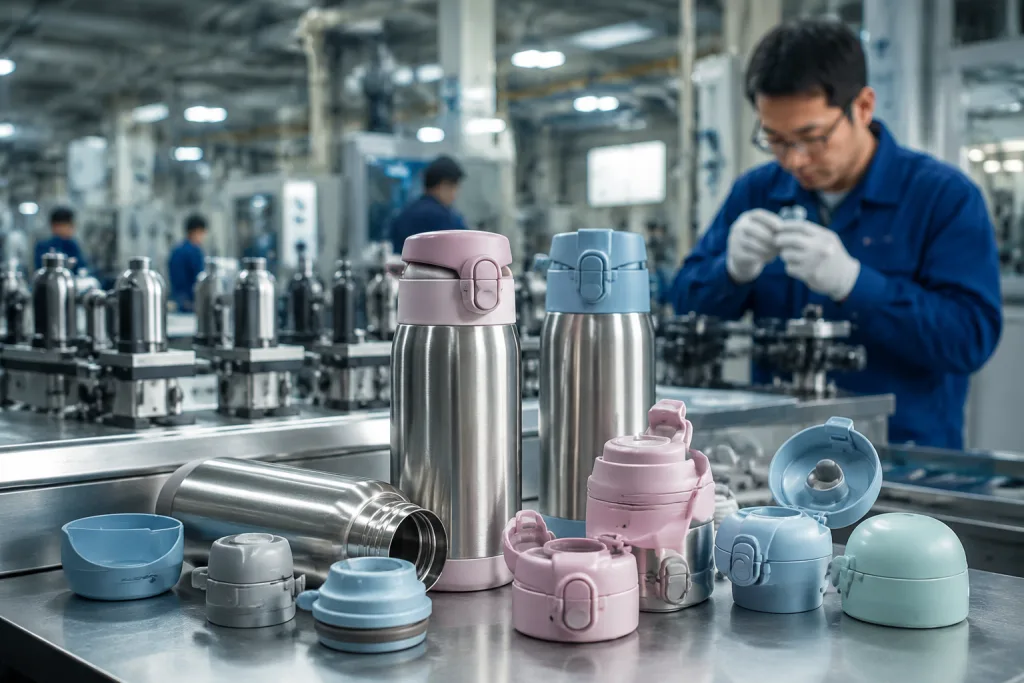
If you are sourcing an fda approved vacuum insulated bottle for schools, the lid is usually the first thing that draws complaints. Kids twist caps hard, drop them on tile, and lose small parts. We see it on the line every week. The best lid is not the fanciest one; it is the one with fewer loose parts and one clean sealing path. For a kids’ bottle, we usually spec food-grade PP or Tritan, a single silicone gasket, and a thread profile wide enough to stop cross-threading. Push-button lids look nice on a sample table, but unless the buyer is paying for extra tooling and we have already run cycle tests, this is the wrong question to ask.
For school orders, I want a lid that survives 5,000 open-close cycles without seal failure. That is a factory target, not a slogan. QC pulled the sample on a 12-day run and found a worn gasket after 3,800 cycles once; the buyer flagged it, and we changed the durometer before mass production. If the bottle uses a straw, check the cleaning path, because parents will not accept residue hiding under a narrow bend. If it is a screw-top cup style, verify torque consistency and leak testing at hot and cold temperatures. We ship from Zhejiang, and the line should run leak checks on every batch with AQL sampling records. If a supplier cannot show that, walk away. Simple lids win in school purchasing because the math does not work any other way.
Good lid spec sheet should show:
- Seal material and hardness
- Drop-test result from 1.2 m
- Leak test at 50°C and ambient
- Spare gasket availability
School, hotel, and restaurant use cases
Different buyers ask for the same bottle with different priorities. A school buyer wants a lid that survives drops, easy numbering, and fast wash-down. A hotel buyer wants a clean face, carton-to-carton consistency, and spare parts that ship fast. A restaurant buyer wants hygiene, quick refill, and a body shape that works with the service line. One generic bottle does not cover all three. We saw a 24 oz sample fail a 1.2 m drop test when the ABS cap cracked at the hinge, and the buyer flagged it on the first round. The phrase fda approved vacuum bottle for schools usually means the toughest spec discipline, because schools beat up weak lids and sloppy printing. The same goes for fda approved vacuum flask for schools in dorms and canteens.
For hotels, the search terms fda approved vacuum insulated bottle for hotels, fda approved vacuum bottle for hotels, and fda approved vacuum flask for hotels usually point to minibar or room-service use. That pushes the spec toward a slimmer silhouette, plain branding, and a surface that wipes clean in one pass. We run a 300 mm spray-and-wipe test on matte coats, and the greasy fingerprint issue shows up fast if the finish is wrong. Restaurants are about service fit, not pretty styling, so fda approved vacuum insulated bottle for restaurants, fda approved vacuum bottle for restaurants, and fda approved vacuum flask for restaurants should lead you to a bottle that opens fast, pours cleanly, and does not pick up tea, coffee, or milk stains.
Buying rule: schools buy for abuse resistance, hotels buy for presentation, restaurants buy for workflow. One bottle family can serve all three, but only if the cap system, finish, and pack-out are set from the start. A PO once came in with "hotel" typed as "hotal" and the pack label went out wrong; we caught it at carton sampling, not after shipment. That's the wrong question to ask if someone says one bottle should fit every channel.
How to audit a China factory
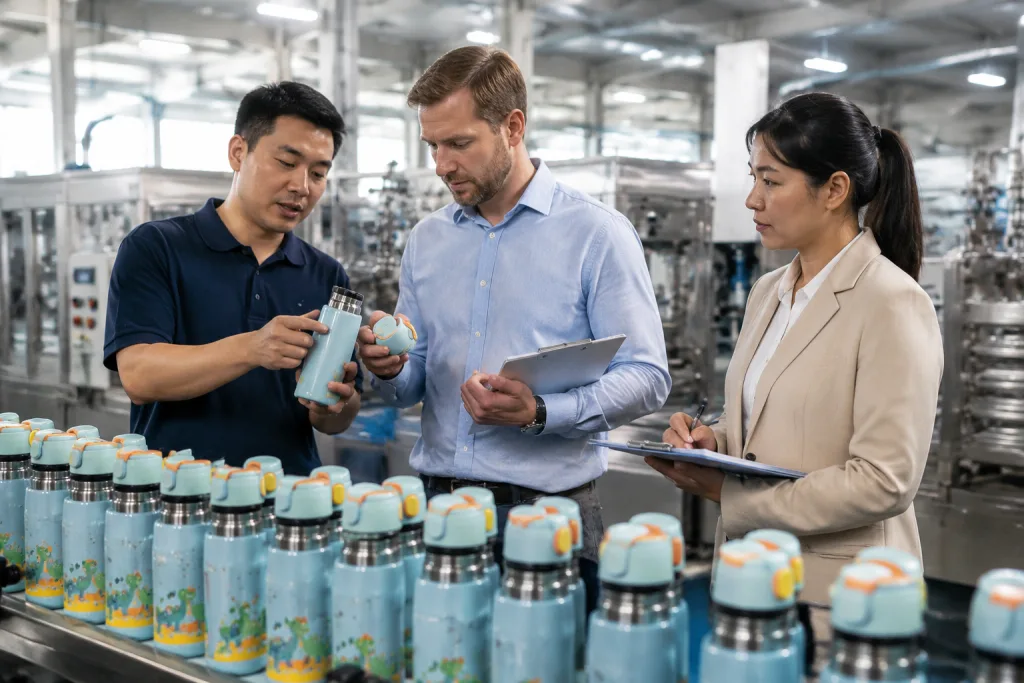
Once the sample passes, the real work starts. A solid China supplier should quote MOQ straight, show the line schedule, and explain how they check vacuum loss, coating adhesion, and drop damage in the outer carton. In Zhejiang, a serious stainless thermos factory should run 300,000 units per month across multiple SKUs, with a standard lead time of 25–35 days after sample approval and deposit. We once saw a PO typo turn “kids blue” into “kid blue”; QC caught it before packing, which is why vague answers usually mean vague control.
Ask for the following before you issue a PO:
- MOQ: 1,000–3,000 pcs per color for custom kids’ bottles
- Sample time: 5–10 days for stock tooling, 12–18 days for new molds
- Inspection standard: AQL 2.5 for major defects, 4.0 for minor defects
- Testing: thermal retention, leak, drop, coating adhesion, and dishwasher cycles if required
- Traceability: batch code, production date, and carton label control
Good factories in Zhejiang do not dodge these questions. They answer with numbers, and they show the gauge, the leak tester, or the drop tower. If you are buying for a retail chain or school tender, this is the difference between a supplier you can run with and a guess that will go sideways.
Price, packaging, and order math
For a custom kids’ thermos, unit price comes down to steel grade, lid structure, surface finish, and print method. On our line, a clean 350–500 ml bottle usually sits at USD 2.40–4.80 FOB China for 1,000–3,000 pcs. Single-color logo, simple cap, plain kraft box: that lands near the low end. UV print, laser engraving, or an accessory pack pushes it up fast. We had a buyer try to bundle a handle, straw, and two artwork positions into one quote, then ask why the math moved. It moved because labor moved, carton size moved, and the load count changed.
Packaging is where a lot of buyers miss the bill. A gift box, insert tray, polybag, and warning label can add more than the print itself, and the carton size can knock your pallet count down by 12% on the shipper. If you sell on marketplaces, the bottle needs barcode labels, polybag warnings, and carton marks that match FNSKU or distributor rules. If your route to market includes Amazon, check our Amazon FBA drinkware sourcing guide for pack-out logic. If you want a logo that stays after daily washing, compare decoration methods through silkscreen vs laser engraving. We’ve seen a cheap print fade in 30 wash cycles. That is a warranty claim, not a saving.
Use this order math: product cost + packaging + freight + duty + local compliance + reject allowance. QC pulled the sample at AQL 2.5 on one run and still found two bad lid seals in 200 pcs, so if you skip reject allowance, your margin is fiction.
Request a kids’ thermos spec and quote
Send your target age, size, artwork, and market. We will match steel grade, lid structure, MOQ, and compliance documents for China sourcing.
Frequently asked questions
Is there really an FDA approved vacuum insulated bottle for kids?
Strictly speaking, FDA usually does not “approve” standard drinkware the way buyers assume. What you want is a vacuum insulated bottle for kids made with food-contact-safe materials and backed by testing. Ask for FDA food-contact support, migration test reports, and declarations for stainless, PP, silicone, ink, and coating. For a kids’ bottle, I would also ask for leak and drop testing. A good supplier in Zhejiang should explain this clearly and give documents within 2–3 days, not hide behind the phrase “FDA approved.”
What MOQ should I expect for custom kids’ thermos orders?
For a custom stainless thermos, the normal MOQ is 1,000–3,000 pcs per color or design in China. If you need multiple lid colors or two print positions, the MOQ usually moves up. Some factories in Zhejiang will do lower quantities, but the price often jumps 15%–30%. If you are testing a new school or outdoor retail program, start with one main color and one artwork version, then expand after sell-through data.
Which steel grade is better for a kids’ vacuum flask?
304 stainless is the standard choice for most kids’ bottles because it balances cost, corrosion resistance, and availability. 316 is stronger against salt and harsher liquids, but it usually adds 8%–15% to material cost. For school water use, 304 is usually enough if the factory controls weld quality and passivation. For soup or acidic drinks, or if your brand wants a premium story, 316 can be justified. In both cases, the finished product still needs food-contact compliance.
How do I check if a supplier is suitable for schools or hotels?
Ask for a batch-controlled sample, thermal retention results, and packaging details first. For an fda approved vacuum insulated bottle for schools, the lid should survive at least 5,000 open-close cycles and a 1.2 m drop test. For hotel use, the bottle needs cleaner styling, stable carton counts, and consistent logos. For restaurants, focus on pour control and cleaning access. A supplier that can show AQL records, production photos, and monthly capacity above 300,000 units is a much safer bet.
What lead time should I plan for custom production in China?
For standard custom stainless thermos orders, plan 25–35 days after sample approval and deposit. New molds, complex lids, or unusual coatings can push that to 40–50 days. Shipping time is separate, so do not confuse factory lead time with landed time. If you are serving a retailer with a fixed launch date, build in 2 extra weeks for packaging approval, QC, and freight delays. In Zhejiang, good factories can move faster, but only if the artwork and specs are locked early.