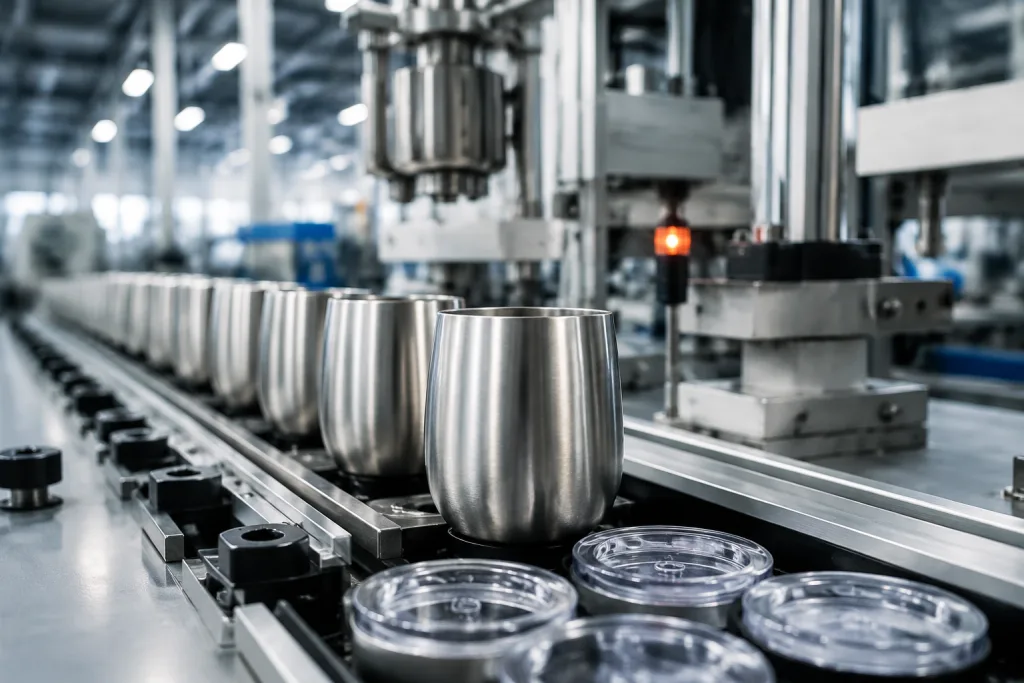
Key Takeaways
- Set specs first: 12 oz and 16 oz factory wine tumbler models usually run 0.4-0.5 mm outer wall and MOQ starts at 1,000 pcs per color.
- Decoration changes cost and speed: 1-color silkscreen can add USD 0.08-0.15, laser engraving USD 0.18-0.35, and full-wrap printing more.
- Standard production lead time from Zhejiang, China is typically 25-35 days after sample approval and deposit, plus 3-7 days for export booking.
- Use AQL 2.5/4.0 with lid leak checks, adhesion testing, and carton drop tests to control claim rates below 1.5%.
You can buy a wine tumbler from almost any trading company in China. Easy part. The hard part is locking the right wall thickness, lid fit, logo process, carton drop result, and ship window before the mistakes hit your cost later. For retail, promo, hospitality, or distributor programs, the wrong call at the RFQ stage usually comes back as claims, delayed launch dates, or 3,000 pcs of dead stock. We’ve seen this go sideways over a 0.3 mm body change and a loose slide lid the buyer flagged after mass production.
A buyer checklist beats a long feature list. You need to set four points early: body construction, decoration method, compliance scope, and order structure. Those choices move FOB cost, MOQ, sampling days, and defect risk fast. This is the wrong question to ask: “What’s your best price?” Ask what steel grade, what print method, what AQL, and what pack test the line will run. At BottleForge Industrial in Zhejiang, China, we see the same pattern every month on wine tumblers, custom canteen programs, and customized drinkware projects for Europe and North America. Last month QC pulled the sample on one PO because the logo position note was off by 2 mm.
Start with the four buying decisions
Most sourcing trouble starts when buyers treat a factory wine tumbler like a commodity item. That is the wrong question to ask. Four decisions control most of the result: unit economics, compliance scope, visual quality, and delivery reliability. On our line, QC pulled a first article last month because the rim roll was out by 0.3 mm, and that one detail would have changed both appearance and lid fit.
- Decision 1: Construction. Single-wall stainless costs less, but it does not fit a premium insulated program. Double-wall vacuum 18/8 stainless is still the standard for retail and gift-channel wine tumblers, and buyers usually start with 12 oz or 16 oz. We run both, and the weight difference is not cosmetic; a 12 oz body can feel light in hand if the outer wall gauge is pushed too far.
- Decision 2: Decoration. Silkscreen, heat transfer, powder coat plus laser, UV print, and embossed bases do not behave the same on curved drinkware. A flat proof often passes the buyer review, then fails on the actual cup because the textured coating cuts adhesion. We have seen this go sideways after a cross-hatch tape test on powder coat, especially when the logo sits too close to the curve break.
- Decision 3: Compliance scope. Europe and North America ask for different paperwork and different supporting files. You may need REACH, LFGB-style migration support from component suppliers, California Proposition 65 review, or ASTM/CPSIA alignment if the assortment sits near kids' use. The buyer flagged this once on a lid gasket material, not the steel body, which is where teams often look first.
- Decision 4: Order structure. One SKU with 5,000 pieces is a different production plan from five colors at 1,000 pieces each. MOQ, packaging setup, and booking efficiency change fast, and the math does not work the same once you split colors and cartons. On the factory floor, five 1,000-piece colors usually mean more changeovers, more label checks, and more chances for a PO typo to turn “matte navy” into “navy mate.”
If you also buy a custom canteen, custom growler, or a broader customizable drinkware line, use one spec logic across the full program. A canteen manufacturer or canteen factory might quote a sharp body price, then take margin back on lid tooling, color splits, or packaging add-ons. We ship these projects every month, and the same pricing pattern shows up in wine tumblers.
For B2B buyers, the right question is not “Who is cheapest?” It is “Which spec set gives acceptable risk at the margin target I need?” In Zhejiang, China, a stable factory can normally support 300,000 units per month across tumblers, bottles, and related canteen customizable projects, but only if the specification is locked before mass production. If artwork, coating code, or carton pack changes after pilot run, 12 days can become 18 days fast.
Choose the build before the finish
Lock the body spec first, then talk Pantone or logo position. On a factory wine tumbler, the standard build is food-contact 18/8 stainless steel inside and outside with double-wall vacuum insulation. Common outer wall thickness is 0.4 mm. Some buyers push for 0.5 mm because they want more hand weight when QC pulled the sample. Inner wall is usually 0.3-0.35 mm. Thicker steel helps with dent resistance, but the math doesn't work if you ignore higher steel usage and extra freight weight per carton.
Ask these questions early:
- Is the tumbler seamless or does it show a visible weld line?
- What is the lid material: AS, SAN, Tritan, or PP with silicone gasket?
- Is the base flat enough for stable pad printing and carton stacking?
- What temperature retention is being claimed, and how was it tested?
For a 12 oz vacuum wine tumbler under FOB Ningbo, a workable quote usually lands at USD 2.10 to 3.40 based on steel grade, coating, lid spec, and order quantity. At 1,000 pieces per color, price movement is tight. At 5,000 pieces, we run the line with better material yield and lower setup spread, so the quote usually loosens up.
Where buyers overpay
The mistake we see is simple: buyers overspend on finish and leave the body spec loose. A premium powder coat on a thin shell still dents during transit; we’ve seen this go sideways after a 76 cm carton drop test. If you are a canteen distributor, distributor drinkware buyer, or distributor growler importer building a coordinated assortment, match the hand feel across categories. Your canteen customized bottle, customized growler, and wine tumbler should feel like one program, not three factories stitched together.
You can save USD 0.12 on decoration and lose USD 0.40 in claims if the lid fit or vacuum integrity is weak.
For hospitality or promo use, a lighter build is often acceptable. For retail, customers pick up two cups and decide in 3 seconds. Heavier usually wins. We ship fewer complaint photos on the 0.5 mm option, especially after buyers flagged dented rims and loose lid fit on thinner builds.
Decoration is a margin decision
Decoration is where margin gets made or lost. Buyers often ask us to run the same artwork across a customized drinkware range: wine tumbler, sports bottle, custom canteen, and customizable growler. We can do that, but each body shape and surface needs its own process setup. A 12oz tumbler with a tapered wall does not print like a straight 750ml bottle, and the line will show that fast.
- Silkscreen: lowest-cost option for simple 1-2 color logos. Add roughly USD 0.08-0.15 per unit. Best fit for canteen promotional orders and event programs at MOQ 3000. It struggles on deep curves, tight registration, and metallic inks.
- Laser engraving: durable, sharp, and cleaner on powder-coated surfaces. Add about USD 0.18-0.35. Better for corporate gifting and premium distributor channels. We usually check the mark width at about 0.15mm minimum, or the buyer flags weak contrast on dark coatings.
- Heat transfer or UV print: supports multicolor art and larger wrap coverage. Add around USD 0.20-0.45 depending on wrap area. More setup risk, more approval steps, and more scrap if artwork positioning is off by 1-2mm.
If you are a canteen vendor or canteen supplier serving promotions, ask one direct question: does the logo need dishwasher resistance, or only normal hand-wash durability? This is the wrong question to skip. Those are different standards, different ink choices, and different complaint rates. We have seen buyers approve a nice sample, then push back after 500 pcs because the print dulled after restaurant wash cycles.
Artwork approvals that actually matter
Ask for three checkpoints, and put them on the PO: a flat artwork proof, a pre-production decorated sample, and one photo from the first packed cartons on line. For textured powder coat, ask for an adhesion cross-hatch result and a rub test with 3M tape. For laser marks, ask the factory to confirm contrast level after coating, not before. QC pulled the sample once under office light, it looked fine, then it disappeared on shelf under retail LEDs. That happens.
Canteen manufacturers and canteen suppliers often combine techniques in one order. Fine, if your PO separates each SKU, process, and acceptable tolerance. We have seen this go sideways because one PO said “matte black” for 4 items, while two coating lines produced different gloss levels at 8-12 GU. Put gloss expectation and Pantone reference into the approved spec sheet. One document saves arguments, rework, and delayed shipment.
MOQ, packaging, and shipping trade-offs
MOQ is not just a sales policy. It comes from how the line runs. A factory wine tumbler using standard tooling may start at 1,000 pieces per color for a basic powder-coated body with one logo. Once you add custom box inserts, mixed lids, or low-volume colors, the effective MOQ may rise to 2,000-3,000 pieces because the powder line changeover, jig cleaning, and scrap rate stop making sense below that level. We have seen buyers push for 500 pieces in 4 colors. The math doesn't work.
Typical sample timing in Zhejiang is straightforward:
- Existing model sample: 2-5 days
- Logo sample: 5-7 days
- New color or packaging mockup: 7-10 days
- Mass production: 25-35 days after approval and deposit
Those dates assume normal approvals. If the buyer flagged logo position by 3 mm or changed Pantone after sampling, the clock resets on the line.
Packaging shifts your landed cost more than first-time buyers expect. A standard white box may add only USD 0.10-0.18. A custom gift box with EVA or molded pulp insert can add USD 0.35-0.80, and it also changes carton size, container loading count, and drop-test results. QC pulled a sample last month where the molded pulp fit was too loose by 2 mm, and the tumbler moved inside the box during the carton drop. Small issue, big freight claim later.
If you supply e-commerce or Amazon FBA, ask for FNSKU labeling, suffocation warnings where relevant, barcode scan checks, and master carton weight below your channel threshold. Ask for the actual kg limit, not "standard carton." We ship cartons at 14 kg or 18 kg depending on channel rules, and the buyer flagged one PO because the outer mark had the wrong barcode suffix. This matters for a distributor canteen program as much as it does for tumblers.
When split shipments make sense
If your season is fixed, partial shipment protects the launch date. Ship 2,000 units of the top two colors first, then the balance after secondary packaging arrives. That is usually better than waiting on one late insert supplier, especially if lids, bodies, and print cartons are already passed. We have seen this go sideways when one vendor says "all goods nearly ready" but the export carton is still not die-cut. A capable canteen factory or canteen vendor in China should tell you exactly which upstream part controls the schedule: lid injection, coating queue, packaging print, or export booking.
Do not accept vague lead time promises. Ask for a backward schedule with sample signoff date, production start, in-line inspection, final inspection, and ex-factory date. We run this in a simple sheet by day, not fancy language. Serious canteen distributors and retail importers run on dates, not hopeful language.
Compliance and quality control checkpoints
Good factories don't wait for final inspection to find trouble. On a factory wine tumbler program, QC starts at incoming material: 304 stainless sheet, lids, paint or powder, and packaging. We check steel thickness with a micrometer, usually to 0.05 mm, before the line runs. After that, control points move to vacuum testing, coating appearance, logo adhesion, and packout accuracy.
For export to Europe and North America, ask for the right paperwork, not a random stack of certificates. We've seen buyers get a 20-page file that said little about the actual cup. Useful items include:
- BSCI or equivalent social compliance overview if your customer requires it
- ISO 9001 process documentation if advertised
- REACH-related material declarations from suppliers where applicable
- Food-contact test support on the final product or component set
- AQL inspection standard, commonly 2.5 major / 4.0 minor
For wine tumblers, practical tests matter more than polished paperwork. This is the right question to ask. QC pulled the sample from the sealing station last month because 2 lids from a 125-piece lot had slow seepage after 30 minutes upside down. Ask for:
- 100% vacuum inspection on insulated bodies
- Lid leak test on a defined sample size
- Cross-hatch adhesion test for coating and logo
- Carton drop test, usually 1 corner, 3 edges, 6 faces for transit simulation
- Salt spray reference if hardware or metallic trims are used
If you buy across categories from one canteen manufacturer, one canteen supplier, or several canteen vendors, standardize your QC checklist. We ship mixed programs with a customizable canteen, customizable growler, and factory wine tumbler in one booking, and the packing logic should match across all of them. Same barcode check, same carton seal check, same inner partition fit. Last season, one buyer flagged a PO typo on carton mark printing, and that small error delayed release by 2 days. Standardization keeps claim analysis comparable across SKUs.
A low quote with weak process control is expensive after the container sails.
At BottleForge Industrial, our teams in Zhejiang, China normally target finished-goods defect rates below 1.5% on routine tumbler programs when the spec and artwork are frozen before line launch. The math is simple. Freeze the Pantone, confirm the logo position to 2 mm, lock the approved sample, then we run inspection at incoming, in-line, and final. That's not magic. It's basic factory discipline.
How to compare suppliers without fooling yourself
If three factories quote three different prices, don’t jump to “this one is expensive, that one is efficient.” Normalize the quote first. We see buyers compare a 12oz body with 0.4 mm wall, push-on lid, white box, against a 12oz body with thicker steel, sliding lid, and color mailer, then ask why the approved sample misses the target cost. That is the wrong question to ask.
Use a comparison sheet with these fields:
- Body capacity, dimensions, net weight, and wall thickness
- Steel grade and lid material
- Coating type and decoration method
- Packaging format and carton details
- MOQ per color and total MOQ
- Sample charge, tooling charge, and proof cycle
- FOB port, lead time, and payment terms
Then score each supplier on three things: communication accuracy, engineering clarity, and whether they push back when the brief is off. QC pulled a sample last month where the buyer’s logo stroke was under 0.18 mm, and the line would have filled after powder coat. A steady canteen manufacturer will say that early. Same with a custom box that fails a 76 cm drop test or a PO typo on carton count. A weak canteen vendor just says yes, and we’ve seen this go sideways.
Questions worth asking on the first call
- What percentage of your output is export to EU and North America?
- What is your standard MOQ for vacuum wine tumblers and canteen custom projects?
- Which processes are in-house and which are outsourced?
- How many units per month can you run in peak season?
- Can you share a typical production timeline from PO to FOB?
If you are a canteen distributor, or 2 to 4 canteen distributors combining volume, look at process consistency, not sales polish. The best partner in China is rarely the one with the slick deck. It’s the one that sends a clean deviation report, catches artwork issues before the line starts, and gives you a realistic recovery plan when an upstream lid supplier slips 12 days instead of the promised 7.
Build a repeatable sourcing system
Buyers who hold margin year after year do not rebuild the process every season. They run a sourcing system and reuse it. We have seen the same setup work for a factory wine tumbler, a custom canteen line, and a wider customized drinkware program. On our side, once the spec is locked, the line runs cleaner and QC pulls the sample against one target instead of three shifting ones.
Your minimum system should include:
- A master spec sheet with dimensions, materials, finish, logo process, and packaging, down to items like 0.5 mm wall tolerance and whether the body is 304 stainless
- An artwork approval log with version control, because one PO typo or an old logo file can waste 500 pcs fast
- A testing matrix by market: EU, US, retail, promo, e-commerce, with the exact tests required before shipment
- An inspection checklist with AQL and critical points, including the defects your QC team actually flags on the table
- A landed cost model including freight, duty, packaging, and claim allowance; if this sheet is missing, the math doesn’t work
Once this is in place, conversations with canteen suppliers, canteen manufacturers, and distributor drinkware partners move faster. Sample approval gets tighter too. The buyer stops choosing by feel and starts checking against a fixed target—weight, color, lid fit, carton drop standard. We have seen this go sideways when a buyer signs off on “looks good” and then flags a 2 mm logo shift on bulk goods.
For most B2B programs, a sensible starting point is one standard 12 oz body, two coatings, two lid options, and two decoration methods. That is enough. Prove the quality system first, then add variants like a customized canteen, customized growler, or canteen promotional pack-out after the base program is stable. A clean base SKU usually ships in 12 days vs 18 days for a mixed program with too many last-minute changes.
If a factory resists clear specifications, version-controlled approvals, or third-party inspection, take that as useful information. This is the wrong question to argue about. Good factories in Zhejiang and broader China already know disciplined buying helps line planning, carton booking, and rework control. On our floor, the factories that accept this process early are usually the same ones that pass inspection with fewer surprises. That is what you want from a long-term canteen supplier, canteen factory, or wine tumbler manufacturing partner.
Need a clearer quote for your wine tumbler program?
Send your target size, finish, logo method, and packaging. We will review feasibility, MOQ, FOB pricing, and lead time before you commit.
Frequently asked questions
What is a realistic MOQ for a factory wine tumbler order?
For a standard 12 oz or 16 oz vacuum insulated wine tumbler, a realistic MOQ is usually 1,000 pieces per color with one decoration method and standard packaging. If you need multiple body colors, custom gift boxes, or mixed lid options, the practical MOQ often rises to 2,000-3,000 pieces total. Some factories in China advertise 500 pieces, but that usually means limited color choice, stock components, or higher FOB pricing. If you are combining the order with a custom canteen or customized growler program, ask whether the factory can pool packaging materials or decoration runs across SKUs to improve efficiency.
How much should I budget per unit for a custom wine tumbler?
A workable FOB budget from Zhejiang, China is about USD 2.10-3.40 for a standard stainless steel vacuum wine tumbler with lid, depending on size, wall thickness, finish, and quantity. Add roughly USD 0.08-0.15 for simple silkscreen, USD 0.18-0.35 for laser engraving, and USD 0.35-0.80 for premium gift packaging. If your quote is far below the range, check steel grade, coating thickness, lid resin, and carton spec. Many low quotes exclude details that matter later. For distributor drinkware or canteen promotional programs, plain white box packaging can keep cost under control.
What tests matter most before mass production?
For a factory wine tumbler, focus on tests tied to real claims. Ask for 100% vacuum checking on insulated bodies, lid leak checks on a defined sample size, decoration adhesion testing such as cross-hatch, and transit carton drop testing. For Europe and North America, confirm food-contact compliance support, REACH-related supplier declarations where needed, and any customer-specific requirements. If the item is for retail, also review barcode scan accuracy and packing count verification. AQL 2.5 for major defects and 4.0 for minor defects is a common inspection standard. These checks are more useful than generic certificate bundles with no batch relevance.
How long does production usually take after sample approval?
For an existing model with standard coating and logo, production is commonly 25-35 days after sample approval and deposit. Existing samples can be ready in 2-5 days, logo samples in 5-7 days, and custom packaging mockups in 7-10 days. During peak season, coating queues and packaging print schedules can add another 5-10 days. Ocean booking and export handling usually need 3-7 days after goods are finished. If you are ordering a custom drinkware assortment including a custom canteen or customizable growler, ask the factory for a backward schedule by component so you can see what actually controls delivery.
Should I buy from a factory directly or through a trading company?
Direct factory buying usually gives you better control over specification, sampling, and production follow-up, especially for repeat orders above 3,000-5,000 pieces. You can talk about wall thickness, coating issues, and packaging trade-offs with the people who run the line. A good trading company can still be useful if you need category consolidation, mixed shipments, or communication support across several canteen suppliers and canteen vendors. The key is transparency. Ask who owns tooling, who handles QC, and who issues the final packing list and test support. If those answers are vague, your risk is higher regardless of the channel.